NOTE:
SAFARI seems to no longer work
for comments...use another browser?
Showing posts with label Thaliad. Show all posts

Friday, June 05, 2020

Clive in the mood for Thaliad


Art by Clive Hicks-Jenkins
See Clive's posts on Thaliad here
Book design by Elizabeth Adams


Available
in pb via indies, BookshopAmazon, etc.,
and in both hc/pb from Phoenicia Publishing

Clive, this morning in Wales: 'Ark', a chapter heading from Marly Youman's poem/novel, 'Thaliad'. I set out on my 'Thaliad' adventure with some trepidation, wary of its author's description in several e-mails of being a post-apocalypse-themed epic-poem. Ahead of reading it I wondered what I might offer to add to its words, but as I worked through the manuscript making my notes, I became completely lost in it. Though I've loved all the works I've illustrated for Marly, this is a personal favourite. It was also the first book in which I felt I really began to understand how to 'decorate' the pages of a text. I'm going to return to it when I've finished my current read. I feel it's what I need right now. It was published by Phoenicia Publishing and is still available from them.

* * *

I'm glad that Thaliad is still in print, still trickling out into the world, and I'm happy that Clive thinks it right-for-right-now. (We need to outlaw the phrase, "trying times," and a few others that have sprung up like dandelions. Well, I don't mean to insult those little starry suns in our yards and meadows. How about these? Like Japanese knotweed. Like bishop's weed. Like unwanted periwinkle.)

Tuesday, March 24, 2020

Charis, Thalia, and the Red King on social media

Since most of the online responses to my books and even to blog-post commentary occur on social media, I thought I'd post a few of my favorite facebook posts and twitter tweets of the past days... Charis in the World of Wonders and The Book of the Red King are naturals to pop up now because one is out this week and the other is recent, but Thaliad has come in for some new love, as it deals with a sort of world-Kintsugi--world-rebuilding after disaster. It's not a pandemic that starts breakage, but the narrative does involve piecing together a broken world. You can click on "more" and see all of Clive's commentary, in which he talks about our books together and Thaliad, as well as The Book of the Red King. Thanks to the many tweeters (twits?) and facebookies who have been mentioning the shiny new book as well as the older ones.

Tuesday, December 05, 2017

Phoenicia Publishing holiday newsletter and sale

Beautiful December newsletter--take a look and think about supporting a fine small press founded by Beth Adams. Small publishers need your love, your encouragement, and your financial support (that's a vote in favor of continued life for a small press) to do what they are doing. One-week holiday sale. I've pilfered a copy for anyone who might not be lucky enough to find one in their email or see a share on facebook or twitter. You can also see the original via MailChimp.

GIFTS FOR EVERYONE ON YOUR LIST!

Here are a few suggestions of special books for holiday gift-giving -- or for yourself! Several are on sale for just one week, direct orders only. We also hope you'll visit our full catalogue this season, and give a gift that supports writers, artists, and independent publishing. Thank you so much for your interest and your purchases during past years!
"A nature poet in the great American tradition...and more than that."  -- Ama Bolton
Need a perfect Christmas present, for just $12.00? Dave Bonta's Ice Mountain: An Elegy, was one of three fiction/poetry finalists for the 2017 Banff Mountain Book Awards, and it's receiving glowing reviews from a wide variety of readers. On sale for the coming week, it's also a beautiful book, with illustrations any nature and art lover will enjoy -- some of which are available as original linocut prints, for a very affordable price.
Last December, I gave a copy of Thaliad to a friend. She ended up buying twelve more copies as gifts, and exclaimed over what an extraordinary work it is; she loved the overall design, the artwork by Clive Hicks-Jenkins, and most especially the story Marly Youmans tells in the form of an epic poem-novel for our time. Beautiful books with carefully wrought words and a timeless message are still sought out, because they are books that will last. Thaliad, a consistent Phoenicia bestseller, is available in both hardcover (on sale now) and paperback editions.
"Women rabbis have created poems that see God in a whole series of bold new images that we were not accustomed to seeing before." -- Rabbi Jack Riemer

"She is as young as our century and as old as Judaism." -- Gordon Atkinson
Jewish and Christian readers alike will appreciate the fresh insights and female perspective on the first five books of the Bible in acclaimed writer and rabbi Rachel Barenblat's 70 Faces: Torah Poems, Phoenicia's all-time bestselling book.
Limited Quantity! We're down to our last few copies of Annunciation, so please order early at a special sale price! This book of poetic responses by 16 interfaith and secular poets to the story of Mary has received wide acclaim for its broadly envisioned, thought-provoking words; beautiful design; and many linocut illustrations. It's a lovely and appropriate Christmas gift, and comes in an 8" x 10" softcover format. Several of the illustrations are also available as original linocut prints in our art shop.
View Full Catalogue
We'll be back in early 2018 with exciting news about Phoenicia's upcoming titles. But right now, we wish you a peaceful and joyful holiday season, and thank you once again for your support of independent publishing and the authors, artists and musicians we publish.
Elizabeth Adams, publisher

Wednesday, August 02, 2017

Linkfest: some poems online

Images from three in-print poetry books--
The Throne of Psyche,
Thaliad
,
and The Foliate Head.
All art by Clive Hicks-Jenkins.

I have added about 150 links to poems online on the stories-and-poems page. Some are poems or excerpts from published books--Claire (LSU), The Throne of Psyche (Mercer), The Foliate Head (UK: Stanza), and Thaliad (Montreal: Phoenicia)--and others are from future books, including a good many poems from The Book of the Red King. Some of them are not final versions, having been tweaked before they found a home in a book.

Thanks to Clive Hicks-Jenkins and three wonderful designers--Andrew Wakelin of Wales for The Foliate Head, Mary-Frances Glover Burt of Atlanta for The Throne of Psyche, and Elizabeth Adams for Thaliad--the books are beautiful. Good to have and to hold and to read.

Friday, January 27, 2017

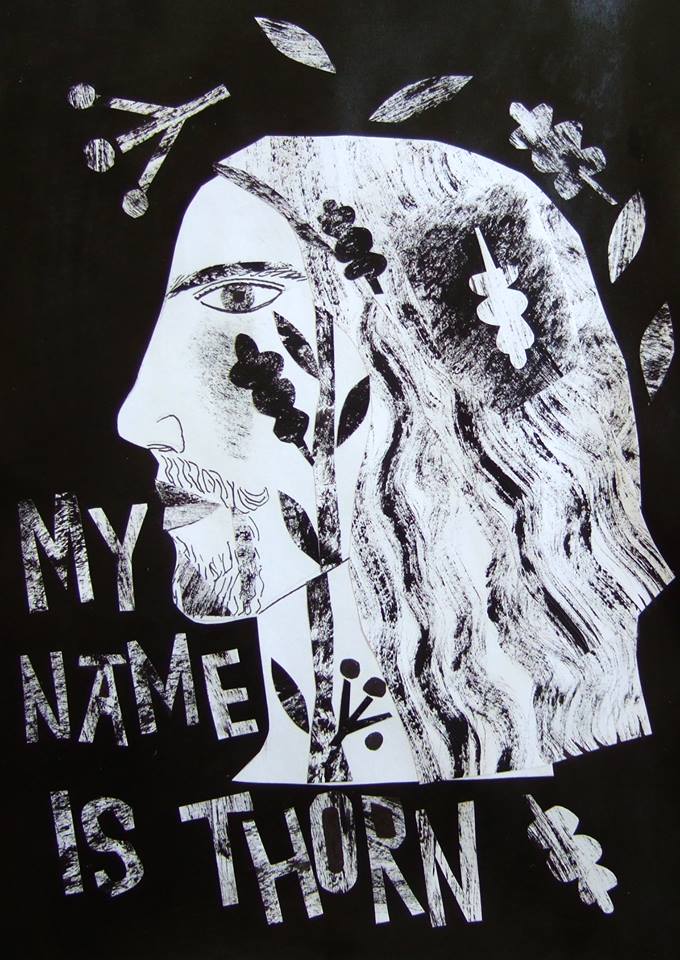
Thorn from Thaliad

Book illumination by Clive Hicks-Jenkins for Thaliad

Clive at the Artlog: When my friend, the writer Marly Youmans asked me how I’d define myself in relation to my collaborations with her, I unhesitatingly wrote back, partly in fun, ‘illuminator’.

Thursday, January 19, 2017

Postscript to "Precipitous slippage"

Illumination by Clive Hicks-Jenkins
 for Thaliad
I've really enjoyed the comments here and on Facebook about my "Precipitous slippage" post--the fun including meeting a poet I like and learning a lot more about other writer friends as well. And now look at this fine news about Thaliad, along with a wonderful, hopeful message about poetry from Phoenicia Publishing editor Beth Adams. Breaking the 400-mark was an initial dream goal for me, though it's often impossible for a poetry book. Truth to tell, I wasn't sure anyone would buy a wild, post-apocalyptic, book-length adventure in blank verse! So now I'm dreaming about 500, 600, more....

Beth Adams
Just for the record, sales of Thaliad are well over 400 copies - 425, in fact - and it continues to sell; it was the best seller at Phoenicia among our pre-2016 titles last year. This says to me that formalist poetry has lasting power in our time, and also it is well worthwhile to produce such books as the most beautifully designed and illustrated editions we can while making them affordable for ordinary readers.

Just before Christmas, I gave a copy to a friend who I thought might appreciate it. She ended up buying twelve copies to give to her own friends, and exclaimed over what an extraordinary work it is; she loved the edition and the artwork by Clive Hicks-Jenkins, but what struck her the most was the story Marly Youmans has told in the form of an epic poem for our time.

In other words, beautiful books with carefully wrought words and a timeless message are still sought out by certain readers, and we need to encourage their writing and making, because they will last.

Wednesday, January 18, 2017

Precipitous slippage

Once upon a time I was a new-made Associate Professor with tenure; my answer to that lovely promotion was to quit academia entirely because I wanted to be a poet and novelist, not an academic poet and novelist. I felt that I would be a stronger, better writer outside the land of ivory towers. What I did not grasp at the time was how completely the academy would take over the world of writing, particularly the realm of poetry, and make it into a near-monolithic enterprise. (Simultaneously, both poetry and literary fiction began to move toward being minor arts--well, poetry was already on the way.) This change has meant that academic writers support one another and give one another various helpful privileges.

Those of us outside the academy are somewhat in the cold, particularly if--as I do--the writer believes that the diminishing returns of Modernism are upon us, and that the way forward is back through tradition and form. Free verse and an obsession with originality (I don't see how that works, given that we're more than a century past modernism's birth--Modernism hasn't been modern for a long time) have become a kind of ideology in our university system. A large number of journals are associated with colleges or are founded by MFA graduates. Most of these are primarily interested in free verse. Meanwhile, I am not primarily interested in free verse, although I do have a recently-finished collection containing poems that derive from a foreign chant tradition that looks free but contains many rhetorical flourishes allied to that tradition.

Do I regret my decision about leaving the academy? No, I don't. I am a better writer because of that choice, and I also had the luxury of having three children, which I probably could not have managed if I had stayed in college settings as a writer and teacher. I find that it is hard to do three major things well, but two--well, you can give up a lot of things that are enjoyable but not essential and so make two big callings work.

I still have a few writer friends who are in the academy and make their living there; I think it's fine that they made the choice to stay in. Most people who gain a perch there do, after all. I just think that I made the right choice for me. What else can we do but try to make right choices? I admire people like poet-professor-mother Luisa Igloria who grasp after mastery in three realms. The late Doris Betts (professor, dean, writer, mother) comes to mind among novelists.

We live in a time when very few poetry books sell in reasonable numbers. I've talked to various editors about sales and found that some poetry books don't break the 50-mark. That's pretty sad, isn't it? I hear that Copper Canyon books sometimes make it to 600; those are the sorts of little numbers a poetry press depends on. (The funny thing about a poetry book is that it can become the sort of book that you return to again and again. So in that way it's a better bargain than most books.)

My picture of how my own poetry books are doing is a bit fuzzy. I know that Thaliad continues to trickle (or seep, maybe!) along in sales for Beth Adams's Phoenicia Publishing and is heading toward the 400-mark in combined paperback/hardcover. [Update: I was pleasantly wrong! 425 copies so far, as of January 19th.] The Foliate Head has sold out its first and second hardcover printings at UK's Stanza Press, though there are still a few copies available on line. I'm don't know the paperback or hardcover numbers at Mercer for The Throne of Psyche. Those are my three books that can be called "in print," though The Foliate Head is technically out of print.

Interior illustration by Clive Hicks-Jenkins
for The Foliate Head
If you care about poetry, please consider buying books. While I would like you to support mine, I tend to be pleased when I see anybody buy a good poetry book. And I always remember the quote taped up on the poetry shelves at the Bull's Head Bookshop (UNC-Chapel Hill shop, now defunct) run by novelist Erica Eisdorfer: People who say they love poetry and never buy any are cheap sons of bitches. --Kenneth Rexroth. It's not polite, but it gets at something. I just looked it up online and found a different version that says, I’ve had it with these cheap sons of bitches who claim they love poetry but never buy a book. Maybe both are right, as Rexroth didn't hold back and may have been muttering variations on the theme for years!

Yes, poetry is rapidly losing its status. Yes, what was once an important art is now a minor one and in danger of going the way of lacemaking. Times change. Television and internet make inroads; well, that's just how it is, we say. What we add to culture changes culture.

But if you care about poetry, do more. In fact, all of us need to support what we love in a time when what is seen and praised and supported is heavily-marketed, commercially-validated books, film, visual arts, etc. And we need to remind ourselves over and over again that we can choose. We can choose roads less taken. It will make all the difference.

Tuesday, August 09, 2016

How a table named a book--

Almost twenty years ago, I was living in a splendid but somewhat ramshackle Arts and Crafts / Tudor house on South Park Avenue in Greenville, South Carolina. A large house, it had a big, wonderful dining room with high fumed oak wainscoting. We had no table to fit such a large room, and no money with which to buy one worthy of the space. One day I found a table in the alley. Unable to find out why it had landed in the alley behind our house like a welcome UFO or who it belonged to, and half believing it had been sent especially to us because we lacked a table, I eventually helped carry it inside.

The table turned out to belong to the back yard carriage house of a neighbor, Wade Hampton Barber (yes, a descendant of Civil War General Wade Hampton and also an architect and a very kind man.) Not wanting to be table-pilferers, we were quite prepared to lug our two-legged friend back out again, but he told us to keep it. So it became ours. A two-pedestal number with one weak, repaired leg--not right as to house style and marked by many long-ago dinners--the table looked wonderful in the room.

Later on, it moved to a federal house in Cooperstown with us and went through many adventures, the leg breaking and being repaired multiple times, once collapsing under the pressure of our daughter's birthday party (eleventh, I think.) Many girls leaning at one end of the table, plus a major Schneider's Bakery cake, did in that table. Happily, both cake and girls survived. The table was propped and cake happily demolished soon afterward. For some years we relied on clamps and supports (jars, cans, anything stackable) hidden under generous tablecloths, the table sometimes standing on its own, sometimes with help. After multiple rounds of repair by a carpenter, we finally consigned the table to the garage and nabbed a sturdy Hickory Chair table on Craigslist. The new table is quite fine and has strong legs, but I miss the old one.

The table's original owner was Wade Hampton Barber's Aunt Thalia. Her name was pronounced this way: THAY-leeah. We always referred to the wayward table as Aunt Thalia's table. Aunt Thalia's name went back to ancient Greece, where Thalia (Θάλεια) was the name of various mythic figures: one of the Charites or Graces; the Muse of comedy and idyllic or short pastoral poetry; a nymph and goddess of plants who was the daughter of the creative god Hephaestus; and one of the Nereids. I like the link in meaning to abundance, flowering, and flourishing.

One summer day in the village of Cooperstown, I woke up with a long poem streaming in my head, and the name of the heroine was Thalia. And that is how a table named a book called Thaliad.

 * * *

Postscript: Sad to say, I just found a mention of Wade Barber's funeral online. His mother is listed as Thalia Chastain Barber. So perhaps the table owner was not Aunt Thalia but Mother. Which is even more appropriate to the book. But maybe this was Great-aunt Thalia, after whom his own mother was named. Given the condition of the table, that seems likely.

* * *

The second printing of The Foliate Head is officially out of print, with no more copies via the publisher, though there are some copies left at online bookstores. In print are: Maze of Blood; Glimmerglass; Thaliad; A Death at the White Camellia Orphanage; The Throne of Psyche. See more links above.

Sunday, April 17, 2016

Elizabeth Adams on printmaking and more

Pulling a print for the Annunciation anthology

Elizabeth Adams, artist, writer, designer, singer, publisher at Phoenicia Publishing in Montreal: what an interesting woman she is! Here's an interesting, down-to-earth interview with her on the subject of printmaking and making art over time:
  Part 1 
and

She is not yet old enough to include in the posts on "elder artists," but here's a great quote from her that applies to the topic of making art and growing older:
Printmaking always carries technical challenges, and I continue to improve my skills and experiment with new materials and techniques. There's no substitute for experience. In all of the arts, we face the challenge of not becoming discouraged, and the risk of "failure," whatever that means to each of us. We need to continually push ourselves in new directions, and not get stuck in repetition. I'm happiest when I am learning new things and pushing myself, so I try to remember that. I'm over 60 now so I've been at this a pretty long time, and hope to be a creative person until my last breath!
Beth is a great publisher / designer (my book with her press is the gorgeously-produced Thaliad with art by Clive Hicks-Jenkins) who is very particular about projects she takes on--that they "fit" her sensibility and vision for Phoenicia. She is also just a wonderful person to know.

Another one from Annunciation

Tuesday, March 15, 2016

You Asked, no. 16: Poetry in our day

R. T. (Tim)10:54 AM, March 15, 2016 I'm going to be bold (and I hope not rude) by making a comment (observation) and asking a question. (1) I've known a few poets in the past half century, and I've been impressed by their commitment even though their reading audience seems to be painfully small; (2) How can poetry now in the 21st century ever grow beyond its self-contained audience (usually academics, other poets, and a smattering of others) and become more commonly read by more people? Perhaps neither my observation nor my question are worthy of your attention. I'm just thinking out loud.
Not only is the audience for poetry small, the academic-realm support for the kind of poetry I want to write is even smaller--that is, I want to write something that is not a free verse lyric poem with a bit of narrative. I want to write in forms, sometimes old and forgotten forms. I want to use all the tools of Puttenham's "arte of English poesy" that were lost in time or laid down in Modernism. Occasionally I do something that looks like free verse, as when I fooled around with poems inspired by Yoruban chant. But it's still a running after shapeliness. For the most part, the academy isn't interested in such things, so that leaves me with the "smattering of others." (A large number of poets are ensconced in the academy, so I can't count so much on those other poets you mention.)

But I happen to think that a lot of the most exciting possibilities in poetry mean chasing the past and making it work for today. That's part of why I pursued a long epic adventure in Thaliad. (Interestingly,  that 2012 book still trickles along in sales, a narrow runnel but not yet stopped.)

I want the past--which contemporary scholars are busy ousting from our best schools--to go along with me. Get an English major without a jot of Chaucer, Shakespeare, and Milton? It happens. Spin poetry out of your navel instead of out of the rich gold of the past? Lack a proper humility in standing before the masters? It happens.

Little springlike shoots, desires for tradition and its magic and powers are cropping up in all the arts, I expect. In painting, somebody like Makoto Fujimura, painting in the Nihongan traditions, calls for culture care and the creation of beauty out of the ashes of destruction, a gift to the wounded and dehumanized soul. A devoted follower of the Old Masters like Jacob Collins says, “Those people who never lose sight of beauty and power are attractive. I’m trying to make things beautiful in a deep way. Poetic. Transformative. Mysterious.” A good number of my friends who paint, even when they are clearly children of Modernism, have embraced narrative and sometimes figurative work. Many of them seem like bridges between one thing and another, and some have moved (I'm thinking of Victoria Adams in particular) from something near abstraction to an enchanted realism.

The great transcendentals, beauty, truth, and goodness, are returning to us in various ways, though there are many who fight against their elemental powers. At times, they feel fresh and alive with energy once more.

You suggest that numbers in poetry are a problem. I am not so sure, though it certainly would be lovely to have more readers. Many a press has foundered over poetry's small sales. The "sugar'd sonnets of Shakespeare, among his private friends" were passed by hand (Francis Meres, 1598.) Later on, we know that Donne's poems were circulated this way, as were the works of many others. A small, beautiful work like Chidiock Tichbourne's "Elegy," written before his execution, may well have been dependent upon a single hand-written copy, though the poem soon made it into a book. Poems have survived their times despite small readership.

Was there ever a mythical age when all the world knew poetry? Perhaps not since the days of oral recitation by the fire, if then. What can we do? Well, schools could focus more on memorization and recitation and appreciation instead of dissection. (Need a written school assignment? Translate a sixteenth-century sonnet into your own words. Or write a sonnet, and then look at it two weeks later. Time tells all.) But how much needs to be done? I don't even know. I expect we might be surprised by meeting people in seemingly un-poetic occupations who read poetry--perhaps not contemporary poetry, but poetry all the same. Certainly it was not uncommon in the nineteenth century. And today there are elements of poetry in popular slams, rap, song. Do those lead young people on to better work? I have no idea. Maybe not.  But I'm not fond of the idea of shoving poetry down people's throats as if poetry were an intellectual castor oil.

Makoto Fujimura would say that culture belongs to all of us, and it is our responsibility to share what's beautiful and good. Surely that is true, and one thing we all can do is talk about the poems and books and art we love. I buy art, mostly by friends, and I buy books that I want to support. Often they sit a long time before I read them because I am busy with deadlines, but I buy them anyway because I know a purchase is an encouragement to the writer and an assurance to the publisher. The most destructive thing to a book is, after all, to be ignored. And some degree of that is the fate of most books, poetry or not. How could it be otherwise when only some minute percent of all writers are self-supporting, and when publishers choose and push the lead books of fiction and nonfiction?

Perhaps there's some lovely good in the idea that the best poetry, even in its loneliness and neglect, resists the current world where art is an expensive widget often fettered to ideology, where commercialism is god, and where utilitarian pragmatism rules. Perhaps that small, burning lamp--a gift to the world that mostly looks away--will continue to call to itself those who love the high play of language. Perhaps that readership will grow. As Mako says, art offers "our dying culture unfading bouquets, gifts of enduring beauty that we do not want to refuse." Poesy as posy: I, too, wonder who will accept that gift, those flowers.

Sunday, December 20, 2015

Good wuthering

I'm very glad to have landed a spot on Amateur Reader's Wuthering Expectations end-of-year lists because I love that site. If I had all the time in the world to read blog posts, I would never  miss a post of that one. Here's the quote from the "Best of the Best" section The Wuthering Expectation Best Books of 2015 - the noodles they make for me:
Gustave Flaubert, Sentimental Education; A Shropshire Lad, A. E. Housman; Little, Big, John Crowley; Life Is a Dream, Pedro Calderón de la Barca; Germinal, Émile Zola. The confusion of the two dinners at the end of the first act of Richard Bean’s and Carlo Goldoni’s One Man, Two Guvnors; Rosso Malpelo digging for his buried father in Giovanni Verga’s “Rosso Malpelo”; Richard Jefferies falling in love with a trout; Mark Twain getting his watch fixed; John Davidson on the beach with his dogs; Lizzie Eustace trying to memorize Shelley in The Eustace Diamonds; the scene in Marly Youmans’s Thaliad where the little kids in the van drive away from the little boy – no, even better, when they go back for him; and the end of “All at One Point” in Calvino’s Cosmicomics when Mrs. Ph(i)Nk0 creates the universe in an act of generosity – “Boys, the noodles I would make for you!” – which may perhaps be an allegory for what all of these writers were doing for me this year.
I also love this and am so amused because my friend Paul Digby has mock-reproached me (for three years!) about what happens to Gabriel in Thaliad (Phoenicia Publishing, 2012.) This despite the fact that some of Fr. Augustine Wetta's students at the St. Louis Priory School gave Gabriel some fanfiction-style adventures of his own...

You can find Amateur Reader on twitter (@AmateurReader) as well. He's worth a follow. And Paul? He's the lovely fellow who has made videos for some of my poems, which you can find here:
Follow Marly's board Digby videos: videos by composer-videographer Paul Digby for poetry by Marly Youmans on Pinterest.
You can also find some recordings of Paul singing at the same Pinterest account.

Related:

Thursday, December 17, 2015

You asked, no. 2: writer, artist, designer

Clive Hicks-Jenkins: When time allowed and opportunities came my way, I began to make book cover images for some of my friends, the chief among them being Marly Youmans, who because of her reputation as a writer was able to persuade one of her publishers to employ me. For The Foliate Head she even persuaded the publisher to take on my brother-in-law, Andrew Wakelin, as the designer, and he produced a splendid book-cover and ensured the layout inside was handsome. It was The Foliate Head that also established my regular practice of making page-division images and vignettes for Marly’s books.
Sienna Latham asked how Clive and I work with a designer. Perhaps there's no one answer to that, as to so many things! But now I'll try to think my way through and find out, right now.

What is always the same is our relationship. The two of us trust each other to do good work, and we don't interfere--I don't try and make the artist draw a certain element or in a particular mode, that is, and he doesn't try to encourage me to write other than I do. We never try to hurry each other in any way. We are curious about what the other is doing. Although we are very different, we have common loves, a kinship in sensibility, and are drawn to some of the same material, something we discovered early in writing letters back and forth.

As there are some books that have only a jacket (and cover) from Clive, I'll speak to those that are also decorated by him on the interior. We have worked with three designers on interior / exterior art, and I would say that it's a great help to have a designer care about the material. Our three designers are Andrew Wakelin (The Foliate Head), Elizabeth Adams (Thaliad), and Mary-Frances Glover Burt (Glimmerglass and Maze of Blood.) Perhaps it is surprising that each of the three people involved with making the book--writing, art, and design--is so free to do what he or she likes. Certainly I've been in situations where I've had little knowledge of what was happening with a jacket/cover. I've also been privy to the sight of publishers (not mine) and writers (not me) attempting to budge Clive, though why one would do so, I cannot imagine. Gratefulness that he wants to do a piece of work for a book of mine is always my slant on things.

The main hurdle with books with a good deal of art is getting publishers to agree with what we will do. The great advantage with heading toward small and university presses is that people can be willing to agree or compromise. (The down side tends to be less visibility, less "push" for books, of course, as there is less muscle behind a launch.)

Andrew Wakelin, the brother of Clive's partner, was an interesting choice as a designer, in that it was possible for Clive and Andrew to meet in person to discuss layout, and for Peter Wakelin to render opinions as well. Clive and I have a love for foliate heads, and the images arrived with that sense of ease that comes from love and long practice. I had little to do but admire, although we certainly discussed choice and placement. As I had met Andrew while in Wales, I found it easy to imagine their meetings at Ty Isaf when reported by email. The primary challenge with having Andrew serve as designer is that he is not an employee of Stanza Press (a division of P. S. Publishing in the U.K.), and so we had to get permission to use a different designer and also to tinker with the Stanza Press template for poetry books. (Val/Orson, which has jacket art from Clive, was outsourced by P. S. to writer / designer Robert Wexler, so we knew it was possible. Interestingly, I got to stay with Robert and his wife, Rebecca Kuder, when I taught in the Antioch summer workshops.) It helped that Pete Crowther asked for a poetry book, since when people ask, they're more likely to accept some variation (though Pete is a wonderfully nice and agreeable man.) It also helped that Andrew is a grand designer. We had an unexpected bit of difficulty with pagination and length because of the template, and at the last moment added a few poems that were congenial with the manuscript.

Designer-and-more Beth Adams is someone I met long before she asked for Thaliad (Ivy Alvarez and I had edited an issue of quarrtisiluni, the magazine she founded with Dave Bonta, and I live not far from Beth's childhood home.) She is a visual artist, writer, editor / designer, and publisher. Her Phoenicia Publishing (Montreal) is a micro-press in staff and a macro-press in ambition. As a team, we had many common interests and were united in the desire to make the most beautiful book possible, given the constraints of small press. (Constraints are often good challenges that lead to ingenuity.) The three of us kept in close touch. Our emails were full of forwarded quotes from one another and the many images Clive made, all influenced by American folk art.

One marvelous aspect to Phoenicia Publishing is that Beth's hand is in everything. Because she writes and makes art and designs, there's a seamlessness and feeling of a central editorial taste about all Phoenicia's books.

Mary-Frances Glover Burt, who designs for Mercer University Press (her company is Burt and Burt), had a great many images to work with for Glimmerglass, as Beth Adams did for Thaliad and Andrew Wakelin for The Foliate Head. Because the press stands as an intermediary between artist and its chosen designer, one would think that we might feel a little more detached from Mary-Frances. But it's a new world now, and we're all hooked together by social media. We're big fans of Mary-Frances. Here's Clive on her imaginative jacket design:
Clive: By contrast [with The Throne of Psyche, which used existing art] I made the artwork for Glimmerglass specifically for the project, and I’ve greatly enjoyed working with Mary-Frances Glover Burt as she’s sensitively transferred my drawing to the cover and made clever adjustments to finesse it into what you see at the top of this page. (I shall not spoil the illusion by indicating where adjustments have taken place, but suffice to say that she’s been quite the magician!) Moreover she’s made the wrap-around truly beautiful, with the lettering for the cover cleverly reconfigured for the spine, and the foliate elements unspooling onto the flaps. I particularly like the detailing of where she’s inserted a white rectangle for the necessary barcode on the back cover, but sweetened it by having a foliate element passing in front of a corner of it. Gorgeous work, Mary-Frances.
We felt confident about each person's part in the process--Clive and I had already seen what an elegant job Mary-Frances did with The Throne of Psyche, which won an Abby design award for Burt and Burt and Mercer--and we looked forward to seeing what she would do. (Clive's description of what she has accomplished is so appealing, and I also liked the tiny minotaur on the spine, hooked onto the lettering Clive mentions.)

Perhaps it's in Maze of Blood where one sees most vividly how very imaginative a designer can be. In some ways, Mary-Frances appeared to have less to work with and more of a challenge when Clive's many small decorations for the interior of Glimmerglass gave way to something larger. with Maze of Blood. Despite being busy with other projects, Clive made six portraits for division pages, plus the head on the jacket.
Clive: The drawings, which are variously embellished versions of a man’s head, are intended as poetic expressions of the text rather than as representing specific episodes. Because I had only six images to play with, I tried to densely layer my ideas, so any one drawing might be seen to be referencing multiple aspects of the narrative. Vegetation and flowers figure strongly in Marly’s text, as do the imaginative universes the protagonist conjures in his novels and short stories. I wanted to combine both in this image, and so while the ‘flowering’ has been informed by aspects of American folk-art… particularly appliqué-quilts… by setting it like the crest of a headdress, it can simultaneously echo of some of the writer’s elaborate inventions of ancient and mythic cultures. In each image the man’s eye has been replaced by a substitute. There’s been a beetle, a flower, the sighting of a revolver and a coiled ribbon of paper. Here a ‘folk-art’ bird is the stand-in, and I like that the plumes of its tail might be seen as ‘tears of blood’.
At one point, Mary-Frances requested a sketch of folded paper like the maze in one of the heads, and she used it on the title page. Other elements were plucked from the six portraits--a bird, a gun, insects, flower--and woven into the text pages, as well as appearing like a passage into the prefatory and out the concluding pages. The jacket flaps and rear of the jacket also show how she has re-used signal elements like the passion flowers and moth and gun, all dark and shadowy in the rich blue of the background. The foliate bar code detail that Clive liked on Glimmerglass? There's a moth that has settled onto, slightly into, the bar code of Maze of Blood.

What strikes me about all these triangular relationships is that they are founded on a trust in the abilities and creativity of other artists. In all cases, the people involved respected the abilities of the others and left them in freedom. While it always seemed that a good deal of collaboration was happening because I was constantly seeing fresh images, in truth we were simply immersed in one another's work and having the great and happy pleasure of watching how one art generates another. Seeing the energies of the initial work flow elsewhere and generate new work is marvelous. When this sort of collaboration goes well, each person is a part of a dynamic, moving whole--as, say, one spiral branch of a triskelion.

p. s. In answer to another question, the hardcover of Thaliad is only available via the Phoenicia site. The paperback can be ordered via the usual places.

p. p. s. If you want to see Clive's lovely response and some also-lovely comments, go here. And Alan Lee has ordered three of our books! My fantasy-loving, writing-and-cartooning child was as excited as when a Diana Wynne Jones blurb arrived for Ingledove.

p. p. p. s. All the above is an attempt to describe something that is simple, full of love and joy and magic.

Wednesday, April 22, 2015

NPM2: I give you crazy epic adventure

April, national poetry month, no. 2

All art by Clive Hicks-Jenkins
Design by Elizabeth Adams
Yesterday, harpies. Today? Murder! Invasion! Grief! Loss! Even a happy ending of sorts... Here's a snip from late in the long-poem Thaliad, at the end of the 21st chapter, a point in which Something Terrible has happened, and death has paid a demanding call. Thalia is attempting to comfort Samuel, but she ends up being rather blunt in her truth-telling. (This bit is also a bit of an homage to Cavafy, and if you are a fan, no doubt you will be able to see how my tip of the hat works.)

Then Samuel in sorrow vowed to her,
Now I will leave and find another place,
A village where my heart is not in earth,
And Thalia replied to him with truth:
There is no other village, is no place
To find where your dead heart is not in earth.
And still he moaned his lot, exclaimed with tears,
I want to go where ground is not a waste,
And where my life is not a ruined town.
And Thalia with mercy said to him,
In time you will begin to heal your heart
And all that seems a waste will bloom once more.
But he went on in anger, blaming God,
The strangers who had maundered into town,
The grave that meant a stone around his neck,
Until she spoke in haste against his words:
For you there is only this blood-drenched ground,
The murdered life that is your freight of guilt,
Also the murdered life that is your own,
The world that you create by how you act
Or see or how you dream the world to be,
Your world that's ruined everywhere like this,
Which you yourself have caused to be a waste,
Which you yourself have scorched with inner fire.

The sample is a good example of how the poem crosses epic with novel to make a hybrid, because the blank verse poem manages to make room for drama, dialogue, character confrontation, even in this small space.
Happily, there’s a fantastic inter-textual rationale behind this book’s title and its neo-classical form. The narrator (and supposed writer) of Thaliad, Emma, is speaking 60 years after the events she describes, and learnt her trade as a poet-historian by salvaging what books she could (presumably the Classics) from the ruined world’s libraries. So Thaliad, then, fictionalises the story of its own creation; the book itself is supposedly a piece of history, written as a record of the first years following ‘The Fire’. -Tom Atherton
This is a brilliant and imaginative work. It's a writer stretching and doing something creative and different. And Youmans is poet enough to pull it off beautifully... Verdict: I loved this. Who the hell writes a post-apocalyptic ...novella in blank verse? Obviously, someone inspired by a non-commercial muse. Thaliad is beautiful and touching and deserves a wider audience. Highly recommended!" --Inverarity 24 October 2013
I would be remiss if I did not point out that the book is beautifully produced by Elizabeth Adams and Phoenicia Publishing, with profuse decoration by Clive Hicks-Jenkins. Clive and I are proud of our collaborations on books, and Thaliad is as beautiful as yesterday's book, The Foliate Head.

Available in hardcover and paperback. If you want to see more of what people say about the narrative--and there is, I must say, some stellar commentary from poets and fiction writers and critics--go here.  If you're interested in a copy of your own, you can order via Amazon or Barnes and Noble or indie bookstores, though if you want a hardcover, you'll need to go straight to Phoenicia Publishing. 


Wednesday, March 25, 2015

the Luck Child, again--

Yesterday I wanted a kiss from the Luck Child, and today I have got it--a gorgeous glory of a review in Strange Horizons from that wonderful reviewer who always sees what no other reviewer sees, Tom Atherton of Wales. It's strong and wide-ranging and full of insight, delineating aspects of the book I like to see revealed. (He's even got a few criticisms, and I can tell you that he's the sort of reviewer whose remarks I will remember, next time I am revising a novel.)

Earlier he wrote an equally insightful review of Thaliad (and he begins this review with Thaliad) that pleased me very much--even, I can say, enlightened me. I am infinitely grateful to him for the results of his story-mining and contemplation.

I have sometimes doubted that beauty and perception can find their reward in our culture of trend and frantic change and celebrity. The fact that Strange Horizons has picked up Tom Atherton as a reviewer is heartening.

***
In more Luck Child news, most or all of my marked galley pages turned out to be not lost forever but scattered about "in the mail bin."

***
Images in this post: Art for Glimmerglass (Mercer, 2014) by Clive Hicks-Jenkins of Wales, book design by Mary-Frances Glover Burt of Georgia. Art for Thaliad (Phoenicia, 2012) by Clive as well, with design by Andrew Wakelin, also of Wales. May I just confess that I love Wales?

Friday, March 20, 2015

Poetry, drama, fiction!

The marvelous collages
(painted papers and drawn elements)
of Clive Hicks-Jenkins for Thaliad
Thaliad at the Priory School 

I just opened a big, lightweight package from the Saint Louis Abbey. The inside is stuffed with letters from boys of Saint Louis Priory School, each containing a return envelope and a book plate to be signed for Thaliad. There's also a little note from their teacher, Fr. Augustine Wetta, who was one of my private students at the Antioch Writing Workshop last summer, along with a rosary made by him.

This year the priory boys in his care have been reading an impressive range, from Homer to me--"Homer, Virgil, Chaucer, Spenser, Shakespeare, Cervantes, Milton, Carroll, and Youmans." And I think that list sheds an interesting light on some of our public school syllabi, where teachers sometimes appear to have canon-allergy and now fear to teach the great books. It can be done. It is done. And these are middle school boys!

It's lovely to make a circle from teacher to student-and-teacher to students and back again. I'm proud of Father Dude and wish him much pleasure in his writing and many readers. He's not only writing but doing a teacher's part to make genuine readers who will be able to tackle any text.

And here's a review of Thaliad (from Goodreads) that I especially love because of the pitch, which says you should buy the book because it's from a small, artsy press but wonderful, and because it manages to be post-apocalyptic in an "aggressively non-commercial way." Hah! Thank you to David, somewhere on the planet.

Words at another school 

In other word-related news, child no. 3 has had an interesting couple of weeks, last week serving as an amusing co-host for the annual high school poetry slam (and also reading a poem written for the occasion) and this week making a surprising splash as Mortimer Weird on stage. He has a reputation as being a rather quiet student, so his flamboyant walk and talk has been astonishing to all. Treading the boards is thrilling!

Maze of Blood in the pipeline

First pass galleys of Maze of Blood have been returned to the publisher, after three straight reads. Clive Hicks-Jenkins is currently working on six large, beautiful images for the division pages, and there will be a series of six smaller images used in repetition for chapter headers. Will it be as beautiful as Glimmerglass, Thaliad, and The Foliate Head? Yes, they are all wonderfully decorated by that soulful limner, Clive! It's like trying to pick a favorite child or the best flower in a wonderful bouquet to pick which one is most loved.

Thursday, February 05, 2015

In which I have fan fiction! And answer more questions..

Montreal: Phoenicia Publishing, 2012
Art by Clive Hicks-Jenkins
Since the post on Fr. Augustine's class of Thaliad readers has had so many hits, I'd better answer their "two more questions" right here. I am looking forward to reading some of the alternate sequels (Gabriel! fan fictions! can't wait!) written by the students and to watching the youtube videos of some of the class discussion.

I'm touched that Gabriel gets to have his own adventure in the sequels. I expect he's pleased as well. And I must say that I never expected readers to continue their own stories based on a blank verse narrative. That's downright amazing--Fr. Dude must have quite a class. Guess I'll know after I watch those youtube videos.

So a big hello and thanks to Fr. Augustine's students of St. Louis Priory School at the St. Louis Abbey. I'm so pleased that you read Thaliad.

1. In Book III of the Percy Jackson trilogy, Thalia battles a Manticore named Doctor Thorn. Mere coincidence? 

Coincidence, although my younger son did read the Percy Jackson books when they came out. So it was probably in the house somewhere... Osmosis?

I'll tell you where Thalia came from (and I pronounce it THA-lee-ah, rather than the traditional Greek way.) One day when I was living in Greenville, South Carolina, I found a dining room table in the alley. It was a somewhat battered and broken two-pedestal number. I had a dining room but not a table. After some ferreting about, I found the owner and permission to tote the thing into my house. It stayed with me for many years, one of the pedestals repeatedly breaking (notably at my daughter's 11th birthday party, when there was cake and presents on the table, as well as a lot of girls leaning on one end.) I finally got a new one last year because there were now too many clamps under the tablecloth. The two-pedestal table belonged to the Great-aunt Thalia (THA-lee-ah) of my neighbor in Greenville, so I always referred to it as Great-aunt Thalia's table.

As for Thorne, I just like the sound of it, though you could ponder the presence of metaphorical thorns in the way, I suppose.

2. Also…was your name spelled without the ‘A' on the book spine because it looks cool? 

I am afraid that came as a surprise! It's amazing how a book can be proofed and proofed and proofed, and some obvious thing like that can be overlooked. You'll just have to consider that edition as extra-valuable, like a rare postage stamp with the picture printed upside down.

3.  Why Castor and Pollux to represent Samuel and Ran, and not Romulus and Remus? 

Good question. Romulus and Remus would probably be better! After all, they are city-foundation figures. Since they quarrel and one kills the other, those quarreling twins would be evocative parallels for Ran and Samuel.

On the other hand, Castor and Pollux become the bright stars in the constellation Gemini, and there's a lot of sky and star in Thaliad. And some other parts of their story are suggestive. Since Castor and Pollux were horsemen, people regarded them as patrons of travelers. They were known for athletic contests and fighting (the mortal twin dies as a result of a foray into revenge.) When their sister Helen is stolen by Theseus, they set out for rescue but also vengeance, so there's a bit of analogy for you. (Of course, they weren't adverse to stealing brides for themselves....)

If you all had been around when I was writing, it might have gone otherwise!

4. Will there be a sequel? 

I doubt it. It arrived in my head one day, and the story unreeled until the end. But perhaps I'll wake up one morning with a related tale lodged in my brain.

* * *

You're right. That wasn't two!