Out for dinner with another writer, I said, "I think I've forgotten how to read."
"Yes!" he replied, pointing his knife. "Everybody has."
"No, really," I said. "I mean I actually can't do it any more."
He nodded: "Nobody can read like they used to. But nobody wants to talk about it."
--Michael Harris, "I have forgotten how to read," Globe and Mail
Going on a twitter and facebook fast...
Showing posts with label reading. Show all posts
Showing posts with label reading. Show all posts
Wednesday, February 14, 2018


Saturday, December 30, 2017
Some books I read, 2017

I'm not sure how much of a picture this gives of my reading, since a great deal of it is piecemeal (especially with poetry) and not shown here. But it is a part-picture of a ramble through the year. And you can probably puzzle out something or other about my current manuscript by a study of these books.
Currently I'm reading some MacFarlane, some Denis Johnson, and various poets. Again, the poetry is mostly piecemeal. The most accurate portrait of my poetry reading over a year would be a fat anthology I make myself, including a good bit of Yeats. I've only listed poetry here if I read a complete book. I point that out for those of you who might possibly pass by and wonder why your book is not listed--must mean I have not read the entire thing as yet!
* * *
Bible. Various forays into the library of books that we call The Holy Bible. Took a class on Genesis and one on Exodus. Have been reading KJB, NRSV, Robert Alter's translation of Genesis, and David Bentley Hart's brand new translation, The New Testament, meant to mimic the style of the Greek, even where rough, impetuous, and careless as to tenses. It was lauded recently in The Atlantic. A more tempered view by Wesley Hill here.
C. Day Lewis. The Poetic Image. Still pertinent and well worth reading. Essays/lectures from someone who understands literary history and the Modernist place in it for good and for ill. "The Lyric Impulse" is a great introductory piece. I thoroughly enjoyed the whole book. Highly recommended for those interested in song, ballad, and shapely poems.
C. P. Cavafy, The Complete Poems of Cavafy, translated by Rae Dalven, with an introduction by W. H. Auden (Harcourt, Brace and World, 1948.) Auden: "The most original aspect of his style, the mixture, both in his vocabulary and his syntax, of demotic and purist Greek, is untranslatable." Every now and then I feel drawn to reread Cavafy in various translations. I love the way he writes of things historical!

A CLOSET for Ladies and Gentlewomen, or the Art of Preserving, Conserving, and Candying. With the manner how to make divers kinder of Syrups, and all kinds of Banqueting-stufs: Also divers Soveraigne-Medecines and Salves. London: Printed by R. H. [Richard Hodgkinson], 1651. I loved holding this one in my hands and wished I could put it in my pocket (tiny!) and take it home. Cordial waters, preserves, candying, medicines. I've read some other books like this one (I won't list them all!) in the past year, and they are invariably enjoyable--there are some online. Read in a 90-degree cradle at The American Antiquarian Society, AAS.
C. S. Lewis, The World's Last Night. Essays. Here's a favorite clip on culture and on what is "real and live and unfabricated": "But when the things are of high value and very easily destroyed, we must talk with great care, and perhaps the less we talk the better.... For the true enjoyments must be spontaneous and compulsive and look to no remoter end. The Muses will submit to no marriage of convenience."
Cynthea Masson, The Alchemist's Council. I had failed to pack a book for my flight to Japan, and an ARC of this novel was the sole volume on the United book-giveaway shelf, so of course I had to take it along. The author is a Canadian professor who had a postdoc fellowship in medieval alchemical manuscripts at The British Library. As I used a more traditional mode of alchemy to structure a forthcoming book (written some years back), I'm always interested in seeing what others do with alchemical meanings. The realm is complicated enough that the author is forced into info-dumping at times, but it's ingenious, using strange erasures that bring memory losses and an elaborate linkage between scripts and our world. And bees! I left it at an onsen on Sado Island, so perhaps it found someone who can read English.

David D. Hall, Worlds of Wonder, Days of Judgment New York: Knopf, 1989. Hall looks at learning faith via gaining literacy and the sacred nature of text. Interesting on the reading matter of the godly (and the less so) of Mass Bay, as well as the wonders and "remarkables" of the time. More on the Sabbath, Sewall, etc. I knew a lot of the material discussed already but still found it interesting. Checked it out at AAS and then ordered a copy--well worth the read.
David Schmer Svahn. Conflict and Genius: A Brief Introduction to a Complex Man--19th Century Scholar, Poet and Priest. William Wilberforce Lord 1819-1907. Doylestown, PA: Otsego Press, 2017. Bassett doctor and amateur historian David Svahn wrote this account of W. W. Lord, poet praised by Wordsworth and eviscerated by Poe, priest who served in the siege of Vicksburg and at Christ Church Cooperstown, where he got into a colorful ruckus! Great book for Cooperstonians and people interested in nineteenth-century poets, thinkers, and clergy. Reviewed for the local Christ Church Chronicle.
Emma Donoghue, Wonder (Boston: Little Brown, 2016.)

French Poetry from Medieval to Modern Times, ed. Patrick McGuinness (New York: Everyman's Library, Knopf.) Read on a trip and need to reread.
G. K. Chesterton, The Wit and Wisdom of G. K. Chesterton (New York: Dodd, Mead, and Company, 1911. LibriVox. I did not expect these to be so very good--the first half is wonderful. Listened to them while on the treadmill. Amusing and full of marvelous turnings and surprise. In his words, even the frailest of subjects become "thistledown...the roots of stars." The wonder of nonsense, a defense of public obsession with absurd facts, the decline in rash and impossible vows, the proper worship of babies (each a new world), and more.
George and Weedon Grosssmith, The Diary of a Nobody. LibriVox.
(Sir) George Webbe Dasent's translation of Popular Tales from the Norse (Norske Folkeeventyr) collected by Peter Christen Asbjørnsen and Jørgen Moe. Folk tales. You may remember this book from childhood; I did. Tolkien referred to "Soria Moria Castle" as a possible name-source for his Mines of Moria. He also refers to Dasent in "On Fairy-Stories." 71 tales short and long, with a wild variety of voices and accents. LibriVox.
Joanna Moorhead, The Surreal Life of Leonora Carrington (London: Virago Press, 2017.) Reviewed in a round-up called "The Runaway Powers of Leonora Carrington."
John T. Hull, The Siege and Capture of Fort Loyall: Destruction of Falmouth, May 20, 1630. A paper read before the Maine genealogical society, June 2, 1885. Portland, ME: Owen, Strout and Co., Printers, 1885. Hard to believe he read the entire book to the state genealogical society.... Though it is quite interesting. Read at AAS.
John Dane, A Declaration of Remarkable Providences in the Course of My life. By John Dane of Ipswich. 1682. To Which is Added a Pedigree of the Dane Family, And a Few Notes. By a Member of the New England Historic-Genealogical Society. [Identified as John Ward Dane in pencil.] Boston: Samuel G. Drake, 1854. An account of some charm, full of temptations (a proto-Tom Jones!) and odd events. Influenced a passage in my novel. Read at AAS. I keep seeing this referred to, but with no sense that John Dane is closely related to the heroic Mr. Francis Dane, minister of Andover and defender of accused witches and wizards.
James Turner Johnson, A Society Ordained by God: English Puritan Marriage Doctrine in the First Half of the Seventeenth Century. Studies in Christian Ethics Series. Nashville and New York: Abingdon Press, 1970.
Kingsley Amis, Lucky Jim. I read again after many decades and was surprised to find how well I remembered it, particularly the episode of the burned bedclothes and the "Merrie England" talk. The apex of the drunken address still reminded me of Fink-Nottle's, and antihero Jim Dixon of a sharper, less hapless and sweet Bertie Wooster. After being in the British army, Kingsley Amis must have been out to break all the campus rules.... Is Dixon sometimes roiling with class rage, spite, boredom, maliciousness, immaturity, self-contempt, and an Amisian-Larkinesque view of women? Sure. Here's Dixon in the morning: "Consciousness was upon him before he could get out of the way; not for him the slow, gracious wandering from the halls of sleep, but a summary, forcible ejection. He lay sprawled, too wicked to move, spewed up like a broken spider-crab on the tarry shingle of morning. The light did him harm, but not as much as looking at things did; he resolved, having done it once, never to move his eyeballs again. A dusty thudding in his head made the scene before him beat like a pulse. His mouth had been used as a latrine by some small creature of the night, and then as its mausoleum. During the night, too, he'd somehow been on a cross-country run and then been expertly beaten up by secret police. He felt bad.” Now I feel like rereading some Wodehouse and maybe The Loved One.

Leena Krohn, Doña Quixote and Other Citizens. Portrait: Tales of the citizens of an usual city. I wrote about Doña Quixote here.
Leonora Carrington, Down Below (New York Review of Books, 2017.) I reviewed Carrington books here.
Leonora Carrington, The Complete Stories of Leonora Carrington (The Dorothy Project, 2017.) Reviewed in a round-up called "The Runaway Powers of Leonora Carrington."
Leonora Carrington, The Milk of Dreams (New York Review of Books, 2017.) Reviewed in a round-up called "The Runaway Powers of Leonora Carrington."
M. Michelle Jarrett Morris, Under Household Government: Sex and Family in Puritan Massachusetts. Cambridge, MA: Harvard University Press, 2013. I don't think I read all of this one...
Michael Donaghy, Shibboleth (Oxford, 1988) Recommended poetry collection. "...the dive was there before the hawk was, / Real as a wind shear before the blown snow reveals it."
Peter J. Bohan, Early Connecticut Silver, 1700-1840. Middletown, Conn.: Wesleyan University Press, 1870. This one also talks about earlier silver in the short text. Lots of images. AAS.
Philip J. Greven, Jr., Four Generations: Population, Land, and Family in Colonial Andover, Massachusetts. Ithaca and London: Cornell University Press, 1970. AAS. Had to skim this one, as I didn't have it for long.
Philip Larkin, The Whitsun Weddings. I wrote about this volume (and a bit about Charles Causley as well) here.
Robert Alden Rubin, Seeing the Bones and Other Poems (read in manuscript.) This one will find a home eventually.
Robert Forby, The Vocabulary of East Anglia--originally published in 1830. 2 vols. Fascinating.
Robert Macfarlane, Landmarks (Hamish Hamilton, 2017.) Lovely, bumpy, tactile, strange place names in the UK.
Rod Dreher, The Benedict Option. New York: Sentinel, 2016. Oddly, I found this book helpful in thinking about the feelings behind Puritan emigration and town establishment in New England. That is, it's really clear on communities needing to form in resistance to the dominant culture. In other ways, entirely different!
The Saltonstall Papers, 1607-1815: Selected and Edited, with Biographis of Ten Members of the Saltonstall Family in Six Generations. Boston, Massachusetts Historical Society, 1972. 2 vols. I only used the first volume--some great letters, and the biographies were useful and sometimes contradicted earlier sources I had used. Great interest, and answered some questions I had. Read at AAS.

The School of Good Manners, 1769. I finally learned the source of "the upper hand." When you're walking with another person, the right hand position is the one for the superior person. When three, he/she should be placed in the middle. (This reminds me of Darcy and Bingley's sisters walking in the garden, and Darcy's attempt to have Elizabeth join them. But no, they are "charmingly disposed." Or something like that.) Hey, and "Spit not in the Room, but in the Corner, and rub it with thy Foot...."
Steve Turner, Imagine. Basic. Very much in line with his International Arts Movement talk.
Susan Hankla, Clinch River (Roanoke: Groundhog Press, 2017.) Poetry collection reviewed for The Hollins Critic. Read it! Our interview is also forthcoming. This is one of the second series of volumes from poet and writer R. H. W. Dillard's new and much-appreciated Groundhog Press (Roanoke, Virginia.)
T. McClure Peters, A Picture of Town Government in Massachusetts Bay Colony, at the Middle of the Seventeenth Century As Illustrated by the Town of Boston. Dissertation, School of Political Science, Columbia College. The McWilliams Printing Co., 1890. A highly useful little book to help understand town officers in early towns and Mass Bay governmental courts and structure. The number and variety of offices is surprising. And some offices are open only to Selectmen. Really curious and interesting if you like knowing such things! Read at AAS.

Thomas L. Purvis, Colonial America to 1763. Almanacs of American Life. Facts on File, 1999.
(The Reverend) Thomas Morong, Puritan Life and Manners. An Address, Delivered in Ipswich, Massachusetts, at the Memorial Services on Forefathers' Day, Dec. 21, 1870, Together with a Notice of the Exercises on That Occasion. Boston: Lyman Rhodes, Printer, 1871. A good year-by-year source, despite a few oddities. Fat tabloid publication. Another one that it's hard to believe was a presentation because it's the length of a short book. People must have been more patient than we are. Read at AAS.
250th Anniversary of Ye Anciente Town of Haverhill. Worcester, MA: F. S. Blanchard and Co., July 2 and 3, 1890. A big fat tabloid publication. What a bargain for a mere 10 cents! Loved this crumbling, darkening source. So helpful. Read at AAS.
[William Badcock.] W. B. of London, Goldsmith, Touch-stone for Gold and Silver Wares. Directing how to know Adulterated and unlawful GOLDSMITH'S Works, and the greatness of the Cheat therein; and how to punish the Offenders, and recover Recompence to the party wronged. Being a Treatise of great life for every Buyer of PLATE, and all Buyers and Wearers of Silver-Hilts, and Silver Buckles, and all other kind of GOLDSMITHS Works. The second Edition with Additions, Comprising the principal matters relating to the Goldsmiths and Cutlers Trades, and material things concerning all other Manual Trades. London: Printed for J. [?] Bellinger, in Cliffords-Inn-lane, and T. Basset at the George near Cliffords-Inn in Fleet-street, 1678. This is one I didn't get to keep long enough to read the whole thing, but it's fascinating and another volume that is tiny and packed and delicate. Read at AAS.
Monday, January 02, 2017
Selected Reading, 2016 Happy New Year
Selected 2016 Reading List, in ABC order by author
Books by friends, books recommended by friends,
new reads, lots of rereads, books read to review or blurb.

Of course, I lost my list (so me!) partway through the year,
so here's what I remember right now in the way of books read in full.
Aldhelm, Saint Aldhelm's Riddles, translated by A. M. Juster. Reviewed for First Things. (Yes, I liked it and gave it a great review.) My husband bought me a copy at the same time I bought myself one, so clearly it must be a "me" sort of book!
Jane Austen, Persuasion. Reread, again. It has climbed higher on the Austen list. Maybe I'm finally old enough to appreciate its virtues.
Jane Austen, Pride and Prejudice. Reread for the Nth time. In the kingdom of the novel-in-English, I can never be done with rereading Fielding, Austen, Dickens, Hawthorne, and Melville.
Jane Austen, The Watsons (fragmentary novel.) If you're a fan....
Willis Barnstone, translator of The New Covenant Volume I: The Four Gospels and Apocalypse. Translated from the Greek and informed by Semitic sources. Extensive introductory and appendix essays. I don't always agree with him but the essays and notes are interesting, and so is the translation, which uses Aramaic / Hebrew name ways and returns the text to poetry.

Louise Bogan, The Blue Estuaries: Poems, 1923-1968. Fine poems, well worth reading. As with Muir, I like the mythic ones a lot. That may be because they were the first I knew, as both writers were in a mythic poetry anthology by John Alexander Allen bought when I was seventeen.
G. K. Chesterton, The Ballad of the White Horse. If you're a fan of LOTR, read this! Clearly a major source, far more suggestive of Tolkien than I expected.
Wilkie Collins, The Woman in White. Reread yet again. Such a marvelous "sensation" novel, such curious characters, such moody "set pieces," starting with the initial encounter with the Woman in White. While it was very clear on the unequal status of men and women (particularly as regards inheritance) at the time, I suppose that its marked fluidity of male and female roles within a Victorian world always conscious of what is proper must be of new interest to scholars in our era.
John Putnam Demos, Entertaining Satan: Witchcraft and the Culture of Early New England.
Annie Dillard, The Abundance. If you like Dillard, which I do, you might order this thinking (as I did) it would be chock full of essays. I was rather disappointed that this selection was not a little more abundant in its choice. Great starter book if you haven't met her before.
Seb Doubinsky, Predominance of the Great: non-haikus. Narcissitic comment: always so pleasant to have a poem dedicated to you--to find out what words the poet thought suited to "you."
Jeffrey Ford, The Shadow Year. Interesting to read another Ford novel. But if you have not but wish to read him, start with the short stories.
Richard Goldbeer, The Devil's Dominion: Magic and Religion in Early New England.
Georgette Heyer, The Marriage of Convenience. Read this one because Ellen Kushner kept talking about Heyer. It is frothy--rather as if Leon Garfield, Jane Austen, and P. G. Wodehouse had a word-frolic.

Mary Kinzie, The Cure of Poetry in an Age of Prose: Moral Essays on the Poet's Calling. Learned about this one via a Michael Juster tweet. This book would be salutary for any young poet to read, no matter his or her bent, because he or she would be challenged by the description of the poetry of our day. Even if the poet radically disagreed (perhaps especially then?), such strongly formulated arguments would be helpful in coming to understand his or her own thoughts.
Ursula LeGuin, A Wizard of Earthsea. Holds up from the first read, many years ago.
Ursula LeGuin, The Tombs of Atuan. Ditto.
George MacDonald, At the Back of the North Wind.
I loved this as a small child; it feels dated but still has the MacDonald sweetness.
George MacDonald, Phantastes. Foundational book for 20th-century fantasy.
 Jo Mazelis, Ritual 1969. You can read my review of this collection (her third) for Planet: The Welsh Internationalist. "Jo Mazelis’s well-crafted stories in Ritual, 1969 (Seren, 2016) stand at a crossroads—liminal place between worlds where criminals and suicides were buried—of the fantastic and the homely real."
Alda Merini (Susan Stewart, translator), Love Lessons: Selected Poems of Alda Merini. I have read this book twice, trying to see why I should be a fan. Still not, alas. It seems more than a language problem, as I once again felt let down. Truly, I would like someone to explain to me why I should admire the poems. I would welcome a little enlightenment. Alessandra Bava tells me that Alda Merini is quite good, and I believe her but still can't see.
Edwin Muir, Collected Poems. I had not read him in a long time; I like his poems, especially the myth-tinged ones.
Garth Nix, Sabriel, Lirael, Abhorsen, Goldenhand and To Hold the Bridge. Y. A. fiction. The two last are new, a novel and a collection (the title novella is set in the Old Kingdom.) Thinking about going back to a novel for teens than I abandoned when almost finished, but I think this is about all the contemporary Y. A. I read last year.
 Adam Roberts, The Thing Itself. I tweeted a lot of quotes from this book in the fall, and regret that it has not had a wider readership. If you love irrealism of any sort, try it. If you love Kant, try it. Oh, just go ahead and try it!
Robert Louis Stevenson, Kidnapped. Enjoyed as much as when I was a mere sprat. The "flight in the heather" (admired by Henry James) and the roundhouse battle are well-handled pieces that mix action with forcible inaction and watching. I also like the wild weirdness of the hideout for Cluny Macpherson, Jacobite rebel. The relationship between David Balfour and Alan Breck Stewart is effective in great part because Alas is so rash and bold and childish and proud, and David is tested in his loyalty to the man who has saved him. Set in the eighteenth century and making use of the murder of Colin Roy Campbell the Red Fox near Ballachulish (the Appin Murder), the story is well worth a read if you missed it, growing up.
Michel Tournier, Gilles and Jeanne (translated by Alan Sheridan.) Definitely should not be the first Tournier read. I think it must be called a failure, though failures are, of course, important to art and shed light on related work or can be transitional bridges to something more successful. Yet I dislike it. You know it's not kindred when the book is short and you start skimming anyway!
Robert Walser, Oppressive Light (selected poems, translated by Daniele Pantano.) Walser made me write a few poems in opposition to his, so I am grateful to him. I was a little disappointed--somehow expected more, when I should have been simply curious--but interested all the same.
Dallas Willard, The Divine Conspiracy: Rediscovering our Hidden Life in God. The self as kingdom flourishing within the divine kingdom.
W. B. Yeats, Crossways.
I always read Yeats, but this year I'm looking at his poems as separate collections instead of hopping about at whim (although I am doing some of that as well.) New poem "I Met My True Love Walking" has a sigodlin relationship to "Down By the Salley Gardens."
W. B. Yeats, The Rose.
Philip and Carol Zaleski, The Fellowship: The Literary Lives of the Inklings. How lovely to have such a wonderful setting, to be a writer in a setting where words mattered so very much. How sweet to grow and aspire in a small, encouraging country that cares about its literature.
Saturday, March 19, 2016
I ask, I ask, I ask--
 |
| Found on Pinterest. Could it be Lucas Cranach the Elder? Or is that insane? Thought of "Princess of Saxony" hands. |
What was the last thing you read (and the last thing you read and liked), and what are you reading now (or what is in the line-up for next)?
New acquisitions this week: the late Christopher Logue's full version of his long poem, War Music: An Account of Homer's Iliad; Annie Dillard's selected essays, The Abundance. (The only other book of essays I've read lately is Mary Kinzie's The Cure of Poetry in an Age of Prose.) I'm already reading War Music. Prior to this, I've only read the also-titled War Music, a portion of the now-whole, or as close to whole as we will ever have.
Last book I listened to was Karen Savage's reading of Jane Austen's Persuasion. It's a LibriVox recording also on youtube as a single listen. I always thought that I liked Persuasion less than the others, but I was wrong. Maybe I'm finally old enough for it.
I'm also reading Robert Walser's The Walk (the translation of the revised version) and assiduously looking for the copy of Scott G. F. Bailey's The Astrologer that the naughty person who was going to read it aloud to us has deposited . . . somewhere. It's as if there's a terrible jinx on that book. But it'll be next, whenever found. My misbehaving eyes are better, and I shall read it for myself!
I'm also reading some Louise Bogan and Edwin Muir poems. And memorized another Yeats poem. I do want to memorize more.
Your turn. Tell.
Thursday, February 05, 2015
In which I have fan fiction! And answer more questions..
 |
| Montreal: Phoenicia Publishing, 2012 Art by Clive Hicks-Jenkins |
I'm touched that Gabriel gets to have his own adventure in the sequels. I expect he's pleased as well. And I must say that I never expected readers to continue their own stories based on a blank verse narrative. That's downright amazing--Fr. Dude must have quite a class. Guess I'll know after I watch those youtube videos.
So a big hello and thanks to Fr. Augustine's students of St. Louis Priory School at the St. Louis Abbey. I'm so pleased that you read Thaliad.
1. In Book III of the Percy Jackson trilogy, Thalia battles a Manticore named Doctor Thorn. Mere coincidence?
Coincidence, although my younger son did read the Percy Jackson books when they came out. So it was probably in the house somewhere... Osmosis?

As for Thorne, I just like the sound of it, though you could ponder the presence of metaphorical thorns in the way, I suppose.

I am afraid that came as a surprise! It's amazing how a book can be proofed and proofed and proofed, and some obvious thing like that can be overlooked. You'll just have to consider that edition as extra-valuable, like a rare postage stamp with the picture printed upside down.
3. Why Castor and Pollux to represent Samuel and Ran, and not Romulus and Remus?
Good question. Romulus and Remus would probably be better! After all, they are city-foundation figures. Since they quarrel and one kills the other, those quarreling twins would be evocative parallels for Ran and Samuel.

If you all had been around when I was writing, it might have gone otherwise!

I doubt it. It arrived in my head one day, and the story unreeled until the end. But perhaps I'll wake up one morning with a related tale lodged in my brain.
* * *
You're right. That wasn't two!

Thursday, November 06, 2014
Home

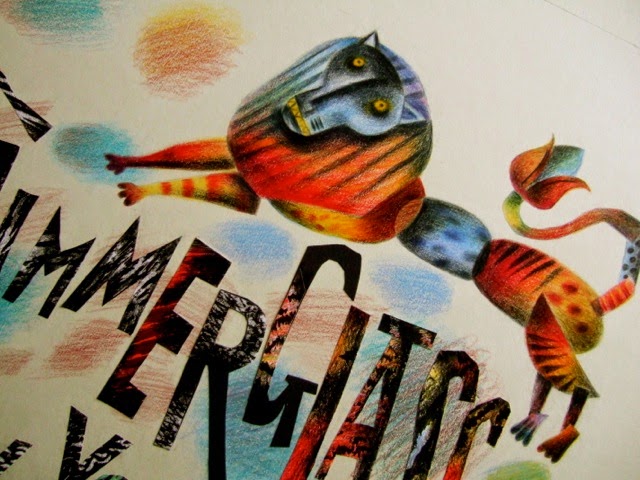
Home after many weeks and a final Glimmerglass reading-and-signing event at The Doylestown Bookshop, plus a romp through Henry Chapman Mercer's Fonthill castle! Thanks to my generous Doylestown hosts, David and Karin Svahn. Here's a snip from the somnium or dream-vision passage in the book:
Jacket and title page art above by Clive Hicks-Jenkins. Design by Mary-Frances Glover Burt for Mercer.In a sunbeam, the angel's tree glittered, bare and silver. Going to it, she found glistening leaves stuck to the surface of Glimmerglass and pods that stood erect on the branches like golden torches. On peering into the ice, she made out a snake knotted around the bole and a ball of fur snuggled below. She sank through, drawing herself onto the other side of the lake by a tangle of silver roots. Far off, she glimpsed a skater in a black cloak, bowed against the wind as he pulled a child's heavily loaded sleigh.
As she walked in the labyrinth by the lake, a needle slipped from her gown, making an infinitesimally small ping! as the eye widened to let her in. She glimpsed a path of splinters and droplets of water before threading the eye of the needle and sliding head first into the plush midnight fabric of sleep.
Wednesday, October 22, 2014
Sylvan lights
 |
| I'll be reading from Glimmerglass. Art by Clive Hicks-Jenkins. |
City Lights Bookstore
Sylva, North Carolina
Saturday, November 1st
3:00 p.m.
I'll post some pictures of Norfolk and Athens events soon. But I'm having a good time and doing lots of hiking around the mountains and visiting in the Cullowhee area. I'm probably going to take a quick trip to Jonesborough, TN before I depart.

Monday, October 13, 2014
Drunk Bay & Athens reading
 |
| Art by Clive Hicks-Jenkins |
A story of mine that originally appeared in Postscripts #13 (Winter 2007) is now up at Weird Fiction Review, reprinted with the permission of PS Publishing. It is the rather peculiar result of spending a few days on the island of St. John's, where I once hiked into and along the wild, strange beach of Drunk Bay. Thanks to David Davis and the staff of Weird Fiction for that request!
Go here if you dare.
On the Road
I'm still in the Carolina mountains, visiting family and doing some hiking about and seeing friends. On Wednesday, I'll head to Athens, Georgia. On Thursday, October 16th, I'll be reading from Glimmerglass with long-time friend Philip Lee Williams at 7:00 p.m., Athens Barnes & Noble.
Wednesday, September 24, 2014
At SIBA and Stella's in Norfolk

 |
| With Luisa Igloria at Stella's |
I've been out and about with Glimmerglass--spent three days in Norfolk, Virginia to attend the Southern Independent Booksellers trade show and was no doubt the most memorable person heard there because I had raging laryngitis almost the entire time. At Sunday afternoon's The Moveable Feast (where a writer plunges from table to table of booksellers), I sounded like a cross between Frog (as in Frog and Toad are Friends) and a squeaky toy. When not at the trade show, I was staying at the lovely Page House Inn bed-and-breakfast in the Ghent neighborhood--and there's an imaginative French restaurant there, well worth visiting. It's Nouvelle, run by chefs Rina and Luke and apprentice, Russ.
During a long break from SIBA the day before, I met and read with longtime penpal Luisa Igloria at Stella's Café... and expect that's where I left my voice, so if you happen in to Stella's and see my wandering dulcet tones, please send them after me! It was the first event for both Glimmerglass and for Luisa's Ode to the Heart Smaller than a Pencil Eraser. Luisa and I exchanged presents, and the event was quite festive. Afterward, she took me out to a Bolivian restaurant for dinner.
Now I'm in Greenville, North Carolina, visiting Gail McIntosh and Michael Poteat--Gail and I met when she was 14 and I was 13 and just starting high school in Cullowhee. So fun! But I still sound strange, rather like a Bacallian tree frog. I am hoping that my voice returns before the next event on the schedule.
I note a new Glimmerglass review...
 |
| Luisa and I take each other's picture at Bolivian restaurant Luna Maya-- mine will have to wait for a downloader... These pictures are all by way of Luisa on Facebook. |
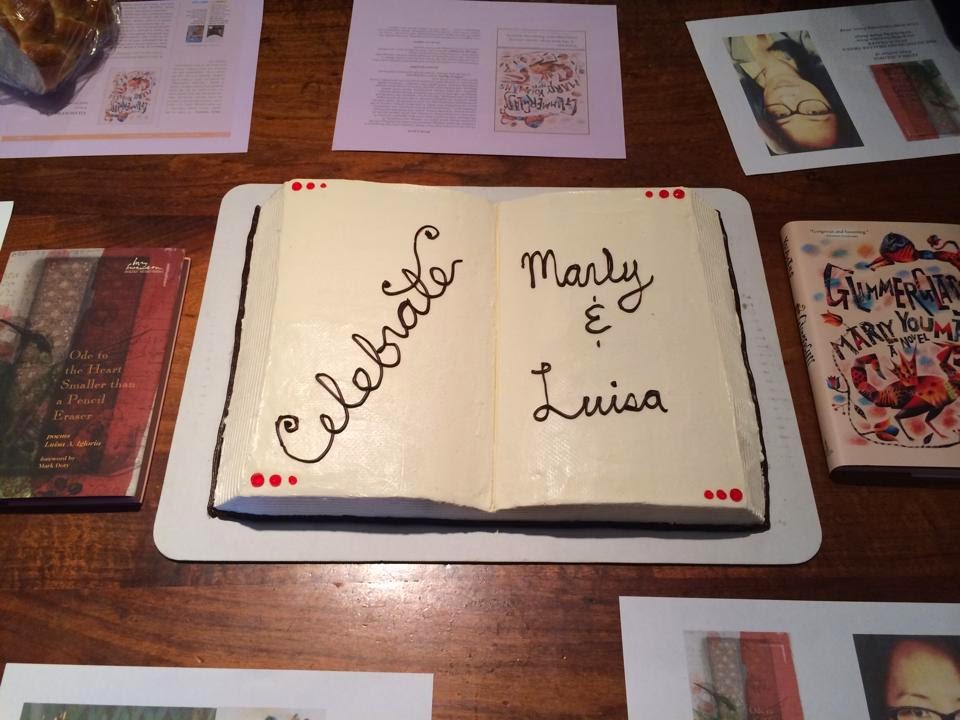 |
| Stella's Marly-and-Luisa book cake! |
Friday, August 29, 2014
Word frolics in Norfolk

Double Trouble:
A Book Launch and Reading Celebration
featuring Luisa Igloria and Marly Youmans
4:00-5:30 p.m.
Saturday, September 20th
Café Stella
1907 Colonial Avenue
Norfolk, Virginia
And here's a prose poem from Luisa's Night Willow, recently out from Elizabeth Adams's Phoenicia Publishing in Montreal. (They also published Thaliad, so we have one publisher in common.) I'm reading Night Willow now.
Night Watch
And if I say heat, expected rain, lassitude--the hollows of my bones begin to mimic the throats of brittle plants. I was seized by thirst, reading a catalogue of inks: morning glory, transparent blue as raindrops on its cheek; moonlight, brazen crimson of azaleas. Purple berries, named after the lady-in-waiting who wrote the first novel. The names of women were not even recorded in her time. I think of her, restless on her sleeping mattress, mining the indigo shade of night after night for illumination. Green sentinels of bamboo; ochre fields, stalks bursting with grain--each pointed like a nib.
Friday, August 01, 2014
Thalia on the move--
 |
| Montreal: Phoenicia Publishing, 2012. Hardcover from Phoenicia only and paperback from the usual suspects. Interior/exterior art, Clive Hicks-Jenkins with design by Elizabeth Adams. |
I have been happy with reviews of the book, including Amazon reviews and Goodreads reviews, which show me that the book's readers (including quite a few writers) like the wedding of a wild novelistic adventure tale, developed characters, and a beautiful, ruined setting with the largeness and force of the epic. I thank them for playing in and helping to create one of my worlds.
To confess the truth, I was prepared for the idea that this book might find only a handful of readers. I am glad that some people in this country and elsewhere are proving me wrong. It is thrilling to find that readers are daring the quest for a home and re-building the world with Thalia.
To confess the truth, I was prepared for the idea that this book might find only a handful of readers. I am glad that some people in this country and elsewhere are proving me wrong. It is thrilling to find that readers are daring the quest for a home and re-building the world with Thalia.
 |
| One of Clive's many interior decorations. |
Energy and persistence conquer all things.
--Benjamin Franklin, wordsmith, founder, inventor, diplomat, etc.
Monday, May 12, 2014
Dreaming better dreams--
 |
| Minotaur study by Clive Hicks-Jenkins for Glimmerglass |
Writer bounces out of bed at 6:30 and scurried about making lunch for her third child, packing track-snack in a sack (can I toss in another rhyme?), fixing breakfast, and tossing books in the backpack (there you go.) Mid-way, the writer turns on NPR and hears that 45% of teens read no more than 1-2 books a year. Or did they say less than 1-2? At any rate, not much of note. Writer plunks down at her laptop to have a cup of tea. First thing she sees: novelist Darin Strauss on twitter, mentioning a new book that uses "Jewish man" as a slur: "Nobody cares / even notices." The Author aka "Ass Queen" is featured in Salon (a coup for a writer, right? like her treatment in Slate or on NPR) with an interview about being a porn star and drug abuser--smoking crack in a BSDM dungeon, anybody? Hey, now we know what kind of lively, appealing-to-the-curious book the almost-non-reading 45% might possibly read! Because that's a book-with-a-hook--we writers are always suppose to have a hook that we are willing to share with the world--that will sell, even to non-reading teens, I expect.
WHO KNEW
Who would have guessed that this would one day be the writer's world, back when she first gave her years to making something true and rejoicing in putting words into new shapes? A world where teens don't read and professors complain that their students don't crack open their books. A world where a clever volume reveling in unabashed porn and drug use has more of that desirable quality, hook, and will get more coverage than a first-rate novel (and infinitely more coverage than a good book of poems.)
ASPIRE
All you lovers of reading and shapeliness in words, defy this crazy world! If hopeless, still be brave. Read better books, make better books. Encourage taste, a human achievement that used to support culture. Online or in-person, recommend what's best in the arts. Make the better world, even if you fear that you are the only person who inhabits it. Dream of a better culture, a more worthy gift to hand on to our children.
Thursday, May 01, 2014
3 for May Day
 |
| Interior art by Clive Hicks-Jenkins for The Foliate Head (UK: Stanza Press, 2012) |
It's May Day, so I hope you went out and washed your faces in dew! If not, how can you expect to be beautiful forever? The birds are singing, the first chilly flowers are stars in the grass, the rain drops are on the rose canes, and it is Yankee-springish around here.
THOUGHTS ON READING CERTAIN CUSTOMER REVIEWS
What is a right reaction to a book that goes against the grain of our expectations? The closer a book is to our expectations, the less surprise--and the more comfortable we feel as readers, so comfortable that we might as well be asleep and having a pleasant, undemanding dream. But let's say a book doesn't conform to our expectations. It doesn't, say, have the sort of resolution and closure we expect. Or maybe it's airier, more
 |
| Vignette, chapter heading by Clive Hicks-Jenkins, Thaliad (Montreal: Phoenicia Publishing, 2012) |
The easiest way to deal with variation from expectation is to point out the variation as if it were a bad thing. To point out is to discern something, though not to discern deeply. It's a step on the way to understanding.
A difference is noticed. Why does it exist? What was it trying to do, and why? Is it interesting? On its own terms, according to the internal laws and shape of the book, does it work?
THE NPM POETRY GIVEAWAY
By midnight, I will write all those names on little pieces of paper and put them into a hat! I did rescue a lot of names from the moderation abyss--don't know why they went there, but there they were--and will be picking out a hat and then a national poetry month great poetry giveaway winner. Maybe I'll let child no. 3 pick, when he gets home from track practice this evening, just to make sure the chooser has no hint of bias! As stated, the prize will be the winner's choice of Thaliad (pb) or The Foliate Head, plus another writer's book...
ADDENDUM MAKES 4
I like Joseph Epstein's essays, and am always recommending "What Yiddish Says," about the marvelous tales of Isaac Bashevis Singer. William Giraldi has written a bright "look at Joseph Epstein's work, the importance of reading, and the role of the critic. I recommend it! (Hat tip to Prufrock News.)
The critic of abiding literary values and astute aesthetic sensibility has an obligation to help influence the reception of a book, a duty to punish efforts that transgress against originality and vigor, and to laud efforts that, in their language and vision and architecture, aspire to greatness—and then, alas, normally go unnoticed by the public.
Plot never supersedes artistic purpose and artistic purpose is never separated from moral vision: Add “the dynamism of language” to “moral vision” and there’s your working definition of the difference between literary work with one eye on immortality and commercial work with both eyes on the trashcan. In “The Literary Life Today” (1982), Epstein quotes the great Cyril Connelly: “The true function of a writer is to produce a masterpiece and no other task is of any consequence.”
Thursday, October 31, 2013
Glass half empty, glass half full--

67% of high school grads do read another book. And that's a hopeful thing.
58% of college grads do read at least one more book. Some read lots!
43% of books are finished. (Confession: I don't think that's so bad. The older I get, the more demanding I am. At 35, I threw away my first hardcover. In the garbage. Didn't want it to pollute another mind. I very frequently quit novels and books of poetry. Life is short. My wish for a good book is long. And no book is right for every reader, it seems.)
30% of U. S. adults have been inside a bookstore in the last five years. And that's a lot of people.
20% of families bought or read at least one book last year. Some bought many more than one!
And the last two lines stand blessedly unchanged.
When has it ever been that more than a minority of people wanted a life of books? Go back far enough and our ancestors didn't even have any, though no doubt they told stories. Everybody does, even now. Books seem to be an acquired passion. (We may do our best to pass on a love of them, but often it doesn't take, or we do it the wrong way, as when a school prevents boys from moving around and having recess and then plunks a book in their hands and drones on about it.)
Hat tip to Flyleaf Books of Chapel Hill, now on tumblr. Me too.
Monday, July 01, 2013
More reading, more writing--
Think of someone like Frederick Douglass, who brought himself up out of slavery by sneaking out and teaching himself to read. Books weren’t some idle pursuit or pastime to him, they were survival itself. And despite this dire situation, he managed to read and, as the writer Thomas Sowell once put it, “educate himself to the point where his words now have to be explained to today’s expensively under-educated generation.” --Ryan Holiday, "How To Read More--a Lot More" (hat tip to Prufrock)
 |
| Phoenicia Publishing, 2012 |
The "trick" that people expect to underlie Holiday's extensive reading reminds me of what people say about writing. People often ask me about quantity when it comes to writing. It's probably the most frequent question I hear. "How do you get so much done?" It usually seems like a silly issue to me because writing is not in the least about quantity. For one rather lurid example, the young Chidiock Tichbourne--wonderful name--is remembered for a single lovely poem, written just before he was eviscerated, hanged, and drawn and quartered. Two of his other poems survive. Meanwhile, poets who wrote hundreds or thousands of pages have vanished into oblivion, with none of their words remaining for later times.
For once, though, I'll take the question seriously.
On the inside, what I accomplish doesn't feel like so much, particularly of late when I had all my usual duties plus serving as a judge for a national award and having the surprise of two adult children returning to the nest for a year. As a member of a busy family with five members, I decided to let go all thought of writing a novel; I didn't want to feel resentful about any increased work that would prevent daily writing. In fact, I decided that I would only write poetry, and not a long, sustained poem like Thaliad but poems under three pages. Still, on some days I am drowning in errands and old-house repair and drudgery, and my three children have needs that must be addressed. It seems impossible to be a writer then.
 |
| UK: Stanza Press, 2012 |
It's not so very different from Holiday's advice to readers...
Saturday, February 23, 2013
Thaliad / surprise / artist and reader
The week past
was a pleasant one for Thaliad, with wonderful things said privately and on the net. As a number of people have asked me if there is anything they can do for Thaliad or another of my 2012 books (A Death at the White Camellia Orphanage, The Foliate Head, and Thaliad), and as I seem to be irredeemably shy about asking people to do anything at all, I am linking to a pretty good list (from somebody who is not a bit shy about telling us!) of what anyone can do for any newish book they want to help. It's accurate enough, though I think that the importance of "likes" and reviews for Amazon's secret algorithm is underestimated. Those things change how (in)visible a book is, and determine whether it comes up as an alternative in searches and "you might like" lists, as well as in such things as Amazon newsletters.
A surprise
that I hope people will find pleasant is on the way! If you want a hint, go here, although it won't be quite like what has gone before. I'm feeling pleased and glad that other people like Thaliad and want to celebrate it. I'll be recording a portion of the poem this week in advance of this interesting surprise...
Addendum: I wasn't so sure that people would be lured by surprise, but now that I have seen some immediate remarks by people at twitter and facebook, I feel pressed to add here that the work at the link was done by the marvelous Paul Digby, who is a fascinating man--UK-born composer, videographer, photographer, painter, bespoke framemaker, carpenter, etc. He has an artistic sensibility that affects everything he touches. Thank you, Paul!
I left a quote
on poet Dale Favier's blog yesterday, in response to some comments on his second post on Thaliad. I remembered the quote this morning and add it in here, as I think it sums up something I believe and also pays tribute to readers as co-artists:
If an author interprets a poem of his own he limits its suggestibility... Ultimately meaning in art--both meaning of literary symbol and of that greater symbol the work of art itself--is a joint achievement of artist and audience. As the artist pounds into his symbol all the richness he can summon, as he 'takes a word and derives the world from it,' so to the symbol the intelligent reader brings all of the past he has been able to gather into himself. --John Unterecker, from his guide to Yeats
Wednesday, November 28, 2012
Gary asks a question...
Marly, here is your assignment for the week now that you have signed your contracts and judged your contest.
In your life and career as a poet, are you writing for yourself, for an existing audience of poetry fans, or are you tying to help expand those who appreciate poetry (and yours, specifically)?
I think that this is a question, if answered thoughtfully by any author (or any builder of any creative output for that matter) could be a good guide to how successful they feel. In other words, does their idea of what they WANT their output to do for the world match their approach in how they deliver that output to the world -- and how far along are they to reaching their particular goal (and what could / would they change to help better achieve their goal).
I expect my answer in sonnet form. In French.
Thanks, Gary
BEING 14 BURBLINGS (14, as in lines of a sonnet)
+ SALTED WITH FRENCH for Gary
Sacre bleu! Writing is different from marketing or promotion--very different. Poetry and business do not often go together. Even on the rare occasions when they appear to go together, they don't go together. And writing poetry is different from writing prose. Usually people who find joy in playing with words aren't the same people who find joy in playing with business. (Gary Dietz, you may be the exception.)
When I draft a poem, I am not in the least concerned with readers. If the poem is any good, I am concerned with an alien, vertical infusion of force passing through my body and soul. I'm trying to capture some of that for my very own. (If it's not good, I'm just fiddling. Fiddling for a long time can be enjoyable and produce some quite pleasant work, but it's not the same as being struck by a metaphysical asteroid--and that's the strange sort of thing that a poet ought to desire.)
So, no, I have absolutely no thought of any possible reader here or in any other world when I make a poem. I am in the grasp of word-pleasure, a certain sort of intense, self-obliterating celebration.
That means I am not even thinking of me as a reader. If thinking of myself or of readers, I would not write as well as if I let myself be cast away by the tide of the poem. No poet would. Not one. All poets desire to be that kind of castaway. (Well, maybe not what we used to call the avant garde. They're up to other things.)
Poetry is evidently one of the weirder activities a human being may devote him- or herself to pursuing. Because the Muse wants all. Whenever the Muse visits, she seeks to seize.
Not only that, the proper stance toward the poets who wrote memorable poetry in the past is one of humility. So a poet's desires must demand a kind of humility toward the past and a kind of self-obliteration in the present. What a weird pursuit!
Do I have "an existing audience" of poetry fans? Yes. Is it large? No. It is composed of, insofar as I can tell from observation and what people say, writers and painters and bloggers and friends and kind strangers who love poetry and like to own poetry books--particularly people who love form and force in poetry. Because I do a certain amount of collaborative work with artists and designers, I collect a few readers among their fans as well.
How do I know such people exist? Some of them write email notes or leave facebook messages or blog comments or twitter messages or some such. Sometimes a publisher tells me what fans say. Sometimes I get a letter on paper. I get comments on places like Eratosphere or blogs, particularly when I publish in an online journal like Mezzo Cammin or qarrtsiluni, which has a large readership and an editor who sometimes lets me know how many readers show up. Those places may be where I have the most readers; certainly far more than in a paper journal or even a poetry book.
Do I worry a lot about the number of readers? No. Saperlipopette! That poetry no longer sells the way it once did is a hard pebble in the shoe, impossible to remove. I have mentioned before discussing with an editor the dropping of a line of poetry from a well-known press with well-known poets. Why? Because not one book they had published in the past ten years broke the mark of selling 300 copies. Holala. That's fairly sad, given the number of potential readers in the U.S. We lost readers in the very long wake of Modernism, and I alone will not bring those readers back to poetry. Easier entertainment has replaced the arts for many, many people in our culture. So I am glad that there are people out there in the world who make it a friendly goal to try and get young people and others to read more poetry. It's not my calling. Nevertheless, I'm always glad to talk to people about poetry.
And what do I do about such things when I have a new book? I make a plan with my publisher (unless said publisher is on the other side of the ocean, in which case I do a rather less) and try new ways of reaching readers. I tour. I do various things on the internet. I go to West Chester. I record and let the wondrous Paul Digby make videos of my poems. Etcetera.
But the best way a poet of genuine ability and sufficient obsession can improve the status of poetry, including her own, is to write good poems without the least worry about the status of poetry. The only way a poet can lodge a poem in longterm human memory is to pursue the Muse with sufficient stamina and passion and joy. Period.
Luck helps. It's always a mistake to discount sheer blooming luck in a culture that is as jammed with garbage (zut!) and diamonds as ours. If the poet is true to the chase, eventually he or she will find readers.
How am I doing? Well enough so that my second, third, and fourth poetry books were not submitted but solicited, sometimes by more than one publisher. Enough to get magazine requests. Enough to have a little band of readers. Enough to be asked to do panels and events. It's something. Sure, I'd like more readers. What poet and writer would not?
But those are just facts that leave out the joy and word-frolic and metaphysical asteroids. And that's what the goal always is: the joy, the word-frolic, the metaphysical asteroids. And in those measures (un jeu de mots!), I am a happy poet.
Subscribe to:
Posts (Atom)