NOTE:
SAFARI seems to no longer work
for comments...use another browser?
Showing posts with label Luisa Igloria. Show all posts

Wednesday, February 28, 2018

The Buddha, wondering...

Order by March 20 for a discounted price--
one for yourself, some for friends!

http://www.phoeniciapublishing.com/the-buddha-wonders.html


92 pgs, 6" x 9", paperback, 
publication date March 18, 2018
 Preorder price $13.50 US (reg $14.95)

Phoenicia Publishing (Montreal) has announced the forthcoming publication of Luisa Igloria's next book. I'm glad the news is out and, as I feel warmly toward both the publisher, Elizabeth Adams, and the poet herself, I am doing my little bit toward letting the world know.

Many of the 53 Buddha poems have appeared in initial form at Dave Bonta's Via Negativa site; the versions below are from that site. The book is her second with Phoenicia, and follows her 2014 publications, Night Willow (Phoenicia) and Ode to the Heart Smaller Than a Pencil Eraser, chosen by Mark Doty for the 2014 May Swenson Prize (Utah State University Press.)

While you're at Phoenicia (go!), sign up for the Phoenicia newsletter and take a look at the catalogue, the related art prints, and music. The publisher: "Please Sign Up  to receive news and exclusive special offers, 4-6  times per year, via email. In March, two subscribers will win a free copy of "The Buddha Wonders..." in a random drawing among our mailing list members."


The Buddha fills in job applications
Luisa A. Igloria March 28, 2014 

Almond the shape of my eyes; lotus
the width of my hips or the soft
inscrutability of a half-smile.
Virtue the act of sitting still,
going nowhere, being a stick-in-
the-mud. Or being pliable: sucking
the tummy in, filling it out with breath
or bread. Give me the bread, the bowl
of milk, honey from the hive, water
from the well, wine from the skin
that loosens all tongues and turns
every fool into a resident sage.

The Buddha listens
Luisa A. Igloria March 24, 2014

in the kitchen to a classical program
on the radio, one evening while cold rain pelts
the window before turning into pellets of ice—
And he thinks Mendelssohn’s Octet in E flat
Major, Op. 20 is the perfect soundtrack for this
moment— the violins and their upbow so quickly
spanning and gathering a range of feeling
he did not know still simmered under his skin.
Where did they come from: that flare of resentment,
that thorn of anger, the ache of loneliness
from a love he yearned for but could not have?
How is it possible to cultivate detachment
at the same time that one practices compassion?
He rinses his cup and saucer and sets them
on the rack to dry, his fingers lingering
in midair as if to trace the notes
that exit in the scherzo.

Dear Naga Buddha,
Luisa A. Igloria November 10, 2012 

how still, how still you sit
beneath the ticking of the seven-
headed tree; it’s hard to understand,
but just like ours, those tongues
have foraged along the ground
for leftovers, for milky drops
of immortality. O careless and
forgetful gods, you’ve crowned us
with accidents, spiked our appetites,
littered the way with detours
and false starts. No warnings issued
about sharp blades of grass that split
the ligaments in the mouth: and thus,
in dreams, the restless body turns
and hisses, even in brief repose.

Part for the whole
Luisa A. Igloria September 24, 2016 

For my birthday, my friend gave me
the stone head of a Buddha
brought back from her travels
to Nepal and India. My first,

she said, wrapping it in yards
of bubble wrap then hefting all
25 pounds of it into a box.
At home, I found a place for it

in one corner of the deck, next to
the patio set and green canvas umbrella.
Setting shallow terracotta pots of herbs
around it, I wondered where it once held

court: if it sat in a bamboo grove or nameless
village temple, its carved fingers curled,
touching. Its eyes don’t give anything away.
It doesn’t say what blasted the rest

of its anatomy, what saved it from complete
ruin in order for the soft bloom of green
to spread like the shadow of a milkweed
butterfly across the high cheekbones.


Luisa Igloria

Friday, January 01, 2016

You Asked, no. 3: Luisa's Ode

A FEW POSTS FOR LUISA

I promised myself that some time between last night's feast and this morning's homemade doughnuts or this afternoon's New Year's Day feast, I would begin to write about Luisa Igloria's poems in Ode to the Heart Smaller than a Pencil Eraser. So now, while the red wine is soaking out of the giant tablecloth and the guests are occupied, I will take a few minutes to share a poem from Luisa Igloria. Thanks to those of you who said this would be a good idea. Novelist Midori Snyder said she liked posts about poetry, and painter Mary Bullington and writer Jeff Sypeck said they would like to hear about a poet I mentioned (and that was Luisa.), Some others on Facebook liked this idea as well. So I may just share a small group of Luisa's poems this month, starting with one today.


FIRST, WHY TALK ABOUT ODE--AND WHAT YOU CAN DO

Isn't it curious to consider that a book of poetry can win a national prize (in a competition judged by poet Mark Doty), and yet remain without a single review for an entire year afterward? And yet that is exactly what happened with Luisa's latest book. In our time, books that do not cater to a mass market audience can be easily overlooked. Worthy books can be invisible.

One day I wrote a Facebook post about Luisa Igloria's Ode to the Heart Smaller than a Pencil Eraser (May Swenson Poetry Award Series, Utah State University Press, 2014), and how it had not gotten a review in its first year in the world. Several friends left notes to say that they had ordered copies. One small mention managed to find the book at least a few readers, and many seemed surprised at the lack of attention. But if a book has little notice, it is unlikely to sell because people don't know it exists. 

What can you do to help this book, and any book you like? After all, unless a book is a lead choice at one of the Big 5, it is not guaranteed to receive a great deal of push. Small and university presses in particular simply cannot put a great deal of marketing muscle behind a book. 

But you as a reader can do something, just as I am doing a little something right now. Post or tweet about the book. Buy a book (particularly during release week.) When you buy, read, and live with a book, you are not only more likely to get to know it well, but you cast a vote. You say to publishers (and in particular to the publisher of the book) that this book is by a writer worth your time and your support. Your support, joined with the support of others, makes the writer's next book easier to place with a publisher. Doesn't it make sense that an engaged readership is essential to books and to publishing? You can also support a book by suggesting the book to your local bookstore, or asking your library to order it. 

LUISA IGLORIA, ELSEWHERE

Luisa talks about her daily practice here
Luisa at Dave Bonta's Via Negativa site: vianegativa.us
Luisa at luisaigloria.com
Luisa's latest prize: http://poetrysociety.org.uk/news/luisa-igloria-wins-resurgence-poetry-prize/

A TASTE

Landscape, with an End and a Beginning

In those days, we too looked to the sky
for omens--away from the burning effigies,
the barricades, the soldiers whose phalanxes
we broke with prayers and sandwiches made
by mothers, teachers and nuns passing rosaries
and flasks of water from hand to hand.
The city was a giant ear, listening for news
of the dictator. (Sound travels swift through
a mass of suffering bodies.) Snipers perched
like birds on the peripheries of buildings.
Thickening contrails striped the sky.
Two ravens flew side-by-side over the abandoned
palace, trading hoarse commentary. When night came,
the people scaled the gates. What did they see?
Papers of state whirling in the fireplace. Masses
of ball gowns choking the closet, shoes lined with satin
and pearls; gilt-edged murals above the staircase.
Days and nights of upheaval, their new history
alive; the old one writhing on the floor
with a blur around its mouth like hoarfrost.

I've shared a poem that, if you are old enough or else fond of reading about post-colonial history, may remind you of a time when Aquino followers seized the state broadcasting station in Manila. The autocratic Ferdinand Marcos and his retinue fled the Philippines and People Power, and Malacañang Palace was overrun--and the world learned exactly how many "ball gowns choking the closet, shoes lined with satin" Imelda Marcos possessed. Those shoes out-Kardashianed our celebrities. If you are neither of those things, the poem will stand as a kind of mythic tale of transformation.

The world and the image-rich language in the poem is an interesting mix of war and devotion--"soldiers whose phalanxes / we broke with prayers and sandwiches made / by mothers, teachers and nuns passing rosaries / and flasks of water." Like the metaphysical Body of Christ, made up of believers, the city is all one, "a mass of suffering bodies," "a giant ear, listening for news." They also look skyward for omens, finding snipers like birds, the stripes of contrails, and ravens over the palace. In the end, the "mass of bodies" looks not upward but down to the floor to see a cold death and a resurrection: "Days and nights of upheaval, their new history / alive; the old one writhing on the floor / with a blur around its mouth like hoarfrost."

Wednesday, September 24, 2014

At SIBA and Stella's in Norfolk


With Luisa Igloria at Stella's

I've been out and about with Glimmerglass--spent three days in Norfolk, Virginia to attend the Southern Independent Booksellers trade show and was no doubt the most memorable person heard there because I had raging laryngitis almost the entire time. At Sunday afternoon's The Moveable Feast (where a writer plunges from table to table of booksellers), I sounded like a cross between Frog (as in Frog and Toad are Friends) and a squeaky toy. When not at the trade show, I was staying at the lovely Page House Inn bed-and-breakfast in the Ghent neighborhood--and there's an imaginative French restaurant there, well worth visiting. It's Nouvelle, run by chefs Rina and Luke and apprentice, Russ.

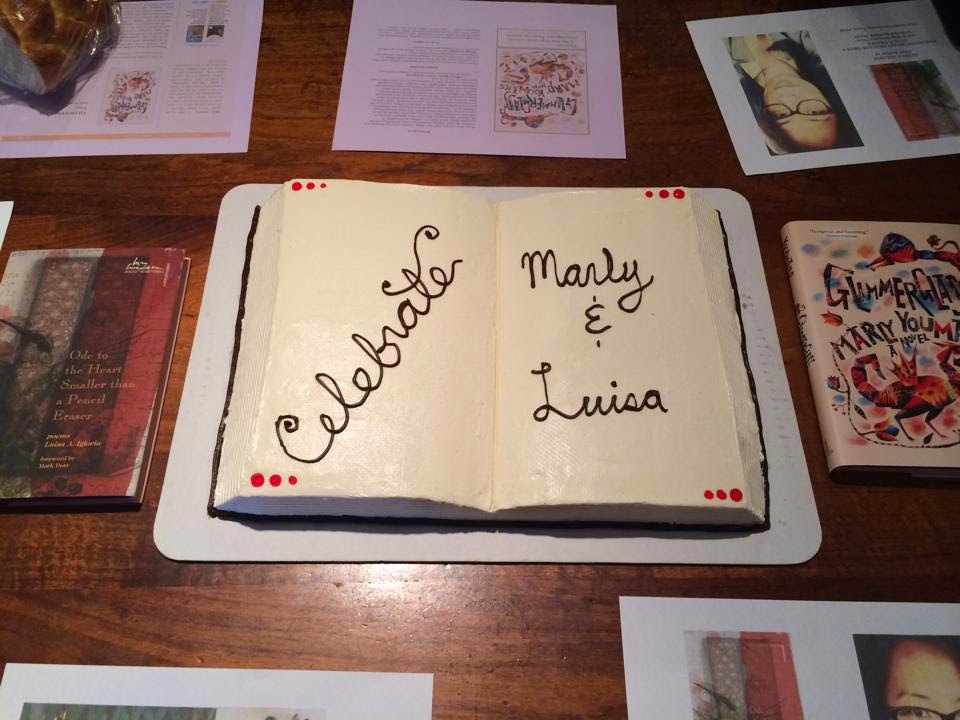
During a long break from SIBA the day before, I met and read with longtime penpal Luisa Igloria at Stella's Café... and expect that's where I left my voice, so if you happen in to Stella's and see my wandering dulcet tones, please send them after me! It was the first event for both Glimmerglass and for Luisa's Ode to the Heart Smaller than a Pencil Eraser. Luisa and I exchanged presents, and the event was quite festive. Afterward, she took me out to a Bolivian restaurant for dinner.

Now I'm in Greenville, North Carolina, visiting Gail McIntosh and Michael Poteat--Gail and I met when she was 14 and I was 13 and just starting high school in Cullowhee. So fun! But I still sound strange, rather like a Bacallian tree frog. I am hoping that my voice returns before the next event on the schedule.

I note a new Glimmerglass review...

Luisa and I take each other's picture
at Bolivian restaurant Luna Maya--
mine will have to wait for a downloader...
These pictures are all by way of Luisa on Facebook.
Stella's Marly-and-Luisa book cake!

Friday, August 29, 2014

Word frolics in Norfolk

In September I'll be doing an event at the SIBA trade show in Norfolk. And now I've added an open-to-the-public reading with Luisa Igloria. It'll be my first event for the new book--and I think for hers at well. We've planned to get together for years, and now an event is finally happening. We shall read and eat (and frolic and drink chipotle lime margaritas with our feet on Alice-in-Wonderland tuffets! Something like that...)

Double Trouble: 
A Book Launch and Reading Celebration
featuring Luisa Igloria and Marly Youmans
4:00-5:30 p.m.
Saturday, September 20th
Café Stella
1907 Colonial Avenue
Norfolk, Virginia

We both have brand new books--Glimmerglass (novel) and Ode to the Heart Smaller than a Pencil Eraser (poetry collection.) You know that idiom about hints, put a bug in someone's ear? If you have a book-reading friend in Norfolk, please put a go-to-reading bug (about the size of a pencil eraser) in his/her ear...

And here's a prose poem from Luisa's Night Willow, recently out from Elizabeth Adams's Phoenicia Publishing in Montreal. (They also published Thaliad, so we have one publisher in common.) I'm reading Night Willow now.
Night Watch

And if I say heat, expected rain, lassitude--the hollows of my bones begin to mimic the throats of brittle plants. I was seized by thirst, reading a catalogue of inks: morning glory, transparent blue as raindrops on its cheek; moonlight, brazen crimson of azaleas. Purple berries, named after the lady-in-waiting who wrote the first novel. The names of women were not even recorded in her time. I think of her, restless on her sleeping mattress, mining the indigo shade of night after night for illumination. Green sentinels of bamboo; ochre fields, stalks bursting with grain--each pointed like a nib.

Monday, August 11, 2014

Igloria twice

The 17th May Swenson Award
from Utah State University Press.
"When Luisa Igloria cites Epictetus—'as soon as a thing has been seen, it is carried away, and another comes in its place'—she introduces the crowded and contradictory world her poems portray: a realm of transience, yes, where the vulnerable come to harm and everything disappears, but also a scene of tremendous, unpredictable bounty, the gloriously hued density this poet loves to detail. 'I was raised / to believe not only the beautiful can live on / Parnassus,' she tells us, and she makes it true, by including in the cyclonic swirl of her poems practically everything: a gorgeous, troubling over-brimming universe." —Mark Doty, judge for the 2014 Swenson Award
* * *
Luisa A. Igloria has two brand new books... I have one and will soon have the other. How about you?
Buying a book is a vote for publisher and writer, saying that there should be a next book--that the writer's labor to pluck "the golden apples of the sun, the silver apples of the moon" is worth your reading time and your support.
Why not skip the popcorn and soda at your next movie and get a book instead? Skip a lunch out and buy a book instead? Skip a couple of coffees at Starbucks and buy a book?

* * *

A beautifully-designed book
from Elizabeth Adams's Phoenicia Publishing of Montreal
In prismatic prose poems of daughters and fathers, of aging and longing, of loves and laments, Luisa A. Igloria fashions for us an ancient tongue for the 21st century, one that gets to the heart of why poetry is written: the pure lyric impulse of trying to live. In a time when words too often play flippant ironic games, Igloria instead takes us beneath language’s skin, to show us “how the planets align, how trees cast their shadows along the broken boundary; how the wolves howl as they press closer to their prey.” — Sean Thomas Dougherty​, author of ​Scything Grace; Nightshift Belong to Lorca (Paterson Poetry Prize finalist); Except by Falling (2000 Pinyon Press Poetry Prize); and ​Sasha Sings the Laundry on the Line

Tuesday, May 27, 2014

"I hope more and more people will recognize"

I'm really proud of what we're all doing together -- and it seems like the readers agree. Which is good because we all need their support to keep going. Poetry publication is extremely challenging, and I hope more and more people will recognize the high quality of the books we're bringing out, not only in terms of the writing but the design, art, typography, and printing. It's a group effort, a lot of work, and very satisfying but the goal is still to get the books into the hands of readers! I'm grateful for every single one. --Elizabeth Adams of Phoenicia Publishing, a response on facebook
Next book up at Phoenicia: Luisa A. Igloria, Night Willow. Pre-order now!

Wednesday, January 01, 2014

Happy buy-lots-of-books year!

first book purchase of the New Year, 12:48 a.m., January 1, 2014: 

I should have managed it earlier, but this is a good one for starting out the year: Luisa A. Igloria's poetry collection, "The Saints of Streets" (University of Santo Tomas, 2013.) Luisa has a website at luisaigloria.com, can be found on facebook and twitter, and publishes a poem a day at Dave Bonta's via negativa. Some day the two of us will put our feet up on the same tuffet at the Palaz of Hoon and drink tea and eat bon-bons, finding ourselves "more truly and more strange."

from the start of Mookie Katigbak-Lacuesta's review of Luisa A. Igloria’s The Saints of Streets for Philippine Graphic Magazine (30 September 2013 issue):

If you began your writing career in the Philippines in the nineties, few names would leap at you with the bristling charge of Luisa Igloria. Known for her powerful lyric virtuosity, Carlos Angeles couldn’t sing her praises enough in her earlier work: “[Her] poetry inhabits the heart first, then the mind, and the soul…her work contains some of the most extraordinary and most polished poetry written by a Filipino poet in English today.” There was no woman poet as prolific as Igloria, or as decorated—she was a Palanca Hall of Famer in her mid-thirties, and a three-time National Book Awardee before migrating to the States. As Igloria left, what remained was the myth of Igloria, the first woman in the Hall of Fame, who wrote as a woman during the newly post-feminist age of Filipino poetry—there was no sloganeering in her work, no Ra-ra fairer sex activism, only a polished and tough lyricism.

more about Luisa: 

Poet Luisa A. Igloria is also the author of The Saints of Streets (University of Santo Tomas Publishing House, 2013), Juan Luna’s Revolver (2009 Ernest Sandeen Prize, University of Notre Dame Press), Trill and Mordent (WordTech Editions, 2005), and other books. She just bought her first house! As well as poet, she is the mother of four daughters and a professor at Old Dominion, director of the MFA program in creative writing.

Tuesday, December 11, 2012

The Next Big Thing - author meme

Lovely poet friend Luisa Igloria invited me to join the self-interview experiment called The Next Big Thing. Writers participating get to answer 8-10 questions, and then tag five other writer friends to post their own “next big thing” the following Wednesday. I'll add a list of the writers later.

1. What is the working title of your book?

In 2012, my ninth, tenth, and eleventh books came out--a thing that, combined with a stint as judge for the National Book Award in Young People's Literature, seems and was insanity.

The first was a novel, A Death at the White Camellia Orphanage, winner of The Ferrol Sams Award for Fiction (Mercer University Press.) This book combines various threads from family lore into a new fabric of adventure. Soon it will be out in paperback.

Then came a collection of formal poetry, The Foliate Head (UK: Stanza Press), wonderfully decorated with green man art by my friend Clive Hicks-Jenkins. It hasn't been out long but is a limited edition.

And last is December's Thaliad (Montreal: Phoenicia Publishing) a post-apocalyptic narrative in blank verse, centering on seven children who leave home.

So 2012 saw three books in three genres in three countries. As Thaliad is the most recent, I will focus on it. (Upcoming books: Catherwood will be back in print; Glimmerglass; and Maze of Blood.)

2. Where did the idea come from for the book?

In July of 2010, the story simply appeared in the curious corridors of my brain. I never expected to publish the poem as a book (an epic poem? in 2012?) but wrote entirely for my own pleasure. I published a section of the fourth part in qarrtsiluni, and afterward received the surprise of several requests to publish based on the excerpt. (Another fragment of the poem appeared in Kim Bridgford's Mezzo Cammin.) One was from Elizabeth Adams (managing editor of quarrtsiluni with Dave Bonta), and I decided she was the most appropriate publisher. And I like her Phoenicia Publishing. In fact, if you don't know her small press, please go take a look.

3. What is the genre of the book?

Blank verse poetry that hews to epic conventions, translated into our day. Some novelistic conventions.

4. Which actors would you choose to play your characters in a movie rendition?

Why should a book be a movie? That is the proper question. Because for once a mid-list writer might make a living? Because people don't read poetry?

Unknown child actors, for the most part.

5. What is the one-sentence synopsis of your book?

If I had wanted it to be one-sentence long, I would have written it so!

Their world destroyed, seven children fare forth to make a new world? Children build a matriarchal world in the face of natural-world and human violence after devastation? The long effort to build something of beauty and meaning in the face of catastrophe?

6. Will your book be self-published or represented by an agency/publisher?

Phoenicia Publishing of Montreal. Owned by that native New Yorker, Elizabeth Adams, designer and artist and writer and more.

7. How long did it take you to write the first draft of your manuscript?

I wrote it in an intense burst through July and into the beginning of August. Then I fiddled a long time.

8. What other works would you compare this book to within your genre?

I am going to have to take that one as a question about artistic debt, since I don't think the book is like much contemporary work. No doubt I would never have written such a poem if I had never read the Anglo-Saxon poets, the Gawain poet, Chaucer, Homer, Virgil, Dante, Milton, Logue, and others. A reader versed in poetry may detect some homage to Homer, the Anglo-Saxons, Milton, and Cavafy. And though it is post-apocalyptic, I would say that the narrative owes a bigger debt to a passion for fairy tales than to an interest in, say, the current spate of post-apocalyptic novels. I am afraid that I have read none of them, aside from those read in 2012 while on the NBA judging panel, and that was too late to influence Thaliad.

9. Who or what inspired you to write this book?

It blossomed in my head. No doubt the reading mentioned above made a difference. I also have a fondness for blank verse. Every time I try to add a sentence about why, it sounds downright erotic. Flexible. Pleasurable. Easy-to-muscular rhythms.

10. What else about your book/your writing might pique the reader’s interest?

Thaliad is a spectacularly beautiful object, from the jacket or cover to the framing full-page illustrations to the title page to the wealth of gorgeous vignettes by Clive Hicks-Jenkins. The design by Elizabeth Adams is immaculate. The profuse art that decorates the pages subtly adds to the narrative.

Tuesday, June 07, 2011

The House of Words, no. 33: Luisa Igloria on daily writing practice

The header to Dave's "The Morning Porch."
From a detail of "Paper Garden" by Clive Hicks-Jenkins.
Earlier in the series, Dave Bonta talked about his "accidental" collabration with Luisa A. Igloria. Here the poet and professor discusses her ongoing morning-porch project. Luisa Igloria's ninth and most recent book is Juan Luna's Revolver, winner of the Sandeen Prize (Notre Dame, 2009.) Visit her at her website--and visit her Morning Porch poems and their inspiration via Via Negativa! Luisa was born in Baguio City, the Philippines, and now lives in Virginia, where she is director of the M. F. A. program at Old Dominion University.  She is the mother of four daughters.

Addendum, 12:20 a.m.: I can't resist adding a link to Luisa's latest Morning Porch poem: there is the beggar queen of The Palace at 2:00 a.m., dreaming on her throne of words. And very fine she is, too! Thank you, Luisa!

From having read the fine poetry that Dave Bonta and Beth Adams gather into each issue of qarrtsiluni journal, I have some familiarity with their blogs and websites, and so I’ve visited Dave’s microblog The Morning Porch before. But in a lull just before Thanksgiving last year, I read Dave’s November 20 observation of a pileated woodpecker inching up the trunk of a locust tree “like a pawl on an invisible ratchet”  and I thought: what a cool image, what a cool word-- pawl-- and immediately I wanted to turn it into a poem. It’s been about a hundred and fifteen days since then, but what’s happened is that I’ve been writing daily poems in response to Dave’s The Morning Porch observations. I really didn’t intend for it to turn out into the daily “devotional” that it seems to have become, but now I’m thoroughly hooked.

What I’m happiest about is how I’ve incorporated it into my daily writing practice, and that the simple rules I’ve set for myself seem to work well in terms of getting me to that place of focus and attention where there is the potential for making poetry happen. My rules are: I don’t have a fixed time for visiting The Morning Porch to read the latest line Dave’s written. But when I do, I try to respond immediately, without premeditation, composing as I go. I try not to belabor what I find in the starting “trigger”-- because I don’t see myself obligated to respond via a form of poetic reportage. What happens instead is that the bit of image or language that first catches my eye or ear, meets what I bring to that moment (a combination of many things- what I may have been reading or remembering recently, what kinds of questions I might be asking that particular day). Finally, I try to do all of this in thirty minutes, forty max; I feel that if I go over this time limit I set for myself, I will be belaboring the whole enterprise too much.

For instance, Dave’s TMP observation on January 28 was “The silence of falling snow. When my furnace kicks on, the three deer digging under the wild apple tree startle and run down the slope.” When I read that, the first sentence, “The silence of falling snow” coupled with the image of “the wild apple tree” had a certain beautiful gravity that felt-- and sounded-- almost biblical. The wild apple tree and the three deer digging also made me think immediately of medieval tapestries, rich with illustrations of plants and animals. From there it was a short leap to recalling stories in bestiaries like the Physiologus. It has these famous animal allegories like the one of the unicorn which only lays its head upon a virgin’s lap, or the phoenix which immolates itself and then rises from its own ashes on the third day; or the pelican that gouges its own breast to feed its young its own blood. I also recalled the famous engravings that Pieter van der Borcht had made of some of these stories, and I refreshed my memory by looking at a few online images. The one I mention in the poem, of the lion and lioness breathing upon a stillborn cub in order to bring it back to life, spoke urgently to me perhaps because some of the difficult questions I am living at this time of my life involve pondering what it means to be a parent, what it means to struggle with raising children with difficulties; pondering what our (my) individual choices have brought to bear on our particular dynamic as a family. All of these came together quite rapidly in the composition of the poem, which I see now is just another form of asking the questions which I continue to grapple with on a daily basis. I don’t-- or the poem doesn’t-- necessarily answer these questions. But there is a certain kind of release in being able to confront them even briefly in this form. The quote from Aquinas that I use as epigraph is something I thought of later, after I’d written the poem.

Intercession

“Adoro te devote, latens Deitas,
Quae sub his figuris vere latitas…”
["I adore you devoutly, O hidden God
truly present under these veils..."]
—St. Thomas Aquinas

The silence of falling snow perhaps is like the hush
that lives somewhere in each moment of great
preparation: as for instance in Pieter van der Borcht’s
medieval copperplate engraving, when you would not know,
unless you read the captions, that the fierce and terrible
mangled faces of the lion and the lioness are from
their desperate expenditure of chi so that their stillborn
cub might live— under the gnarled cypress and rock,
see how its body writhes, stretching and coming to at last
under the double blowtorch of breath. And what of the meal
that the pelican gathers for her young from the cabinet
of her own breast, bright speckled clusters of blood from
the vine? Feathers fragranced with cedar, the phoenix
bursts into flame then crests from its ashes on the third
day; the unicorn comes to lay its head on the virgin’s lap,
and the foliage glistens like a page of illuminated
text. Orpheus knew, afterwards, the dangers of looking
too closely at the silence, of doubting what it might bear.
Think of him ascending from the depths, not hearing
her voice or footfall, not seeing her face. This morning,
also by myself, I bend to attend the furnace’s smolder.
Three deer digging under the wild apple tree
in the garden startle and run down the slope.

The poems that come out of my engagement with the prompts on The Morning Porch do not all have the same tenor. That’s perfectly fine and really to be expected. I’ve really preferred the recklessness of not having a really fixed subject to guide me into the writing. After all, poetry is about “the ineffable”, isn’t it? Some of the poems I’ve written are the result of little happy accidents, like misreading. For instance, on February 4 Dave’s TMP observation was “Dim sun. Trunks and branches still sheathed in ice glisten, surrounded by duller companions like glitterati on the streets of New York.” Perhaps I was hungry, or my glasses need cleaning, or I needed more coffee-- whatever it was, I read “Dim sum” and the result was the (I guess) food poem which I’ve copied out below--


Dim Sun, Dim Sum

Dim sun, your soft
floury edges today
make me think of steam
clouds under a wicker basket,
pillowy mounds of dough
pulled into a pucker
atop sweet or savory buns…

Let the glittery icicles
on twigs and branches trade
their hard-edged, fishnet-
stockinged gossip above us all,
here at an oilcloth-covered table
in a little hole in the wall
where the air is fragrant
with ginger and scallions
and dark plum sauce.

On March 14, Dave’s TMP observation was “Scattered snowflakes wander back and forth like lost souls. I watch one explode against a branch of the dead cherry. The croak of a raven.” That morning, before I visited TMP and before I started working on various tasks at my desk at the university, I was looking at some of the photos on various news websites from the earthquake-devastated towns and cities in Japan. I was particularly riveted by the photograph of a woman weeping, surrounded by broken beams, pulverized concrete. But beside her, inexplicably, neatly lined up, there was a pair of cherry-red rubber boots. And I wrote this poem, where I re-imagined the “croak of a raven” in Dave’s original post as an elegy listing the names of really more than a thousand dead:


Landscape with Red Boots and Branch of Dead Cherry

In a photograph, a woman sits on her haunches
amid a sea of debris. Her feet are bare. A pair of red
rain boots caked with mud perches neatly at her side,
the way they might rest in a parlor. The sky is the color
of rain, the color of heaving things: water a wall
surging over highways, toppling cars and beams
and lorries. The past tense is already active here—
fields have lost their stenciled borders; there’s little left
to read in maps. Above the burning cities, snowflakes
scatter, wandering back and forth like spirits. I watch
one explode against the branch of a dead cherry.
Croak of a raven making the shape of a thousand names.
*

Which is to say, after these examples, that inspiration really comes from many disparate sources. What I try to do in these daily encounters at Dave's The Morning Porch, is to keep myself open, limber, and receptive to the organic totality of all that may come together in the creative process. I think that this is the way most of us work, anyway-- one handhold after another, feeling our way toward that scent, that sense, that feeling which first enticed us with the idea that it might become a poem.

Norfolk, VA; 10 April 2011

Friday, May 20, 2011

House of Words (no. 25): Dave Bonta and the internet, 6

Dave Bonta, "Brush Mountain under ice,"
February 2011
MY: One thing I notice about the online part of what publishers call "presence" — particularly through Facebook and sometimes through my blog — is that I meet people who want to collaborate. I don't always have the time for this, but I have met wonderful artists in various fields this way. They have given me far more than I can ever give back, except through the simple fact of going on and doing work that they like. You are involved in a number of ongoing collaborations. How did they begin, and how do they make you more fruitful or help (imp the wing!) your own creativity?


DB: They definitely help. They come about naturally enough, because if you have a daily writing habit, you're always looking for material. For example, when the nature blogger and photographer Jennifer Schlick approached me last month about writing poems in response to a series of 16 macro photographs of spring wildflowers, I jumped at the opportunity. Ekphrastic poems are fun to write, and I love wildflowers. The fact that the poems will be featured in an artists book associated with an exhibition in upstate New York, and possibly in a print-on-demand book if we can figure out how to do that — that's gravy, but it wasn't my primary incentive.

I like these eyes in a beech bole...
Dave Bonta, "Beech grotesquerie," February 2010

Similarly, Luisa A. Igloria's now daily responses to my Morning Porch posts began almost by accident, on Facebook, where I automatically repost Morning Porch content. A very busy writer and academic, she has just enough time (and brilliance) to write a poem in her spare time each day, but not enough time to chill on her front porch as I do and watch the world go by until a poetic subject turns up. So she gets a daily prompt and a new audience, and I get stellar content to re-post to Via Negativa, plus the opportunity to watch a master poet at work. Her energy feeds off my indolence. I love it.

There are just so many opportunities for collaboration now — I don't see how any serious writer can fail to be excited by that. I think poets need to move away from the mentality of always writing for the next, single-author book, or if that's too much of a stretch, at least stop thinking about collections of poetry solely in terms of print.

Monday, January 31, 2011

Sundry on Monday

BONTASAURUS FLOWERS
I am liking Dave Bonta's wildflower poems at Via Negativa. These are responses to photographs by Jennifer Schlick. Some of Dave's poems have interesting responses in turn from Luisa Igloria. At left is Schlick's unusual photograph of False Solomon's Seal; I think this is the one that most surprised me.

THE BIRTHDAY ROSES & WIELDING THE TREE FINDER http://qarrtsiluni.com/2011/01/24/two-poems-from-the-plant-kingdom/ To my surprise, people are still commenting on "The Birthday Roses" and "Wielding the Tree Finder." I find that I am still such an innocent about how to get the word out about poetry that I feel out-of-the-ordinary pleased when people respond on 'zines that allow comments. Perhaps, given the state of poetry publishing, we are innocents together.

POETRY & PUBLISHING
Last year an editor of an interesting publishing house (mid-size, select) told me that they weren't going to do poetry anymore--than none of their copies broke 300 in sales. Isn't that bemusing, in a big country like ours? And there's a cost, isn't there, to not supporting poetry? Now a house that published good poets will publish no more. I hope those poets have found a new home...

BLOGGERS, ETC.
If any bloggers or others would like press release material for The Throne of Psyche, let me know here or at facebook or by email. I will be bundling what I get from Mercer with some other things soon, and I've started to collect a list. Meanwhile the paperback is up for pre-order at Amazon, but not the hardcover. Soon, I hope.