NOTE:
SAFARI seems to no longer work
for comments...use another browser?
Showing posts with label novels. Show all posts

Sunday, November 15, 2020

Tonight at Easton Book Festival


***
Hosted by editor and book critic John Wilson
7:00 p.m. EST 
November 15

Easton Book Festival event release:  "Marly Youmans is one of today’s masters of language and imagination. Her poetry and fiction blend fantastic, historical, and everyday elements that have delighted readers for decades. In this program, book critic and editor John Wilson introduces a series of dramatic readings of Youmans’s fiction and poetry, from her critically acclaimed Catherwood (1996) to her recently released Charis in the World of Wonders."

Readers include artist, writer, and culture shaper Makoto Fujimura, actor Keisuke Hoashi, professor and writer Chris Phillips, and theatre student Lauren Stango.

UPDATE, THE LOWDOWN FROM ON HIGH: 

"The broadcast is at 7pm EST tonight (I.e., very soon), and will be on eastonbookfestival.com and the festival’s YouTube channel: 
https://www.youtube.com/.../UC6x2DUva4.../featured

[Makoto Fujimura] is uploading his recording, and I’ll add it to a new version of the video." So there will be a slightly longer recorded version up later that includes Mako reading from Charis in the World of Wonders.


Saturday, December 30, 2017

Some books I read, 2017

Selected Reads and Rereads
I'm not sure how much of a picture this gives of my reading, since a great deal of it is piecemeal (especially with poetry) and not shown here. But it is a part-picture of a ramble through the year. And you can probably puzzle out something or other about my current manuscript by a study of these books.

Currently I'm reading some MacFarlane, some Denis Johnson, and various poets. Again, the poetry is mostly piecemeal. The most accurate portrait of my poetry reading over a year would be a fat anthology I make myself, including a good bit of Yeats. I've only listed poetry here if I read a complete book. I point that out for those of you who might possibly pass by and wonder why your book is not listed--must mean I have not read the entire thing as yet!

* * *

Attila József, Perched on Nothing's Branch: Selected Poems. Translated from the Hungarian by Peter Hargitai. Foreword by Maxine Kumin. Buffalo, New York: White Pine Press, 1999. Academy of American Poets Translation Award. Don't miss József's "Curriculum Vitae" at the start, as it will be an effective way for you to break into tiny, sharp pieces glazed with tears. Poem snip: "Shadows of silverfish sweep the corals, / usher in the blackness, flutter on soft sand; / they touch tired snails and fall asleep for a long time..."

Bible. Various forays into the library of books that we call The Holy Bible. Took a class on Genesis and one on Exodus. Have been reading KJB, NRSV, Robert Alter's translation of Genesis, and David Bentley Hart's brand new translation, The New Testament, meant to mimic the style of the Greek, even where rough, impetuous, and careless as to tenses. It was lauded recently in The Atlantic. A more tempered view by Wesley Hill here.

C. Day Lewis. The Poetic Image. Still pertinent and well worth reading. Essays/lectures from someone who understands literary history and the Modernist place in it for good and for ill. "The Lyric Impulse" is a great introductory piece. I thoroughly enjoyed the whole book. Highly recommended for those interested in song, ballad, and shapely poems.

C. P. Cavafy, The Complete Poems of Cavafy, translated by Rae Dalven, with an introduction by W. H. Auden (Harcourt, Brace and World, 1948.) Auden: "The most original aspect of his style, the mixture, both in his vocabulary and his syntax, of demotic and purist Greek, is untranslatable." Every now and then I feel drawn to reread Cavafy in various translations. I love the way he writes of things historical!

Camille Paglia, Glittering Images: A Journey through Art from Egypt to Star Wars. (New York: Pantheon Books.) I read this aloud to my husband on our drive to my mother's house in western North Carolina in October and finished it up on the way back to our home in upstate New York. Some of her speculations are of the very sheerest, but it's a great read if you love art and don't care for the sterility and jargon of much arts criticism. Enthusiasm and respect for spiritual search inform the book. With the early works, the miracle of survival of ancient art and the admiration for the distinctive styles and crafts of shaping wielded by ancient, anonymous people are on Paglia's mind. And if you feel at all uncertain about the history of Modernism, she'll help you out in understanding how one sub-movement reacted to another. (And I must say that she managed to make me see Mondrian in an surprising new way--I had no real sense of what Mondrian thought that he was doing and found him surprisingly symbolic in his mode of conceiving and carrying out paintings.) I like and agree with her ideas of Warhol (or Mapplethorpe) as the dead-end of the avant garde, and I think those ideas translate well to what happened with poetry in the twentieth century, particularly when you look at how both painters pursuing realism and narrative and poets pursuing formal variety (including some ancient forms) and a widened subject matter are slowly gaining ground. Paglia is my favorite feminist because she insists (mightily!) on formulating her own thoughts without a whit of care for the winds and trends of culture in an era when academics tend to march together.

A CLOSET for Ladies and Gentlewomen, or the Art of Preserving, Conserving, and Candying. With the manner how to make divers kinder of Syrups, and all kinds of Banqueting-stufs: Also divers Soveraigne-Medecines and Salves. London: Printed by R. H. [Richard Hodgkinson], 1651. I loved holding this one in my hands and wished I could put it in my pocket (tiny!) and take it home. Cordial waters, preserves, candying, medicines. I've read some other books like this one (I won't list them all!) in the past year, and they are invariably enjoyable--there are some online. Read in a 90-degree cradle at The American Antiquarian Society, AAS.

C. S. Lewis, The World's Last Night. Essays. Here's a favorite clip on culture and on what is "real and live and unfabricated": "But when the things are of high value and very easily destroyed, we must talk with great care, and perhaps the less we talk the better.... For the true enjoyments must be spontaneous and compulsive and look to no remoter end. The Muses will submit to no marriage of convenience."

Cynthea Masson, The Alchemist's Council. I had failed to pack a book for my flight to Japan, and an ARC of this novel was the sole volume on the United book-giveaway shelf, so of course I had to take it along.  The author is a Canadian professor who had a postdoc fellowship in medieval alchemical manuscripts at The British Library. As I used a more traditional mode of alchemy to structure a forthcoming book (written some years back), I'm always interested in seeing what others do with alchemical meanings. The realm is complicated enough that the author is forced into info-dumping at times, but it's ingenious, using strange erasures that bring memory losses and an elaborate linkage between scripts and our world. And bees! I left it at an onsen on Sado Island, so perhaps it found someone who can read English.

Dave Bonta, Ice Mountain. An Elegy. (Montreal: Phoenicia Publishing, 2017.) Design and woodblock illustrations by Elizabeth Adams. With an interesting essay by Dave about his inspiration from 3eanuts and much more. I know Dave through qarrtsiluni, a meeting in Wales, Via Negativa, and mutual friends. "at the top of a hemlock tree / a porcupine sleeps / in a sunlit halo of quills."

David D. Hall, Worlds of Wonder, Days of Judgment New York: Knopf, 1989. Hall looks at learning faith via gaining literacy and the sacred nature of text. Interesting on the reading matter of the godly (and the less so) of Mass Bay, as well as the wonders and "remarkables" of the time. More on the Sabbath, Sewall, etc. I knew a lot of the material discussed already but still found it interesting. Checked it out at AAS and then ordered a copy--well worth the read.

David Schmer Svahn. Conflict and Genius: A Brief Introduction to a Complex Man--19th Century Scholar, Poet and Priest. William Wilberforce Lord 1819-1907. Doylestown, PA: Otsego Press, 2017. Bassett doctor and amateur historian David Svahn wrote this account of W. W. Lord, poet praised by Wordsworth and eviscerated by Poe, priest who served in the siege of Vicksburg and at Christ Church Cooperstown, where he got into a colorful ruckus! Great book for Cooperstonians and people interested in nineteenth-century poets, thinkers, and clergy. Reviewed for the local Christ Church Chronicle.

Emma Donoghue, Wonder (Boston: Little Brown, 2016.)

E. M. W. Tillyard, The Elizabethan World Picture. Just as good as it was years ago. Eustace Mandeville Wetenhall Tillyard, former Master of Jesus College, Cambridge, going at chaos and order and the Great Chain of Being.

French Poetry from Medieval to Modern Times, ed. Patrick McGuinness (New York: Everyman's Library, Knopf.) Read on a trip and need to reread.

G. K. Chesterton, The Wit and Wisdom of G. K. Chesterton (New York: Dodd, Mead, and Company, 1911.  LibriVox. I did not expect these to be so very good--the first half is wonderful. Listened to them while on the treadmill. Amusing and full of marvelous turnings and surprise. In his words, even the frailest of subjects become "thistledown...the roots of stars." The wonder of nonsense, a defense of public obsession with absurd facts, the decline in rash and impossible vows, the proper worship of babies (each a new world), and more.

George and Weedon Grosssmith, The Diary of a Nobody. LibriVox.

(Sir) George Webbe Dasent's translation of Popular Tales from the Norse (Norske Folkeeventyr) collected by Peter Christen Asbjørnsen and Jørgen Moe. Folk tales. You may remember this book from childhood; I did. Tolkien referred to "Soria Moria Castle" as a possible name-source for his Mines of Moria. He also refers to Dasent in "On Fairy-Stories." 71 tales short and long, with a wild variety of voices and accents. LibriVox.

Joanna Moorhead, The Surreal Life of Leonora Carrington (London: Virago Press, 2017.) Reviewed in a round-up called "The Runaway Powers of Leonora Carrington."

John T. Hull, The Siege and Capture of Fort Loyall: Destruction of Falmouth, May 20, 1630. A paper read before the Maine genealogical society, June 2, 1885. Portland, ME: Owen, Strout and Co., Printers, 1885. Hard to believe he read the entire book to the state genealogical society.... Though it is quite interesting. Read at AAS.

John Dane, A Declaration of Remarkable Providences in the Course of My life. By John Dane of Ipswich. 1682. To Which is Added a Pedigree of the Dane Family, And a Few Notes. By a Member of the New England Historic-Genealogical Society. [Identified as John Ward Dane in pencil.] Boston: Samuel G. Drake, 1854. An account of some charm, full of temptations (a proto-Tom Jones!) and odd events. Influenced a passage in my novel. Read at AAS. I keep seeing this referred to, but with no sense that John Dane is closely related to the heroic Mr. Francis Dane, minister of Andover and defender of accused witches and wizards.

James Turner Johnson, A Society Ordained by God: English Puritan Marriage Doctrine in the First Half of the Seventeenth Century. Studies in Christian Ethics Series. Nashville and New York: Abingdon Press, 1970.

Kingsley Amis, Lucky Jim. I read again after many decades and was surprised to find how well I remembered it, particularly the episode of the burned bedclothes and the "Merrie England" talk. The apex of the drunken address still reminded me of Fink-Nottle's, and antihero Jim Dixon of a sharper, less hapless and sweet Bertie Wooster. After being in the British army, Kingsley Amis must have been out to break all the campus rules.... Is Dixon sometimes roiling with class rage, spite, boredom, maliciousness, immaturity, self-contempt, and an Amisian-Larkinesque view of women? Sure. Here's Dixon in the morning: "Consciousness was upon him before he could get out of the way; not for him the slow, gracious wandering from the halls of sleep, but a summary, forcible ejection. He lay sprawled, too wicked to move, spewed up like a broken spider-crab on the tarry shingle of morning. The light did him harm, but not as much as looking at things did; he resolved, having done it once, never to move his eyeballs again. A dusty thudding in his head made the scene before him beat like a pulse. His mouth had been used as a latrine by some small creature of the night, and then as its mausoleum. During the night, too, he'd somehow been on a cross-country run and then been expertly beaten up by secret police. He felt bad.” Now I feel like rereading some Wodehouse and maybe The Loved One.

Leena Krohn, Doña Quixote and Other Citizens. Portrait: Tales of the citizens of an usual city. I wrote about Doña Quixote here.

Leonora Carrington, Down Below (New York Review of Books, 2017.) I reviewed Carrington books here.

Leonora Carrington, The Complete Stories of Leonora Carrington (The Dorothy Project, 2017.) Reviewed in a round-up called "The Runaway Powers of Leonora Carrington."

Leonora Carrington, The Milk of Dreams (New York Review of Books, 2017.) Reviewed in a round-up called "The Runaway Powers of Leonora Carrington."

M. Michelle Jarrett Morris, Under Household Government: Sex and Family in Puritan Massachusetts. Cambridge, MA: Harvard University Press, 2013. I don't think I read all of this one...

Michael Donaghy, Shibboleth (Oxford, 1988) Recommended poetry collection. "...the dive was there before the hawk was, / Real as a wind shear before the blown snow reveals it."

Peter J. Bohan, Early Connecticut Silver, 1700-1840. Middletown, Conn.: Wesleyan University Press, 1870. This one also talks about earlier silver in the short text. Lots of images. AAS.

Philip J. Greven, Jr., Four Generations: Population, Land, and Family in Colonial Andover, Massachusetts. Ithaca and London: Cornell University Press, 1970. AAS. Had to skim this one, as I didn't have it for long.

Philip Larkin, The Whitsun Weddings. I wrote about this volume (and a bit about Charles Causley as well) here.

Robert Alden Rubin, Seeing the Bones and Other Poems (read in manuscript.) This one will find a home eventually.

Robert Forby, The Vocabulary of East Anglia--originally published in 1830. 2 vols. Fascinating.

Robert Macfarlane, Landmarks (Hamish Hamilton, 2017.) Lovely, bumpy, tactile, strange place names in the UK.

Rod Dreher, The Benedict Option. New York: Sentinel, 2016. Oddly, I found this book helpful in thinking about the feelings behind Puritan emigration and town establishment in New England. That is, it's really clear on communities needing to form in resistance to the dominant culture. In other ways, entirely different!

The Saltonstall Papers, 1607-1815: Selected and Edited, with Biographis of Ten Members of the Saltonstall Family in Six Generations. Boston, Massachusetts Historical Society, 1972. 2 vols. I only used the first volume--some great letters, and the biographies were useful and sometimes contradicted earlier sources I had used. Great interest, and answered some questions I had. Read at AAS.

The School of Good Manners, 1769. I finally learned the source of "the upper hand." When you're walking with another person, the right hand position is the one for the superior person. When three, he/she should be placed in the middle. (This reminds me of Darcy and Bingley's sisters walking in the garden, and Darcy's attempt to have Elizabeth join them. But no, they are "charmingly disposed." Or something like that.) Hey, and "Spit not in the Room, but in the Corner, and rub it with thy Foot...."

Steve Turner, Imagine. Basic. Very much in line with his International Arts Movement talk.

Susan Hankla, Clinch River (Roanoke: Groundhog Press, 2017.) Poetry collection reviewed for The Hollins Critic. Read it! Our interview is also forthcoming. This is one of the second series of volumes from poet and writer R. H. W. Dillard's new and much-appreciated Groundhog Press (Roanoke, Virginia.)

T. McClure Peters, A Picture of Town Government in Massachusetts Bay Colony, at the Middle of the Seventeenth Century As Illustrated by the Town of Boston. Dissertation, School of Political Science, Columbia College. The McWilliams Printing Co., 1890. A highly useful little book to help understand town officers in early towns and Mass Bay governmental courts and structure. The number and variety of offices is surprising. And some offices are open only to Selectmen. Really curious and interesting if you like knowing such things! Read at AAS.

Ted Hughes, Selected Translations: Poems, ed. Daniel Weissbort. (New York: FSG, 2006.) A bit of Homer, an opera text (a version, not a translation) for the Bardo Thödol, Ferenc Juhász's marvelous "The Boy Changed into a Stag Cries Out at the Gate of Secrets, and more. Wide variety in close, near-literal versions for the most part. Great collection for Hughes fans or for anyone who wants to take a look at a wide variety of writers.

Thomas L. Purvis, Colonial America to 1763. Almanacs of American Life. Facts on File, 1999.

(The Reverend) Thomas Morong, Puritan Life and Manners. An Address, Delivered in Ipswich, Massachusetts, at the Memorial Services on Forefathers' Day, Dec. 21, 1870, Together with a Notice of the Exercises on That Occasion. Boston: Lyman Rhodes, Printer, 1871. A good year-by-year source, despite a few oddities. Fat tabloid publication. Another one that it's hard to believe was a presentation because it's the length of a short book. People must have been more patient than we are. Read at AAS.

250th Anniversary of Ye Anciente Town of Haverhill. Worcester, MA: F.  S. Blanchard and Co., July 2 and 3, 1890. A big fat tabloid publication. What a bargain for a mere 10 cents! Loved this crumbling, darkening source. So helpful. Read at AAS.

[William Badcock.] W. B. of London, Goldsmith, Touch-stone for Gold and Silver Wares. Directing how to know Adulterated and unlawful GOLDSMITH'S Works, and the greatness of the Cheat therein; and how to punish the Offenders, and recover Recompence to the party wronged. Being a Treatise of great life for every Buyer of PLATE, and all Buyers and Wearers of Silver-Hilts, and Silver Buckles, and all other kind of GOLDSMITHS Works. The second Edition with Additions, Comprising the principal matters relating to the Goldsmiths and Cutlers Trades, and material things concerning all other Manual Trades. London: Printed for J. [?] Bellinger, in Cliffords-Inn-lane, and T. Basset at the George near Cliffords-Inn in Fleet-street, 1678. This is one I didn't get to keep long enough to read the whole thing, but it's fascinating and another volume that is tiny and packed and delicate. Read at AAS.

Tuesday, December 05, 2017

Manuscript critique

Photo by Scott Webb on Unsplash

Who will read my manuscript?
This little gang of editors and writers was formed especially for the people who write and ask me to critique their manuscripts, and for those who ask for recommendations on how to find an editor. I have done some manuscript critiques for others (particularly friends-of-friends and locals) in the past but don't have time to do that now.  I hope this collection of people who critique and edit will help if you are looking for feedback on a book manuscript or screenplay.

Genres, experience, expense
Most of the people on the list handle fiction and nonfiction, but some deal with YA, screenwriting, and poetry as well. My recommendation is that you look closely at the links; the editors are quite varied in experience and interests, and some of them might just feel like a fit for you. I expect there may be a range in the pesky matter of expense as well; I've listed fees where easily available. If this helps you narrow down to a few editors, please google them and see what else you can find.

Investigate
When you read about someone who has worked in the publishing industry, see what they have edited. In the case of editors who are also published writers--as many here are--don't forget that you can often go to Amazon and read a portion of a book. Excerpts and reviews may be on other sites as well. Google is your friend. This is especially helpful with those who do not have a website. Most of the names here are based on a facebook query; if you want to look at the responses (some of which have personal recommendations and more information), they are here.

Recommendations, prose and poetry
I have included the novelist or poet who recommended each person, except when e-friends contacted me directly. Though I've focused on prose, there are a good many no-fee sites where you can share and discuss poems--perhaps the most rarefied being Eratosphere, which concentrates primarily on formal poetry.

Grow the list
Please feel free to add further names and information in the comments. I will be adding any others that come in via email and facebook. And if you use one of the editors, come back and leave a comment.

Thanks to Diane
Oh, and Diane Ducey deserves credit for writing a lovely letter that prompted me to make this list. Good luck to her!

MIKE LEVINE
About Mike Levine Editorial: here
Write Mike Levine on the MLE contact page: here
Recommended by poet and translator Alicia Stallings

JACKIE COOPER
jkershawcooper [at] aol [dot] com
About Jackie Cooper: here
Note: He will not review any book he critiques. (He reviews for Huffington Post.)
Fee for a novel critique: $400.

CAREY WALLACE
About Carey Wallace: here
theblindcontessa [at] gmail [dot] com
Fees worked out on a case by case basis.

LAURA AGIRI
silver [dot] graph [at] juno [dot] com
Laura has published novels and collections of stories
   and has worked as researcher, editor, and writer.

JEN VIOLI
About Jen Violi: here
Write Jen on her contact page: here
Recommended by writer Alice Marks

PETERNELLE VAN ARSDALE
About Peternelle Van Arsdale: here
peternelle [at] peternellevanarsdale [dot] com
YA, novel, fantasy
Recommend by novelist Jeff Giles

CINDY KANE / CINDY TRUMBORE
About Cindy Kane: here
Cindy [at] cindykane.net
Children's books and YA
Recommended by poet Julie Kane

JANET NAYLOR VANDENABEELE
Ink Stains Media: here
janetvan [at] gmail [dot] com

JULIE SCHEINA
About Julie Scheina: here
julie [at] juliescheina [dot] com
Recommended by novelist April Lindner

NEIL AITKEN
About Neil Aitken's work with poets and writers: here
Contact page here
Recommended by poet Robbi Nester

S. J. HODGES
Memoirs, self-help, fiction
About S. J. Hodges: here
Around $500 for a read with notes session, depending on length
She sends science and business mss. to LEIGH ANNE HIRSCHMAN
    at Hirschman Literary

MARGARET DIEHL
About Margaret Diehl: here, here
margaret [dot] diehl [at] gmail [dot] com

KAREN PALMER
About Karen Palmer: here
karenpalm [at] gmail [dot] com
Recommended by Margaret Diehl

MELANIE BISHOP
About Melanie Bishop: here
leximelanie [at] gmail [dot] com
Recommended by Margaret Diehl

JOAN ROGERS
to be added
Recommended by Margaret Diehl

Thanks to novelist Emily Barton for more recommendations,
   though they turned out to be overbooked. How busy
   an editor is just might be something to consider as well.

IMAGE
The Manuscript Critique: "$695 for up to six months of mentoring."
Writer and professor Jessica Hooten Wilson suggested
   both IMAGE's book service and IOWA BOOK DOCTORS.
   I haven't found enough information on the latter, but feel free to investigate further!

FREE FACEBOOK WRITERS GROUP
"Anyone may submit passages of written work for group critiques."
Find other writers who want to swap manuscripts for comments at any stage...
Recommended by Kim Beall, who says she found a few trolls but also
   some helpful friends. (Kim just sold her first book.)

FREE CRITTERS is a free service for writers of sf/f/h, though you have to critique
   other pieces before you take a turn with your own. So you "pay" with your
   time and thoughts. I talked to someone who used the service, and he was
   enthusiastic about one critiquer out of five.

Thursday, January 12, 2017

Reading Doña Quixote

Courtesy of Päivi Tiittanen, sxc.hu
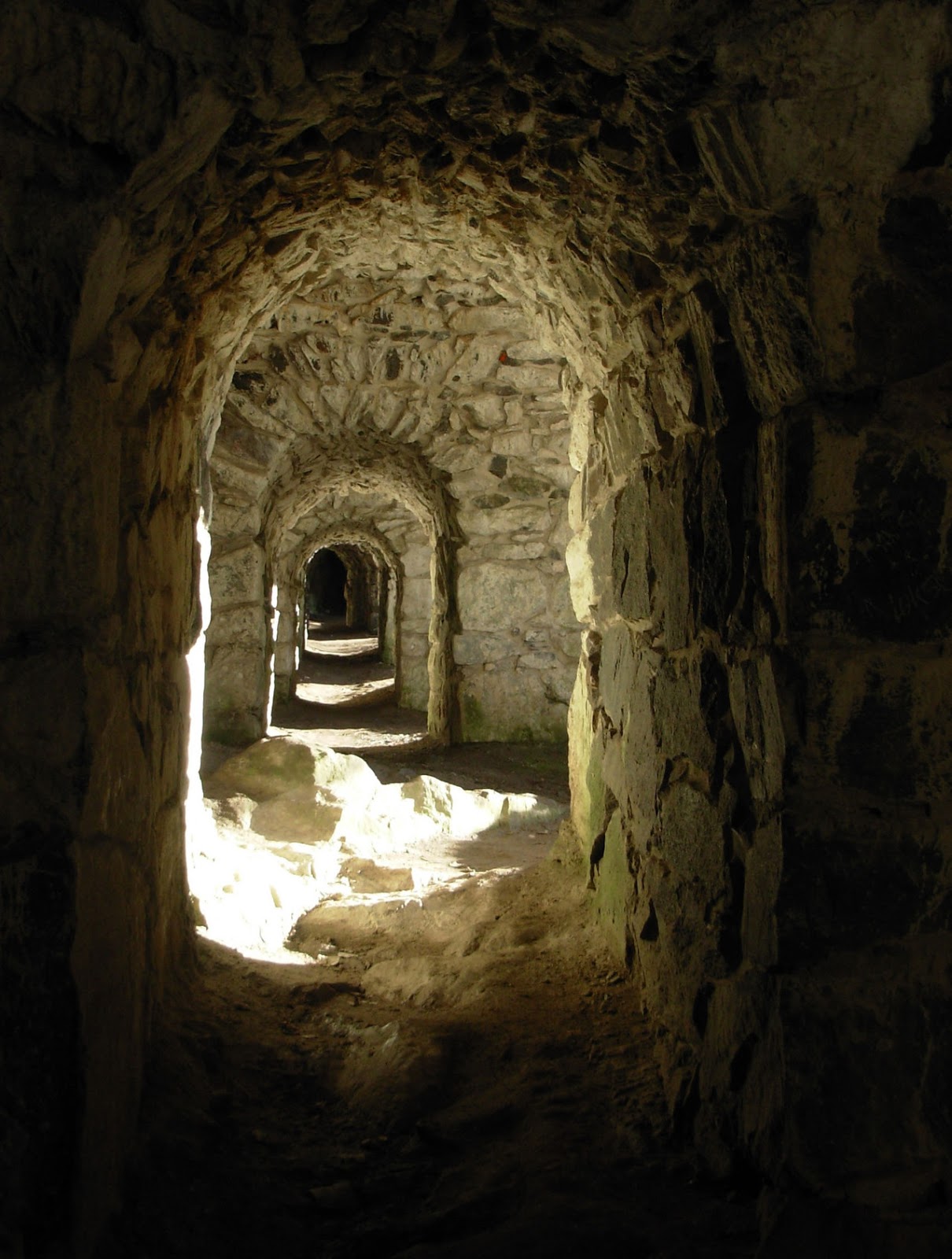
"Catacombs in Suomenlinna"
Yesterday and this morning I read Leena Krohn's Doña Quixote and Other Citizens. Portrait: Tales of the citizens of an usual city, and this is what I have been for some hours: a room through which the narrator and Doña Quixote (the woman who is like a tree that murmurs and sometimes drops shriveled leaves proclaiming death, the woman who is a poet) come and go, talking of many things, and sometimes of what the shriveled leaves proclaim. And in those hours, the city is mine and in me with its green-shining towers of telephone booths and its moving rooms, and I am also a room that holds many objects whose meaning sometimes is profound and secret and sometimes falls away and is lost. In and out of the room of me come figures who are rooms also and who connect with me and whose connection then falls away unaccountably, perhaps to recur, perhaps to drift through the gate built in water and be lost or bob away across the sea and perhaps return to me, for there are many deaths in a life, many passings-away and sometimes returns.

Into the room of me comes Doña Quixote with the poetry of herself and the strange wisdom that makes me know, and her melancholy that is also a fabric in the room of me, that matches something in me. Like a trick chalice, I fill up, and then at once everything I have drains away. All things go. All rooms are pendulums, moving toward a time when they will be no more. In all the city of interlocking and moving rooms (some a lit bus with the moving figures inside), I am found, I am lost, as Doña Quixote is found and lost also.

And now and then I am arrested by the knowing of this: the most important thing about a thing is that it is beautiful, whether it is a mysterious narrow gate in the sea, a gorgeous, filmy-tailed goldfish, a dancer like a flower's corolla, or a silken peacock that trembles, unfurling its mighty fan of eyes while the snowflakes sift down before and behind and onto its glistening green and blue.

But even that knowing cannot be grasped and held until it always lights the room of me or the room that is Doña Quixote but drains away. The loss and passing of that knowledge of beauty is like a death, like passing through a gate built in water. "One doesn't get used to living."

And now I have shut the book, though the sense of myself as a room--a room filled with strange objects that do not give up their secrets--remains. And the sense of beauty also, for the book is still open beside me. And that I have written (carelessly? wisely?) that the book is both shut and open seems entirely right.  10 January 2017


"Peacock feather"
Courtesy of Sean Okihiro, sxc.hu
You may read this short novel (or is it an interrelated collection?), Doña Quixote and Other Citizens. Portrait: Tales of the citizens of an usual city, in that gigantic volume, Leena Krohn's Collected Fictions: A Career-Spanning Selection from Finland's Most Iconic Writer. (What long titles! And I wonder what Leena Krohn thinks about being iconic. I'm not even sure what they mean with that choice. Revered? Painted on a wooden surface? Semiotic-iconic? Flowering from tradition? All of these?)  I do, however, feel quite sure it is a publication from Ann and Jeff VanderMeer's Cheeky Frawg Books (Tallahassee, FL, 2015.) Doña Quixote is translated by Hildi Hawkins.

Monday, January 02, 2017

Selected Reading, 2016 Happy New Year

Selected 2016 Reading List, in ABC order by author
Books by friends, books recommended by friends, 
new reads, lots of rereads, books read to review or blurb. 


Of course, I lost my list (so me!) partway through the year, 
so here's what I remember right now in the way of books read in full.

Aldhelm, Saint Aldhelm's Riddles, translated by A. M. Juster. Reviewed for First Things. (Yes, I liked it and gave it a great review.) My husband bought me a copy at the same time I bought myself one, so clearly it must be a "me" sort of book!

Jane Austen, Persuasion. Reread, again. It has climbed higher on the Austen list. Maybe I'm finally old enough to appreciate its virtues.

Jane Austen, Pride and Prejudice. Reread for the Nth time. In the kingdom of the novel-in-English, I can never be done with rereading Fielding, Austen, Dickens, Hawthorne, and Melville.

Jane Austen, The Watsons (fragmentary novel.) If you're a fan....

Willis Barnstone, translator of The New Covenant Volume I: The Four Gospels and Apocalypse. Translated from the Greek and informed by Semitic sources. Extensive introductory and appendix essays. I don't always agree with him but the essays and notes are interesting, and so is the translation, which uses Aramaic / Hebrew name ways and returns the text to poetry.

Michael Bishop, Joel-Brock the Brave and the Valorous Smalls  Read in manuscript to write a blurb for Kudzu Planet Productions. Illustrated with charm and abundance by Orion Zangara.  Full blurb: "Joel-Brock Lollis's family has vanished into the labyrinthine Sporangium below a curious Georgia emporium, Big Box Bonanzas. Glimpses of an older J-B Lollis of the Atlanta Braves on a BBB television suggest that Joel-Brock may never get back his parents and sister. The Valorous Smalls--almost-ten Joel-Brock, lively teen Addi, and tiny detective Valona--forge their way into the mushroom realm to change that possible future. Young readers who enjoy quests with marvels in the kingdom of the weird (mushroom warriors! mazes! time games! giant slugs!) will find much to interest, amuse, and surprise them in Michael Bishop's unusual fantasy, Joel-Brock the Brave and the Valorous Smalls, well and profusely illustrated in pen-and-ink by Orion Zangara."

Louise Bogan, The Blue Estuaries: Poems, 1923-1968. Fine poems, well worth reading. As with Muir, I like the mythic ones a lot. That may be because they were the first I knew, as both writers were in a mythic poetry anthology by John Alexander Allen bought when I was seventeen.

G. K. Chesterton, The Ballad of the White Horse. If you're a fan of LOTR, read this! Clearly a major source, far more suggestive of Tolkien than I expected.

Wilkie Collins, The Woman in White. Reread yet again. Such a marvelous "sensation" novel, such curious characters, such moody "set pieces," starting with the initial encounter with the Woman in White. While it was very clear on the unequal status of men and women (particularly as regards inheritance) at the time, I suppose that its marked fluidity of male and female roles within a Victorian world always conscious of what is proper must be of new interest to scholars in our era.

John Putnam Demos, Entertaining Satan: Witchcraft and the Culture of Early New England.

Annie Dillard, The Abundance. If you like Dillard, which I do, you might order this thinking (as I did) it would be chock full of essays. I was rather disappointed that this selection was not a little more abundant in its choice. Great starter book if you haven't met her before.

Seb Doubinsky, Predominance of the Great: non-haikus. Narcissitic comment: always so pleasant to have a poem dedicated to you--to find out what words the poet thought suited to "you."

Jeffrey Ford, The Shadow Year. Interesting to read another Ford novel. But if you have not but wish to read him, start with the short stories.

Richard Goldbeer, The Devil's Dominion: Magic and Religion in Early New England.

Georgette Heyer, The Marriage of Convenience. Read this one because Ellen Kushner kept talking about Heyer. It is frothy--rather as if Leon Garfield, Jane Austen, and P. G. Wodehouse had a word-frolic.

Clive James, Poetry Notebook. Wonderful essays, well worth reading. If you write or read formal poetry (you know, the stuff we used to just call poetry, back before Modernism), you will find him congenial, I expect.

Mary Kinzie, The Cure of Poetry in an Age of Prose: Moral Essays on the Poet's Calling. Learned about this one via a Michael Juster tweet. This book would be salutary for any young poet to read, no matter his or her bent, because he or she would be challenged by the description of the poetry of our day. Even if the poet radically disagreed (perhaps especially then?), such strongly formulated arguments would be helpful in coming to understand his or her own thoughts.

Ursula LeGuin, A Wizard of Earthsea.  Holds up from the first read, many years ago.

Ursula LeGuin, The Tombs of Atuan. Ditto.

George MacDonald, At the Back of the North Wind.
I loved this as a small child; it feels dated but still has the MacDonald sweetness.

George MacDonald, Phantastes. Foundational book for 20th-century fantasy.

Jo Mazelis, Ritual 1969. You can read my review of this collection (her third) for Planet: The Welsh Internationalist. "Jo Mazelis’s well-crafted stories in Ritual, 1969 (Seren, 2016) stand at a crossroads—liminal place between worlds where criminals and suicides were buried—of the fantastic and the homely real."

Alda Merini (Susan Stewart, translator), Love Lessons: Selected Poems of Alda Merini. I have read this book twice, trying to see why I should be a fan. Still not, alas. It seems more than a language problem, as I once again felt let down. Truly, I would like someone to explain to me why I should admire the poems. I would welcome a little enlightenment. Alessandra Bava tells me that Alda Merini is quite good, and I believe her but still can't see.

Edwin Muir, Collected Poems. I had not read him in a long time; I like his poems, especially the myth-tinged ones.

Garth Nix, Sabriel, Lirael, Abhorsen, Goldenhand and To Hold the Bridge. Y. A. fiction. The two last are new, a novel and a collection (the title novella is set in the Old Kingdom.) Thinking about going back to a novel for teens than I abandoned when almost finished, but I think this is about all the contemporary Y. A. I read last year.

Adam Roberts, The Thing Itself. I tweeted a lot of quotes from this book in the fall, and regret that it has not had a wider readership. If you love irrealism of any sort, try it. If you love Kant, try it. Oh, just go ahead and try it!

Robert Louis Stevenson, Kidnapped. Enjoyed as much as when I was a mere sprat. The "flight in the heather" (admired by Henry James) and the roundhouse battle are well-handled pieces that mix action with forcible inaction and watching. I also like the wild weirdness of the hideout for Cluny Macpherson, Jacobite rebel. The relationship between David Balfour and Alan Breck Stewart is effective in great part because Alas is so rash and bold and childish and proud, and David is tested in his loyalty to the man who has saved him. Set in the eighteenth century and making use of the murder of Colin Roy Campbell the Red Fox near Ballachulish (the Appin Murder), the story is well worth a read if you missed it, growing up.

Michel Tournier, Gilles and Jeanne (translated by Alan Sheridan.) Definitely should not be the first Tournier read. I think it must be called a failure, though failures are, of course, important to art and shed light on related work or can be transitional bridges to something more successful. Yet I dislike it. You know it's not kindred when the book is short and you start skimming anyway!

Robert Walser, Oppressive Light (selected poems, translated by Daniele Pantano.) Walser made me write a few poems in opposition to his, so I am grateful to him. I was a little disappointed--somehow expected more, when I should have been simply curious--but interested all the same.

Dallas Willard, The Divine Conspiracy: Rediscovering our Hidden Life in God. The self as kingdom flourishing within the divine kingdom.

W. B. Yeats, Crossways.
I always read Yeats, but this year I'm looking at his poems as separate collections instead of hopping about at whim (although I am doing some of that as well.) New poem "I Met My True Love Walking" has a sigodlin relationship to "Down By the Salley Gardens."

W. B. Yeats, The Rose.

Philip and Carol Zaleski, The Fellowship: The Literary Lives of the Inklings. How lovely to have such a wonderful setting, to be a writer in a setting where words mattered so very much. How sweet to grow and aspire in a small, encouraging country that cares about its literature.

Tuesday, October 04, 2016

A beginning, with green sheep...

*
The Ferrol Sams Award.
*
Silver Award, Foreword Book of the Year Awards.

*
"Its themes and the power of its language,
the forceful flow of its storyline
and its characters have earned the right
to a broad national audience."
--About.com review
I have been busy with children and deadlines and applying for a short fellowship, so here is a little snip from A Death at the White Camellia Orphanage in place of a post I've had no time to write. A snip, a clip from the beginning to a first chapter, instead...

1.
Death comes to White Camellia Orphanage;
A savage laugh, a riddle and reply.


The boy called Pip by his father—who had named him after a boy in a famous book, a child for whom everything had turned out well enough—woke in the dense warmth of an Emanuel County summer at 4:17 a.m., a fact that he learned years later when he became acquainted with clocks because for the rest of his life he would wake at the very same hour, the very same moment of the morning as if his body could never let go of the need to be awake for that minute of the day.  He did not open his eyes.  He did not need to open his eyes.  He knew where he was, the same place he had been for almost a year.  He was on the farm sharecropped by the Hooks family although the land was always called by another man’s name as if to remind the husband and wife that they owned not much more than debt and the clothes on their backs plus a spare change for Sunday and a clutter of ironware and dishes and a few clanking enamel chamber pots.  For the last several years it also had been known as The White Camellia Orphanage or The Cottage because of the doings of Mr. Sam Truetlen, owner of a nearby cotton gin and the far-off Gen’l Notions Store, who had traveled all the way to New Orleans and on to Dallas once upon a time, and there, on the outer edge of the known world, had toured a cottage-style orphanage intended for destitute white children and run by the Klan.  Some years later, Mr. Sam, being a man prone to fits of “projecting,” backed his own orphanage though most of its children still claimed at least one parent on some played-out, ramshackle farm.  Wherever his kind had sunk so desperate and low as to scoop up the red clay to eat, Mr. Sam would arrive on muleback and plod away with one or more children riding pillion, some to stay at The Cottage for a month, some longer. It got so that people for miles around could recognize Daisy Belle, the white mule, and Goshen, the soot-gray one.  As for the name of the orphanage, that was the influence of the Klan, with its Knights and Dragon, its Cyclops and Nighthawk and Kamellia—and Mr. Sam’s tip-of-the-hat to the city of Dallas.  So that was where Pip had been lodged for almost a year, in The White Camellia. 
It was high, hot summer in Emanuel County, Georgia, and not one soul was saved from the day’s blaze or from the night’s smother of warmth; up and down the county, the only sleep was a restless sleep, and near Lexsy, one or two old people woke in a fright because the air was just about too dense to breathe—their trembling hands reaching for funeral-parlor fans printed with a portrait of Christ and some luminous, faintly green sheep—and on some gully-shattered sharecropped place, an infant who had been fighting for air yielded up the ghost on his mother’s naked breast.  Mr. Sam, next door to the cotton gin, returned to bed and dreamed his nightly dream of being weighed in the scales and found wanting.  At The White Camellia Orphanage, the bone-tired children slept without dreaming, all but one, who dreamed about a lost penny.    
When he woke, Pip knew something was akilter.  He did not know more, neither whether the hour felt wrong or right.  There was a faint slippage of coolness on his back where his brother—his half-brother—Otto normally slept.  The kinship bond between them was tangible, such that the children seemed inseparable, a blood brotherhood of commingled beings.  Loss and grief had only made their physical need and ache for each other more clearly manifest.  The musky smell that belonged to the little boy was ebbing away, and Pip could detect only the presence of the two others in the bed and the four across the room.  The brothers always slept together, with a careful space between themselves and their bedmates, an act that demanded they cling to their perches even in sleep to avoid tumbling down into the deep valley of the bed.  Now Pip lay breathing in the scent of near-naked boys and the stink of the chamber pots. These were smells he did not find disagreeable, just as he did not dislike the fumes of kerosene from the lamp or the odor of Miss Versie, unwashed and marked with a faint whiff of blood.  

Where was Otto?  
Save

Tuesday, September 13, 2016

More snails

Snail Jar. So I call it!
Terracotta jar with three handles
Late Minoan ca. 1600–1500 B.C.
The Met. Schliemann collection.
Dear diary: What madness it is to start a novel in the midst of upheaval--weekly Wednesday and often Sunday theater performances by my husband and eldest all summer, planning to move a child living at home to Atlanta, need to visit my mother far away, general mayhem of life with three children in town, and so on and on--but I have done this mad thing. I've always been the sort of writer who writes poetry but occasionally trips and falls into a novel and then writes a ridiculous number of pages per day, but now my life is making me write this novel in a different mode, all little zigs and zags. I am distracted by many things. My time is broken into little pieces. I've always thought that the discipline of writing every day was more workable as a man's habit--or maybe that of some single woman with no children--but when I didn't have time to manage to write a novel but did so anyway, I would stay up very late during a draft. During The Wolf Pit, I had very little sleep, which was electrifying and not healthy. But this book is not being written in that way. Days go by with nothing new on the page. Soon I'll be traveling. I'm not sure whether this is the way I can write a novel, but it seems to be the way that this novel will be written, if it is written. I need to be Ariadne who offered the bright thread of the clew for the labyrinth and Theseus and maybe even the Minotaur, but in slow increments. Maybe I am more a snail, leaving a silvery track but making it very slowly and hoping not to end up as an ingredient in "The admirable and most famous Snail Water."

Right now I must go read and write some book reviews. But first I will write a little on my novel. I like this quote from Steinbeck's diary: "Problems pile up so that this book moves like a Tide Pool snail with a shell and barnacles on its back." And yet that book did move. Perhaps this one will also.

Friday, January 29, 2016

Fair warning

Marly Youmans, free of smirks
and tiny emotions
for what seems a zillion years.
At once I am irresistibly impelled to write a novel in which you will find giants and bears, tea and rats, long Faulknerian sentences, and complicated actions and emotions i.e. feels in current parlance. I predict absolutely no smirks and egregious facial expressions, no technology whatsoever, no crime, and no mystery to solve.

Can readers embrace such a book? I shall not worry but shall clutch the giants and bears to my non-bestsellerdom heart or bosom or some such, and rejoice. I suppose that's rather perverse--not the clutching to bosom, heart, etc. but the rejoicing in foiling the work of digital text analysis--but it's me all over. Onward!
Over the past several Saturdays, the French-language Montreal daily has conducted a competitive experiment in using digital text analysis as a way to change the way writers write. The paper asked five established Quebec novelists to compose a story of about 1,200 words using guidelines produced by .txtLAB from a study of 200 titles from the New York Times bestselling fiction list.

Common features of American bestsellers, according to .txtLAB director Andrew Piper, are short sentences (11 words on average), simple actions relayed with active verbs, frequent descriptions of facial expressions and characters who are into technology and have a mystery or violent crime to solve. These books avoid complex emotions, uncertainty and nature description, he says, as well as tea, rats, giants and bears. --Robert Everett Green, Can Computers Teach You to Write a Bestseller? at The Globe and Mail (Montreal)
More Bullington-Youmans frolics coming up soon. No quantitative analysis allowed.

Tuesday, July 21, 2015

Oríkì, Maze, King!

Clive Hicks-Jenkins. Detail, jacket for Maze of Blood.
Or, an answer to that frequent question, "What are you working on now?"

Oríkì-inspired poems

Well, I have a rather large quantity of long poems, all written in the past few months. I love it when work comes in a great rush! The poems were inspired by the form and nature of Yoruban oríkì, or oral praise chants. Traditional elements that appear in one, more, or all of the poems are: parallelism, repetition, lists, naming and re-naming, copia or profusion, quotation, disjunction and seeming randomness, contrasting elements, sequences of parallel cases (sometimes concluding in the key case), wide-ranging comparisons (as, say, linking a man with a plant and a river), and concern for lineage. Certain attitudes linked to oríkì appear: the idea that every thing (object or living thing) has its own special qualities that fit and suit, and the related idea of certain tools and techniques as belonging to each mode of work. The idea that birds and animals and fish show evidence of distinguishing cultural acts (like dying the feathers or fur or scales a specific color, for example) and familial lineages like people leads to the conclusion that the whole of Creation is composed of cultural artifacts. Even the idea of what oríkì scholar Karin Barber calls “vertical social inequality” applies to the hierarchies of things and creatures, as well as people. The poems do not attempt to be oríkì, but were inspired and colored by Yoruban praise chant. Many differences appear, and women play a more acknowledged role as figures in story. The poems are much more governed by narrative and by an overarching unity than oríkì.

Maze of Blood

Forthcoming in September, Maze of Blood was inspired by the life of pulp writer Robert E. Howard. I like to do something different each time I write a novel, and I had never used a life as a template. I drafted the book at Yaddo (back in 2007) but sat on the novel a long time, knowing something was not quite right. Recently I re-worked the order of the book and added new passages as a kind of frame for the whole story. This gave the book more tightness and also a trajectory that moved toward joy and creation rather than following the pattern of a life toward death. (For those interested in the sources of the book, the accounts that influenced me most were: One Who Walked Alone, by Novalyne Price Ellis; Blood and Thunder, by Mark Finn; and Two-Gun Con: A Centennial Study of Robert E. Howard.) Childhood summer weeks spent on a deep-South sharecropper's farm have been a real gift to me. I know something of the dusty, hardscrabble Southern places in the world, their challenges and culture. And I felt that I knew and had sympathy with a lot of Howard's difficulties as well; he could have been a wayward figure in my own family tree. My protagonist is called Conall Weaver--I certainly did not want any confusion with biography--and the book plays with and embroiders episodes that are often based on incidents in Howard's life. If a book is a kind of sub-creation of the Creation, well, Maze of Blood contains a character who makes characters, and those characters occasionally appear as actors in the story. Here's a page for the book. Gorgeous art by Clive Hicks-Jenkins adorns the cover and acts as section separators. Right now I'd love to make contact with people who want to host some sort of blog feature in support of the book--I'm open to mini-interviews, short essays, etc. I'll be at SIBA (Raleigh) and City Lights (Sylva, North Carolina) in September.

Other plans and books "in the works"

I have a lot of uncollected poems and stories, as well as a novel I wrote for my youngest son, all of which I have been promising for ages to set into order and give a final tweak or two. In addition, The Book of the Red King needs a last spit and polish and will have art by Clive. We're just waiting until he has the free time to do the work.

Wednesday, February 11, 2015

Finding the new

copy belonging to artist/illustrator/writer
Jackie Morris
art by Clive Hicks-Jenkins
Since my short Goodreads giveaway for Glimmerglass will end in less than a day (1125 signed up at this moment), I think it's time for a Glimmerglass note...

I am a fan of novelist Scott G. F. Bailey's blog, Six Words for a Hat, and am always interested in what he says about books and writing. Currently he is talking about the need for "a story where a writer keeps working as he goes along, rather than sets up a game board and then simply unspools the plot."

Being but mortal, I am especially fond of what he says about my books (so far):
I have been meaning to write more about Marly Youmans' latest novel Glimmerglass, the second half of which features an adventure that is part fever dream, part mystical experience, and part thrilling escape. The protagonist of the tale encounters characters from scripture, myth, from literary history, and from her own subconscious. There is an admirable angel character who may or may not be Satan; it works either way, which is some trick. Some day soon, hopefully, I'll write about it, but for now I want to say that this is a book where the writer continues to push things, to work with her materials and find something new all along the course of the narrative. Yes, that's what I want to say, and that's what I want to find in a story.
Earlier he wrote about the first half of the book. 

Scott Bailey has a novel of his own, now in a reprint from MDA Books (originally published by Rhemalda.) The late critic David Myers wrote a wonderful  review of The Astrologer on his A Commonplace Blog. It's still waiting in my big To Be Read stack because someone who writes in such an interesting fashion about books is a writer I must read. (My husband has already stolen the book away and enjoyed it very much, I should add.) Scott Bailey also has some short stories in collections and is a writer and blogger well worth following.

Monday, August 04, 2014

Metaphysical tea party with Edith Sitwell and Flannery O'Connor and peacocks

Clive Hicks-Jenkins, interior vignette
for Glimmerglass
SEEING

 Edith Sitwell: It is a part of the poet's work to show each man what he sees but does not know he sees.

 Flannery O' Connor: The writer should never be ashamed of staring. There is nothing that does not require his attention.

 ON “KEEPING RABBITS”

 E: A great many people now reading and writing would be better employed keeping rabbits.

 F: Everywhere I go, I'm asked if I think the universities stifle writers. My opinion is that they don't stifle enough of them. There's many a best seller that could have been prevented by a good teacher. 

HIDDEN LIFE

 E: The poet should speak to all men, for a moment, of that other life of theirs that they have smothered and forgotten.

 F: I use the grotesque the way I do because people are deaf and dumb and need help to see and hear.

HALF-ALIVE

 E: I am not eccentric. It's just that I am more alive than most people. I am an unpopular electric eel set in a pond of catfish.

 F: Whenever I'm asked why Southern writers particularly have a penchant for writing about freaks, I say it is because we are still able to recognize one. To be able to recognize a freak, you have to have some conception of the whole man, and in the South the general conception of man is still, in the main, theological.

 WOOD FOR THE FIRE

 E: I have taken this step because I want the discipline, the fire and the authority of the Church. I am hopelessly unworthy of it, but I hope to become worthy.

 F: Most of us come to the church by a means the church does not allow.

 F: All human nature vigorously resists grace because grace changes us and the change is painful.

 ART AND INCOMPLETENESS

 E: Poetry is the deification of reality.

 F: The writer operates at a peculiar crossroads where time and place and eternity somehow meet. His problem is to find that location.

 F: The novelist doesn't write about people in a vacuum; he writes about people in a world where something is obviously lacking, where there is the general mystery of incompleteness and the particular tragedy of our own times to be demonstrated, and the novelist tries to give you, within the form of the book, the total experience of human nature at any time. For this reason, the greatest dramas naturally involve the salvation or loss of the soul. Where there is no belief in the soul, there is very little drama.

Thursday, July 03, 2014

Peculiar things people sometimes say to a writer--

Preparatory art by Clive Hicks-Jenkins 
for Glimmerglass
That is, to this writer--

"I never read anything written after 1900." (Later on the same neighborhood man read one my novels and declared that he loved it, so maybe he was exaggerating.)

"I never read novels. Can't do it." (Another guy in my neighborhood. Twice. With accompanying head shakes. I'm still wondering if he forgets to what I have devoted my life.)

"Why don't you write something like Stephen King?" (Evidently we all want to sound exactly the same, we writers!)

"Why don't you write something that makes a lot of money?" (Oddly, we don't all have the bestseller gene and the desire to write about alluring vampires or some carbon copy of the latest book-to-movie trilogy or anything that puts money ahead of truth and beauty and well-made sentences--not that the good bestseller doesn't exist, just that it's not the norm. And all that said, we don't object to being paid.)

"Would I have heard of you?" (General mortification abounds.)

"What does the world need with another poem?" (Your answer here. This one came as a tease from a colleague, and it stopped me from poems for a year, during which I began writing fiction. So maybe it was a blessing.)

"Where do you get your ideas?" (I can't say that I get them from the fount at the end of the world and time, or they'll think I'm mad. But that's a better answer than most.)

"What are your books about?" (Read them, and you'll know! My 12th and 13th books are forthcoming, and I look back and see that my books are all as different from one another as rutabagas from fox kits.)

"How can I find an agent?" (I have no idea. Both of my agents asked, one through my first publisher, the other after Louis Rubin suggested my name. But some people ask this so very immediately!)

"Do people read poetry anymore?" (You. Tell. Me.)

Some more via responses to this post on twitter and facebook--

A familiar addition from poet Julie Brooks Barbour via a twitter response: "My favorite: Could you tell me how to get my novel published?" She posted a similar one in the comments with a funny remark.

From writer Gary M Dietz: 1. Your book is on an Amazon list. You must be rich! 2. On (multiple) job interviews "So, you are an author. Why do you want to this job?" (Maybe because my net income from my book is negative!) 3. How many words per minute can you type?

Here's a favorite one, via facebook:  "I don't tell folks I'm a writer. I tell them I'm an astrologer. But it doesn't help. They still say peculiar things" (John P. O'Grady.)

See the comments for more, including some peculiar things people sometimes say to a visual artist...

I am going to have to do a roundup of similar remarks from painter friends, I guess! I think this topic falls into the "weirdly fascinating" category.

Saturday, June 28, 2014

The glittering fall

The Ferrol Sams Award
Silver, ForeWord Book of the Year in fiction
Books and Culture Favorite Books of 2012
     Alden kept whispering in the dark, but Pip was emptied out and unable to speak. The jag of glee had depleted him, and he felt as if he had been gulping at some fine mist of drowsiness. Perhaps it was the Sandman's crystals, flung by the handful into the air. For a long time he lay caught in a no-man's-land between waking and sleeping until he opened his eyes and saw that a delicate and glittering rain was falling in the room. It came to him that he had seen many wonders in his travels, had gone north until he met the midnight flares of the aurora borealis, had waded through the high prairie grass until he knew it to be endless, and had crossed a western beach piled with agates and inset with pools of pink and green stars, but that now he had come to what might be home and this sight was the strangest of them all. In its in-between realm, he struggled to name the peculiar snow but could not. When he realized that he had felt no surprise, it occurred to him that he must be asleep. But yet he could feel the flecks against his skin and piling in the bedclothes though not moistening them. He closed his eyes.

Tuesday, May 06, 2014

Death of the novel and why writers write

Clive Hicks-Jenkins, image
from the rear cover of The Foliate Head
(UK: Stanza Press, 2012)
    For some reason or other (people do argue about why these things happen, don't they?), I wrote a little short story--one about a fantastic event that caused a woman to begin living a set of experiences that would become her next novel--after reading Will Self's essay, "The novel is dead (this time it's for real.)" I didn't believe a word of it! Well, perhaps I believed he had a teen son who strummed a guitar... I immediately dredged up one of his prior remarks as commentary:
I’ve always enjoyed bullshitting people. I still enjoy it. --Will Self, interviewed by Jacques Testard at The White Review
     I've been equally unbelieving (albeit good-tempered) about some of the responses. After all, when a death is predicted for too long, methinks there may be too much protestation.
    David Ulin, book critic of the L. A. Times, says that Self is wrong (so far we agree, and I perhaps Self does too), and points out that even to have any ideas of lodging a book in historical memory is absurd, given the brevity of life and the deluge of books. In face of such difficulties, the job is "how to evoke experience in a manner that does it justice, that gives dignity to the evanescence, to the ephemerality." He believes that the ultimate vanishing of the evocation and the one who experienced is "part of the point; we’re just creating sand paintings against the void." Ulin concludes,
No, the only reason to write is self-expression, which is by its nature a fleeting conceit. --David L. Ulin, in "Notes on the (non-)death of the book," latimes.com
I enjoy his tribute to the shad-fly evanescence of life, but this idea of why we write is wrong. Wrong! Oh, yes, sure, along the way we can say that some evidence of the self (another rabbit hole--what is the self, Mr. Self? Mr. Ulin?) may possibly be expressed or extruded or fingerprinted or some such, but it's not why writers write.
     You have to be very cautious about listening to the claims writers make because they are in the business of making things up. In fact, right now, I might just be making things up. Don't trust me! I might be, like Self, "bullshitting people." I might happen to "enjoy it." However, such a thought never flew into my innocent head until I read Self's claim of the same, so you're probably reasonably safe, if (if only!) I can understand what my own reactions are and not trundle off on some possibly-circular digression.
    Ahem! End of small digression.
    So why do writers (real, sure 'nough writers) write? Because if there is a legitimate reason, perhaps word-twisting and this baggy, odd, changing creature we call a novel really can't die. I will tell you why writers write, and you may laugh at me and go on clicking on links, or you may pause and believe me, as you will. Here is the answer to a hard question (or at least to a much-debated one) in a mere four lines . . .
   Writers write because they find joy in playing with words, hearing them chink together and sing, and feeling them marry and meld with what is told. Writers write because they love to make things and so to bring something with the illusion of life and energy out of nothing. Writers write because to make a story or a poem is an act that is true, beautiful, good, and a singular mirror held up to creation and God, maker of the universe (or the multiverses) out of nothing, and to creation itself. Oddly, all this is true whether a writer believes in these elements--play, word-music, sub-creation and creation, truth and beauty and God and goodness--or not.
     The end. There. Settled.

* * *

P. S. I've been a bit unfeeling to write another post not many hours after posting an interview meant to help get the word out about a brand new anthology, so please pop down to the previous post and take a look, have a read, buy a book, etcetera!