NOTE:
SAFARI seems to no longer work
for comments...use another browser?
Showing posts with label stories. Show all posts

Monday, May 04, 2020

LOL (lots of links)

A illustration by Galen Dara for one of my stories.
Because certain foreign readers (in countries with some difficulty in affordable book ordering) wanted to read more of my poems and stories, I have updated my record on my Short stories and poems page.

Though I tend to be a bit careless about record-keeping, I've added stories and poems, and I have added a lot of links. I hope that people enjoy some of these...

I've also added a section of what I call Tinies, and that section will have more links as some of these appear--ten will be coming out in the next ten months at North American Anglican.

Note for those who use Bookshop.org: I don't know what's going on with Bookshop, but my books have suddenly become hard to bring up by search there. I'll try and have them sort it out, but in the meantime, you can go directly to my own Bookshop page to search. They don't have all of my in-print books, but there are six: https://bookshop.org/shop/Marly_Youmans. 

Wednesday, March 25, 2020

Pete Candler's A New Decameron launches


Pete Candler's storytelling project--an edifice of words and images to be built during our time of pandemic, and glancing back to Boccaccio and the time of the Black Death--begins. Like Boccaccio's Decameron,  A New Decameron will rejoice in a multitude of narratives. Right now you'll find a trailer (including one of my poems as part of an introduction from Pete) and print versions (audio posted soon) of four poems of mine with art by Bruce Herman, who holds the ethereal, leafy Chair of Lothlórien at Gordon College.

Here's an excerpt from Pete's introduction, referencing the original Decameron:
I don’t know how many people are going to read Boccaccio these days, but I had a thought: why not recreate the Decameron for our time? I want to collect 100 stories to share online in written and audio form, to provide some of that common humanity Boccaccio’s characters found in their time. The only rule is that these stories should be as fully human as Boccaccio’s, and will be about anything except the coronavirus. The text versions will be posted here, accompanied by contributions from visual artists. The audio versions will be posted in podcast form and made available on Apple Podcasts, Spotify, and elsewhere.
Each day, for as long as our social isolation lasts (and possibly longer), we will post one new reading in the hopes of making something beautiful together out of our collective isolation, and, in the words of Boccaccio, “to offer some solace…to those who stand in need of it.” We may not have a lavish country estate to retire to wait out the contagion, as Boccaccio’s characters did, but we do have this, and that is not nothing. 
As Pete Candler is already the accomplished maker of the rich and challenging online project (films, still photographs, and stories) titled A Deeper South, I expect A New Decameron will be wondrous. If you haven't visited A Deeper South, go there too. "The vision of A Deeper South is rooted in the idea that the spiritual, political, and cultural health of a nation, region, city, town, or person depends upon an honest and unflinching memory; that the gravest danger to our cities and ourselves is a willful amnesia; that hope is to be found through the work of active remembrance, putting back together the fragments of personhood scattered by a culture of selective memory." Like A Deeper South, A New Decameron is ambitious and unifying in its goals.
To take pity on people in distress is a human quality which every man and woman should possess, but it is especially requisite in those who have once needed comfort, and found it in others. I number myself as one of these, because if ever anyone required or appreciated comfort, or indeed derived pleasure therefrom, I was that person. 
--Boccaccio, The Decameron


* * *
(Thanks to Artemis Journal and poetry editor Maurice Ferguson for permission to reprint two poems, and to Beth Adams for permission to reprint from her Annunciation anthology, which will be back in print from Phoenicia Publishing in July 2020.)

Tuesday, April 25, 2017

Curiouser and curiouser


The fabulous Miss Yo-Yo!
I've written seven pieces so far for a collaborative project that will result in a solo show in September, one that mixes visual arts (pen and ink, with colored inks) with poems and stories. Though I can't say anything much about it in public now--because we all love good surprises, and I can't spoil this one--I will be writing about it more privately in The Rollipoke, no. 3, for those of you who are subscribed.

It's one of the odder series of works I have committed to doing, and has certain challenges that are unusual. I was invited to do this work by Detroit-born painter Yolanda Sharpe (who also sings with Glimmerglass Opera and is the highly successful head of the SUNY-Oneonta art department, so she's formidable--see her work at yolandasharpe.com) and am finding it interesting and sometimes amusing.
SaveSave

Thursday, January 12, 2017

Reading Doña Quixote

Courtesy of Päivi Tiittanen, sxc.hu
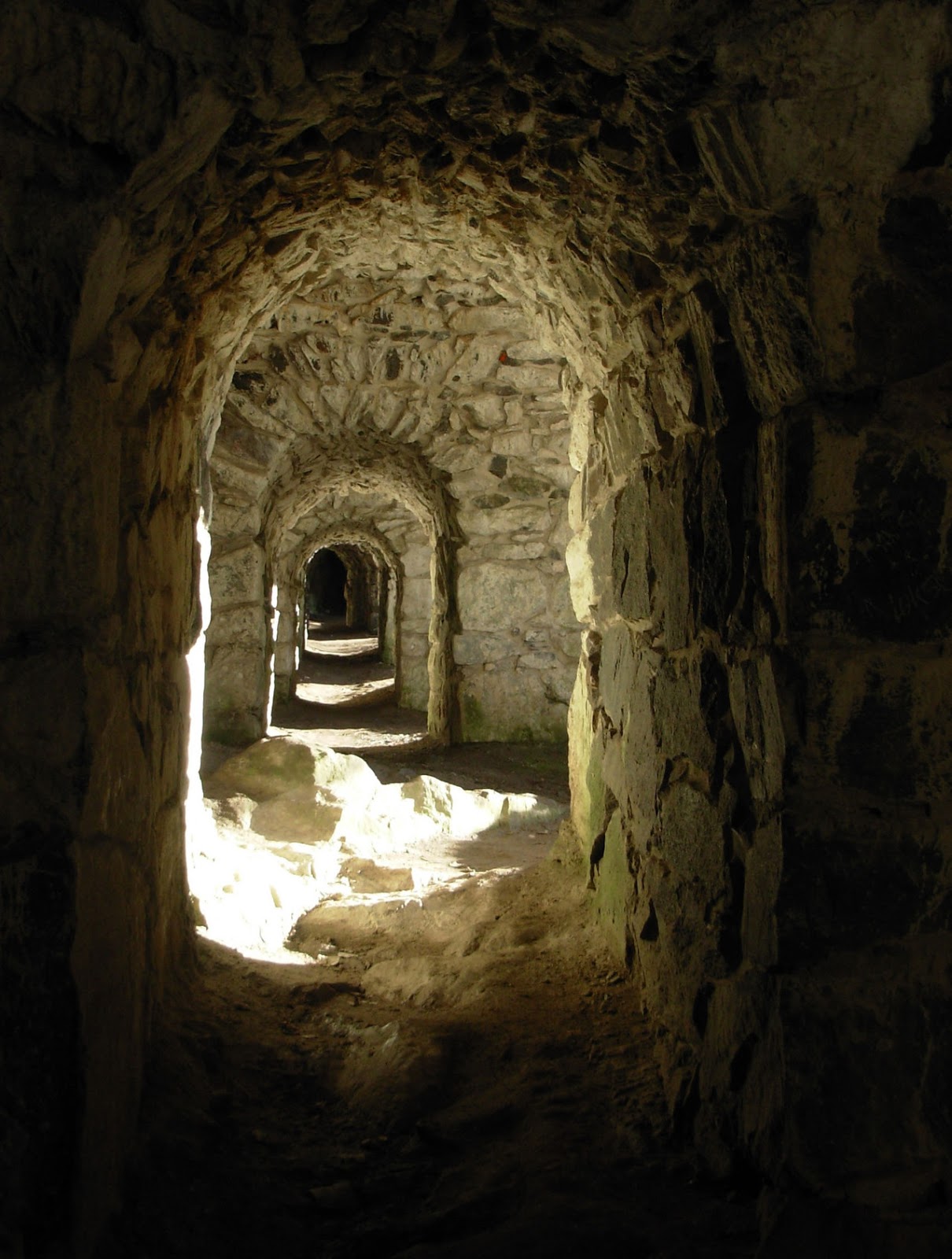
"Catacombs in Suomenlinna"
Yesterday and this morning I read Leena Krohn's Doña Quixote and Other Citizens. Portrait: Tales of the citizens of an usual city, and this is what I have been for some hours: a room through which the narrator and Doña Quixote (the woman who is like a tree that murmurs and sometimes drops shriveled leaves proclaiming death, the woman who is a poet) come and go, talking of many things, and sometimes of what the shriveled leaves proclaim. And in those hours, the city is mine and in me with its green-shining towers of telephone booths and its moving rooms, and I am also a room that holds many objects whose meaning sometimes is profound and secret and sometimes falls away and is lost. In and out of the room of me come figures who are rooms also and who connect with me and whose connection then falls away unaccountably, perhaps to recur, perhaps to drift through the gate built in water and be lost or bob away across the sea and perhaps return to me, for there are many deaths in a life, many passings-away and sometimes returns.

Into the room of me comes Doña Quixote with the poetry of herself and the strange wisdom that makes me know, and her melancholy that is also a fabric in the room of me, that matches something in me. Like a trick chalice, I fill up, and then at once everything I have drains away. All things go. All rooms are pendulums, moving toward a time when they will be no more. In all the city of interlocking and moving rooms (some a lit bus with the moving figures inside), I am found, I am lost, as Doña Quixote is found and lost also.

And now and then I am arrested by the knowing of this: the most important thing about a thing is that it is beautiful, whether it is a mysterious narrow gate in the sea, a gorgeous, filmy-tailed goldfish, a dancer like a flower's corolla, or a silken peacock that trembles, unfurling its mighty fan of eyes while the snowflakes sift down before and behind and onto its glistening green and blue.

But even that knowing cannot be grasped and held until it always lights the room of me or the room that is Doña Quixote but drains away. The loss and passing of that knowledge of beauty is like a death, like passing through a gate built in water. "One doesn't get used to living."

And now I have shut the book, though the sense of myself as a room--a room filled with strange objects that do not give up their secrets--remains. And the sense of beauty also, for the book is still open beside me. And that I have written (carelessly? wisely?) that the book is both shut and open seems entirely right.  10 January 2017


"Peacock feather"
Courtesy of Sean Okihiro, sxc.hu
You may read this short novel (or is it an interrelated collection?), Doña Quixote and Other Citizens. Portrait: Tales of the citizens of an usual city, in that gigantic volume, Leena Krohn's Collected Fictions: A Career-Spanning Selection from Finland's Most Iconic Writer. (What long titles! And I wonder what Leena Krohn thinks about being iconic. I'm not even sure what they mean with that choice. Revered? Painted on a wooden surface? Semiotic-iconic? Flowering from tradition? All of these?)  I do, however, feel quite sure it is a publication from Ann and Jeff VanderMeer's Cheeky Frawg Books (Tallahassee, FL, 2015.) Doña Quixote is translated by Hildi Hawkins.

Tuesday, February 09, 2016

Cephalopodish at TerraNullius (Italy)

More than a year ago I posted about some tiny stories starring cephalopods. Though I've written quite a few miniature stories of late, I haven't sent them out, and so it's entirely to the credit of Italian poet Alessandra Bava that these appear in Italy's TerraNullius. I love being asked. Thank you, Alessandra.

Need octopi and cuttlefish in your day? Jump in here.

What's that? That's the w-shaped eye of a cuttlefish looking at you, courtesy of Wikipedia.

Monday, April 20, 2015

Word soup

Reconnecting with Beauty
for our Common Life.
Poems in the world

I've been a bit lazy about submissions but have poems out or coming out in print journals Artemis ("The Dawn Horse," a poem about Leonora Carrington) and Trinacria ("God and the Mandrake Root," the weird biography of a mandrake root.) Thanks again to editor Joseph Salemi for a Pushcart nod for "The Nuba Christians," which he describes as "a blank-verse lament, in the voice of a displaced refugee, over the Islamic Sudanese government's campaign of genocide."

Thanks, Cooperstown museums--

Thank you to Sue de Bruijn for a lovely lunch today. I was a surprise guest for the Fenimore Art Museum and Farmers Museum shops staff, and I had the privilege of talking about my life and books, as well as reading some snips of poetry and fiction.

American stories in the news

Like many, I recall "duck and cover" in third grade and a sick childhood fear of Russia's bombs. Now the emerging tales of what went in Wisconsin with police home invasions, material seizures, and families with scared children awakened by armed police standing over their beds gives me the same frisson of unrest that I felt as a little girl, crouched under my desk. How anguished would any of us feel, herded into a room with our little children at night? This sad series of narratives is not about right and left but about right and wrong, and it grieves me that representatives of the people in my own country should have done such things to families and children.

We have had too many terrible stories lately, too much overreaching of power, too much destruction of the innocent. Let us bare the truth and bear the truth of these and other recent tales, and let us also strive to have better stories told of us and of our public servants soon. The world is listening to our stories.

At Cairn in June

Evidently I will be serving as Fujimura Institute Fellow and poet-in-residence for the day at Cairn's culture care conference in Philly in June. I'll be doing readings and talking about some of the ideas that have been leafing out from Makoto Fujimura's initial seed of thought--the desire to care for culture and produce beauty, generative work that is worthy of enduring in time. I'll post more about events later on.

Copia

--from Joseph S. Salemi, "The Rebirth of Copia" (Trinacria, Fall 2014)

Copia means abundance. In classical rhetoric, it is the capacity of a writer to fill his work up with plenty of words, usually via repetition and variation, but also by judicious manipulation of tropes and figures, and the expansion of his sentences into colonic subordination....

Every ancient rhetorician, whether Greek or Roman, knew that copia was an essential tool of literary composition, and more crucially, that it was the manifestation of one's command of language. Once you were trained in it, you were never tongue-tied. That peculiarly modern problem, writer's block, was unknown or rare. Can you imagine Cicero or St. Augustine or Thomas Nashe not being able to crank out prose at will?

Thursday, May 08, 2014

Kraken!

Octopus courtesy of Gisela Royo
of Barcelona, Spain and sxc.hu
I have been having fun yesterday and today with my cephalopod stories, mentioned in the last post--there are seven tiny fictions plus an eighth piece, a clerihew for Erik Pontoppidan. And all that goes to show that blog visitors and bloggers can influence my mind because I'm not sure if I would have gone for eight (although so very appropriate when one is contemplating cephalopods), were it not for RT (aka Tim) mentioning numerology yesterday.

Then toward the end of these somewhat bizarre fictions, I suddenly wanted to write a clerihew. That is rather like eating, say, a rather piggish amount of cilantro-pineapple ice and suddenly wanting hoecake on the griddle. I suppose that is why Scott G. F. Bailey's posts on Henrik Pontoppidan popped into my head--at which point it was only natural to leap from Danish Henrik to Danish Erik because Bishop Erik Pontoppidan wrote about the Kraken, and the Kraken is surely a cephalopod.

And I must go and do a little drudgery, now that I have finished my cephalopodish frolic!