NOTE:
SAFARI seems to no longer work
for comments...use another browser?
Showing posts with label literary fiction. Show all posts

Wednesday, January 18, 2017

Precipitous slippage

Once upon a time I was a new-made Associate Professor with tenure; my answer to that lovely promotion was to quit academia entirely because I wanted to be a poet and novelist, not an academic poet and novelist. I felt that I would be a stronger, better writer outside the land of ivory towers. What I did not grasp at the time was how completely the academy would take over the world of writing, particularly the realm of poetry, and make it into a near-monolithic enterprise. (Simultaneously, both poetry and literary fiction began to move toward being minor arts--well, poetry was already on the way.) This change has meant that academic writers support one another and give one another various helpful privileges.

Those of us outside the academy are somewhat in the cold, particularly if--as I do--the writer believes that the diminishing returns of Modernism are upon us, and that the way forward is back through tradition and form. Free verse and an obsession with originality (I don't see how that works, given that we're more than a century past modernism's birth--Modernism hasn't been modern for a long time) have become a kind of ideology in our university system. A large number of journals are associated with colleges or are founded by MFA graduates. Most of these are primarily interested in free verse. Meanwhile, I am not primarily interested in free verse, although I do have a recently-finished collection containing poems that derive from a foreign chant tradition that looks free but contains many rhetorical flourishes allied to that tradition.

Do I regret my decision about leaving the academy? No, I don't. I am a better writer because of that choice, and I also had the luxury of having three children, which I probably could not have managed if I had stayed in college settings as a writer and teacher. I find that it is hard to do three major things well, but two--well, you can give up a lot of things that are enjoyable but not essential and so make two big callings work.

I still have a few writer friends who are in the academy and make their living there; I think it's fine that they made the choice to stay in. Most people who gain a perch there do, after all. I just think that I made the right choice for me. What else can we do but try to make right choices? I admire people like poet-professor-mother Luisa Igloria who grasp after mastery in three realms. The late Doris Betts (professor, dean, writer, mother) comes to mind among novelists.

We live in a time when very few poetry books sell in reasonable numbers. I've talked to various editors about sales and found that some poetry books don't break the 50-mark. That's pretty sad, isn't it? I hear that Copper Canyon books sometimes make it to 600; those are the sorts of little numbers a poetry press depends on. (The funny thing about a poetry book is that it can become the sort of book that you return to again and again. So in that way it's a better bargain than most books.)

My picture of how my own poetry books are doing is a bit fuzzy. I know that Thaliad continues to trickle (or seep, maybe!) along in sales for Beth Adams's Phoenicia Publishing and is heading toward the 400-mark in combined paperback/hardcover. [Update: I was pleasantly wrong! 425 copies so far, as of January 19th.] The Foliate Head has sold out its first and second hardcover printings at UK's Stanza Press, though there are still a few copies available on line. I'm don't know the paperback or hardcover numbers at Mercer for The Throne of Psyche. Those are my three books that can be called "in print," though The Foliate Head is technically out of print.

Interior illustration by Clive Hicks-Jenkins
for The Foliate Head
If you care about poetry, please consider buying books. While I would like you to support mine, I tend to be pleased when I see anybody buy a good poetry book. And I always remember the quote taped up on the poetry shelves at the Bull's Head Bookshop (UNC-Chapel Hill shop, now defunct) run by novelist Erica Eisdorfer: People who say they love poetry and never buy any are cheap sons of bitches. --Kenneth Rexroth. It's not polite, but it gets at something. I just looked it up online and found a different version that says, I’ve had it with these cheap sons of bitches who claim they love poetry but never buy a book. Maybe both are right, as Rexroth didn't hold back and may have been muttering variations on the theme for years!

Yes, poetry is rapidly losing its status. Yes, what was once an important art is now a minor one and in danger of going the way of lacemaking. Times change. Television and internet make inroads; well, that's just how it is, we say. What we add to culture changes culture.

But if you care about poetry, do more. In fact, all of us need to support what we love in a time when what is seen and praised and supported is heavily-marketed, commercially-validated books, film, visual arts, etc. And we need to remind ourselves over and over again that we can choose. We can choose roads less taken. It will make all the difference.

Thursday, January 12, 2017

Reading Doña Quixote

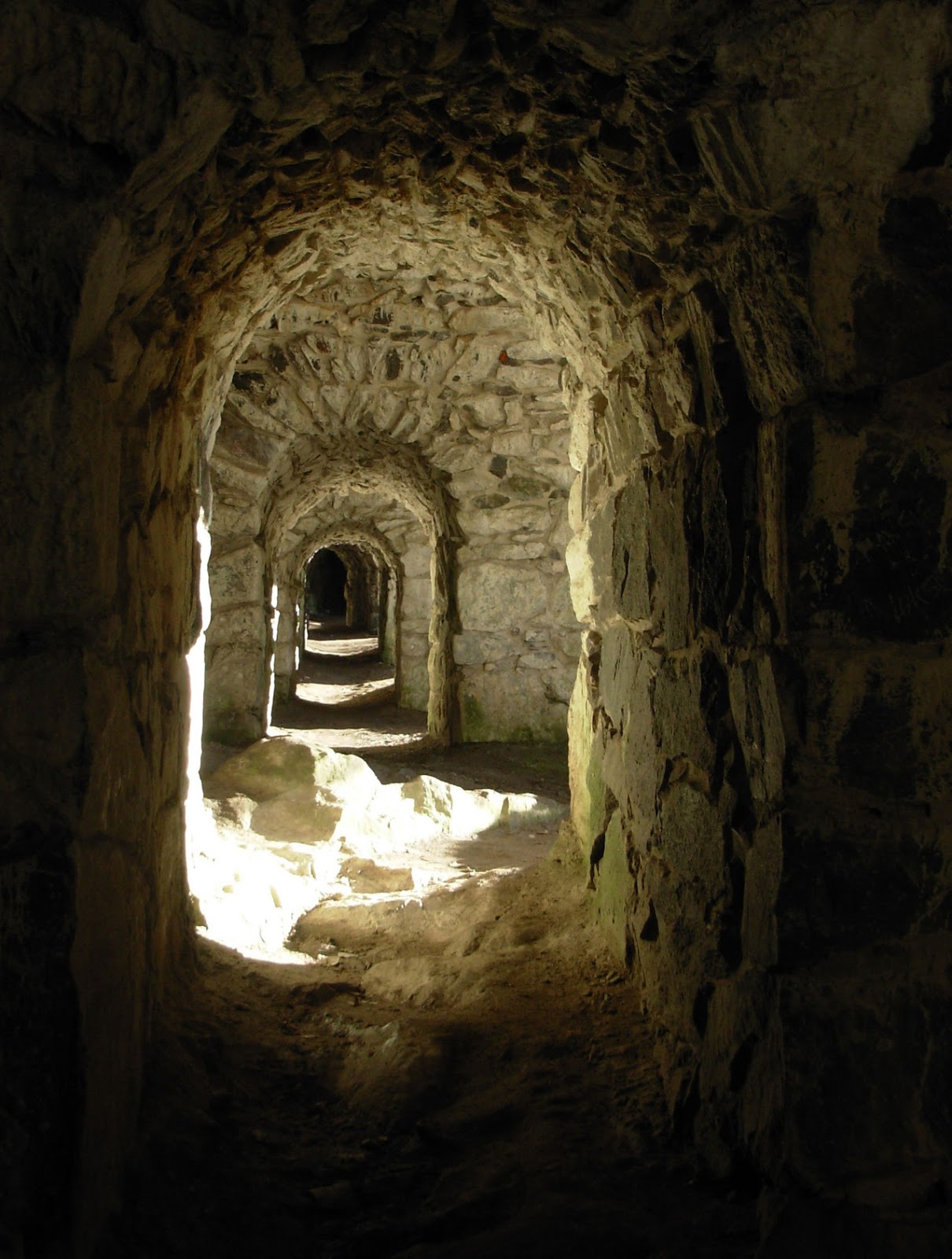
Courtesy of Päivi Tiittanen, sxc.hu
"Catacombs in Suomenlinna"
Yesterday and this morning I read Leena Krohn's Doña Quixote and Other Citizens. Portrait: Tales of the citizens of an usual city, and this is what I have been for some hours: a room through which the narrator and Doña Quixote (the woman who is like a tree that murmurs and sometimes drops shriveled leaves proclaiming death, the woman who is a poet) come and go, talking of many things, and sometimes of what the shriveled leaves proclaim. And in those hours, the city is mine and in me with its green-shining towers of telephone booths and its moving rooms, and I am also a room that holds many objects whose meaning sometimes is profound and secret and sometimes falls away and is lost. In and out of the room of me come figures who are rooms also and who connect with me and whose connection then falls away unaccountably, perhaps to recur, perhaps to drift through the gate built in water and be lost or bob away across the sea and perhaps return to me, for there are many deaths in a life, many passings-away and sometimes returns.

Into the room of me comes Doña Quixote with the poetry of herself and the strange wisdom that makes me know, and her melancholy that is also a fabric in the room of me, that matches something in me. Like a trick chalice, I fill up, and then at once everything I have drains away. All things go. All rooms are pendulums, moving toward a time when they will be no more. In all the city of interlocking and moving rooms (some a lit bus with the moving figures inside), I am found, I am lost, as Doña Quixote is found and lost also.

And now and then I am arrested by the knowing of this: the most important thing about a thing is that it is beautiful, whether it is a mysterious narrow gate in the sea, a gorgeous, filmy-tailed goldfish, a dancer like a flower's corolla, or a silken peacock that trembles, unfurling its mighty fan of eyes while the snowflakes sift down before and behind and onto its glistening green and blue.

But even that knowing cannot be grasped and held until it always lights the room of me or the room that is Doña Quixote but drains away. The loss and passing of that knowledge of beauty is like a death, like passing through a gate built in water. "One doesn't get used to living."

And now I have shut the book, though the sense of myself as a room--a room filled with strange objects that do not give up their secrets--remains. And the sense of beauty also, for the book is still open beside me. And that I have written (carelessly? wisely?) that the book is both shut and open seems entirely right.  10 January 2017


"Peacock feather"
Courtesy of Sean Okihiro, sxc.hu
You may read this short novel (or is it an interrelated collection?), Doña Quixote and Other Citizens. Portrait: Tales of the citizens of an usual city, in that gigantic volume, Leena Krohn's Collected Fictions: A Career-Spanning Selection from Finland's Most Iconic Writer. (What long titles! And I wonder what Leena Krohn thinks about being iconic. I'm not even sure what they mean with that choice. Revered? Painted on a wooden surface? Semiotic-iconic? Flowering from tradition? All of these?)  I do, however, feel quite sure it is a publication from Ann and Jeff VanderMeer's Cheeky Frawg Books (Tallahassee, FL, 2015.) Doña Quixote is translated by Hildi Hawkins.

Wednesday, April 13, 2016

3 readings in time and art

Wikipedia Commons

Literature in time
Sven Birkerts at LitHub:
"Can the 'Literary'Survive Technology?"

Sven Birkerts has been depressing me--stylishly so--for many years. Here's a recent clip:
...I don’t see the literary as we have known it prevailing or even flourishing. With luck, it will survive for some time yet at the present scale, which is, in terms of societal influence and prestige, already much diminished from former times. But we should keep in mind that those were times when the seemingly sedate verbal art was not yet beset on every side by the seductions of easily accessible entertainment. In the future, literature will likely not command enough marketplace attention to make it commercially viable at any corporate level, but might rather become (and this is not a bad thing) an artisanal product that functions either as a vital inner resource or else as a status marker for its reduced population of consumers. What we might think of as old-school “serious” literature may come to function as a kind of code among initiates. At that point charges of elitism will not have to be defended against—they will have been fully earned.
Elder artists, 2
Elder Eden:
clips from Art News

Here's more on artists (sculptors and painters in this case) continuing to work well into old age:
A historical look reveals that a striking number have been highly productive and turned out some of their best work late into old age, including Bellini (who died at 86), Michelangelo (d. 89), Titian (d. between 86 and 103, depending on your source), Ingres (d. 86), Monet (d. 86), Matisse (d. 84), Picasso (d. 91), O’Keeffe (d. 98), and Bourgeois (d. 98).

“Working becomes your own little Eden,” Thiebaud says, while acknowledging the challenge of overcoming the traps of what others think and say. “You make this little spot for yourself. You don’t have to succeed. You don’t have to be famous. You don’t have to be obligated to anything except that development of the self.” 

Obliterating the past
"The Anomaly of Barbarism":
John Gray at Lapham's Quarterly

And here is a clash between ancient art and year-zero desire:
 The destruction of buildings and artworks, which ISIS has perpetrated at the ancient site of Palmyra among other places, has several twentieth-century precedents. Vladimir Lenin’s Bolsheviks razed churches and synagogues in Russia. Mao Zedong demolished large parts of China’s architectural inheritance and most of Tibet’s, while the Pol Pot regime wrecked pagodas and temples and aimed to destroy the country’s cities. In these secular acts of iconoclasm, the goal was to abolish the past and create a new society from “year zero”—an idea that goes back to “year one” of the calendar introduced in France in 1793 to signal the new era inaugurated by the French Revolution. Systematically destroying not only pre-Islamic relics but also long-established Islamic sites, the aim of ISIS is not essentially different.

Monday, July 07, 2014

Glimmerglass at "Publishers Weekly"

Title page with decoration
(collage of painted and cut papers)
by Clive Hicks-Jenkins
Glimmerglass
Marly Youmans. Mercer Univ., $24 (224p) 
ISBN 978-0-88n146-491-7
     This stylish contemporary variation on the Bluebeard legend from Youmans (A Death at the White Camellia Orphanage) serves up an appealing blend of myth, mystery, and magic. [SOME SPOILERS AHEAD - SKIP TO END IF YOU DON'T LIKE SPOILERS.] Cynthia Sorrel, a painter in a creative rut, visits Cooper Patent, a hamlet located on New York's Glimmerglass Lake. she rents a rustic gatehouse cottage from half-brothers Theodore and Andrew Wild, who live together in their ancestral mansion, Sea House. Hired by the siblings to paint a portrait of them, Cynthia feels newly inspired as in artist after spotting a young boy running through the woods outside. The eccentric, "shifty" Theodore unnerves her, but she is charmed by Andrew, a widower and grandfather. The two eventually marry, and Cynthis grows attached to his three young grandchildren, Lizzie, Drew, and Ned. She continues to be wary of Theodore, however, particularly after he creepily relates a story to her of how, when he was young, his cousin Moss was lost in the caved-in tunnels beneath the house. Eventually, Cynthia decides to explore Sea House's subterranean labyrinth for herself in order to put the Wild family's dark secrets to rest. [END SPOILERS.] Even readers who don't go for more traditional fantasy fare should enjoy this vividly written yarn. (Sept.)

Two thoughts, with thanks to the PW reviewer... 

One, Bluebeard never popped into my mind while writing or revising this book! Perhaps I should have thought of him...

And two, I think there could be a serious and interesting argument between people who like to categorize fiction whether this book is literary fiction without a single fantastic thing in it (though much that is very strange), or whether it is, indeed, fantastic in nature. It does contain a figure that is or is not the Muse, and it does contain a strange passage derived from the classical world, the somnium. And it feels strange. But would or should a genre-loving person call it one or the other, literary fiction or fantasy? I don't know. Maybe they would call it interstitial. As I tend not to categorize except by good vs. bad, I don't worry about it. But as other people do, particularly reviewers, I think about categories from time to time.

Saturday, May 03, 2014

Real and irreal

Detail from the cover of Thaliad. Art by Clive Hicks-Jenkins.
I picked this one for the post because it suggests a kind of leafing
and fruiting and singing that joins all good writers, maugre the mode!

This post is a wandering set of responses to another post, in which the ever-interesting Patrick Kurp talks about the literary loves and antipathies of H. L. Mencken. The portions about Mencken as a boy are full of charm, and the whole piece is of interest.

* * *

Having written two fantasy novels (grounded in the landscape and Scots-Irish/Cherokee lore of western North Carolina) and a number of short stories because one of my children was mad for fantasy, I find that am equally happy on either side of the "fanciful and unearthly" vs. "highly literal" divide. Oh, just remembered that I wrote a book-length post-apocalyptic poem, so that's tumbling into the fantastical, too, and I went back to the classical idea of the somnium for a chapter in a forthcoming book. Perhaps I am impossibly mixed--or mixed up--at this point. You see, somehow I fail to feel a keen, profound difference between what others view as various modes when I write. I like to frolic as and where I will, and as story leads.

I'm fond of mythic and fantastic classical works, and in English I like many of the fantastic-leaning poems of Old English and the medieval world. I find it curious that so many people have a pronounced love for or dislike of what we call irrealism. And yet how far it goes back in Western and world literature... So shall we toss Homer? Ovid? Portions of Shakespeare? What about Dante? Gilgamesh? The Mahābhārata? The Dream of the Rood? Or were those elements fine then but not fine now, or not fine for the novel?

In the end, I don't find the divisions of genre helpful for me--I mean, as a writer--and am quite willing to look for a good book under many sorts of labels. But I don't find it a fault that somebody else wouldn't feel the same way. Instead, I find the tendency to like or dislike in this way to be interesting and intriguing. (Of course, maybe that's because it says something about a person's makeup, so I'm off on a writer's nosey, personality-examining jag when I consider the subject.)

Such strong opinions are a challenge to my own stance, surely. And while I know my own mind, I'm not adverse to changing it.

I wonder what Mencken thought of the more fantastical creations of Twain. He may be labeled a realist for perfectly sensible reasons by literary historians, but Twain has some creations that fall strongly into another realm. Even Huckleberry Finn revels in the fact that people have very different angles of vision on the world and how to navigate it--a profusion of angles that just might suggest that we're already living in a kind of metaphorical multiverse, right here and now.

As to this matter of "realist" and "speculative" (choose whatever term you like for the latter--the sf/f/h world seems to expend a great deal of energy arguing that point) fiction, I believe it's all the same realm--a kind of continuum. A writer can move about on that continuum. A writer can stay put. Writers on many points of the continuum can strive to make a truthful and strong story. (Or they can strive for something lesser, but winning the world and losing your soul is a whole other dilemma and fish-kettle...)

Don't all narratives differ from reality and rejoice in making up a world? If a writer reached the point of absolute realism--impossible--we would have reality. And wouldn't that act of transforming words into complete realism be an irrealist tale?

Saturday, February 16, 2013

"Childe Phoenix" again--

Illustration by Galen Dara
SF Signal has reviewed Lightspeed 33. Here's a consideration of my story from that issue. You may read the entire review here.
“Prolegomenon to the Adventures of Chílde Phoenix”                            by Marly Youmans http://www.sfsignal.com/mt-static/images/stars4p5.gif
A coming of age story, a metamorphosis, the remembrances of a young boy now deemed a man wrapped in the imagery of familiar childhood folklore and fairy tales.  Youman’s language is often lyrical in its beauty, conjuring up fantastic images.   Blaise’s sister Vesta lays in a glass coffin inset into the floor. His loving mother is either very much present with him or absent and cannot be found. His father is an alchemist who will not allow his presence to be disturbed.  His grandmother tells dark, black tales from the Old World.  Without the presence of other children in his life Blaise feels very much alone, his only playmates the books in the house’s wondrous library.  Blaise’s recollections are underpinned with melancholy and a miasma that takes the form of an abyss that is slowly tearing his home apart.  This was my first experience with the work of Marly Youmans and I look forward to tracking down more of her work.
One thing I really like about playing in the sandbox with speculative fiction writers is that a story that does not quite "fit" in categories--like an odd, surreal piece--is welcomed and is reviewed more than once. There's a huge, enthusiastic support for the form of the short story that's lacking in the "literary" world.

Sunday, September 30, 2012

Janus-post: look both ways

Why do you feel that it is important that commercial fiction receive critical attention?
Jodi Picoult: Because historically the books that have persevered in our culture and in our memories and our hearts were not the literary fiction of the day, but the popular fiction of the day. Think about Jane Austen. Think about Charles Dickens. Think about Shakespeare. They were popular authors. They were writing for the masses.
vs.
Appreciation! Recognition! is Jove appreciated? Why, ever since Adam, who has got to the meaning of his great allegory--the world? Then we pigmies must be content to have our paper allegories but ill comprehended. 
--Melville to Hawthorne, in reply to a letter about Moby Dick, long considered a failure

"Thank goodness you're a failure--it's why I so distinguish you! Anything else to-day is too hideous. Look about you--look at the successes. Would you be one, on your honour?” 
--Henry James, The Ambassadors

Monday, September 10, 2012

Tolkien/Jacobson, genre/literary

Update: Book designer John Coulthart just sent me a link to this piece, in which he says Jacobson is more nuanced about genre. "The best fiction doesn't need a label." It looks interesting, and I'm going to read it now and then get back to work. Thank you, John!

High school started here on Thursday. The three children and I watched The Lord of the Rings trilogy in celebration of the start of the youngest's sophomore year in high school (the hallways of Orcs! the all-seeing principal Eye! the young women sharp as a blade!) and finished the last bit last night, finally obliterating the sign of sin and overreaching power in the volcanic flow of Mount Doom. Of course, the movies are nothing so complex as the book in three volumes that was praised by Auden and has been dearly loved and reread by many, but it got me considering that curious man, Tolkien, off and on all week. Last night I was thinking about how interesting it is that he disliked Macbeth and yet clearly does more than nod to it with his moving forest on Ent-march and his "no man" oracular prophecy and plot twist.

This morning I read Howard Jacobson's interview in the Guardian, where he says he is "contemptuous of genre things...." Not books but things. (I tend to be with Sendak in thinking that there are "good books" and then the others, but we live in a world where people like to categorize.) Jacobson goes on to reference without naming the Twilight series and then to cite 50 Shades. Ridiculously easy potshots! I'd like to see what he thought of Crowley's Little, Big, for example. He is also contemptuous of the term "literary fiction." He writes "fiction," he insists, while others write "crap." I know a lot of these attacks are a clever, Amis-like use of a media that desires column inches with sharp teeth and blood and hair. No doubt they are good publicity for the new book.

Those of us who write what is called "literary fiction" evidently want to be acknowledged as writing the only fiction that matters; that's why we desire that simple label, "fiction." What we do, we believe, matters more. But it ain't necessarily so. What I learned in writing two fantasies for young readers and a number of fantastic stories for anthologies is that our "literary fiction" worldview is provincial. Writers in other genres believe strongly that we write in simply another genre, one often less vital than their own. Sometimes they are right--depends on the book. It always depends on the book. Likewise, a book in another genre can clamber up to the heights. Entertainment may fly up into the realm of art. Why not? There are no rules, only the force and heart and skill of the mind behind the keyboard. What is The Tempest if not a romance of first love and a fantastic tale of a wand-wielding and -breaking wizard intended to please both the ruled rabble and the ruling classes?

Oh, I have sympathy for Jacobson's past situation, and am glad he has been lifted into light where he is visible. I know all about his "working away at the edges for years." No doubt the stacks of sold copies for A Death at the White Camellia Orphanage and Catherwood and all the rest are but very little hobbits compared to the giant cave trolls of a Booker winner or a NYT bestseller. But hobbits are sturdy, lovable storytellers and song-makers. And the hinterlands and the edges have their advantages. From the edge, you can reach out into space that has no chart, building a world outward as you will. From the edge, the trends and bubbles of the day are only white noise, lost in the distance, and what matters from the past stands like a great field of monuments where a writer can lose and find himself in wandering.

Any of us "at the edges" would trade something for visibility, for a greater number of readers. But it's an old story; I imagine that Melville, say, would have been willing to give up a limb and hobble like a peg-leg sailor to keep the readers he had with Typee and gain a few more. Poe certainly wrote wild attacks with teeth and hair and gave up everything in search of a wider audience. Dickinson ventured out and then back, sealing the door. Yet they and others like them--some remembered, some not--had their painful, joyful, austere reward, just as Stephanie Meyers and the writer of 50 Shades of Gray have a reward of another kind. Let's look to Jacobson's "genre things" for what we must do about the strange ways of the world. As Gandalf says, what comes to those in a time "is not for them to decide. All we have to decide is what to do with the time that is given us."

Thanks to Damien Walter, Guardian columnist, for the Jacobson interview link.