NOTE:
SAFARI seems to no longer work
for comments...use another browser?
Showing posts with label Makoto Fujimura. Show all posts

Friday, August 12, 2022

Wordishly

My beautiful child!
FAVORITE LINE AT THE COUNTY FAIR

"The Beautiful Child Contest is now underway at the Cow and Sheep Barn." 

Last night I went to the Schoharie County Fair with my husband and youngest--Demo Derby! Royal Hannaford Circus! Gaudy rides! Crazy carnival eats! And all the joys of beribboned rabbits and hares, cows and sheep and friendly goats.

CHARIS IN THE WORLD OF WONDERS, AGAIN

Hurrah for a lovely new review from Sarah Collister at The North American Anglican. I'm grateful that this book, launched in the most uncertain part of the pandemic, is still receiving reviews two years on.

Sample clip:

Youmans takes readers on a triumphant yet honest journey from death to new life in the ten chapters of her luminous novel.

I had the hardest time reviewing this book because every time I picked up to work on the review, I ended up getting lost in the narrative once again. Though the themes of this tale are quite serious ‒ death, loss, and new life ‒ Youmans’ prose is still dazzling and joyful, repeating the profound Biblical metaphor that darkness often brings further illumination to the light.

For the whole review, go HERE.

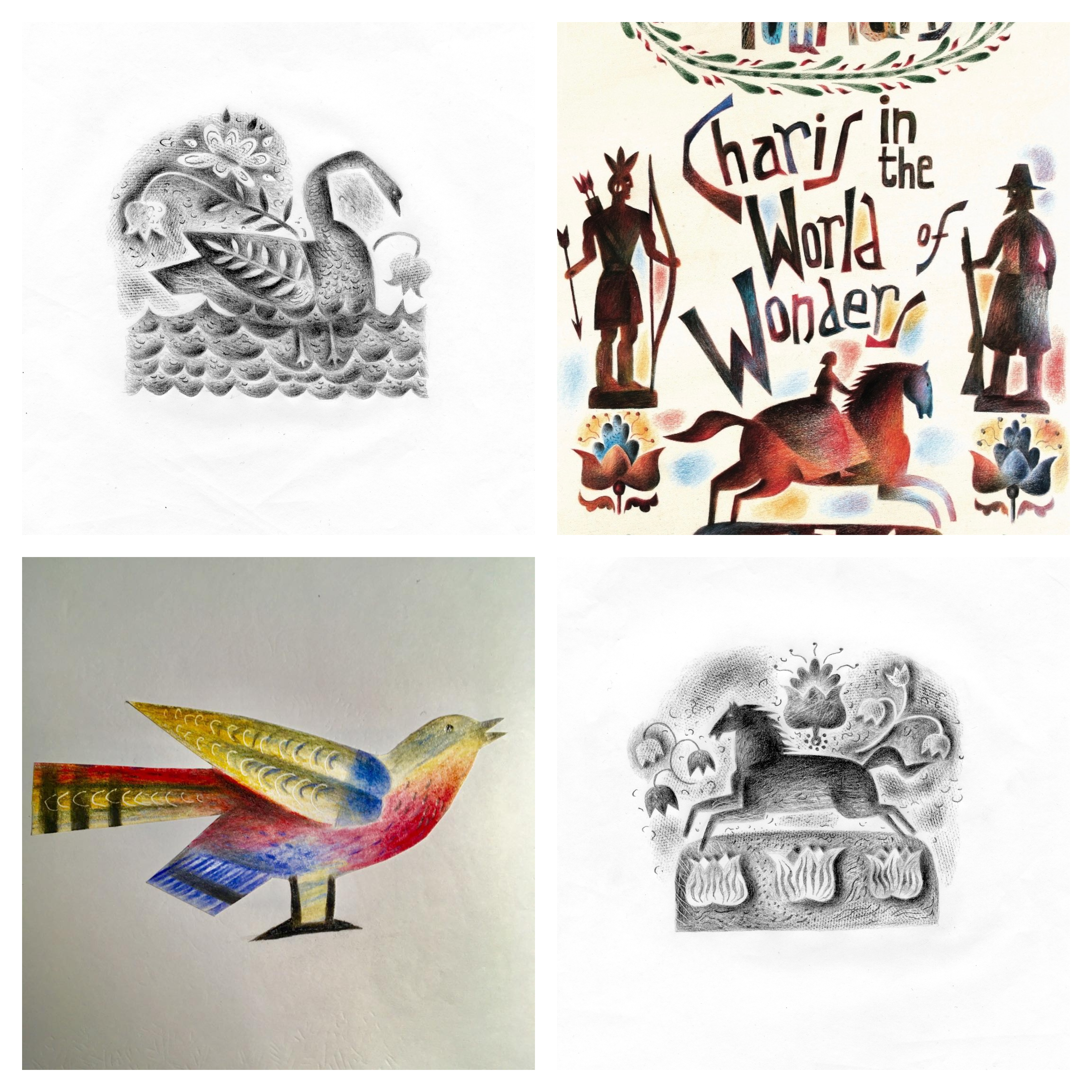
Art by Clive Hicks-Jenkins
Find him at hicks-jenkins.com


SEREN OF THE WILDWOOD

The poem has been typeset, two of three requested blurb comments are already in, and I need to make a list of places that or people who might be interested in reviewing for Wiseblood Books. Clive Hicks-Jenkins will be at work on the illumination this fall. They typeset version looks highly symmetrical and handsome, as each little section is blank verse followed by bob-and-wheel.

OTHER WORDISH NEWS

Poems are coming out here and there... 

I've agreed to be on the judging panel for a national poetry award. And that's a bit insane, as life is overly busy already. But I should learn a thing or two.

And there's this splashy event: Makoto Fujimura's latest book, Art and Faith, was an inspiration for Holy Ground, premiered recently at our own Glimmerglass Opera, and I was invited by Mako to the pre-opera picnic and premier. It's always lovely to see him, but I also got to meet his new wife, Haejin Shim Fujimura (co-founder of Embers International), as well as Holy Ground's librettist Lila Palmer and composer Damien Geter, and Lila's composer husband Josh Palmer. 

The other side of the table...
Damien Geter, Lila Palmer, Makoto Fujimura

Sunday, November 15, 2020

Tonight at Easton Book Festival


***
Hosted by editor and book critic John Wilson
7:00 p.m. EST 
November 15

Easton Book Festival event release:  "Marly Youmans is one of today’s masters of language and imagination. Her poetry and fiction blend fantastic, historical, and everyday elements that have delighted readers for decades. In this program, book critic and editor John Wilson introduces a series of dramatic readings of Youmans’s fiction and poetry, from her critically acclaimed Catherwood (1996) to her recently released Charis in the World of Wonders."

Readers include artist, writer, and culture shaper Makoto Fujimura, actor Keisuke Hoashi, professor and writer Chris Phillips, and theatre student Lauren Stango.

UPDATE, THE LOWDOWN FROM ON HIGH: 

"The broadcast is at 7pm EST tonight (I.e., very soon), and will be on eastonbookfestival.com and the festival’s YouTube channel: 
https://www.youtube.com/.../UC6x2DUva4.../featured

[Makoto Fujimura] is uploading his recording, and I’ll add it to a new version of the video." So there will be a slightly longer recorded version up later that includes Mako reading from Charis in the World of Wonders.


Saturday, March 14, 2020

Post-Pasadena

Art by Clive Hicks-Jenkins

*
Sunny California

I had a wondrous time at Fujimura Institute with Joe Gallagher, Makoto Fujimura, Pete Candler, Jia Kim, Esther Meek, Curt Thompson, and Shann Ray. And some other in-residence Fujimura Fellows. Writers, filmmakers, philosopher, neuropsychiatrist, painter, cellist! Many chats, interviews, and a concert...

Most of all, thank you to Joe and Mako for inviting me. Thanks to writer Kristen Havens and actor Keisuke Hoashi for picking me up at LAX and taking me to dinner in Culver City and showing me their interesting life. Thanks to Dea Jenkins for a ride back to LAX. Thanks to Stephen Dudro for showing me around the Huntington and gardens on my first day before events began, and to Joe for taking me to the Norton Simon Museum in a free hour. Thanks to Eric Tai for the hand-drawn map, and to Julia for the kintsugi workshop.

And I flew home and caught a bug along the way, alas, but it does not seem to be The Bug.


*
Lady Word of Mouth

I am planning to pay more attention to my Lady Word of Mouth site in this time of launch and event cancellations, and hope you will as well. Just yesterday my keynote talk and workshops were canceled in Albany, and I am sure many such planned or tentatively planned events are simply not going to happen. Please give some extra love to writers, artists, and indie filmmakers in this peculiar time. Today a page for Sally Thomas's new book, Motherland, went up. Please take a look!

*
St. Patrick's Day Pandemic Book Launch

On facebook, I posted an imaginary book launch for Tuesday, when my novel, Charis in the World of Wonders, will be released. Ignatius has bumped up the pub date, and so perhaps they are hoping for the good interventions of the saint! That would surprise Charis, the Puritan girl, I expect...

Tuesday, January 24, 2017

Seeing silence

Andrew Garfield and Yôsuke Kubozuka
Having seen Martin Scorcese's Silence (seeing silence--strange way of speaking) late Sunday night in Utica, I want to recommend it, and also this Alissa Wilkinson review, which I find more nuanced, attentive, and accurate than most of the reviews I have seen since.
The genius of Endō’s story and Scorsese’s adaptation is that it won’t characterize anyone as a saint, nor will it either fully condone or reject the colonialist impulses, the religious oppression, the apostasy, or the faltering faith of its characters. There is space within the story for every broken attempt to fix the world. Endō’s answer still lies in Christ, but his perception of Christ is radically different from what most people are familiar with — and even those who don’t identify with Christianity will find the film unnerving and haunting (Vox.)
Having mulled over the review, I would add that the hidden Christians, poor and dirty Japanese peasants, already know something important that the young, eager Rodrigues does not: that they will never be Christ but that they need Christ. By trampling the fumi-e to save five tortured Christians, Rodrigues fully enters into that knowledge for himself. The shift to a more removed voice-over narrative emphasizes this impression, as we observe the broken, reprobate priest from a Dutch Christian point of view, while the camera shows us what the narrator cannot know.

Now I expect an interesting thing to do would be to read Shūsaku Endō’s Silence and Makoto Fujimura's Silence and Beauty, both sitting on my shelves. (Mako is credited in the movie credits as advisor, and as an artist in the nihongan mode who grew up in Japan and the states, he is well placed to consider the complexities of the novel.)

p. s. Yes, Rodrigo Prieto received the only Oscar nomination for this movie. (That's only slightly worse than I expected.) Don't let that stop you.

p. p. s. Linnet Moss on the book and the movie here.
SaveSave

Friday, March 25, 2016

500-year art for Good Friday

A few years back, I was startled by a face looking out of the marvelous Fra Angelico show at the Met. It is a common enough compliment to say that images are arresting, even when they are not. I can say from experience that this one is.  ‪It's right for the day, right for a week that reminds us of murdered innocence and grief for the world.


The image also reminds me of painter Makoto Fujimura's essay, "Fra Angelico and the Five Hundred Year Question."
I entered the halls and the golden aura of a diminutive Virgin Mary painting greeted me, with her azurite robe, and the Christ child’s supple body, reflecting her humanity -- a simple work full of weighty colors. Then I had to close my eyes, after a few seconds of pondering the saturated surface. I realized this was too much to behold, all at once. As I staggered about looking for a blank wall to stare at, almost feeling ashamed to be in the presence of such greatness, I had a “500 year” question pop up in my mind.

What is the five hundred year question? Well, it’s a historical look at the reality of our cultures, and asking what ideas, what art, what vision affects humanity for over five hundred years. It’s the opposite of the Warholian “15 seconds of fame.”
It was, you see, inspired by his visit to the Fra Angelico show.

Tuesday, March 15, 2016

You Asked, no. 16: Poetry in our day

R. T. (Tim)10:54 AM, March 15, 2016 I'm going to be bold (and I hope not rude) by making a comment (observation) and asking a question. (1) I've known a few poets in the past half century, and I've been impressed by their commitment even though their reading audience seems to be painfully small; (2) How can poetry now in the 21st century ever grow beyond its self-contained audience (usually academics, other poets, and a smattering of others) and become more commonly read by more people? Perhaps neither my observation nor my question are worthy of your attention. I'm just thinking out loud.
Not only is the audience for poetry small, the academic-realm support for the kind of poetry I want to write is even smaller--that is, I want to write something that is not a free verse lyric poem with a bit of narrative. I want to write in forms, sometimes old and forgotten forms. I want to use all the tools of Puttenham's "arte of English poesy" that were lost in time or laid down in Modernism. Occasionally I do something that looks like free verse, as when I fooled around with poems inspired by Yoruban chant. But it's still a running after shapeliness. For the most part, the academy isn't interested in such things, so that leaves me with the "smattering of others." (A large number of poets are ensconced in the academy, so I can't count so much on those other poets you mention.)

But I happen to think that a lot of the most exciting possibilities in poetry mean chasing the past and making it work for today. That's part of why I pursued a long epic adventure in Thaliad. (Interestingly,  that 2012 book still trickles along in sales, a narrow runnel but not yet stopped.)

I want the past--which contemporary scholars are busy ousting from our best schools--to go along with me. Get an English major without a jot of Chaucer, Shakespeare, and Milton? It happens. Spin poetry out of your navel instead of out of the rich gold of the past? Lack a proper humility in standing before the masters? It happens.

Little springlike shoots, desires for tradition and its magic and powers are cropping up in all the arts, I expect. In painting, somebody like Makoto Fujimura, painting in the Nihongan traditions, calls for culture care and the creation of beauty out of the ashes of destruction, a gift to the wounded and dehumanized soul. A devoted follower of the Old Masters like Jacob Collins says, “Those people who never lose sight of beauty and power are attractive. I’m trying to make things beautiful in a deep way. Poetic. Transformative. Mysterious.” A good number of my friends who paint, even when they are clearly children of Modernism, have embraced narrative and sometimes figurative work. Many of them seem like bridges between one thing and another, and some have moved (I'm thinking of Victoria Adams in particular) from something near abstraction to an enchanted realism.

The great transcendentals, beauty, truth, and goodness, are returning to us in various ways, though there are many who fight against their elemental powers. At times, they feel fresh and alive with energy once more.

You suggest that numbers in poetry are a problem. I am not so sure, though it certainly would be lovely to have more readers. Many a press has foundered over poetry's small sales. The "sugar'd sonnets of Shakespeare, among his private friends" were passed by hand (Francis Meres, 1598.) Later on, we know that Donne's poems were circulated this way, as were the works of many others. A small, beautiful work like Chidiock Tichbourne's "Elegy," written before his execution, may well have been dependent upon a single hand-written copy, though the poem soon made it into a book. Poems have survived their times despite small readership.

Was there ever a mythical age when all the world knew poetry? Perhaps not since the days of oral recitation by the fire, if then. What can we do? Well, schools could focus more on memorization and recitation and appreciation instead of dissection. (Need a written school assignment? Translate a sixteenth-century sonnet into your own words. Or write a sonnet, and then look at it two weeks later. Time tells all.) But how much needs to be done? I don't even know. I expect we might be surprised by meeting people in seemingly un-poetic occupations who read poetry--perhaps not contemporary poetry, but poetry all the same. Certainly it was not uncommon in the nineteenth century. And today there are elements of poetry in popular slams, rap, song. Do those lead young people on to better work? I have no idea. Maybe not.  But I'm not fond of the idea of shoving poetry down people's throats as if poetry were an intellectual castor oil.

Makoto Fujimura would say that culture belongs to all of us, and it is our responsibility to share what's beautiful and good. Surely that is true, and one thing we all can do is talk about the poems and books and art we love. I buy art, mostly by friends, and I buy books that I want to support. Often they sit a long time before I read them because I am busy with deadlines, but I buy them anyway because I know a purchase is an encouragement to the writer and an assurance to the publisher. The most destructive thing to a book is, after all, to be ignored. And some degree of that is the fate of most books, poetry or not. How could it be otherwise when only some minute percent of all writers are self-supporting, and when publishers choose and push the lead books of fiction and nonfiction?

Perhaps there's some lovely good in the idea that the best poetry, even in its loneliness and neglect, resists the current world where art is an expensive widget often fettered to ideology, where commercialism is god, and where utilitarian pragmatism rules. Perhaps that small, burning lamp--a gift to the world that mostly looks away--will continue to call to itself those who love the high play of language. Perhaps that readership will grow. As Mako says, art offers "our dying culture unfading bouquets, gifts of enduring beauty that we do not want to refuse." Poesy as posy: I, too, wonder who will accept that gift, those flowers.
Sunday, June 21, 2015

At Cairn: Culture Care

Fujimura Institute 
Culture Care Day
Wednesday, June 24, 2015
Cairn University
Chatlos Chapel
200 Manor Ave.
Langhorne, PA 19047

"Join friends of the International Arts Movement and the Fujimura Institute for an evening of lectures and performances exploring Culture Care.

"IAM founder Mako Fujimura (author, Culture Care) will host an afternoon discussion with Dr. Esther Meek (philosopher and Fujimura Institute Fellow) and Dr. Peter Candler (author and Fujimura Institute Fellow) and Marly Youmans (poet/author). The evening benefit concert will feature Danielson and The Nine-Fruit Tree, MAE, Andrew Nemr with Max ZT, Ruth Naomi Floyd, Marly Youmans, Ron Witzke, and white lotus."
My event schedule for the day, subject to lots of change as we approach the day. This is probably not the final word:
Poetry and fiction reading at 11:00
Interview, conducted by Makoto Fujimura, after lunch
4:15-5:00 p.m. I'll be joining the panel on culture care. Chatlos Chapel.
6:30-9:30 p.m. I'll kick off the benefit concert with a tiny poetry reading. Chatlos Chapel.

Strong-minded words from Makoto Fujimura:

Younger artists often ask me whether their art is "good enough," and whether they are called to be an artist. My answer is: "if you are not sure, you are not called." That may seem harsh, but the reality of the arts requires that we follow our calling no matter what others think, or even what we believe ourselves. When art is simply what we must do to stay true to ourselves, it is a calling.

It is not surprising that Emily and Vincent--and their art--were marginalized, for both intuited that such an exiled existence was the only way to remain consistent with their humanity given the cultural pressures of their time. Yet  more than a century later these two exiled souls still speak eloquently to what our hearts long for. Her poems give us words to express our own resistance to utility. His paintings offer parables of beauty that sow seeds of authentic being into our wounded, dehumanized souls. Their works are antidotes to utilitarian drive for commercial and ideological gain, remedies for the poison in the river of culture. They offer our dying culture unfading bouquets, gifts of enduring beauty that we do not want to refuse (p. 63, Culture Care.)

...who you are and what you are built to do...


from Michael Lind, at The Smart Set:
"Artless: Why do intelligent people no longer care about art?"

The fine arts don’t matter any more to most educated people. This is not a statement of opinion; it is a statement of fact...

What happened? How is it that, in only a generation or two, educated Americans went from at least pretending to know and care about the fine arts to paying no attention at all?

Our culture...

Tuesday, May 12, 2015

The argument for culture care--

"Ki-Seki"
© 2014 Makoto Fujimura
Mineral Pigments, Sumi ink, silver, and gold on Kumohada paper
60.25 x 45.25 x 1.25 in
Private Collection
Prints are available - click here.
Frontispiece to Culture Care.

Though I've been and am still awash in away track meets, graduation ceremonies, awards nights, prom, and other festivities that pop up toward the end of a school year, I'll leave a little sheaf of quotes from my current reading. I'll be reading some more from the book while I am hanging out at the Toyota shop later in the day--it'll be a good clash of sensibilities, or maybe a
reminder of the need for repair!

The book is Makoto Fujimura's Culture Care: Reconnecting with Beauty for Our Common Life, which I am spending some time with in preparation for reading at and participating in the June Culture Care Summit, sponsored by International Arts Movement and Fujimura Institute, at Cairn University in Philadephia. Here are some quotes from the part of the book that is foundational and sets up the terms of his argument for change.
In the aftermath of two World Wars, artists began to articulate the culture's dramatic loss of humanity... artists recognized the gap left by the weakening witness of the church in culture and increasingly came to see themselves as secular prophets and priests with a call to "speak the truth" against the "establishment." They intentionally isolated themselves from society and produced work aimed at shocking people into recognizing and decrying the horrors of the age. As critic Robert Hughes has noted, "the shock of the new" became a way of life in the twentieth century modernist experiment.
*** 
Artists have been pressed--sometimes willingly and sometimes not--to speak not for their own work, vision, and principles but for (usually leftist) ideologies. The implicit and explicit cultural pressures for ideological uniformity are so high that one could say that in the culture wars artists are free to express anything other than beauty.
*** 
With the exception of ideological uses, today's art has been commoditized to such an extent that we often see commerce as the prevailing goal of art, and value the arts only as transactional tools to achieve fame and thus wealth.
*** 
Why is Culture Care needed? From the perspective of the arts, it is because today, an artist cannot simply paint; a novelist cannot simply write; a pianist cannot simply play. Utilitarian pragmatism and commercialism so thoroughly pervade culture that without some shift in worldview and expectation, what we do as artists--the activities of the arts--will be neither sustainable nor generative. We will not be able to resist their use as weapons in the culture wars. 
We need to recognize our time as a genesis moment.
Order here.

I recommend it--the book is suffused with Makoto Fujimura's bright vision of a world that is generative for artists and others, a world that flourishes and produces arts that our descendants will find worthy and beautiful. As a Christian, Mako tends toward the ideas of fruitfulness and wholeness that pervade the book. It is a book for anyone who cares about the vicissitudes of culture, and where our culture is headed after Modernism and its aftershocks.

Wednesday, April 29, 2015

Desire in a time of chaos:

To be whole and make whole art in the midst of a broken culture.

Makoto Fujimura, Golden Fire II
Mineral Pigments, Gold on Kumohada 89x132"
"Fujimura continues the theme of "Fires of destruction and sanctification" that he began with Water Flames." 

Friday, December 26, 2014

For the second day of Christmas: the river of culture

Yolanda Sharpe
Watercolor by a local friend--
soprano, painter, SUNY-Oneonta professor in studio art.
Blue, Red, and Yellow, 26 by 40 inches, watercolor on paper, 2014

And words by another friend--nihongan painter Makoto Fujimura, founder of International Arts Movement and The Fujimura Institute:

The words at left and below are
from Makoto Fujimura's Culture Care,
the lovely result of his Kickstarter campaign.
Available here.
An industrial map in the mid-twentieth century colored New York's Hudson River black. The mapmakers considered a black river a good thing--full of industry! The more factory outputs, the more progress. When that map was made, "nature" was widely seen as a resource to be exploited. Few people considered the consequences of careless disposal of industrial waste. The culture has shifted dramatically over the last fifty years. When I share this story today, most people shudder and ask how anyone could think of a polluted river as good.

But today we are doing the same thing with the river of culture. Think of the arts and other cultural enterprises as rivers that water the soil of culture. We are painting this cultural tier black--full of industry, dominated by commercial interests, careless of toxic byproducts--and there are still cultural mapmakers who claim that this is a good thing. The pollution makes it difficult for us to breathe, difficult for artists to create, difficult for any of us to see beauty through the murk.

It is widely recognized that our culture today is not life-giving. There is little room at the margins to make artistic endeavors sustainable. The wider ecosystem of art and culture has been decimated, leaving only homogeneous pockets of survivors, those fit enough to survive in a poisoned environment. In culture as in nature, a lack of diversity is a first sign of a distressed ecosystem.

Many of the streams that feed the river of culture are polluted, and the soil this river should be watering is thus parched and fragmented....

Yolanda Sharpe, Neighborhood, encaustic on panels
(center panel: 23 by 22.5 by 3 inches), 48 by 43.75, 2013

Saturday, May 31, 2014

The Magician's Card


The Magician’s Card by Marly Youmans

Poet, novelist, and short story writer Marly Youmans has written a compelling response to Makoto Fujimura’s On Becoming Generative: an Introduction to Culture Care! In the 10-page essay, Youmans explores the role of the artist in caring for culture through the powerful story of her friend Louis D. Rubin, Jr. You can download the full PDF for free here.

* * *
About Fujimura Institute. Wander around in the project, resource, and event pages.

Tuesday, April 29, 2014

Portals and awakenings

Talking to Afghanistan, oil, 2013
The portals of Ashley Norwood Cooper

If you're in the Otsego area of New York and have an interest in the region, the arts, or visual narrative, please come to an opening honoring Ashley Norwood Cooper at the Wilbur Mansion this Friday, 5-8 p.m. This Community Arts Network of Oneonta event hails the start of a solo show that features paintings from Ashley's new deployment series.

An interesting departure from Ashley's prior handling of paint, the mode of the paintings implicitly contrasts the smoothness of our world of screens and flattened-out images with a dramatic, built-up surface.  These narrative pieces make ordinaryAmerican life strange--they are full of little portals (via held iPads and iPhones) to the other side of the world, and are themselves windows onto the daily duties and longings from the daily life of a mother and wife in middle-class America.

detail from Washing Dishes, oil, 2014
This one also involves portals and seeing across space--
see the figure (one of two) in the window across the way.
Also, the mother becomes an image reflected on the
surface of the kitchen window--rather like the iPad/iPod
portal surfaces in other paintings.
Made during Shelby Cooper's deployment to Afghanistan, the paintings suggest the simultaneous closeness and distance that afflicts all of us in an electronic landscape, but which is a particular, sometimes painful part of the life of a family with a soldier on the other side of the world. Painter and mother of three, Ashley Norwood Cooper has turned the difficult time of separation into art. Notice that these subjects--narrative images of the military, and in particular the military family at home--are simply not a part of the accepted vocabulary of American painting in our time. I'd love to see the paintings end up as a collection in some often-visited setting because they speak strongly of and to the world of soldiers and their families, and also
Coming Home, oil, 2013
because they are the work of a painter who is once again re-making the way she sees and apprehends our world through paint.

If you're in the area, please come!

* * *

A recommendation from Ashley--

Here's an essay Ashley suggested to me this morning, relating to many things we both find of interest. Jordan Wolfson discusses a lot of issues that our little IAM satellite group has talked about: the lack of "a stable purpose" of art in our era; the lack of correlation between achievement and regard when the artist's place is often established by how well he or she can interact with market forces; "secularization and fragmentation" as leading to a landscape where it's hard to achieve a place. Wolfson grapples with the question of how the arts function in our time, their "use and utility." He examines art's effort to awaken us--to take "raw material and somehow charge it with presence," "consciousness becoming aware of itself." Here are a few clips of note:
On the one hand, a painting is a flat two-dimensional object, with its surface texture and color shapes. On the other hand, a painting offers the possibility of a three-dimensional experience, the illusion of moving into space and discovering form. Stability and instability. Fact and imagination. Actual and fictive. It is this twin role, and its simultaneity, that gives painting such power. Real and unreal. Real and more real. Painting, through the coexistence of two seemingly opposite experiences, interwoven into an actual unity, may provide the receptive adult the possibility of moving from an experience of fragmentation into an experience of wholeness and integration, not only within oneself but with the world at large.

Clement Greenberg got painting’s essence exactly wrong. It isn’t the stability of painting’s flatness—its “ineluctable flatness”; it is the inextricable unity of painting’s impossible flatness/fullness, stability/instability, stillness/movement. This is life.

Painting does have a necessary and ancient function; it isn’t to depict the world—it is to weave the world; or rather, it is to reveal and make visible the actual weave of the world, the weave that already exists.

I believe that what I am trying to describe here is actually an ancient way of looking at painting. Images carry power. It is only with the rise and development of our secular culture with its accompanying market economy that painting has found itself delegated to a luxury commodity that is devoid of any real use and value in our society beyond sophisticated decoration, investment and chic. This is not particularly the plight of painting—so much in our culture has been radically reduced to a flattened materialist, financial definition—the logical endpoint in the Story of Separation. But the act of painting carries much greater power than that. And we need to re-describe this activity, re-imagine it, in order to sharpen its power and focus; in order for painting to more fully participate and take its place in our global regeneration.
Read the whole thing here.

Wolfson is not alone in thinking about dead ends and regeneration, not just in painting but across the arts; it's something that a lot of us have been discussing. For one example, it's part of why Makoto Fujimura founded International Arts Movement "to promote conversation and meditations on culture, art, and humanity," and then Fujimura Institute, which describes itself as "defying fractured, fragmented modern perspectives, the Fujimura Institute encourages artists and thinkers to collaborate, cooperate and inspire their audiences to piece together a whole view of the world." It's why so many artists are turning away from what makes for worldly success in a blockbuster world and reaching back to old skills and tools in order to rethink and re-make an art for today.

Monday, December 02, 2013

Aphoristic morning

Makoto Fujimura's Dark Shalom, 2012

This morning I feel like bundling all my thoughts into tiny packages--perhaps I shall place them under a metaphysical tree, and hope they are not simply waste of breath! Aphorism too often becomes Polonial, and adds nothing to the accumulated thoughts of the world. Perhaps it is now impossible to add an aphorism that has not been conveyed already in other words.
I don't try in words to be better than some other writer; I try to be better than I am, to increase what is me
Surely it is just as sad to achieve only the expected and conventional--that thing we too often like because it is comfortable--as to do nothing with a gift in the realms of art. 
Poems without joy in sound are dead leaves that will never dance in the wind. 
The problem with much criticism of the novel and poetry in the past century is that it attempted to replace art, not realizing that art is an experience that cannot be replaced. 
Each of us is a secret that cannot be revealed; the portrayal of character in its ideal gives a sense of person and mystery. 
An artist of any sort needs the understanding of what he or she can do, joined with a yearning desire to topple over that boundary--and the next, and the next. 
After hearing many words in various orders read by many poets, I found myself longing for mystery.  
The element most often missing in our arts is the sense of abundant life. 
Even a ruined shack is a chamber of mystery if people have lived and died there.
Well, that was an interesting exercise. Evidently I find mystery to be more important than any other element this morning...

Monday, July 15, 2013

Kickstarter projects by friends


Gary Dietz 

"A book of stories for, by, and about fathers of children that experience disability. (And the women who love them.)" This one is a very worthy project that has not yet reached its goal. Please share with anyone who might be concerned with the topic! And if you are lucky enough that this issue has not touched you or your family, think about dropping a few dollars in the kitty.

I am choosing a few poems for the book as well. See here for more information on the associated poetry contest.

Ruth Sanderson 

"The book will span my career as an illustrator and fine artist, reproducing both published and previously unpublished paintings, as well as showing my process.."

James Artimus Owen 

"The 20th Anniversary Nearly Complete Essential Starchild"

Makoto Fujimura 

The Golden Sea.

This one is over, and I'm looking forward to receiving the book!

Saturday, February 02, 2013

Unworldliness

Fra Angelico (1395-1455) Annunciatory angel
Here's an account of the "sublime exhibition"
where I encountered this angel in 2005.
Rose at five to roust a boy for a faraway wrestling tournament and dry the singlet (ah! forgot.) The world is still deep-blue-and-night-on-snow. I've had a number of reasons of late to remember how strange it is to be an artist of any kind--how odd my concerns look in a worldly light. And yet I am so blessed and lucky to live when I do, in a time when I didn't die in childbirth (but would have, in an earlier age), a time when a woman is allowed to twist words into shapes and a man is allowed to cook her dinner.

In front of me is an image of one of Fra Angelico's angels, the reality encountered and the print bought at an extraordinary show at the Met some years ago. The shape between halo and wing is full of grace and beauty, and the flushed, alien skin and rich hair are still alive with an unworldly light. The wings are eyed like a peacock's, seeing everything. How wonderful that half a millenium later, this angel is still speaking, and I am alive and harking to its lovely gestures.

In his turbulent age, Fra Angelico found again and again the peace to make such radiant paintings, ballasted with what Makoto Fujimura calls "angelic weight." In our time, so rife with visual noise and loud, time-frittering leisure and the world's terrible alarms, that peace is an island of hush that still exists if we can only sit still and wait--as I wait now on words.

Wednesday, July 18, 2012

Gold-motes

GOLDEN SEA

I've signed onto Makoto Fujimura's Kickstarter project and hope you will as well. I admire Mako and his nihongan-style painting, as do many people around the globe.

LABYRINTH

Midori Snyder has shared Paul Digby's wonderful video of my poem "In Extremis," and reminded me of her lovely blog, In the Labyrinth: She also has this and more to say about The Throne of Psyche: "First up read Marly Youmans's splendid and mythicaly off the charts collection of poems, The Throne of Psyche. It will get under your skin immediately -- like all myth and fairy tale weaving together darkness and violence, coupled with beauty and transcendence. The taproot of nature anchors the poems in the material world but family and the powerful bonds of maternal love invite the visionary power of grace."
The Throne of Psyche book page here

QUAIL RIDGE BOOKS: QUAIL MAIL #648
(July 18)

Reader review by Mamie: Nancy, I agree 100% with your comments about A Death at the White Camellia Orphanage by Marly Youmans (Mercer $24). This book is to be savored, read over and over, and thought about in between readings! It has, as you said, all the markings of a true classic. -- Mamie
A Death at the White Camellia Orphanage book page here

Saturday, June 16, 2012

Makoto Fujimura on the core of existence


My friend Mako is a great leader in the arts and the church, and I often find that he has a wisdom that strikes to the heart of things. Here's a clip from his address at Biola:

Art and love are fundamentally the same act, operating on the same sphere of our lives. You see, art is not a frivolous, peripheral activity, but it has to do with the deepest core of existence; it is to love yourself, and your neighbors.  Art defines what makes us human; and fully human, we will be making things.

We either create toward that love or away from that love; if we sit Idle to this reality, we abdicate our responsibility to steward culture: to say that we do not create, while consuming culture all the time, is to let the commercial forces determine our identity as a nation. 

So instead of consuming, go and create.  Be an entrepreneur, a nurse, a teacher, a missionary, an engineer, a politician, a scientist or a chef.  Are you called to the arts?  Do not forget to learn to ask yourself "what do you want to make today?"  I find that artists are guilty of not asking this question today.  Art has become a kind of game you play in an elitist circle, divorced from everyday concerns.  Artists are more concerned with "being in the right circles" to be recognized, rather focusing on creating art that only they can do. By the way, if anyone, institution, ideology or an art school crit tells you that you cannot use the word "creative," transgress.  But if you must transgress to make a point, do transgress in love.

Friday, March 30, 2012

Marly at "The Curator" of International Arts Movement

Photograph courtesy of Young Tran of San Francisco, California
 and sxc.hu. Find Young Tran's photographs here.
Not only is it launch day for A Death at the White Camellia Orphanage (first chapter here), but I have something special up at The Curator, a magazine of International Arts Movement. Today's issue contains pieces related to the celebration of a long-ago gift of cherry trees from Japan to the states--the same cherry trees in bloom along the tidal basin of the Potomac in D. C.

Makoto Fujimura, nihongan artist and founder of IAM, asked me for a poem on the cherry trees, so mine is very much an occasional poem written to fulfill a request related to a particular event, the gift's centennial. (Thank you, Mako!) The poem is in six parts:

Sakura
1. As Far as East from West
2. Self-portrait as Dryad, no. 9
3. East to West to East
4. The Dryad in Cherry-Blossom Time
5. Riddle
6. Tree Spirit Song

Read it here.

Wikipedia, cherry blossom: the flower of any of several trees of genus Prunus, particularly the Japanese Cherry, Prunus serrulata, which is sometimes called sakura after the Japanese (桜 or 櫻; さくら.)

Also up: "Ito Jakuchu: the Preserved Colors of Independence" by Makoto Fujimura, on the Ito Jakuchu exhibit, Colorful Realm: Japanese Bird-and-Flower Paintings at the National Gallery; Joshua Bengston's poignant "Waiting for Blooms" photographs taken at Hiyoriyama Park in Ishinomaki City.

Tuesday, February 28, 2012

Frolic with Gala

Makoto Fujimura linked to Gala Bent yesterday on twitter, and last night I couldn't resist writing a poem inhabiting one of her vast landscapes. Today I'm saving a smidge of time to read in her blog. I would offer an enticing image but haven't asked permission--just go look!

Marly Youmans's novel now in pre-order is A Death at the White Camellia OrphanageHer 2011 book of poems is The Throne of Psyche.

Saturday, February 18, 2012

The news of poetry--

I just sent off my response to Makoto Fujimura's request for a poem honoring the 100th anniversary of Japan's gift of cherry trees for the Tidal Basin in Washington, D. C.  Good commissions are inspiring, and so I wrote a poem in six parts, mingling modes and including dryad and kodama, grafting and planting, journeys and deep-growing, war and peaceful ease.

Thanks to Dale Favier for taking a look beforehand--very helpful to have a California Buddhist read one's cross-cultural poem! I am enjoying his poetry book, Opening the World, which you may inspect at the Pindrop Press site.
Update:
Dear Mole,
Mea culpa! 
Oregon! Oregon! Oregon! 
Yrs,
Ratty

Fascinating or terribly depressing or both, sales for poetry books are so slim compared to fiction that one can figure out exactly what is happening a good deal of the time. For example, according to Bookscan (which counts a large number of reporting bookstores but not all), I have just sold seven copies of The Throne of Psyche in New York and in unnameable rural places--part of that's obvious, as The Anesthesia Book Club in Fly Creek has invited me to visit their group in March--and one in Albuquerque, New Mexico. If I knew somebody in Albuquerque, I might have a chance of guessing who had bought that copy! Lesson: be sure and buy yourself a copy and be counted? Get seven copies and be of staggering importance? Nab eight and rule the world? XD!

My friend Yolanda Sharpe and I put our heads together and submitted to the collaborative journal, Yew, and so now will have three poems entwined with three paintings there some time soon. Fun!