NOTE:
SAFARI seems to no longer work
for comments...use another browser?
Showing posts with label art. Show all posts

Thursday, July 11, 2019

5 more PP-preorder days--

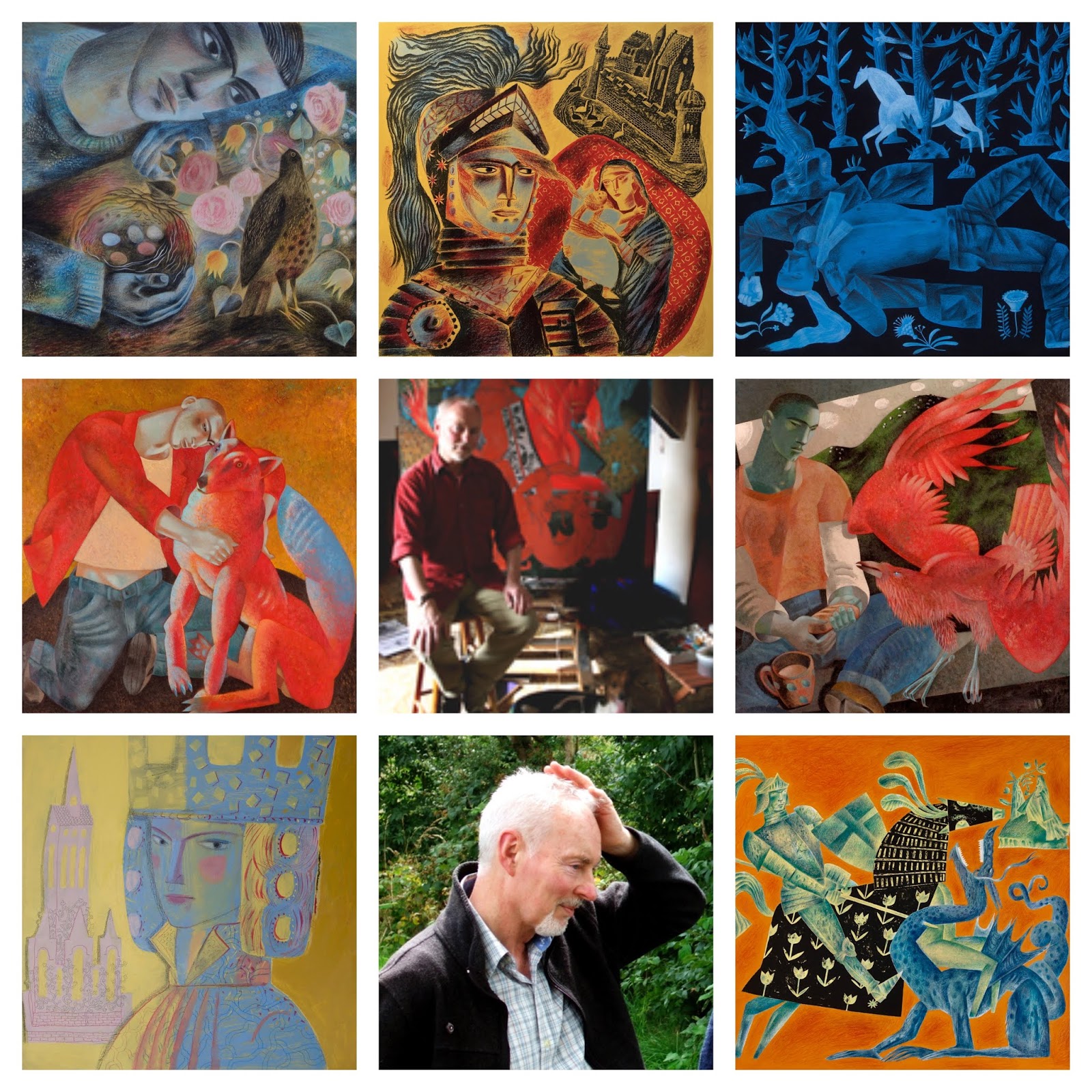
Art by the great Clive Hicks-Jenkins of Wales.
Design by Elizabeth Adams.

Five days left to pre-order The Book of the Red King in hardcover or paperback from Phoenicia Publishing, nab a discount, and support the small press directly. (Hardcovers will only be available from the publisher; paperbacks will be available widely.)

Praise for THE BOOK OF THE RED KING

"Marly Youmans is brilliant, perhaps a genius. Her poems tell a story, offering us a vision of, well, I would say the Trinity, but that is only one possible interpretation. After a difficult and sometimes dangerous journey, a Red King, a Fool, and Precious Wentletrap converge into one, a resurrection that is heavenly. Is it true, or is it fable or fairytale? "When I want to write a new book," she has said, "I run across the land and leap off the edge of the known world." Her formal poems are impeccable and include sestinas, villanelles, rondels, rhyming schemes she may have invented, and perfect metrical patterns. Every poet can learn from this poet, and the reader—the reader will be spellbound."
--Kelly Cherry, poet, novelist, and former Poet Laureate of Virginia

"The Book of the Red King by Marly Youmans is an ambitious, magical book about the nature of power and language.  The Red King and the Fool, while they control different realms, make us consider whether it is better to rule on earth or in one’s imagination. In these gorgeous poems, Youmans makes the case for both.  Whatever side we take, Youmans reminds us of the paradox in each.  Even if we side with the Fool in this world of “hurt joy,” we are left with the realm of poetry.   It is not a bad trade.  For those who love well-formed poems and for those who love fantasy, this is a must-read and a distinctive, evocative voice. There is no one like Marly Youmans."
--Kim Bridgford, celebrated poet, editor, and director of the global conference, Poetry by the Sea

"Marly Youmans occupies an imaginative space that straddles both the present and the mythological past. It is the territory of Yeats and Tolkien, and Youmans shares not only a taste for primal imagery with these great poets, but also their love of rhyme, rhythm and sound."
--A. M. Juster, award-winning poet and translator

*

Clive with St. George, the dragon, maiden,
and his late, lamented little jackanapes...


Clive Hicks-Jenkins was born in Newport, south Wales, in 1951. The early part of his career was as a choreographer and stage director. In the 1990s he turned away from theatre to concentrate on painting. He has been praised by critics in The Independent, Modern Painters and Art Review. Simon Callow has called him ‘one of the most individual and complete artists of our time' and Nicholas Usherwood in Galleries has described his work as ‘reflective, expressive painting of the highest order.’


Wednesday, July 10, 2019

Midsummer reads

Despite rushing-about, despite progeny, despite getting ready for The Book of the Red King, and despite celebrating the 4th of July over three days of barbecues and events and fireworks, I have been managing to do a little reading. And as it is feeling good, I thought to share the list. Please add your own midsummer list in the comments if you're reading something you like...


Irene McManus, Dreamscapes: The Art of Juan González (New York: Hudson Hills Press, 1994.) I picked this up at The Village of Cooperstown Library and was so fascinated by the artist's symbology and concerns (a father who came out as gay and became HIV+ in the 1980's, a man obsessed by Catholic imagery from his Cuban childhood, a painter who shows theatricality and love of tiny stage sets and shrines in his paintings and drawings versus a strong meditative tendency, a master of trompe l'oeil, a reader with a love of poetry, particularly Garcia Lorca's poems, a myth-maker especially down to Narcissus--with mirrors and doublings--and Orpheus, a symbolist who is sometimes clear and sometimes hermetic, a visionary concerned with psychological and spiritual states) that I ordered my own copy. While it's clear that he was influenced by certain contemporaries and movements (his Minimalist-influenced pieces are surely my favorites from that particular corner of the art world), he is strongly drawn by European art made for cathedral and church settings and also by Vermeer and Rembrandt and other Dutch Golden Age painters.

And González has made me go back to Federico García Lorca, Collected Poems (New York: Farrar, Straus and Giroux, 2002). And as I always say, rereading is the best reading.


David Lyle Jeffrey, In the Beauty of Holiness: Art and the Bible in Western Culture (Grand Rapids, Michigan: William B. Eerdmans, 2017.) I ordered this beautiful volume because of John Wilson's review, which is here: "David Lyle Jeffrey's Unpopular Project." I'm on page 25 and liking the book very much. And one thing I just learned that I like a lot is that the Hebrew word for artistic creativity is chokma-lev, or wise-heartedness. I'll have to aspire to that! Here's some praise from John Wilson: "Jeffrey is a scholar who could easily intimidate readers with his erudition: master of many languages, ancient and modern; equally knowledgeable about literature and the visual arts; and intimately familiar, above all, with Scripture. Open his book at random and read a few pages: You’ll be stunned by the sheer range of his learning. And yet, unlike many of his academic peers, he doesn’t employ a style designed to exclude all but a handful of readers fluent in this or that jargon."

Wow. Crack-stroke of lightning, almost simultaneous with the thunder... Where was I? Hmm. I'm doing my third book event for my women's group (a group focused on creating and attending events related to arts and religion for going-on-two years now.) And the next discussion is of readings from Kathleen Raine, Richard Wilbur, Charles Causley, and Elizabeth Jennings. So of course I am reading those four to get ready. (Past readings: Frederick Buechner's little masterpiece, Godric; and The Cloud of Unknowing in the new Carmen Acevedo Butcher translation from Shambhala.) Oh, and I've just reviewed a book of poems and a novel by Valerie Nieman for North Carolina Literary Review. And that was an interesting assignment for me, as those of us who write poetry and fiction are the in the minority, and an even smaller minority of us write either a book-length poem (see Poochigian below) or a book-length series of poems (Nieman's Leopard Lady, out from Press53 in Winston-Salem, 2018, and Jeffery Beam, below.) As I have done both (Thaliad and The Book of the Red King), I'm always glad to encounter new examples.

Thinking about an unusual book form in a current read...

Jeffery Beam has long been a devotee of beauty, and his Spectral Pegasus / Dark Movements is one of the prettiest books to appear in recent years. This poetry collection is another in the realm of the book-length series of poems, and is also an addition to the world of ekphrastic poetry. It is a book of free verse responses to paintings--and since the art is intricately tied together in a series, naturally the poems are as well. And internally they are held together, elaborate parallelism often binding the lines, so there is a kind of macrocosmic and microcosmic structure in the form.

Spectral Pegasus / Dark Movements display a different way of thinking about what a book of poetry is, and it strikes me that the book is determined to create its own audience--that is, to create the reader's understanding and sympathy for the project--through what is included. Short excerpts from Lindsay Clarke and Joseph Campbell serve as a kind of preface, nudging us in a desired direction. The poems and art form the core of the book, but they are followed by three essays about the poetry and the art. So the book itself teaches how to read it, and also how to look at the art by Clive Hicks-Jenkins... Then there's a whole other dimension to the book in which music and poems join in the CD. It's an interesting and rare way of looking at the making of a poetry collection, and one that must have taken a lot of love and care.

Here's a sample that goes with the weather outside...

THE GRIM REAPER APPEARS AS A NIGHT-FLOWER - Jeffery Beam (see below)

Delicate thief!
I thought your roar something
children imagined in a storm
Instead you light up the night meteoric
I hear you flash
Then all quiet
Done


Currently on the starlit nightstand of poetry:

Ned Balbo, 3 Nights of the Perseids 2018 Richard Wilbur Award
  (Evansville, Indiana: University of Indiana Press, 2019)
Jeffery Beam, Spectral Pegasus / Dark Movements (thank you to Jeffery)
   Higganum, CT: Kin Press, 2019
   Includes reproductions of art by Clive Hicks-Jenkins. And a CD with poems and music!
Maryann Corbett, Mid Evil 2014 Richard Wilbur Award
     (Evansville, Indiana: University of Indiana Press, 2014)
Jeanne Larsen, What Penelope Chooses (thank you to Jeanne) 2017 Cider Press Review Award
   (San Diego, CA: Cider Press Review, 2019)
Amit Majmudar, Dothead
   (New York: Borzoi Book, Knopf, 2016)
A. E. Stallings, Like (thank you to Ashley Cooper)
   (New York: Farrar, Straus & Giroux, 2018)
Aaron Poochigian, Mr. Either/Or 
   (Wilkes-Barre, PA: Etruscan Press, 2017)


Unweavings

IN ROMARE BEARDEN'S COLLAGE, BODACIOUS - Jeanne Larsen

sirens croon among birds: a small crane, twin
gulls wheeling. Out there on the mast Odysseus
hangs hog-roped, neck a twist, his chin wrenched down.
What binds him is inescapable, & white.
Oh the blue blues, oh naked women's sweet
bone-black hips, oh shoreline's flame-green flames.
Look: in a mirror that is & is not beyond
this hanging objet's frame, a mob. But with honey
-comb our great hearted man stopped up soft ears.
He'll make it to Ithaka, after all. A poem,
then, not about cosseting steep-walled shames. No threnody.
Poem of the trickster's survival. Poem of how
we do go forward. Of shuddering bodies, compassed.

It's always curious how certain threads coalesce in the world of letters. I'm still pondering the current combination on the loom of literary time, of which Jeanne Larsen's book is a part. Why re-think Homer now? Along with Emily Wilson’s translation of the Odyssey, Pat Barker’s Silence of the Girls, and Madeline Miller’s Circe, Jeanne Larsen's twisty, jazzy poems in What Penelope Chooses question (interrogate would be the hip critic's word) that composite, passed-down voice we call Homer. 

Even more than in Wilson's translation, which makes the Homeric line something different, more tense and compact by compression into iambic pentameter, Larsen's lines are tightened, broken, contemporary, full of frisky language play. Try these: nasty / sassy queasy peephole; beagle-brained square-jawed skull-thickener; poly-vocal fingers; sea dog, pollywog, old tarpaulin, / storm-scoured gob; blood-streaky, breached; nerve-zap yearning; clit / -whipped; PTSD blues; future snarled, blue-screened, timed-out. The poems question not just Homer but also form and what language is suited to a trickster--cheerfully tossing out not just the Homeric line but also pulling into new, wild shapes the sonnet form to which Larsen nods.

The freedom of time-leaping and the frolicsome language remind me a bit of Christopher Logue's unfinished versions--or "accounts," as he called them--of the Illiad, War Music. But as with Barker, Miller, and Wilson, a different sort of metamorphosis is underway. What was at the margins or not conceived to be worth sustained attention now gleams under a light: torn, ignored, or cast-off women; autistic (!) Polyphemus who loves his "nubbly" ram; a tapestry- and Homer-unweaving Penelope who may have had "a few brawly boys, a fickle maid" in her bed. What is at the margin takes stage, becomes center.

Friday, February 23, 2018

bethadams.ca

Whelk by Elizabeth Adams. 12" x 10", $150


Elizabeth Adams has a newish art site with portfolio of drawings, watercolors, pastels, oils, acrylics, prints, and drawings. Still life, landscape (Iceland, Vermont, Quebec, New Zealand), and figurative work... Much of the work is for sale, and at reasonable prices. You can also check out her small, lovely publishing company, Phoenicia, and her blog journal, The Cassandra Pages.

Skorradalur, Iceland. Pastel, 63 x 21 cm, 2014.
(Private Collection, Iceland.)


Green Almonds. Watercolor, 4" x 4", 2017. $100.

Wednesday, December 13, 2017

St. Lucy's Day lights--


Saint Lucy (Lucia) of Syracuse as portrayed by art student Mary MacArthur of the Catholic Illustrator's Guild--she did this piece in a figure drawing class (and made a few additions) back in 2010. I had never heard of the CIG before this, but as I love Fra Angelico, I like their motto: Fra Angelico ora pro nobis. Instead of presenting St. Lucy's eyes on a gold plate, Mary MacArthur gives us what looks like the back of a hand mirror with the eyes peering out--an odd effect that looks like a small, surreal person gripped in Saint Lucy's hand. 

You can find out more about the young artist-illustrator here. Evidently she has illustrated several children's books.

In the literary world, Saint Lucia is probably most famous for her importance to Dante's The Divine Comedy. Why is she so meaningful to Dante? Light and poets ought to go together, certainly, especially when poets venture into dark places. Surely Dante desired light (a natural problem in earlier times), metaphysical and godly illumination, and also relief from the eyestrain he described in Convivio.

Wishing you light on St. Lucy's special day--and now I'm off to a celebration and dinner in her honor!


Tuesday, November 07, 2017

Reads of the moment


Camille Paglia, Glittering Images: A Journey through Art from Egypt to Star Wars. (New York: Pantheon Books.) I read this aloud to my husband on our drive to my mother's house in western North Carolina in October and finished it up on the way back to our home in upstate New York. Some of her speculations are of the very sheerest, but it's a great read-aloud if you love art and don't care for the sterility and jargon of much arts criticism. Enthusiasm and respect for spiritual search inform the book. With the early works, the miracle of survival of ancient art and the admiration for the distinctive styles and crafts of shaping wielded by ancient, anonymous people are on Paglia's mind. And if you feel at all uncertain about the history of Modernism, she'll help you out in understanding how one sub-movement reacted to another. (And I must say that she managed to make me see Mondrian in an surprising new way--I had no real sense of what Mondrian thought that he was doing and found him surprisingly symbolic in his mode of conceiving and carrying out paintings.) I like and agree with her ideas of Warhol (or Mapplethorpe) as the dead-end of the avant garde, and I think those ideas translate well to what happened with poetry in the twentieth century, particularly when you look at how both painters pursuing realism and narrative and poets pursuing formal variety (including some ancient forms) and a widened subject matter are slowly gaining ground. Paglia insists (mightily!) on formulating her own thoughts without a whit of care for the winds and trends of culture in an era when academics tend to march together.

C. Day Lewis. The Poetic Image. 1946 Clark Lectures, Cambridge University. Still pertinent and well worth reading. Essays/lectures from someone who understands literary history and the Modernist place in it for good and for ill. "The Lyric Impulse" is a wonderful introductory piece. I thoroughly enjoyed the whole book, which is governed by the idea that human beings naturally seek to create and find harmony and orderliness in a world that is ever in flux, ever more various than we can compass. Highly recommended for those interested in song, ballad, and shapely poems.

Kingsley Amis, Lucky Jim. I read again after many decades and was surprised to find how well I remembered it, particularly the episode of the burned bedclothes and the "Merrie England" talk. The apex of the drunken address still reminded me of Fink-Nottle's, and antihero Jim Dixon of a sharper, much less hapless and sweet Bertie Wooster. After a stint in the British army, Kingsley Amis must have been out to break all the campus rules.... Is Dixon sometimes roiling with class rage, spite, boredom, maliciousness, immaturity, self-contempt, and an Amisian-Larkinesque view of women? Sure. He's an antihero all the way down. Here's Dixon in the morning: "Consciousness was upon him before he could get out of the way; not for him the slow, gracious wandering from the halls of sleep, but a summary, forcible ejection. He lay sprawled, too wicked to move, spewed up like a broken spider-crab on the tarry shingle of morning. The light did him harm, but not as much as looking at things did; he resolved, having done it once, never to move his eyeballs again. A dusty thudding in his head made the scene before him beat like a pulse. His mouth had been used as a latrine by some small creature of the night, and then as its mausoleum. During the night, too, he'd somehow been on a cross-country run and then been expertly beaten up by secret police. He felt bad.” Now I feel like rereading some Wodehouse and maybe The Loved One.

* * *

Here is the close of this post, written a day after Sayfullo Saipov, the man whose name means "Sword of Allah," mowed down bicyclists in Manhattan: "After hearing another New York round of generic responses and platitudes following the latest terrorist attack, I think we all need to send our politicians a well-written book or two. And maybe that should include a novel or two so they can begin to understand that not every human being thinks alike." But now that closing is already out of date, as we go on to the next massacre, alas.

* * *

I practice imaginative eliminativism about the category of entities known as "politicians." This is always a problem on election day.

* * *

Tonight I voted, and it was all so very Village of Cooperstown. First I walked with my husband to the Vets Club and had the traditional Rotary Club pancake dinner (with sausages from The Otesaga, mind you.) And I saw and chattered with all sorts of people I knew (including the former mayor, Carole) and was served by other people I knew (and the one I didn't know my husband knew and I promptly met.) Then we went a couple of blocks to the polling station, where I also saw lots of people I knew, voted for people I knew, hugged people I knew (especially Janet, whose birthday it was, and MaryAnne, who I hadn't seen in a long time), laughed with people I knew, received invitations from people I knew, and was asked if I was old enough to vote by somebody I knew (the sassy Rick, naturally.) So village-y. So lovely. So astonishingly NORMAN APPLE PIE AMERICA ROCKWELL! Okay, maybe not Norman Rockwell but pretty dear. Sometimes being a Southerner in Yankeedom is sweet. Yep.

And hey--it snowed. First flakes of the season. Pretty late, but I still resent it on principle. Southern principle.

Friday, November 03, 2017

Hot Buttons in the Arts

Clive Hicks-Jenkins, Christmas at Camelot, study for a screen-print, 2016.
Sir Gawain and the Green Knight series.

No undead Nobels!

The lesson of history is that most writers, however celebrated they might have been in their own time, are quickly forgotten. --Samuel Johnson

The latest flap about the Nobel prize in literature is Daphne Williams-Fox's effort to have the Nobel prize awarded to the dead, and specifically to her grandfather, William Carlos Williams. While I give a bow of recognition to a reader-grandaughter's feelings, the current discussion misses something essential. And the argument against dead recipients is not simply because, as biochemist Sir Richard J. Roberts, said, “It could lead to a lot of problems [because] you could imagine the recipients all being dead, which might not be good for the ceremony.” Shades of the Zombie Apocalypse!

Williams-Fox is packed with unimpeachable sentiments. She says, “It’s wrong to also see a hugely influential figure like my grandfather not considered." She stresses that changing the rule would allow books to be awarded on literary merit. And she's right that Williams has been influential. She's right that it's sad to see people overlooked. Absolutely right. We can all come together in sweet, chiming chorus and agree with the general sentiment that unfairness exists in awards (and marketing and public acclaim and many other elements of the publishing-and-rewarding system.) For that matter, aren't we all clear on the idea that life itself tends to be unfair? But think about this: rewarding the long-dead is absolutely the only way books could be reliably awarded on literary merit.

The Nobel prizes, particularly in literature, are a salutary illustration of the fact that we sometimes get it right and sometimes get it wrong. They are a picture of justice side by side with injustice. Societies and writers are familiar companions in the realms of justice and injustice. Did life and readers get it right with Poe, scrabbling for survival? With Melville, who kept writing, decades into obscurity? With Kafka? With Keats? With Dickinson? With Hurston? Did anybody realize exactly how large Shakespeare would loom through time? The Nobel prizes in literature are a reminder that we don't always get it right, that we don't see fully and understand our own times and our wielders of words.

Ashley Norwood Cooper, Sleepless Night, 2017
36" x 30"
We don't need the Nobel prize to decide who is a major writer; that's not its purpose. Why don't we need it to measure greatness? Because we have time, the Mower. Time is wiser than we are. Some books are alive in their own time but suffer a decline among readers as years pass. Perhaps they rode the waves of culture and did not manage to catch and seal the energies of life, so they eventually vanished. The writers and artists of all sorts who are remembered are the ones who remain alive in lengths of time, who influence other writers and artists as time passes. Generative writers. Fertile writers. Writers of books that help their literary descendants to flourish.

To imply that the Nobel committee members have to "get it right" is also wrong. Because they are human beings seated in time and blown by the frisky, sometimes-harsh winds of culture--no way to escape that! Neither the Nobel Prize Committee nor our canon-abolishing universities are able to tell us for certain what current books or plays or poems captured life and will remain. Because these are human structures and institutions, limited in time. There is something much more powerful than English departments and committees that will sound the last word. Instead, we have the Nobel to show us what a society thought at a particular time.

So let the Nobel prize in literature be tossed to the living, sometimes justly, sometimes unjustly. The prize sharply illuminates our inability to roam through time, to see what will live beyond our own day. It shines a light on our successes and our failures at clear sight and understanding, at our limitations as beings caught in the sticky web of time. And those are things we need to recall.

Firing the canon

The central argument against rewarding the dead relates to what's rather pompously called canon formation. It used to be assumed that high aspiration and achievement in writing meant that work might last. Keats, for example, openly aspired to be in the canon of great English poets. In the last century, the canon was essential to the English major. But many (most?) English departments in universities don't teach to or support a canon these days. (As William Giraldi points out, neither do many readers: "The potent brand of immortality that was possible for Wordsworth, Keats, and Austen is no longer possible, and for myriad reasons, chief of which is the basement-level regard we now have for serious writers—the world doesn’t care about literature the way it did when those three were undergoing their immortalization.")

I'm curious about the recent attack on The University of Nebraska - Lincoln that started when a student was allegedly bullied by professors and then administrators. I don't know a lot about it; maybe you do! But I was particularly intrigued by how the event ended up impacting the English Department. In response to events, Nebraska senators have asked whether anyone teaches English anymore at UNL. When legislators start muddling around in the academy and asking such questions, trouble often follows.

I was interested enough to look up the English Department's mission statement, which begins with this mouthful of many marbles: "We, the faculty of the Department of English at the University of Nebraska-Lincoln, believe that one of the greatest strengths of our department is that in all areas of our curriculum—literary and film studies, creative writing, composition and rhetoric, and the digital humanities—we help students develop their capacities in imaginative reasoning so that in their lives as citizens of the world and members of their local communities they can discern connections and synthesize across seemingly incommensurable ideas or beliefs." The mission statement goes on to say that imaginative reasoning feeds into and supports a number of core values our department affirms, including:
  • pursuing social justice
  • affirming diversity
  • engaging with a broad array of real and imagined communities based on empathetic understanding
  • fostering a sense of belonging
  • instilling a desire for civic engagement
It is curious to see how the intentions of a department and its majors have changed over time. There's no mention of literature or the best thoughts and creations of humankind. The language announces itself through a sort of clubby, up-to-date-with-the-culture jargon that is exactly what the writers desire to convey. The major is now a different thing entirely from what it once was, with different aims and different results.

Clearly the English major has come a long way from when I was an undergraduate, back in the winding mists of time, reading Gawain and the Green Knight and Shakespeare and George Eliot and Dickinson and Yeats. My recollection is being full of fire to make the beautiful, the true, the fine, the lasting--all that impossible youthful aspiration! I believed that adding to the sum of such things was a noble goal, one that did a little bit to transform the nature of the world.

Statement art

Last night I had a conversation with a poet friend on Facebook that seems to be related to issues of replacing art (literature, in the Nebraska comments) with some other program. Here's a little excerpt:
M: ...despite my Southern allergy to saying anything the least bit rude, I feel impelled to confess that I dislike this sort of "art" because it has no depth of meaning (the meaning is plumbed and exhausted instantly), no respect for craft, and no beauty--it interests me no more than Tracey Emin's unmade bed or Jeff Koons's balloon animals. The avant garde (and the ability to transgress in art) died about the time of Warhol's soup cans, but an amazing number of art schools haven't figured that out yet and keep producing people who do profoundly boring work. Shoot me now!
L: I can understand where you're coming from. Still, there is truth in the artist's statements about the pain that there is in making these kinds of art. I feel this national malaise in somatic and emotional ways every day-- and as the blows to civility affect us all, it seems harder to even write or make art...
M: I would say she's making a statement, period. I get it; I'm not stupid. I get it instantly. But just as I don't accept Emin's tent or bed as art, and I don't accept this as art. If we're going to talk about politics and the morale of the country, well, that's entirely different--a whole different issue from the debasement of art. Of course, people will have conversations around such objects (just as they might around other objects or around articles in a magazine) and many will find those conversations significant and meaningful. The conversations may advance thought. (But I still feel moved to say that I don't think that makes the objects into art. The visual arts have been suffering a malaise ever since Warhol. It's interesting to see the return of painting with narrative and figurative work...)
L: There are, nevertheless, artists (and art) that also desire to make "statements" - but are infinitely more layered and complex. So I agree with you on that. I think of Kara Walker's work, for instance - and compared to this one - instantly, also, one can see what a far cry it is from "statement, period."
I confess to being quite fascinated with the return of story and figure to painting, and the disparate ways that is being done, just as I'm interested in how form and sound and meter are seeping back into the mainstream of poetry. The aftershocks of Modernism may be dying away. Or not. I'm unsure. Are we heading forward by going back through tradition, and what will that look like? What does it already look like?

The art market looms like a monster, casting long shadows. Almost all art is eventually forgotten, but we are in an odd time when the market has thrown millions at new artworks, elevating their value in the eyes of many. The market does not want art schools to teach skills and craft again, does not want painting (long in abeyance) to return to figure and narrative, does not want already-purchased pieces (investments) to lose value. But a shift is occurring, little by little. What will happen next?

Friday, September 08, 2017

Art that says life matters

See this and more photographs of Juliette Aristides
at The Bay Area Classical Artist Atelier post
about a 2012 workshop with the artist.
This year, the affliction of perpetual curiosity has sent me to podcasts related to the return to classical realism (or whatever you wish to call it) in painting. Perhaps because I have a lot of friends who are painters, perhaps because I'm always aware of the parallel of "art renewal" to the return of forms, meter, and rhyme in poetry, perhaps because seeing paintings has often felt like experience to me, I have been fascinated by people groping their way out of the mainstream, well-supported world of Koons and Emin and Hirst and into the rich world of Titian and Rembrandt and Caravaggio. I like many of the podcasts--they're often, at least in part, coming-of-age stories, and those always have an in-built structure that appeals--but one of them stands out to me. 

I'm recommending Juliette Aristides' conversation with hosts Tony Curanaj and Edward Minoff at Suggested Donation. The chat might be fruitful for you--it's thoughtful, graceful in places (surprising in a podcast), clear on the collision between what's lasting and the technological transformation of the world, exploratory and metaphysical in its aims, and wonderfully deep-diving (to borrow Melville's word for the profound when it's captured in a net of words.)

Who is Juliette Aristides? "Juliette Aristides is a Seattle based painter who seeks to understand and convey the human spirit through art. Aristides is the founder and instructor of the Classical Atelier at the Gage Academy of Fine Art in Seattle, WA.  Juliette teaches workshops both nationally and internationally. Author of Classical Drawing Atelier, Classical Painting Atelier, Lessons in Classical Drawing, and Lessons in Classical Painting, published by Watson-Guptill, NY." --aristidesart.com

* * *
Eventually I'll post a list of my favorite podcasts / videos about painters and visual artists. I try to listen to one every time I walk the treadmill, and that grows more frequent once winter comes to Cooperstown....

Monday, July 17, 2017

Larking at the Clark

https://www.marlboromusic.org/visit/clark-art-institute/
Michael and I had a glorious 30th anniversary celebration over the weekend in Williamstown, MA. Two days at the ever-fabulous Clark Art Institute, feasting at Coyote Flaco etc., lots of walks around Williamstown. (If you go and are of a literary bent, St. John's has a splendid Bunyan "Pilgrim's Progress" window, and there are fabulous John Martin mezzotints of "Paradise Lost" hidden away in a little gallery in the Clark cellar.) Special exhibits on Alma-Tadema, Picasso, and Frankenthaler are on at the moment. Bemused by several pieces that suggested how much Sendak learned from Picasso.... The collection is splendid, with wonderful works by Ghirlandaio, the Master of the Embroidered Foliage, Pesellino, Gainsborough, Homer, Inness, Singer Sargent, and many more.

I discovered that a person cannot get away from Cooperstown in Williamstown, and not only because Sterling Clark was brother to Stephen Clark, who founded so much in Cooperstown with their father's share of the Singer fortune. Saw a stone-and-bronze monument to Ulysses Grant (Negro Leagues star) that mentioned The Baseball Hall of Fame, and three paintings by local painter Tracy Helgeson were hanging in the front window of Greylock Gallery. 

That was my third and longest visit to the Clark. If you have not been, it is well worth the trip. And there are now trails and a big reflecting pool and new galleries and study areas. I came home with books about the Clark collection, Dürer, and Owen Jones's The Grammar of Ornament.

Sunday, April 30, 2017

"tremendous beauty and continuous revelation"

"Exploring the Psychology of Creativity" (click for the video.) Below are some quotes from a conversation between Marc Mayer, Director of The National Gallery of Canada, and Dr. Jordan Peterson, Professor of Psychology at the University of Toronto. March 9, 2017. I liked the video; you might also. Peterson has a Jungian perspective, and he leaves room for the dignity and freedom of human beings.

Professor Peterson, University of Toronto
Photo via BBC News Toronto
The known world inside chaos: "Imagine that the world is basically explored territory inside an unexplored territory.... Every world is like that."

Where artists live: "The artists like to be right out on the edge. That's the edge between chaos and order.  They like to expand the domain of order out into chaos. They do that first by transforming perception."

Artist on the edge: "You can fall into the chaos at any time."

Artist as dream: "Artists have always been on the frontier of human understanding. The artist bears the same relationship to society that the dream bears to mental life."

More artist as dream: "The dream mediates between order and chaos. It starts to make chaos into order, so it's half chaos. That's why it's not comprehensible. And artists play exactly the same role in society."

Old and New Worlds: "The beauty that the Europeans have produced, it's infinitely valuable.... People go from all over the world on pilgrimage to Europe just to look at beautiful things. It nourishes their soul. They're priceless. Paris is priceless. Rome is priceless. And it's all beauty that drives it. It's phenomenally valuable! And Canada is just ugly as sin. Really. Really. We should be ashamed of ourselves."

Ugly as sin: "Hell is a place of drop ceilings and fluorescent lights."

What there is other than worldly success: "One of the things that pays off big for creative people is that they get to be creative. There's great aesthetic joy in that, and depth."

Jung and the arts: "The reason Jungian psychology works is because it works for creative people. It doesn't work at all for non-creative people. It just falls dead and flat for them. It isn't how they think."

Power of art: "It speaks of the ultimate depths...."

The start of a great explanation of how publishing works according to an airport book shelf, and how winner takes all: "Half the money in the publishing business goes to Stephen King."

Openness as a personality trait for artists: "Creativity loads very high on openness."

The artist's gamble: "There's a high probability you will lose."

Teen telling parents about a desire to be an artist: "It's like discussing color with someone who is color blind."

Artists and society: "Artists and entrepreneurs are the same people."

On regimentation in schools: "They're factories. You don't produce creative people in factories. You produce factory workers. That's fine except there aren't any factory workers anymore, so we should probably stop doing it."

The pepper grain in a salt shaker: "Creative people are as rare as the winners of races."

Worldy success for artists: "You have to be more creative than everyone else, and good luck with that."

Wednesday, March 15, 2017

"Lessons in history, beauty, and the point of life"

Moreau's Jason and Medea,
Musée d'Orsay, Wikipedia public domain
It's a bit odd that I made it to Angkor Wat and Machu Picchu before I ever made it to Paris but so it is. Here are a few scattered thoughts about my just-finished trip, which was quite wonderful and not at all like Lent (aside from sore knees and seeing many skulls and bones and rambling in the chilly rain.) What is so alluring about Paris is the beauty and also the plain fact that there is so much worth knowing: it has many satisfying layers of culture.

How we change! At 19 I loved Burne-Jones. Decades later, I hardly give him a glance because he's hung so close to Gustave Moreau at the Musée d'Orsay. That place alone is proof that high culture in the West cannot do without the "dead white male," like him or not.

Mystery is always an element in the most pleasing work, and I thought about this repeatedly in Paris. Probably the most over-familiar example there or anywhere is La Gioconda. But in La Dame à la licorne tapestries at the Musée de Cluny (Musée national du Moyen Âge), I like the way the final motto, À mon seul désir, can be read in so many different ways that it tends up seeming pregnant with meaning but not at all revealing itself.

Climbing the winding stair from the lovely lower level and turning the corner into the upper level of Sainte-Chapelle: surprise linked to intense beauty is as pleasing in architecture as it is in a garden of winding paths with secret sculpture and discovered vistas. I'd like to go back there again. If you're in doubt as to whether high culture is a worthy and beautiful ideal, Sainte-Chapelle will settle your mental hash.

Perhaps as we grow older, what culture we have tells us what things we don't really need to know. While I regretted not being faster here and there (never quite got to the Manet), I found myself a bit cool on royal gaud at the Château de Versailles. I didn't regret missing some of the rooms, though I loved the outrageous chapel, and it was interesting to see works by Bernini, the Clicquot organ, etc. in a "home" interior. I hung around the Morand clock, waiting for the playlet of the laughing dwarf to appear on the hour, but it seems to no longer function. (I love automatons and clockwork--well, who doesn't?) Enjoyed walking the André Le Nôtre gardens and poking around the grounds and seeing the smaller structures, particularly the adorable hamlet of Marie Antoinette, tumbledown though it is. Perhaps what I was cool on was Louis XIV himself, as the degree of narcissism seemed overwhelming and sometimes comical. Or perhaps it was the Baroque? But I like Bernini. And Caravaggio. Maybe Louis, then? Because I enjoyed seeing the broken royal monument of Queen Adelaide of Savoy, wife of Louis VI. Yes, I think the Sun King's affectations must be why--that and the prodigious ostentatiousness of the place, even though I saw many things to like.

À mon seul désir, Musée de Cluny, Wikipedia public domain

An element that is seldom seen in the states but common in Europe and Asia is that interesting sense of one phase of culture taking over another in architecture. It must be wonderful to live with that constantly. It is a rich thing for a writer, too. Living with tradition is to be fed by culture. You have a sense of ongoing culture in Notre Dame and other churches, but it's even stronger elsewhere. I liked seeing Crypte archéologique du Parvis Notre-Dame where the medieval bumps into the Roman--or the Roman frigidarium bumping into the medieval at Cluny--or the constant refurbishing and remaking in churches like St. Severin or St. Pierre. There's also a sense of the place as layered and undermined with the Les Catacombes and sewers and various archaeological underground sites. That must do something to one's mind. And a good thing, too. It's pleasurable for someone from the states and for a writer. I think of all the early writers bemoaning our lack of "thick," built-up civilization, or of Charles Brockden Brown transforming the forests into Gothic structures. We do have some ancient native American sites, but they are not so woven into our cities, and none of them have the presence of the sites in Latin America.

It is possible to walk from rue Meslay up to the Seine and past the Tour Eiffel with lots of side wanderings even if you have a bum knee that makes you sorry you did it later on. What a walkable city! Sidewalks are often a bit narrow, but who cares? I live in a little Yankee village with lots of museums that's quite walkable when we're not in the mad middle of a blizzard, as we are now, but eventually all sidewalks have been thoroughly walked many times....

Did I say that I love the medieval world? I adore medieval carved ivory and stained glass. And bizarre reliquaries and goldsmith work and tapestries. If only I wouldn't drop dead in childbirth (would) or die of illness in childhood (would) or be a miserable peasant (would), I could be a happy medieval traveler.

In lieu of a medieval life, I might just like to live in the Louvre. I managed to stare at the Vermeer show, Egypt, Assyria, the medieval rooms, and a huge amount of European painting, but I think it might take a lifetime to look over the place properly.

Lovely to see the university classes using the Louvre. We live in a time in which American academics kick out the highest achievements of culture in the name of increasing diversity and equality, but we will never achieve a high culture of diversity and equality if artists and writers don't stand on the greats of the past. And in the West, those greats of the past are dominated by those pesky dead white males. But when art goes out from the soul and becomes part of the soul of the world, well, the best of it is beyond considerations of gender or race. And the very finest is what we want to stand on. If we don't stand on tradition and the finest creations of the past, we are but spiders, spinning from our own limited guts.

Food, one must say something about Paris food, no? And I have now eaten ice cream at Berthillon--quite good but not up to the fabulous, weird, magic flavors of Emporio La Rosa in Santiago, Chile. I would hate to admit how many of those flavors I tried in a rather short span of time. Ceviche was better in Peru, but everything else edible in Paris was hard to beat. The food in cafes and restaurants the locals know more than the tourists was wonderfully imaginative. Fun to let them bring whatever they like in many small courses and be surprised. Fun also to visit a market like La Marché des Enfants Rouges and eat in a little rainy tent. Also, I definitely had a weakness for the layered sables and the small cakes at Bontemps in the Marais. (And we met interesting people at restaurants, including a Texan who fell in love with Paris and stayed, and who I now realize was Rick Odums of the Centre International de Danse.)

Paris myths... Perhaps it was the frequent rain and cold at fault, but Paris was not quite as fashionable as I expected it to be, particularly in Paris Fashion Week, though I did enjoy passing by shop windows and staring at clothes (and art and flowers and so on.) We did keep noticing that Asian tourists were wearing pale gray with pale shell pink in beautifully shaped wool coats. Unlike the myth, Parisians are not all mere fashionable sticks for clothes to hang on. They come in all size and shapes. Nor were they rude about a tourist jabbering at them in schoolgirl French, as I was led to expect, but were quite willing to engage, ever helpful and friendly. And now that it is blizzarding outside, I'm ready to return. Already two fresh feet of snow, falling fast, and set to snow into tomorrow...

photo by Chatsam, Cluny, CC via Wikipedia
Roman baths with capitals from the Abbey of Saint-Germain-des-Prés

Friday, January 20, 2017

Cat exploded? Make good art.

Illumination by Clive Hicks-Jenkins for Thaliad

Life is sometimes hard. Things go wrong, in life and in love and in business and in friendship and in health and in all the other ways that life can go wrong. And when things get tough, this is what you should do. Make good art. Husband runs off with a politician? Make good art. Leg crushed and eaten by a mutated boa constrictor? Make good art. Cat exploded? Make good art. Someone on the internet thinks what you are doing is stupid or evil or it's all been done before? Make good art. Do what only you can do best. Make good art.  --Neil Gaiman

Alternatively, spend some time with good art....

Monday, May 09, 2016

Childishness and complexities and culture

Johanna Basford page from her Colouring Gallery,
colored by Philip
The invention of Mother's Day

Sunday was pleasant, with flowers and chocolates and a necklace so pretty it could have been a flower--most of all, a dinner with my husband and sons (our daughter was off in Montreal.) The familiar rumor is that Hallmark invented Mother's Day, but in fact it was a daughter, Anna Jarvis, who eventually attacked the commercialization of the holiday and thought that tributes should be heartfelt and homemade. No doubt she would have disapproved of my gifts, though perhaps not of Sunday dinner; I enjoyed my day, mainly because my sons came out to celebrate.

(Side note: Are there any great poems about mothers? Poems by Heaney and Plath and Poe and more, surely, come to mind. I think of Yeats's worn mothers, their daughters with ribbons in their hair--the mothers can't warn or fix a thing! If you like some poem about a mother, please leave the title and author.)

But Anna Jarvis brings up the idea that so often what starts out as a lovely thing becomes co-opted and degraded, doesn't it? And that goes for every little wisp and strand of culture.

Kidnapped

Currently I am listening to two books I've read before, The Woman in White or Kidnapped, when I fold laundry (one of my least-favorite things to do.) In Kidnapped, I'm just up to the point where David Balfour must defend his life for the first time. And I'm thinking about how different the book is from popular young adult books of our own day, though it has adventure and a teen protagonist. David Balfour begins as a very adult sort of child who has already suffered losses and is seen off in the world by the kindly Mr. Campbell, minister of Essendean. He goes off on foot to find the House of Shaws. He is no fool and does not trust his Uncle Ebenezer, but his downfall comes when he persuades himself that his uncle may mean some degree of good to him--even though his uncle tried to kill him earlier by sending him up rotten tower stairs in the dark--and he also feels a desire to step on board a ship. David suffers both physically and mentally for indulging his desire and distrusting his own instincts. Quite soon he faces another situation where he must assess right and wrong and make a moral, high-cost decision about whom to support and whether to be brave, and he sides with the outnumbered Alan Breck Stewart, even though he fears that it may cost his life and even though Stewart is a Jacobite, while David is a Whig. But it is a giant leap into adulthood, where David opposes the child-killing Shuan and the ongoing evil of Captain Hoseason.

The horror of what he has been forced to do in the battle of the roundhouse wrings David's heart, but Alan Breck Stewart is full of frolic and poetry. It is Alan who is the child, and David who is full of civilized unrest and regret and grief. And I'm looking forward to "the flight in the heather," which no less a stylist than Henry James admired. Up ahead in the tale, things become quite murky, and it's difficult to sort the moral threads, and to know exactly what Alan Breck Stewart is, and whether he is on the side of right and the angels or not. The moral crux cut through by love in Kidnapped is as fundamental to the book as the one in that other great boys' book, Huckleberry Finn.

Stevenson in a modest mode, to James, 1884
I am rejoiced indeed to hear you speak so kindly of my work; rejoiced and surprised. I seem to myself a very rude, left-handed countryman; not fit to be read, far less complimented, by a man so accomplished, so adroit, so craftsmanlike as you. You will happily never have cause to understand the despair with which a writer like myself considers (say) the park scene in Lady Barberina. Every touch surprises me by its intangible precision; and the effect when done, as light as syllabub, as distinct as a picture, fills me with envy. Each man among us prefers his own aim, and I prefer mine; but when we come to speak of performance, I recognise myself, compared with you, to be a lout and slouch of the first water.
We could use such "a lout and a slouch." It's like thinking of Auden on vacation, learning Icelandic.

Complexities and the adult

I'm thinking about Stevenson in the light of Susan Nieman's article about the infantilization of Western culture.
Each of us has to take some responsibility for this collective madness. As individuals, we are scared to read “difficult” books or attempt other challenging activities. As the Enlightenment’s two greatest philosophers, Rousseau and Kant, argued, growing up is a challenge.

Real adult activity takes effort and often courage. Colouring in someone else’s designs is always easier than making your own, just as forming your own opinions – after gathering and weighing information – is always harder than parroting other people’s views. This is why Kant wrote that thinking for oneself is the key to growing up. 
The moral complexity of the relationship between Balfour and Stewart: is it equaled in our "young adult" novels? According to Nieman, more than half of the young adult books sold are sold to adults, and most of those report buying them to read themselves. In a world awash in Marvel hero movies, infinite games, artists who can't paint or sculpt, writers who want to shock an unshockable world with heightened sex and violence, and coloring books for adults, do we even desire morally complex relationships in any kind of novel? Does anyone care if entertainment wrestles art to the ground and skips away triumphant?

All of this leads me to conclude that I am really a minor character in Gawain and the Green Knight, unseen, occasionally bringing out a serving dish but mostly scribbling in a back room by the fire, leaves in my hair. I send you greetings from the leafing castle.

More from Basford's gallery of fans.
Colored by Lynn Lamont
with Staedtler Noris Club pencils.

Monday, April 11, 2016

Elder artists

"Born around 1910, Loongkoonan is the oldest living Nyikina speaker
and one of Australia’s oldest practising artists. A revered matriarch
in her community her life experiences inform Loongkoonan’s
shimmering and delicate paintings of Nyikina country."
-Mossenson Galleries

I am fond of and heartened by stories of older people making their art--tales that suggest it is quite possible to keep on keeping on (even without Yeatsian monkey hormones!) Take a peek at Mossenson Galleries to see the work of Loongkoonan, who at somewhere over 100 is lively and active as a painter.

Elizabeth Adams recently pointed to the writing of retirement home resident Mary McPhee. Her latest book is in the nomination process at Kindle Scout, and you may see a sample and vote here.

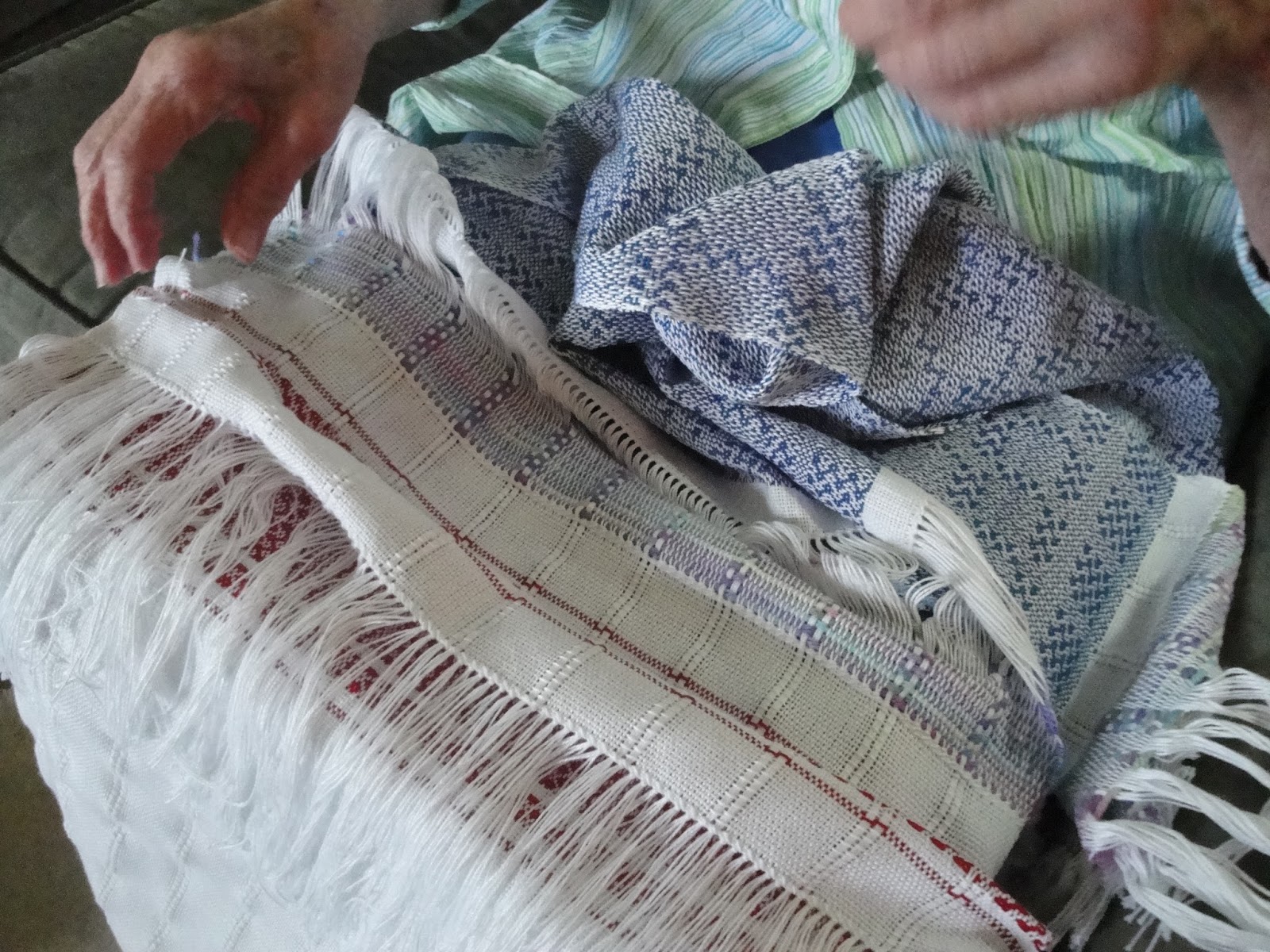
And here is a picture of my mother's hands at work--hands that are still weaving and gardening and helping others at 87:

Unfinished work from her 4-harness loom
Another glimpse of works in process.
Leave a name or a link if there's anyone you especially admire in the over 80 crowd...

Friday, March 25, 2016

500-year art for Good Friday

A few years back, I was startled by a face looking out of the marvelous Fra Angelico show at the Met. It is a common enough compliment to say that images are arresting, even when they are not. I can say from experience that this one is.  ‪It's right for the day, right for a week that reminds us of murdered innocence and grief for the world.


The image also reminds me of painter Makoto Fujimura's essay, "Fra Angelico and the Five Hundred Year Question."
I entered the halls and the golden aura of a diminutive Virgin Mary painting greeted me, with her azurite robe, and the Christ child’s supple body, reflecting her humanity -- a simple work full of weighty colors. Then I had to close my eyes, after a few seconds of pondering the saturated surface. I realized this was too much to behold, all at once. As I staggered about looking for a blank wall to stare at, almost feeling ashamed to be in the presence of such greatness, I had a “500 year” question pop up in my mind.

What is the five hundred year question? Well, it’s a historical look at the reality of our cultures, and asking what ideas, what art, what vision affects humanity for over five hundred years. It’s the opposite of the Warholian “15 seconds of fame.”
It was, you see, inspired by his visit to the Fra Angelico show.

Thursday, September 10, 2015

Rips in the fabric of culture--

Portrait of the artist as flourishing, flowering...
Division page image by Clive Hicks-Jenkins
for my just-out Maze of Blood (Mercer.)
With this story, inspired by the life
of Texas pulp writer Robert E. Howard,
I got to revel in the life of someone
who died before I was born, who
was unlike me in almost all ways,
save for his love of words.
My third child is now in college, and I've thought a lot about how English departments have changed since the year when I gave back my just-won tenure and promotion and became a full-time writer and then also a mother. Clearly it's now possible in many places to obtain an "English" degree without having much acquaintance with Shakespeare, Chaucer, or Milton, and it's quite possible to have little acquaintance at all with the legacy of the classical world with its great transcendentals. In fact, it is so very possible to go without reading the life-giving, important writers of the past or present that studies tell us many people never bother to read a book again once they graduate from college!

Likewise, I've seen many mentions of MFA students who do not know the tradition--I feel sure that complaint is not always justified, but it appears to be true often enough for many complaints to be made in print. Similarly, the visual arts have suffered from a lack of craft and skills in student training. But what is an artist alone? We are not spiders working and spinning alone but one body with the work of the past--those of our own culture and works in translation as well. Moreover, the tools and techniques of the past are part of how an artist thinks, and without them, he or she is lessened. Artists of all sorts are linked together through time and space, and the fallen generation just past grew out of the work of all previous artists, and the generations alive now from them in turn. To make art out of ourselves like a spider is to ignore all the power, truth, beauty, and good work that came before.

As an inhabitant of a small, often convulsive world, I find alarming the tendency to avoid reading books. Novels and stories and poems are gifts to us across barriers of space and culture and time. They are a vital way for us to experience the mind and living energies of the Other, the person who is not like us, not our sex or race or religion or culture. They are a path to understanding and empathizing with another's mind, heart, and soul. They are often the closest we can come to experiencing--to being pierced and affected by--another's dailiness and pleasures and sorrows. And stories and poems catch us up with the sheer joy of creation.

Without these wonderful little time-and-space collapsers, we are lesser beings, caught inside ourselves, less able to empathize and to love the world in all its shapes and colors, less able to love one another. As a writer, I have been able to stream outside myself and become a seventeenth-century woman in the wilderness (Catherwood), a nineteenth-century soldier (The Wolf Pit), a Texas pulp writer (Maze of Blood), a Depression-era boy in flight (A Death at the White  Camellia Orphanage), a child in a post-apocalyptic world, fastening together the pieces (Thaliad), a painter in the heart of a hill, searching for truth in a labyrinth (Glimmerglass), and much more. My readers have been those things as well, choosing to take my hand in the wondrous storyteller-and-listener dance that has been going on for hundreds, thousands of years.

What can we say in the face of ongoing news of decline, except that there is much more to being alive than what is useful and practical? Without art and culture, we are left in a dry landscape of the useful and practical, without an oasis in sight.

Monday, July 27, 2015

Strange seas

Kari Cadel photograph, The Glimmerglass Festival
Last week I bought a book of selected poetry by a poet whose work I do not care for--have not cared for it at all for many years, aside from one poem that I think is very good. (Of course, to lodge one poem in the mind is an achievement.)

And once again I am thinking how strange the arts are, that even what one doesn't love can woo. Little glimmerings in the poems appealed to me. Here and there are sparks, intriguing sounds, strange collisions of thought.

This morning I wrote something that is very much indebted to Vivaldi's "Cato in Utica," which I saw last week at Glimmerglass Opera, but it also owes smaller debts to the poet whose work I do not care for. Here and there, I see him faintly, some trace of him derived from reading his words. The sea of art is a great body with both great, mysterious whales and little salty guppies, and somehow the guppies are just as essential as the whales in the making of that sea. So strange and wonderful a thing...

Saturday, May 23, 2015

The unguessable current

Clive Hicks-Jenkins
for Glimmerglass
Three days in Vermont for the graduation at The Center for Cartoon Studies, lots of long track meets in far-off places, deadlines, an Antioch Midwest independent study, a month jammed with events for a high school senior... I've been busy and off in the wilds. And I suppose that was good because I was a little weary of the online world. All that flogging of books coming up on the twitter feed! All those links to advice about getting at least 15 Amazon reviews for algorithm visibility, all those "Top Ten" things to do in order to sell, all those cries of hawkers! Somehow it can be disheartening to see so many people striving so hard to be what we call visible and commercial and successful. I'd rather not see what appears frantic. I'd rather know that those people were working and playing in joy, twisting words into beautiful shapes and sounds.

When I was younger, I felt conflict between what the world seemed to want and what I wanted, but now I feel clear on the odd times that are ours. The over-focus on commerce and unleashed torrent of new books are just facts of our era and our cracked culture, nothing to do with what happens when a writer sits at her table and lets the words stream forth.

In the end, I am a solitary maker who is dreaming something into being, spinning the straw of the world into what I hope will be gold, true and beautiful and doing justice to the marvelous, tragic, lovely Creation. And I am mad enough to think that the gold-spinner dreaming along in the room is what an artist should be.

Also Clive, a portrait of Thalia
for Thaliad
Many of my strongest relationships tend to be with artists in other fields, and I often find the words of a composer or a painter pertinent to what I do. This morning my favorite online words about making come from my longtime collaborator, painter Clive Hicks-Jenkins.
I begin with an underdrawing, sometimes faint like smoke, sometimes confident, usually a bit of both, mostly fluid at this early stage. Then the painting and the rendering begin. It feels as though I'm attempting to produce a mosaic from thousands of glittering tesserae, each one of them a different micro-thought flashing through my brain. When I'm working away I have to make the image one tiny tile-of-thought at a time, and it's as though this flood of thoughts and moods spreads across the board. The thoughts/voices/poetry at this point are a cacophony, and I have to try and catch at the most insistent ones to fathom their meanings, all while listening/watching for the next to emerge. Each takes me where it will. I get buffeted in one direction by playful zephyrs, carried smoothly for periods on the dazzling surface, or dragged down into deep currents where all is shadowy and cold. Sometimes everything slows and then halts. I trace the curved route for the stem of a tulip, graze a petal with the striations of its markings. Becalmed, I drift.

Then something pulls at me again, the insistent and unguessable current reasserting, the line of poetry that lightning-flashes in the head, the breeze though the open window that sends all the fragments of drawings and poetry flying, and in a moment I'm away again, off into the unknown.
Into the unknown, leaping off the edge of everything one has created before...

***
Coming up soon: events at Hanford Mills in central New York and at the Culture Care Summit at Cairn in Philly.