NOTE:
SAFARI seems to no longer work
for comments...use another browser?
Showing posts with label Charis in the World of Wonders. Show all posts

Friday, August 12, 2022

Wordishly

My beautiful child!
FAVORITE LINE AT THE COUNTY FAIR

"The Beautiful Child Contest is now underway at the Cow and Sheep Barn." 

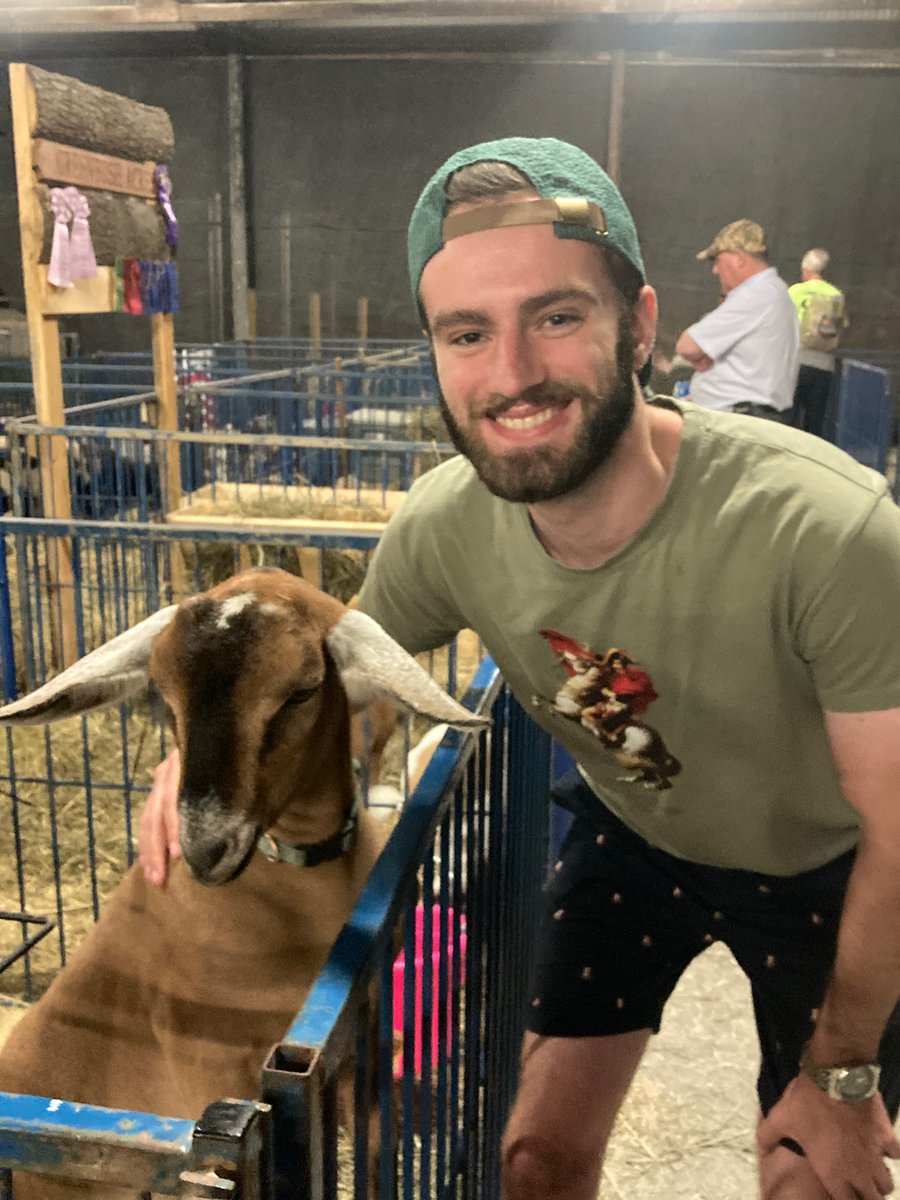
Last night I went to the Schoharie County Fair with my husband and youngest--Demo Derby! Royal Hannaford Circus! Gaudy rides! Crazy carnival eats! And all the joys of beribboned rabbits and hares, cows and sheep and friendly goats.

CHARIS IN THE WORLD OF WONDERS, AGAIN

Hurrah for a lovely new review from Sarah Collister at The North American Anglican. I'm grateful that this book, launched in the most uncertain part of the pandemic, is still receiving reviews two years on.

Sample clip:

Youmans takes readers on a triumphant yet honest journey from death to new life in the ten chapters of her luminous novel.

I had the hardest time reviewing this book because every time I picked up to work on the review, I ended up getting lost in the narrative once again. Though the themes of this tale are quite serious ‒ death, loss, and new life ‒ Youmans’ prose is still dazzling and joyful, repeating the profound Biblical metaphor that darkness often brings further illumination to the light.

For the whole review, go HERE.

Art by Clive Hicks-Jenkins
Find him at hicks-jenkins.com


SEREN OF THE WILDWOOD

The poem has been typeset, two of three requested blurb comments are already in, and I need to make a list of places that or people who might be interested in reviewing for Wiseblood Books. Clive Hicks-Jenkins will be at work on the illumination this fall. They typeset version looks highly symmetrical and handsome, as each little section is blank verse followed by bob-and-wheel.

OTHER WORDISH NEWS

Poems are coming out here and there... 

I've agreed to be on the judging panel for a national poetry award. And that's a bit insane, as life is overly busy already. But I should learn a thing or two.

And there's this splashy event: Makoto Fujimura's latest book, Art and Faith, was an inspiration for Holy Ground, premiered recently at our own Glimmerglass Opera, and I was invited by Mako to the pre-opera picnic and premier. It's always lovely to see him, but I also got to meet his new wife, Haejin Shim Fujimura (co-founder of Embers International), as well as Holy Ground's librettist Lila Palmer and composer Damien Geter, and Lila's composer husband Josh Palmer. 

The other side of the table...
Damien Geter, Lila Palmer, Makoto Fujimura

Wednesday, January 12, 2022

Charisean, Clivean, and poems!

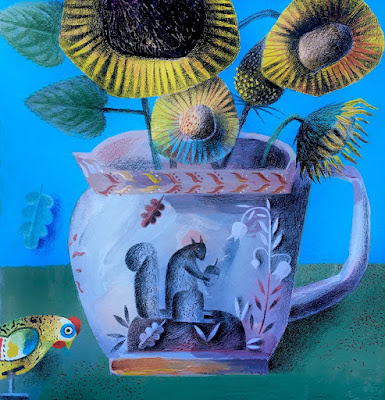
Yellow Hen and Sunflowers. 2021. Oil, gouache and pencil on panel. 
All paintings from the current
Clive Hicks-Jenkins series...

CHARIS, CLIVE, SUSSEX, MORE!

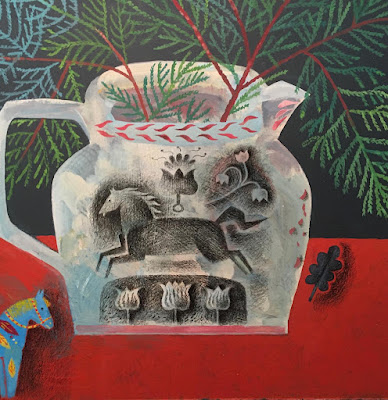
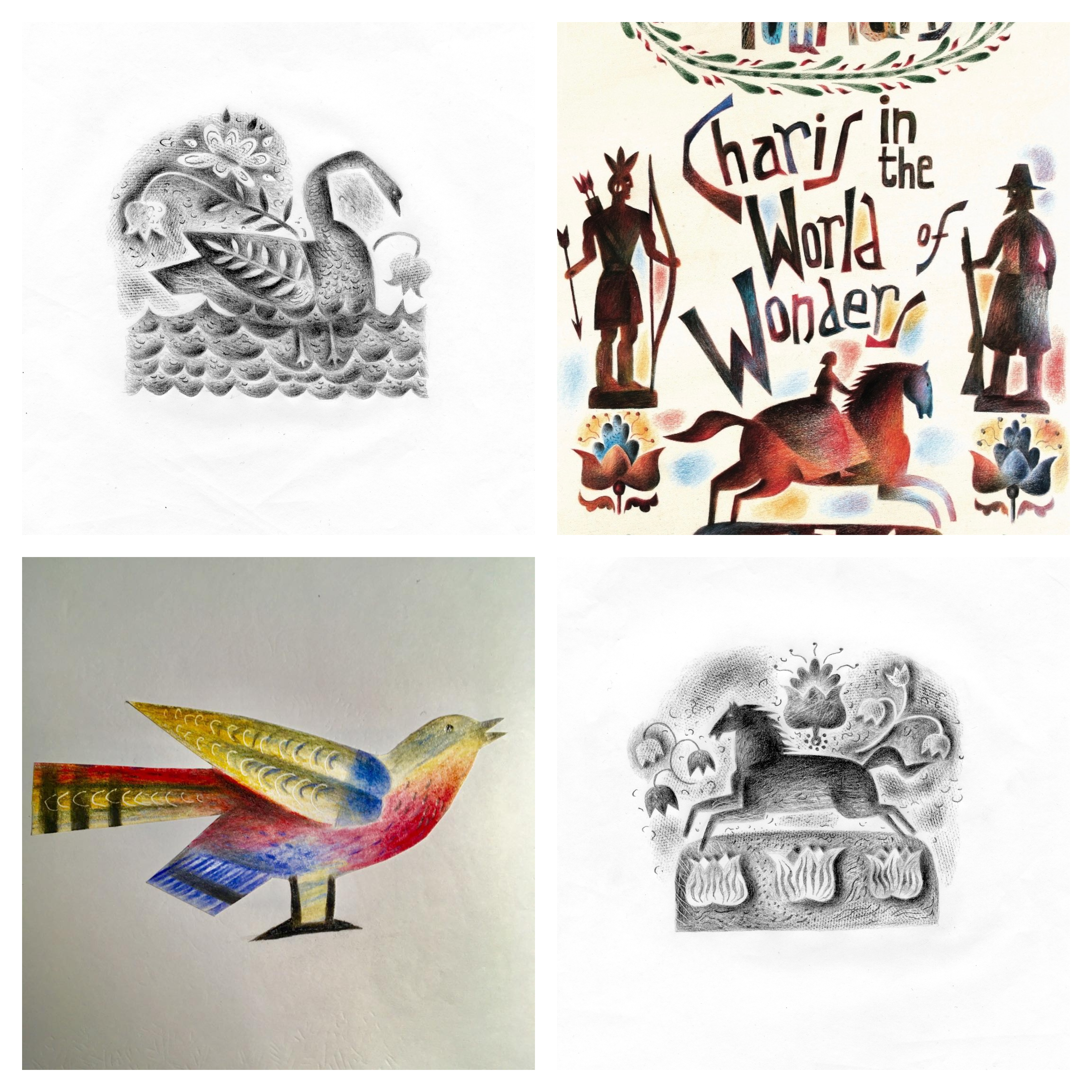
Clive Hicks-Jenkins made chapter headings and the cover of Charis in the World of Wonders. Then the chapter headings became a cunning line of plates, cups, bowls, teapots, etc. from Sussex Lustreware! And now Clive has made a whole series of paintings featuring the Sussex Lustreware with Charis chapter headings. 

Next up, I'm expecting wallpaper, fabric, everything in the world to be Charisean and Clivean! He is such a clever fellow...

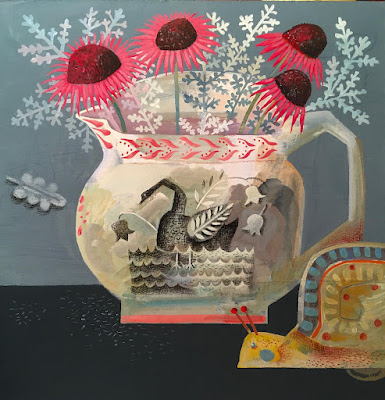
Swan and Snail, 2021
Oil, gouache and pencil on panel.


CHARIS IN THE WORLD OF WONDERS

HERE's an extended review of Charis in the World of Wonders by a retired English teacher, posting at the Science Fiction and Fantasy Chronicles Community Forum. 

Clip: "People today are regrettably predisposed to assume they know all they need to know about the people of Marly Youmans's novel. They may enjoy the fresh air that will blow through their minds when they read this accomplished novel."

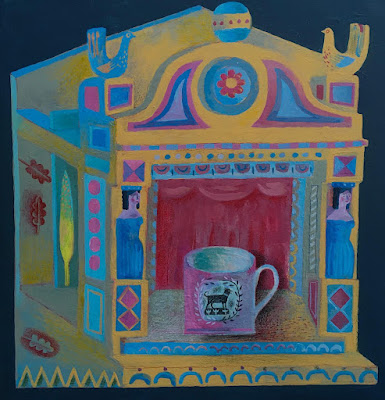
This painting has a Sussex "Loyal Friend" mug
nestled into a toy theatre
by Jim Pilston.

WILLOWS WEPT

Had lots of lovely feedback on "Birds and Lilies in Rugosa Canes" (poem.) It's on p. 44, but you can flip through and read the whole magazine HERE.

I'll have to nab the title from Clive later--
don't see it with the facebook image.

EKSTASIS

"The Curtal Candlelight at Tenebrae" (poem) can be found by flying HERE.

This one has garnered lots of gorgeous comments here and there, but I think my favorite might be this: 


FIRST THINGS

And if you missed "Starting with a Sentence by Aidan Hart" at First Things, pop over HERE to read. I love Aidan Hart's book on icons and much more, Beauty Spirit Matter. This poem also found a lot of readers and commenters--a thing which I appreciate so much.


                                                        Cockerel and Lustreware Teapot. 2021
Oil, gouache and pencil on panel.

Wednesday, March 31, 2021

Jackson Center interview

Though most people who keep up with me go to social media sites, I'm posting this for the wonderful dinosaurs who still follow blogs and don't follow facebook. It's a copy of the facebook interview from The Jackson Center for Creative Writing at Hollins. Conducted by MFA student Lena Fultz. Thanks to her and to the Jackson Center!


Hollins Creative Writing Alum Spotlight: Marly Youmans, M.A. ‘75 

Marly Youmans describes herself as a “Carolinian astray in snowy upstate New York.” After graduating from Hollins in 1975, she has written across genres—novels, short stories, and poetry. Youmans returned to Hollins in 2010 to serve as a Writer in Residence for the Children’s Literature summer program. 

Her work continues to win awards, with novels regularly appearing as finalists in ForeWord’s Book of the Year contest, among many others. John Wilson, editor at Books and Culture Magazine, describes Youmans as “the best-kept secret among contemporary American writers. She writes like an angel—an angel who has learned what it is to be human.”

Youmans spoke on her time at Hollins and her most recent (fifteenth!) novel, CHARIS IN THE WORLD OF WONDERS, with MFA student Lena Fultz.

LF:  What was your experience at Hollins like? What did you take away from your time here?

MY:  I wrote reams of poems at Hollins, and when I left at 20, I threw them all away—very much a young poet’s thing to do, though now I regret renouncing all those sparks of youth. Some years ago, Lee Smith told me that she found one of those old poems lying about the department and liked it: “The Magician’s Daughter.” 

Some of the women who were entranced with poetry (and the beloved Richard Dillard) are still friends of mine, especially Mary Bullington, Robbi (Kellman) Nester, and Susan Hankla. Susan was at Brown with me as well (riotous days!), and my fifteenth book, CHARIS IN THE WORLD OF WONDERS, is dedicated to Richard and Susan.

Amanda Cockrell invited me to be Writer in Residence at the summer Children’s Literature program some years back, and I enjoyed the return and still hear from some of the students. Just last fall, I had the decided pleasure of discussing Susan Hankla’s first full-length book, CLINCH RIVER, in THE HOLLINS CRITIC.  

I suppose that many a young writer discovers a need to rebel against what she has been taught in school, and against the times. And so I have ended up bounding away from the vers libre of Modernism and its after-shock movements, and have embraced meter and sometimes rhyme as liberating and strengthening forces. I’ve gone back to older and larger definitions of what poetry can be and can include: narrative and long poem, as in THE THRONE OF PSYCHE; long sequence with repeating characters, as in THE BOOK OF THE RED KING; epic adventure, as in THALIAD. Falling into the land of stories helped, for I soon wanted my poems and fiction to be entirely different creatures.

LF:  Your recent novel, CHARIS IN THE WORLD OF WONDERS, is set in Puritan New England. What does your research process look like for writing in a time before you were born? What is the biggest challenge?

MY:  In the books where I’ve delved into the past, I’ve moved through regions of time where I felt comfortable: CATHERWOOD and CHARIS in the seventeenth century, THE WOLF PIT in the nineteenth, and A DEATH AT THE WHITE CAMELLIA ORPHANGE in the Depression. 

I tend to consider fiction-time as a place rather than as an inaccessible era. Some of this is due to my extended family in Georgia. As a child, I spent some of my summer traveling-time at my maternal grandmother’s big Queen Anne house and property in Collins. My mother was the accidental ninth baby of a woman born in 1883; the home and our matriarch, Lila Eugenia Arnold Morris, felt Edwardian. And some of my vacation time was spent with my paternal grandparents; the sharecropper’s shack and farm are closely described in A DEATH AT THE WHITE CAMELLIA ORPHANAGE. Utilities were minimal, comforts sparse, mules stubborn, sun boiling. Tenant labors of ploughing in the fields, picking cotton and tobacco, preserving food, or making turpentine in the piney woods didn’t appear impossibly distant from the peasant’s vassal duties in a medieval and feudal world. My two Georgia family homes have been a blessing to me as settings for my imagination and as ways of understanding how to live and move in the past, as well as how to navigate a landscape of hardship, toil, and poverty. 

(Here I should pause and thank my late father for the burning motivation that made him a teenage tailgunner on a B-17 in World War II and afterward a professor of analytical chemistry—one who bought his elderly parents a house in town. And thank you, America, for the G. I. bill.)

For CHARIS IN THE WORLD OF WONDERS, I could skip over a lot of basic research because I had read so much colonial documentation and literature in earlier years. But I spent nine days at the American Antiquarian Society in Worcester, looking up specific things: occupations and titles in Massachusetts Bay Colony; accounts of Haverhill and Andover (now North Andover); letters; modes of address in England and the colonies; laws and punishment; differences between English and colonial goldsmiths; silver styles; contracts; marriage ways; recipes, etc.  

Mainly, I didn’t want to tumble into the silly ways in which “the godly,” as they called themselves, have been depicted with black clothes (out of reach for most), buckles on hats, constant dreariness, and so on. The keys to writing a novel set in the past are few but essential: never put contemporary beliefs and contemporary characters into the past (unless, of course, you are writing a time-travel book!); show the same amount of “stuff” and landscape as you would in writing of your own place and time; don’t feel that you must prove (by over-reference to songs, politicians, scandals, etc.) that a character really and truly is in past time; and wear any historical research lightly, avoiding the dread info-dump.

LF:  With the current state of the world right now, are you finding time and space to write? What does your writing routine (if you have one) look like?

MY: A great deal of my adult life has been spent as a mother of three (one is still at home), and children have no need for a writer. They need a writer about as much as an octopus needs a party dress, and this is a good thing; it has kept me from ever accumulating any big-headed thoughts and forced me to be ingenious about scraps of time. So no, I never developed a routine; I seem to be fatally allergic to anything that smacks of over-organization, outlines, or the old-fashioned writer with wife who protects writing time. I do, however, have a husband who cooks and bakes wonderfully well, and for that I am grateful.

Despite the pandemic, I am dividing my days between Cooperstown, New York, my home for the last 22 years, and Cullowhee, North Carolina, where I attended high school and where my mother lives. So, I’m sometimes shuttling back and forth along the Appalachian chain . . . Given my current situation, I’ve decided not to start a new novel until later, but I am writing poems.

LF:  Any future projects or upcoming events we can look forward to? 

MY:  I expect that the next book will be a poetry collection. Meanwhile, reviews and interviews and podcasts for CHARIS are still trickling out—it seems that I have an unfortunate tendency to have books launch during national disasters, but I’m hoping that readers will be kind enough to support pandemic books!

Tuesday, February 16, 2021

This snowy, icy week...

A few warm things... 

Charis in the World of Wonders

I've updated the Charis page, so please take a look--there is a great deal there now. This week I'm glad of a lovely long review of Charis in the World of Wonders by notable musician, teacher, and editor Lorraine Hale Robinson. And it's hosted at North Carolina Literary Review, edited by Margaret Bauer. To have four thoughtful pages in NCLR is something for which I am grateful! 

You may find the digital version of the magazine HERE, or you may leap directly to the review HERE.


     Charis in the World of Wonders offers diverse sources of enjoyment—an exciting adventure saga, for example. Or, readers interested in the philosophical concepts of time and place, tracing the path of Charis’s adventure offers attractions. For readers interested in history, the book presents a vivid and engaging picture of “a world lit by fire.” Or for those of a metaphysical bent, there is the fascination of the bewildering “forests” of contradictions that drive Every Woman Charis’s interior, psychological journeys. For readers who relish the mot juste, there is delicate and nuanced writing craft and a sparkling use of kennings. My own recommendation is to read the book for all of its many wonders. --Lorraine Hale Robinson, “Homage to Hawthorne: A (New) Wonder Book,” North Carolina Literary Review, pp. 124-127. 11 February 2021.

The Dreamer as Architect

And HERE is "The Dreamer as Architect" at the digital version of First Things...  The second of two poems chosen by poet A. M. Juster in his brief time as poetry editor there, so I thank him. This one has received loads of lovely comments on twitter and facebook, so if you have not already seen it, perhaps you might like to peregrinate over that way... It's dedicated to novelist Midori Snyder.


The start of  the poem, for a taste:

                                              Last night in dreams, she lived a thousand years
                                              And was the architect who made a house
                                              That wandered from the mountains to the sea.

Hope you had a wonderful Valentine's Day, passers-by! 

Wednesday, January 27, 2021

Bailey, Wetta, Charis...


Scott G. F. Bailey on Charis in the World of Wonders

Here's a clip from a new extended post about Charis in the World of Wonders from novelist Scott G. F. Bailley, author of The Astrologer. I picked this bit because he talks about language, but he has a lot more to say and is always interesting, so please take a look.

This is a beautiful book. Some readers, I have noticed, have difficulty with the poetic nature of Youmans' prose, and to them I say they should become better readers and lovers of language's music. "tilt and spill" "wondrous cascade" "ungrasped length" "bear and vessel what is unearthly and rained down" are wonderful constructions: just listen to the vowels and the rhythms, the moving accents from one sentence to the next. Youmans stretches prose, but never goes too far. Sound and sense, it's all there. I never do any book justice when I write about it, and I keep that tradition with this wee essay. Charis in the World of Wonders deserves lots of readers. Go be one of them, do. 

--novelist Scott G. F. Bailey, review post at Six Words for a Hat, 22 January 2021

And his earlier comment:

Marly Youmans' latest novel, Charis in the World of Wonders, is a great book...a rich tapestry of invention, a lovely long song of many overlapping themes. As with so much of Youmans' work, it is a myth writ on human scale, an instruction manual for discovering beauty and love in this fallen world. I do not exaggerate. 

C--novelist Scott G. F. Bailey, Six Words for a Hat, 31 December 2020

* * * * * * *


Fr. Augustine Wetta video on Charis

A Wetta-and-moi video was supposed to be up on youtube, but I can't seem to find it... so HERE is a link to the video on facebook.  If you click, you'll discover me in my dining room being interviewed by author and Benedictine monk Fr. Augustine Wetta (who was a private student of mine at the Antioch Workshops a few years ago. He has since published the novel we discussed (in part) at Antioch:  The Eighth Arrow: Odysseus in the Underworld.) I always cringe at seeing/hearing myself, so I have not watched it, but Fr. Dude (as he is known to his students at the St. Louis Priory school) asked some interesting questions...

Saturday, January 16, 2021

Charis at year's end, again...

Art by Clive Hicks-Jenkins

Thank you to Melanie Bettinelli and The Wine-Dark Sea for calling Charis in the World of Wonders "probably my favorite book of the year and the one I am most likely to recommend to anyone looking for a good book to read, and especially for a bookclub." She describes the book as "luminous" and says that she "cannot praise it highly enough." 

If you want to read why she thinks so, jump into The Wine-Dark Sea at this very spot.

I'm glad to see Charis walking onto her 6th year's end list. She's a intrepid traveler. And she's on the list with my friend Sally Thomas's Motherland (at Able Muse, Bookshop.org, Amazon, bn.com, local indies etc.) So pleasant!

Wednesday, January 13, 2021

Clive's sketchbook for Charis


Clive Hicks-Jenkins and Charis in the World of Wonders: 

A tiny linen-bound sketchbook in which I made all the preparatory work for Marly Youmans’ historic novel, ‘Charis in the World of Wonders’, published last year by Ignatius. 

Note that throughout my sketches I mis-titled it ‘Charis in a World of Wonders’. Luckily I noticed the error before making the finished artwork.


* * *
More Clivean goodness:

Clive's website: 

Clive's Artlog: 

Gray Mare Press: 

Shows, commissions, collections: 

Clive's fascinating life in ballet, theatre, puppetry, book arts, and painting: 

Friday, January 01, 2021

Year ends, year begins

(CC by 2.0, Tim Reckmann at Wikipedia via flicker) 

Good wishes, plus a polkadot jot...

Indulgent feast with progeny save the one stranded in Montreal, much champagne, a game of Catan, and much pot-beating to chase away the annus horribilis! Happy new year, friends, and have a marvelous trip around the sun in 2021.

The polkadot jot of caution

The very late P. G. Wodehouse for early 2021: "I’m not absolutely certain of the facts, but I rather fancy it’s Shakespeare who says that it’s always just when a fellow is feeling particularly braced with things in general that Fate sneaks up behind him with the bit of lead piping." 


*****************************

                                                   Image by Helen Montague Prichard Foster

***

Lists for Year's End


Stephen J. Anderson at Medium
"2020: A Few of My Favorite Things"
5 January 2021
I think this book will become a classic. It should, at any rate. It’s an epic set in early colonial North America, full of danger, devils, mythical beasts, wilderness, splendid 17th century vocabulary, and of grace. Charis comes of age in an untamed time in a world of wonders. Everything about it fits. More people need to know about this book.

"What we read (and loved) this past year"
30 December 2020
Rosemary Callenberg, Associate Editor: My favorite work of fiction this year was Charis in the World of Wonders, by Marly Youmans. This novel was beautiful. The language was rich and poetic without ever crossing the line into 'too much,' and I felt a great sense of intimacy with the main character in both her struggles and joys.

December 2020
and
"Twelve Important Fiction Books of 2020"
December 2020
Description and excerpt.

“The Best Books I Read in 2020"
18 December 2020
Catherine Harmon: Charis in the World of Wonders by Marly Youmans. A close contender for my favorite book of the year. Like Eifelheim, this novel also treats its historical setting and characters with respect—Youmans’ 17th-century men and women are recognizable to us in their humanity, with faults, foibles, and virtues we can see in ourselves and those around us, but they are also, clearly, the inhabitants of a time very different from our own, from which we can learn much. Youmans’ “World of Wonders” is a grace-filled, sacramentally-charged landscape that reminded me of Flannery O’Connor’s world, different as it is in time and place.

John Wilson, "A Year of Reading: 2020" 
26 November 2020
Youmans’s latest novel, one of her best, is set in 17th-century Puritan New England. My copy is a thicket of Post-it Notes. Here I will simply repeat what I wrote for the back of the book: “Charis in the World of Wonders confirms once more Marly Youmans’ place among the magi. There is indeed ‘a dark and amazing intricacy in Providence,’ as this spellbinding novel attests.”


*****************************

Updatery


Thanks to editor Patrick Key for an acceptance on the first of January--a good start to 2021! And today the poems are up:  After the Pandemonium, George Herbert, and Child with a Bird Shrine. And if you want more, check out Reverie, Silk, and Metamorphoses in the October issue. Nonce stanzas, Herbertian stanzas, poulter's measure, blank verse... Happy 10th day of Christmas!

Updatery, again...

A bit of Burne-Jones for Epiphany  (PD Wikimedia Commons)

All I can do for a chaotic, upside down world is to add my daily jot of making to the sum of beauty, truth, and goodness in the world. And we may all add our mites to that strange and marvelous sum because each of us is homo faber, the maker who can transform self and world.


Manuscript page with an image of Christine Pizan writing, 
The Book of the Queen, c. 1410, 
British Library, public domain.

Thursday, December 24, 2020

Christmas, Charis, Willows


And it's Christmas Eve day! 
Here's stellar Fra Angelico, dreaming the Madonna and naked infant Christ 
with embodied angels, Peter of Verona, Thomas Aquinas, Barnabas, Dominic. 
Detail, Fiesole altarpiece, 1422, Convent of San Dominico. 
Public domain CC wikipedia.

Some bits of news:


Short version, Englewood Review of Books
"Twelve Important Fiction Books of 2020" https://www.goodreads.com/.../156371.ERB_Twelve_Important...
and
Longer version of the Charis in the World of Wonders page... 


"The Changes," "The Ruined Garden," and "Come to the Selvage of the Sea" kick off issue 19 Winter  2021 of Willows Wept: https://willowswept.com/ and https://www.magcloud.com/webviewer/1903662?__r=150177&s=w for the online version...  (And weirdly, the cover image by Troy Urquhart shows a Cherokee spot only a few miles from Cullowhee, NC, where I went to high school and still spend part of every year.)

Friday, November 13, 2020

Gratitude!


I'm still in house quarantine after returning from North Carolina (the state now has a shorter and more lenient version, but I don't qualify for that, having left under the old rules), so my life has not been too exciting of late. However, I'm expecting something wonderful about my books at the online Easton Book Festival, I have some other e-events coming up, I have a long interview coming out soon, and I'm about to meet up with the Cathedral Arts committee in Albany in a few minutes.

And I'd like to share a link to this just-out review of Charis in the World of Wonders by Jane Greer. While the review has been shared and re-shared on social media, I am hoping it gets a little more attention through the blog. I could not be more grateful for her remarkably strong review. Please read and pass on to readers you think might be interested. I would be glad of that at any time but especially glad in this year of pandemic book launches.

Sample clip:

The book invites comparison with other works, such as The Odyssey (arduous homecoming after war), The Book of Job (wretched loss without lost faith), and Cinderella (good prevailing over evil). It has aspects of all these classics. Charis faces nearly insurmountable issues but perseveres. She is heroic inside and out.

The novel’s compelling plot, realistic characters, gentle humor, and historicity are strengths, but the first attraction is its glorious prose. Reviewers—there have been a few—can’t resist quoting the book’s opening paragraph. Someday it may be as well-known as the first lines of A Tale of Two Cities or Anna Karenina.

Sunday, October 25, 2020

New reading, new poems--

POETRY, MOSTLY

I've been down in Carolina for some weeks, and of course I did not bring enough books with me (because who can bring enough?), even though there are books here as well, and I somehow tumbled into the lovely Harry Alter Books while my mother was at PT and came out with a Modern Library Pound Poems and Translations, some Horace odes, a pretty Petrarch collection, and Rupert Brooke. This plunge into book-greed happened despite the fact that I toted plenty of books with me, including the new Sally Thomas and Jane Greer collections (if you didn't see our three-way reading, it's mostly--minus a bit of techno-slip--on my Charis in the World of Wonders page, near the end. Jane reads from Love Like a Conflagration and Sally from Motherland.)

The reason I succumbed to another Pound collection was that I had the yen to read him while reading Timothy Steele's interesting nonfiction book, Missing Measures. Having a memory like a sieve, I did not recall--or else Steele has been an indefatigable hunter--so many expressions of uncertainty about vers libre from Pound, Eliot, and Williams. I'm afraid I laughed at Eliot's dismay when his niece sends him some of her school-assigned homework: free verse poems. What you and the public schools have unleashed on us, Thomas Stearns! A Niagara of poems... Steele talks at length about the disappointment of all three with what was accomplished, and how no hoped-for new metric emerges from Modernism and why that might be. It's a fascinating book that zooms back to the classical world to show the roots of free verse, and how various ideas pertaining to prose writing and poetry writing become braided, swapped, or muddled along the way. It's a useful book for any young poet, I would think, and might just convince one of the need to return to roots, or at least examine them.

A FEW POEMS JUST OUT AND ONLINE

"An Apple Tree Carol"

at 


and


"The Little Place"
at
North American Anglican

(Click on my name for lots more.)

and some

at 

"Reverie,"

"Silk," 

and

"Metamorphoses." 

So that's 3 poems at Patrick Key's new Grand Little Things.

DR. JOHNSON

Versification, or the art of modulating his numbers, is indispensably necessary to a poet. Every other power by which the understanding is enlightened or the imagination enchanted may be exercised in prose. But the poet has this peculiar  superiority, that to all the powers  which  the perfection of every other composition can require  he adds the faculty of  joining music with reasons, and of acting at once upon the senses  and the passions.

Sunday, August 02, 2020

Anders, Charis, Red King

Another "tiny" at North American Anglican: 


And if you go here on the NAA site, you can take a look at more tinies and a few poems.  Thanks so much to Clinton Collister for requesting poetry and tinies! 

* * *

Clips from new reviews of Charis in the World of Wonders:

Photo by Paul Digby
Photo by Paul Digby

A charming literary work that envelops the reader in the chaotic frontier life of Puritan Massachusetts.
--Historical Novel Society Issue 93, August 2020

Youmans shrewdly presents the collective madness of witch trials as one of many destructive forces in the world — on a level with Indian massacres, concussions, and drowning. As such, the hysteria seems less alien, our modern complacencies less sure, leaving behind the uneasy suspicion that we may be as prone to collective madness as they are, and as blind to it, lulled by the tools we vainly depend upon, just as they depend on their brimstone preaching, to save us from destruction. This sojourn in Charis and the World of Wonders lets us experience reality bare of illusions: life can end at any moment, avoiding grief is folly, joys should be taken gratefully when they come, and creation is full of beauty, fear, mystery, and God.
--novelist H. S. Cross. "In the Liminal Zone," The Living Church (Anglican Communion), 30 July 2020

* * *

And here's a pandemic poem from The Book of the Red King...


The Cloud Like a Child
A Folk Story of the Red King’s Kingdom


A cloud no bigger than a child appeared
And hovered just above the castle spires.
Next the sickness came with evening sweats
That seemed to bleed all force away from those
Who ploughed or pounded hammers at the forge,
Strong souls who laughed at first but later wept.
At night the cloud became a rag of blood
That served to veil the brightness of the moon,
And people said, “The end of the world is near.”
The greater part of the Red Kingdom’s men
Died, and no child was born, for women all
Were barren. So the Red King in that time
Took pity on the sons and daughters who
Were not and seemed unlikely to become:
Three generations he raised them from stones
Until the demon rag was worn to shreds
And lost to every eye except the King’s.
So was preserved the kingdom of his love. 

You may see and hear a reading of the poem here.

Friday, July 24, 2020

The Charis-and-poems news...

Once again, I'm guilty of being lively on twitter and facebook but ignoring the blog! Hope all you passers-by have remained healthy and sane in the midst of topping chaos. A few new notables are below:


I've updated the Charis in the World of Wonders page with some new comments and review clips. A review from novelist H. S. Cross is forthcoming, and another from Robbi Nester, as well as an interview. And the book will be featured on writer Marjorie Hudson's Kitchen Table Writers, an interesting group to join if you're a budding writer. Though it has been sad to have a book come out mid-pandemic (my crazy history of launches timed at disasters!), I hope that Charis--being an indomitable sort--will find her way through the wilderness of this strange time.
Remember how you used to read as a child, stretched out in the grass or on the couch, lost in the magic of a book.... Be prepared to re-enter that world of magical reading, being so engrossed in the world of the book that you never really leave it, living in a dreamy haze of words and beloved characters. Marly Youmans' new novel, Charis in the World of Wonders (Ignatius, 2020) will put you there, into that trance of reading and joy, as though you had never left it.
               --The Hollins Critic, Fall 2020


This I can't skip mentioning; I have several poems in the new issue of Mezzo Cammin edited by the late Kim Bridgford--that's her picture above. It's a lovely, thoughtful image of a bright poet and professor who brought many interesting projects into being and added to the sum of beauty and truth and goodness in the world. Nine of the thirteen poets in this round (Maryann Corbett, Wendy Sloan, Myrna Stone, Jane Scharl, etc.) were chosen by her. As my poems have appeared there many times under her editorship, and I was once lucky enough to be her featured poet, I am glad to be in this issue.  It's not the end of Mezzo Cammin, but it is the close of Kim's actions in the world, though she leaves behind publications, editorial work, the Poetry by the Sea conference, and much more.

Taste of the poems, a title and two lines for each:

House at the Edge of Sleep

She dreamed this: in the field she built a house.
She lugged the stones from streams and built a house.

and

The Watering Place

We wished the stream to be alive, as rinsed
And quick as a twisting blue rill of thought.

Grateful thanks to Anna Evans for continuing Kim's work.


Here's a review of the anthology, The Slumbering Host, by poet Lisa McCabe in Front Porch Republic. I only had a couple of poems in it (reprinted from North American Anglican), but she talks about one of them.

Monday, July 06, 2020

If you missed our video...


If you were cast into woe by missing the Greer - Thomas - Youmans reading, here it is. I couldn't get youtube to accept an image of all three of us; we are too complex for youtube, it seems! So apologies that it's just my cover as thumbnail.

Jane Greer - Love like a Conflagration 
Sally Thomas - Motherland 
Marly Youmans - Charis in the World of Wonders

12 June 2020
via Zoom

Friday, July 03, 2020

Reviews and a thorn tree

A new poem just out at North American Anglican


Godric of Finchale as a Thorn Tree
Homage to Frederick Buechner

Fly HERE to read the poem.

Snitching a twitter-comment from poet Lisa McCabe @LAHMCCABE:
Replying to @NorthAmAnglican and @marlyyoumans - thank you for writing this beautiful poem. The dedication is perfect.

*  *  *


A new review of Glimmerglass at Brandywine Books

Glimmerglass the novel may be like Glimmerglass the lake. It’s beautiful from the shore, warm, inviting, even with hints of danger and mystery, and alien, if not weird, under the surface. When Cynthia falls into the icy lake, metaphorically speaking, she emerges among chain-smoking ghosts, feathered angels with parasols, minotaurs, and palace dance halls. Sure, it sounds trippy, but it works beautifully well.   --Phil Wade

Read the rest HERE.

*  *  *

New reviews of Charis in the World of Wonders
#pandemicbooklaunch

I'm hoping for more of those helpful Amazon reviews, as even indie bookstores and people who do not buy from Amazon check them out. But I'm happy to have long, thoughtful reviews there, many of them by writers. So please check them out HERE.  

Please scroll down the blog to recent posts about reviews from Wuthering Expectations and Melanie Bettinelli.

                                    *  *  *

And The Book of the Red King

Please scroll down to find novelist Eugene Garber's wonderful comments on The Book of the Red King.

Tuesday, June 16, 2020

Charis and Kristin at Wuthering Expectations

* * *
I am so pleased that two of my books have been discussed at the stellar Wuthering Expectations! Please take a look at the new post on Charis in the World of Wonders. See posts on both Charis and The Book of the Red King HERE.

Tuesday, June 09, 2020

Go, little pandemic book!

1. 
Hurrah for reviews!

At The Wine-Dark Sea, Melanie Bettinelli has published a long, thoughtful review of Charis in the World of Wonders that dives into wonders, grace, character oppositions (sometimes as structure), transcendentals, freedom, language, narrative mode, variation in "Puritan" thought among late seventeenth-century characters, the wilderness, and beauty. I'm glad that she found something very different from what she expected, and that she tells us about what she did find with such care. Every writer wants reviews that explore a book and extend a reader's sympathy to its aims, and this extended treatment is just that.

A couple of clips:
The period vocabulary never feels forced or strange not like a gimmick; but rather, like a key that unlocks the door into the past. The novel never makes the mistake of imbuing the heroine with an anachronistic worldview that will be more familiar and safe for the 21st century reader. Rather, it invites us to enter in to Charis’ world of wonders, a place rich and strange and not always comfortable, a true foreign country and not at all like my current day Massachusetts.
I’m not usually a fan of first person narration, but Charis employs it to good effect. The novel is as much a portrait of a soul as the story of a journey and the exploration of a time and place. Charis’ internal life is rich and poetic, informed by the poetry of Anne Bradstreet, the Bible, and the classical literature to which her father has introduced her— she’s studied Greek and Hebrew alongside her brothers. Youmans is a poet and Charis’ narration is thick with metaphor and imagery and the language often has the heightened quality of poetry. But it never feels overwrought or strained. Rather it feels like the very texture of the thoughts of a highly literate woman who, formed by all she has read, sees the world through a lens of language and metaphor. 

 
Charis means grace and this book is very much about the movement of grace in a fallen world of sin. I was surprised at how much the novel’s worldview was imbued with faith— you don’t often find that kind of faith— simple, unalloyed with skepticism and untainted with hypocrisy— in contemporary literary novels. What’s more, in addition to the expected faith that had the familiar “Puritain” strains of fascination with sin, the devil, witchcraft, and hellfire; Charis also has a faith that is more familiar to me: one that is infused with a deep awareness of grace and mercy of a loving God. Certainly Charis is aware of those in her community who emphasize sin and the presence of the devil, but her personal vision of God is as a God of wonders, a God of love and mercy. And much of the drama and beauty of the novel is watching her navigate between those different worldviews (the Satan-haunted and the grace-haunted) which are both present not only in Charis herself but also in her community. 
There's a great deal more, so please fly here to read more. I don't usually see reviews that talk about faith animating a character, about the structural use of oppositional characters, or about the world (as in her treatment of Hortus) as a symbolic place. And as I have long loved Hawthorne, I was pleased to see that she tackles the book's relationship to works like The Scarlet Letter: "a very different thing, going in a 180 degree different direction."

* * *

2.
#pandemicbooklaunch
A few comments plucked from the past five days...
two writers, one actor, one painter...
on twitter and facebook...
used by permission

sebastien doubinsky @sebdoubinsky: I absolutely love @marlyyoumans's universe. If you don't know it yet, you should really give it a try. Beautiful, magical and thought-provoking. 9 June 2020

Chris Phillips @MobyProf: A bit of a sequel to my tweet a couple of weeks ago about my latest book-buying: @marlyyoumans’ Charis in the World of Wonders is THAT GOOD. The pacing is masterful, the world is pungent & tangible, & Charis’s inner life is exquisitely done. Thank you, Marly! 8 June 2020

Patricia Heaton @PatriciaHeaton: I’m loving your book "Charis in the World of Wonders!" What a unique voice you've created!  4 June 2020

Mary Bullington, painter and poet: Last night, I started Marly Youmans’ new novel, “Charis in the World of Wonders" and was 63 pages deep when I made myself turn off the light. In midst of an Indian attack on her tiny Puritan settlement in the spring of 1690, a teenager begins to tell her life story, even as she makes a harrowing escape into the forest with her 7-year-old sister. Charis's lens on the events and people of her time is devastating. At once innocent and clear-sighted, she speaks to all that she sees, imagines, and feels. Parts read as though Goya’s Disasters of War --“This I saw”-- were told not by a mature and cynical court painter, but by a devout, well educated young woman who has no choice but to observe and participate. 9 June 2020

3. 
Image by Lizza Littlewort
The second of the "smalls and tinies"
(fictions and fiction-like pieces)
out or forthcoming at The North American Anglican 
over ten months

And if you're interested in current online poems, look through recent posts...

Friday, May 29, 2020

On traveling in the past: Charis in the World of Wonders

One of the demands of writing a novel set in the past is that a writer not put people and thoughts of his or her own day into fancy dress. Not give us woke people in linsey-woolsey. Not present people with our own concerns about climate (well, maybe if it's a Ruskin--so prescient!) or our own beliefs about how a woman may be heroic or our own attitudes toward childbirth or child-rearing or many another thing. In Catherwood, A Death at the White Camellia Orphanage, Maze of Blood, and now Charis in the World of Wonders, my desire is always to enter into another world, to believe that time is a realm I can find and walk around in if I am imaginative and reasonably knowledgeable. 

For the new book, one wish of mine was that Charis be a convincing citizen of the godly (Puritan to us), and that I would not fail to enter into her feelings about family, the wilderness, native peoples, the French, God, marriage, childbirth, community, and all the terrors and pleasures of the New World. And where she came to differ from the most common view, it had to be because she was forced by circumstances to learn something new that tempered or transformed what she thought to be the truth. It struck me that the most difficult thing to portray for contemporary readers would be religious faith and feeling, now so alien to many, and so easy to get wrong.

So I was especially pleased to see a comment about Charis's faith from poet Sally Thomas, discussing a review at the DarwinCatholic blog. Here it is, pilfered from facebook:
I particularly appreciate the allusion to Ron Hansen's Mariette in Ecstasy in this review. I hadn't thought of those two novels as parallel in any way, but among other things, a comparison on the point of the un-ironic handling of religious sensibility is apt. It is so very, very easy for the contemporary novel to wink and nudge at the reader – the religious characters are either dumber than we are in their belief, or are hypocrites whom we see through (wink wink nudge nudge). Or else they're caught in amber, as not-quite-living relics of a not-quite-living past. 
What I think both Charis and Mariette accomplish (though this is far from the only thing both novels accomplish) is to present a spectrum of characters, a whole human range of people, who all believe in God (and further, operate wholly within the world of a shared tradition of belief). There is awareness of a world outside that tradition – for Charis it's the indigenous tribes and the Catholic French. In fact, Charis goes farther in imagining the whole diverse tapestry of its world than I remember Mariette's doing. But the world that is each novel's focus is itself a tapestry of human personalities and livings-out of belief. This is part of why, as a novel taking up religion as a concern, each one rings true.
And surprise, Sally Thomas is doing a launch for her poetry book Motherland on Zoom on this very day at 3:00! Go HERE if you want an invitation.