NOTE:
SAFARI seems to no longer work
for comments...use another browser?
Showing posts with label Christmas. Show all posts

Tuesday, December 24, 2019

Christmas thoughts on painting and symbol...

Detail, Zanobi Strozzi, c.1433.
(Perhaps with some figure work by Fra Angelico?)
Predella to an altarpiece.
Tempera with gold on wood.
Wikipedia Creative Commons licence.
Image donated to CC by the Met.


* * *
                                           Oh Thou, whose glorious, yet contracted light,
                                           Wrapt in night's mantle, stole into a manger;
                                           Since my dark soul and brutish is Thy right,
                                           To man of all beasts be not Thou a stranger
                                                 --from George Herbert, "Christmas" (I), 1633

I've long been friends with painters, and I love wandering among drawings and paintings. I have a particular affection for medieval paintings, and for the iconography of that era. One thing I especially find intriguing about medieval religious paintings is that the images possessed a function that was far more vital than that of paintings today. A painter in our time often wishes to have his or her painting in a static or traveling group show or a solo show. The painter desires to have images appear in an article or review, and longs to achieve the status of seeing his or her own paintings housed permanently in a museum. I dearly love to visit museums and would never dismiss them. But a medieval painter's labors joined a great variety of other crafted works to beautify and inspire in churches, cathedrals, synagogues, shrines, and castles. Art meant skill to make significant, beautiful creations. And many an artisan felt himself to be such a maker, part of a great body of people crafting and incarnating a house or way-station for God. Afterward, the made things were intimately connected to the highest spiritual feelings of many people, and they became an essential part of worship. Paintings, carvings, and sculpted pieces have frequently ended up in our museum collections, where they now have a more limited existence, drained of prior life and power, but yet... they once had that earlier glory. The symbolism in medieval paintings and icons likewise held meaning and a living power, where for most viewers today it remains merely a colorful mystery. 

So here's my Christmas greeting, rife with symbol and beauty: an adoration scene with ox and ass portraying the yoking of clean and unclean, centered on the infant Jesus. This iconography is extra-biblical, though reflected in St. Peter's highly symbolic dream of a sheet of clean and unclean foods let down from heaven. Such yokings reflect the baby's bringing of clean (Jewish) and unclean (Gentile) peoples together under the rule of Christ. Meanwhile the baby who binds the earthly and divine is radiant and haloed in gold, the metal at the top of the medieval hierarchy of metals. Perhaps he is so nearly naked and so radiant because painters of the era were inspired by a mystical vision from the prior century. St. Bridget of Sweden saw the baby lying naked on the ground, transfigured by light. 

St. Bridget may also be the source of the portrayal of Mary in prayer--and of her oddly blonde hair as well. Meanwhile, Joseph is less important, smaller, set back, crossing his arms in the attitude of one receiving a blessing. Mary wears a robe of heavenly, royal blue that discloses red, the color linked to Pentecost and the influx of the Holy Spirit. In Joseph, the colors are reversed. I imagine that for a Medieval viewer, the link from red to blood and martyrdom would have been clear as well--the fact that this strange, surprising child is born to die a martyr's death. Mary and Joseph are both serious-faced, befitting their role as guardians of the Messiah and the womb-tomb suggestions of the picture. I'm a little puzzled about the angels, as eleven is a peculiar choice, given medieval numerology. But there is another medieval piece that gives us eleven angels, the wonderful Wilton Diptych (and it has been argued that its heavenly court parallels Joseph's dream with sun, moon, and eleven stars, with Joseph himself honored as the twelfth.)

As in many medieval portrayals of the Nativity, the scene takes place before the shelter of a cave. The visual link between womb and tomb runs back to certain Neolithic passage tombs, and probably earlier. The womb is a place of transformation leading to new birth; the Christian vision of the tomb is also one of transformation and rebirth. The image of the cave (a mix of natural and altered stone) also reminds the viewer of the placing of the body of Christ in the cave (rock-hewn) tomb of Joseph of Arimathea. A cave being a piercing of the hard substance of the world by an ethereal body of air, the shape also suggests the divine that has come to pierce through the material world, and to be pierced in turn. The two support poles before the cave and the single bole of a tree may well have suggested the three "trees" on Golgotha to a medieval man or woman versed in the symbolism of the time. The tree is flourishing, again emblematic of new life. Far in the background, seven (a number of fullness and completion) towers on a hill and points the way toward heaven.

So there you go--a medieval Christmas card.
Have a joyous Christmas Eve and Day.


The Met site states that this tempera painting was originally attributed to the marvelous Fra Angelico but is now thought to be by his pupil, Zanobi Strozzi. Strozzi is known for his illuminations.

Monday, December 24, 2018

Besançon Christmas


Happy Christmas Eve... 
Joseph tends the baby (i.e. the teeny-weeny Word or Logos) 
while Mary reads the Word; 
the pure and impure animals are joined in the pen, 
and the ass is munching on Joseph's halo! 
From the 15th century Besançon Book of Hours. 
French, vellum.

Tuesday, December 26, 2017

St. Stephen's Day, Wren Day, the 2nd Day of Christmas

Carlo Crivelli's St. Stephen, 1476
The Demidoff Altarpiece
National Gallery, London
Read about it here

Jack Yeats, "Wren Boys"
Source: @LissadellHouse, twitter
Read about The Hunting of the Wren here


Thursday, December 21, 2017

Christmas card


from "The Snow Queen" in The Snow Queen
and Other stories--
an oversize Golden Book
with illustrations by Adrienne Segur

I pored over my copy of The Snow Queen and Other Stories when I was a small child as blonde and blue-eyed as an Adrienne Segur character. Later little gold crowns ringed my pupils and my eyes turned green. My hair would darken. Back then I had a deep love for Segur's illustration that I now find was not uncommon among women writers around my age. Many of us had one (or two--the lucky ones!) of the big story collections Segur illustrated for Golden Books. I bought the second one some years ago and wished that I could send it through time to the child-me. Instead, I shall send you a little card from child-me and current-me: Young Crone-me.


Segur, "The Little Lamb"

The Year of the Blue Christmas Tree
Part 1
Part 2
Part 3
Part 4
Part 5


Here’s Snow Day in the Writing Room.

And a childhood favorite at Christmas.


Here’s a poem for Christmas Day.


***** 

Maybe a little William Blake (1757-1827) to accompany that illustration?

The Lamb 

Little Lamb who made thee 
         Dost thou know who made thee 
Gave thee life & bid thee feed. 
By the stream & o'er the mead; 
Gave thee clothing of delight, 
Softest clothing wooly bright; 
Gave thee such a tender voice, 
Making all the vales rejoice! 
         Little Lamb who made thee 
         Dost thou know who made thee 

         Little Lamb I'll tell thee, 
         Little Lamb I'll tell thee!
He is called by thy name, 
For he calls himself a Lamb: 
He is meek & he is mild, 
He became a little child: 
I a child & thou a lamb, 
We are called by his name. 
         Little Lamb God bless thee. 
         Little Lamb God bless thee.


One of my favorite books as a child. Segur illustrations.
Segur, "Melito and his Soul"
Segur illustration, "La Rose de Noël"

The New-year's Gift

Let others look for pearl and gold,
Tissues, or tabbies manifold:
One only lock of that sweet hay
Whereon the blessed Baby lay,
Or one poor swaddling-clout, shall be
The richest New-year's gift to me.

Robert Herrick (1591-1674)
Segur. I'm not sure what this one is from...
Segur, for "The Legend of the Rossignol"
Segur detail, "The Little Girl Made of Snow"

Christmas-Eve, Another Ceremony

Come guard this night the Christmas-Pie,
That the thief, though ne'er so sly,
With his flesh-hooks, don't come nigh
                  To catch it

From him, who all alone sits there,
Having his eyes still in his ear,
And a deal of nightly fear
                  To watch it.

                --Herrick
Three kind Segurian dwarves assisting a poor child
shoved out in the snow by her
cruel stepmother!

Saturday, December 24, 2016

The Witch and Clive on Christmas Eve

The most fun payment for a poem, ever!
Art by Clive Hicks-Jenkins. Printed by Daniel Bug at the Penfold Press.
The Toy Town Theatre in Christmas lights.

If you would like to see the poem I wrote for Clive Hicks-Jenkins while taking a break from adorning the Christmas tree, fly here to his Artlog. "The Witch of the Black Forest" appears in honor of his marvelous, just-out Hansel and Gretel (Random Spectacular), which I expect that you will wish to buy during the 12 Days of Christmas. The poem was written for a contest to accompany the appearance of the book (with the prize of a Toy Town Theatre), and it's not the first time Clive has impelled me to write a poem.

And it's wonderfully scary, that book, and perfect for a launch date in Advent, when good Christians are to consider The Four Last Things: death, hell, judgment, and heaven! But good viewing and good reading all year long.... Here you can see some images and the great little book trailer.

Merry Christmas!
And thank you to Clive....

The Toy Town Theatre in toy snow.

Gretel and a ginger threat!

The witch's forest.

The witch's nose!

Friday, December 25, 2015

The knitting Madonna--

Eric Gill, Madonna and child and angel, 1916
Woodblock on paper
At the Tate and other collections
Merry Christmas!

Thursday, December 24, 2015

Eve light at 2:00 a.m.


Here's a Christmas poem from a little collection of poems at At Length, all drawn from the manuscript of The Book of the Red King. Fool says, Be merry!


THE CHRISTMAS BONFIRE

Bewitched, the Fool is watching acanthus
And oak–the bristling leaves of Christmas flame–
When the Royal Alchemist empties salts
From bags and bottles, raising up chartreuse
And emerald and yellow, orange-red,
Like a sorcerer who summons demons.
Dangerous salts of lithium awake–
The crimson leaves erupt from walnut grain,
Exploding upward, battering the air,
And change to silver. Sound’s sea-constant, wind
Fluttering and folding, origami
Of one substance rumpled, crumpled, bent.

And afterward the Fool stares in a cave
Of magic rippling like a cuttlefish,
A secret place where Lord and Lady shine,
Coalescing in their blazing castle,
A tiny Red King and his glowing Queen,
Two salamanders glorying in flame.

Thanks to editor Jonathan Farmer, who accepted that group of poems from The Book of the Red King.

Friday, December 26, 2014

For the second day of Christmas: the river of culture

Yolanda Sharpe
Watercolor by a local friend--
soprano, painter, SUNY-Oneonta professor in studio art.
Blue, Red, and Yellow, 26 by 40 inches, watercolor on paper, 2014

And words by another friend--nihongan painter Makoto Fujimura, founder of International Arts Movement and The Fujimura Institute:

The words at left and below are
from Makoto Fujimura's Culture Care,
the lovely result of his Kickstarter campaign.
Available here.
An industrial map in the mid-twentieth century colored New York's Hudson River black. The mapmakers considered a black river a good thing--full of industry! The more factory outputs, the more progress. When that map was made, "nature" was widely seen as a resource to be exploited. Few people considered the consequences of careless disposal of industrial waste. The culture has shifted dramatically over the last fifty years. When I share this story today, most people shudder and ask how anyone could think of a polluted river as good.

But today we are doing the same thing with the river of culture. Think of the arts and other cultural enterprises as rivers that water the soil of culture. We are painting this cultural tier black--full of industry, dominated by commercial interests, careless of toxic byproducts--and there are still cultural mapmakers who claim that this is a good thing. The pollution makes it difficult for us to breathe, difficult for artists to create, difficult for any of us to see beauty through the murk.

It is widely recognized that our culture today is not life-giving. There is little room at the margins to make artistic endeavors sustainable. The wider ecosystem of art and culture has been decimated, leaving only homogeneous pockets of survivors, those fit enough to survive in a poisoned environment. In culture as in nature, a lack of diversity is a first sign of a distressed ecosystem.

Many of the streams that feed the river of culture are polluted, and the soil this river should be watering is thus parched and fragmented....

Yolanda Sharpe, Neighborhood, encaustic on panels
(center panel: 23 by 22.5 by 3 inches), 48 by 43.75, 2013

Thursday, December 25, 2014

Readings and thoughts for the first day of Christmas

"The Angel Door"
Here is a Christmas commission by a friend from college, artist
Mary Boxley Bullington. I suggest to those of you who love
and collect art that she is highly collectible and, indeed,
under-valued at this time. Her work is full of energy and beauty.
Click for a large version.

I heard this sung by Fr. Mark Michael last night, in a church that has for several centuries been a notable home to writers--novelist James Fenimore Cooper, nature writer Susan Cooper, poet W. W. Lord, essayist Fae Malania, children's author Paul Fenimore Cooper, and many more. It is one vision of things that have eternal life and power:
The Proclamation of Christmas

Today, the twenty-fifth day of December, unknown ages from the time when God created the heavens and the earth and then formed man and woman in his own image. Several thousand years after the flood, when God made the rainbow shine forth as a sign of the covenant. Twenty-one centuries from the time of Abraham and Sarah; thirteen centuries after Moses led the people of Israel out of Egypt. Eleven hundred years from the time of Ruth and the Judges; one thousand years from the anointing of David as king; in the sixty-fifth week according to the prophecy of Daniel. In the one hundred and ninety-fourth Olympiad; the seven hundred and fifty-second year from the foundation of the city of Rome. The forty-second year of the reign of Octavian Augustus; the whole world being at peace, Jesus Christ, eternal God and Son of the eternal Father, desiring to sanctify the world by his most merciful coming, being conceived by the Holy Spirit, and nine months having passed since his conception, was born in Bethlehem of Judea of the Virgin Mary. Today is the Nativity of our Lord Jesus Christ according to the flesh.
And here is a clip from the discussion of another vision of immortality--cultural immortality--yoked to its debunking:

On the presumed immortality of fame as a cause of art and cultural significance.
Fame, according to Socrates, is therefore a form of reproduction. For those who can achieve it, it is far superior to the messy biological kind. Who, when he thinks of Homer and Hesiod and other great poets, would not rather have their children than ordinary human ones? Who would not emulate them in the creation of children such as theirs, which have preserved their memory and given them everlasting glory? Socrates is here expressing a fundamental belief of the Greeks: that acts of heroism or epic poems are not only nobler than mere sprogs, but also considerably more durable. Where living things fall like leaves in autumn, our cultural objects can endure. Kingdoms, titles and honour survive to be passed from one generation to the next; stories persist to be told by new generations of bards; bronze statues do not fall sick. Unlike human children, cultural offspring promise to be ‘everlasting’.  --Stephen Cave, Everlasting glory: There are few fantasies so absurd as the idea of living on through fame. So why does immortality still beckon?
Thoughts on literary immortality

Mary Boxley Bullington,
Winged Creatures,
Acrylic and mixed media collage on paper, 22" x 25"
December 2014
Some day the glacial lake some hundred yards from my door will vanish; some day a mountain may stand where it sank in earth. All things on Earth pass and change, as do we. 

Stephen Cave's vision of humanity's striving to be noble (or simply plain old famous for being famous, like a Kardashian) or make lasting art as an absurd quirk of biology and evolution is interesting, but in the end it means little to me. I do not write for glory or to have my name enrolled in stone. I write because it gives me joy, and because as I pursue something larger than myself, I also become larger than myself. What I am on the inside is then better and bigger than it was before. So I write to redeem the time and give a gift to a world in which I have sometimes been harmful or mere useless lumber--as we all are at times, more or less. 

In thinking so, I am far closer to the sentiments of a figure like the ignored, scorned, solitary artist of Hawthorne's "The Artist of the Beautiful," who creates the beautiful mechanical butterfly that flies with grace and natural motion but who also catches a "far other" butterfly--who becomes greater than he was before because he has participated in creation. The soul has long been compared, in art and words and on tombstones, to a butterfly. Like Hawthorne, the artist gives the creation of his heart and soul away, knowing it may be accounted a trifle, knowing it may be mocked. But he gives it freely in love.

Christmas wish

Experience sublime and beautiful things and be alchemically transformed to metaphysical gold, be in surpassing peace, love one another, be merry...

Butterflies on Mary Boxley Bullington's
cherry tree in Roanoke, Virginia.

Saturday, January 04, 2014

11th day of Christmas--


Now and then I've been glancing at my husband's progress toward Istanbul... and now he has landed. He'll be there for a bit before flying on to Bishkek, Kyrgyzstan, land of Himalayas and snow leopards and ibex and yurts. If you are a follower of this blog, you probably already know that I married a man of adventure. He got up in the small hours and drove to JFK in the blizzard, and only went off the road twice...

I'm missing him already, and so I'm posting some images of the at-home part of Christmas. This was the first Christmas we were not all together as a family, as our eldest child was in North Carolina with Mamama, my mother.

Good night, world--you are so big, so small.


Okra pod Santa


Newel post and friend
Antique baby's head that survived a tree fall...
Lovebirds


Dreamboat to the land of Nod

Whee!
Little Red


Clay ornament made by our eldest in 1st grade, Mrs. Sweet's class, Carrboro Elementary, NC

Advent wreath


Putting on the Doctor's red bow tie

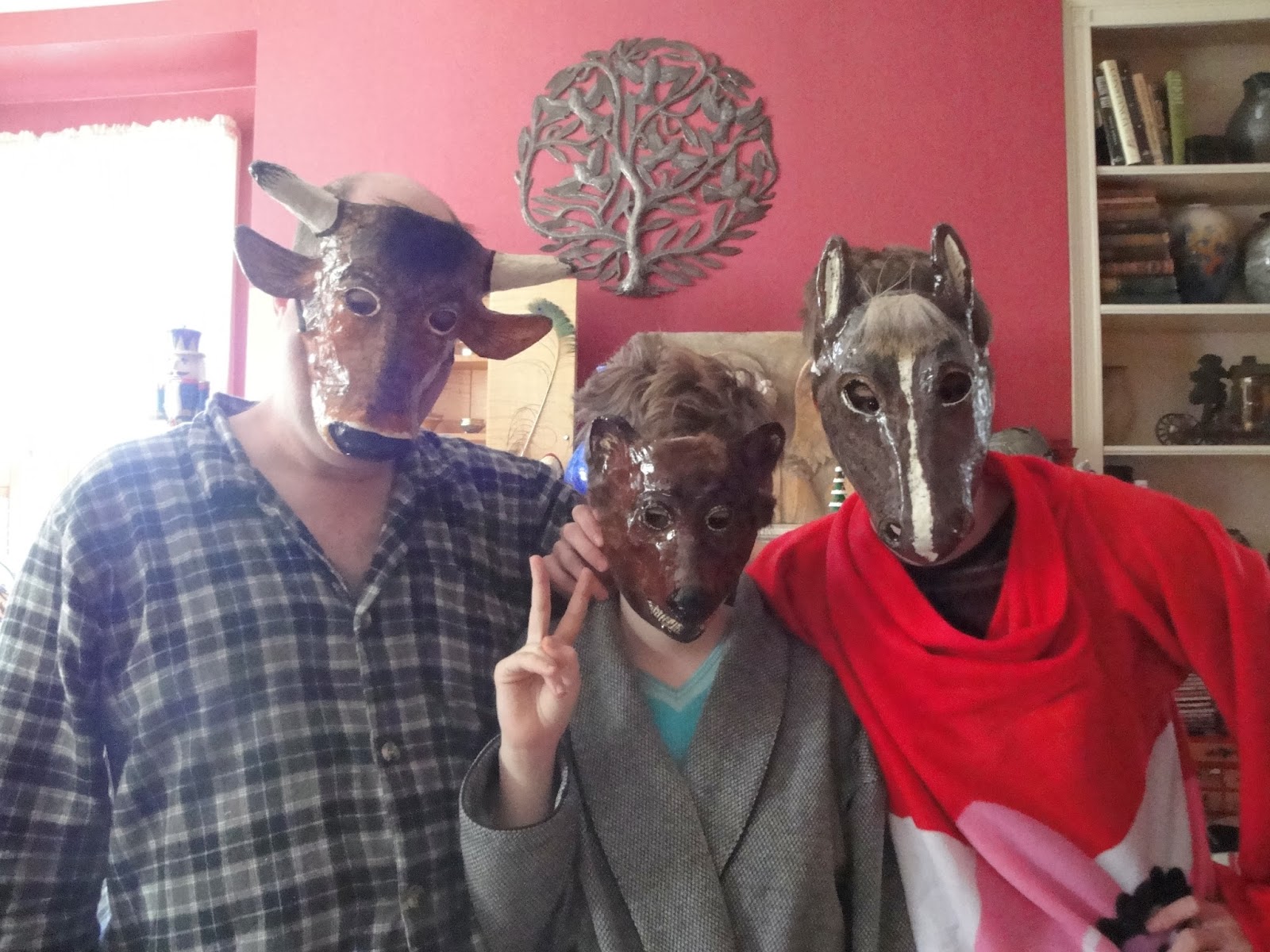
Child no. 3 in horse mask and silly Hello Kitty! snuggly given him by a classmate


Etsy's Jevgenia masks