NOTE:
SAFARI seems to no longer work
for comments...use another browser?
Showing posts with label Catherwood. Show all posts

Wednesday, November 30, 2016

Emily Barton on Catherwood

Farrar, Straus & Giroux, 1996
When a wonderful writer writes a essay about a book of mine that is more than twenty years old, well, I am more touched and grateful that I can easily express. It could not have come at a better time--a time when I, like Catherwood, have been wandering in a wilderness, though mine is not the same as hers but more the sort of Hansel and Gretel forest that a writer sometimes wanders when feeling particularly alone in the art.

It's a beautiful essay. Catherwood has (so I have been told) made many people cry, but only once has a piece about the book given me tears.

Thank you, Emily Barton.

Read the essay here, in Post Road Magazine.

Saturday, September 06, 2014

More "10 books"

Not a bull's head but a minotaur.
Clive Hicks-Jenkins
I love popping up on these lists. It's fun to be on one, and it's interesting to see what books are chosen. Here's the third one I've seen one of my books on, this one from Erica Eisdorfer, novelist and 35-year ruler of the Bull's Head Bookshop at UNC-Chapel Hill. That's an awful lot of service to words in the right order! Thanks, Erica.
Rules: In your status list ten books that changed your life in some way....

a. The Radetzky March by Joseph Roth
b. The Siege of Krishnapur by JG Farrell
c. Catherwood by Marly Youmans
d. Regeneration by Pat Barker
e. Wolf Hall by Hilary Mantel
f. Wet Nursing by Valerie Fildes
g. Buddenbrooks by Thomas Mann
h. Farmer Boy by Laura Ingalls
i. You Never Call! You Never Write: A History of the Jewish Mother by Joyce Antlerd.

Thursday, September 04, 2014

More "10 books that haunt me"

Farrar, Strauss and Giroux, 1995
paperback, Bard, 1996
Editions from Literary Guild, Claasen Verlag,
Editions Anne Carriere, Ediciones B. Also in braille.
Catherwood

Thanks to director/producer Stacy Title for including me on her "10 books that haunt me" list--I'm glad to be popping up in such places, and it's interesting to see preferences. (See Midori Snyder's list here, with a different book of mine. Midori writes fantasy and mythic fiction, as well as essays on folklore and myth.)
A Thousand Acres, Jane Smiley
Waiting for the Barbarians, Coetzee
A Good Man is Hard to Find, Flannery O'Connor
The Wasp Factory, Ian Banks
Paris Trout, Pete Dexter
The Child in Time, Ian McEwan
Shot in the Heart, Mikal Gilmore
Catherwood, Marly Youmans
The Man Who Mistook His Wife for a Hat, Oliver Sacks
Roman Fever, Edith Wharton.

"one of the glories of American fiction from the last 50 years" 
John Wilson, editor Books and Culture, June 11, 2014
  • FORTHCOMING in a new edition. The Farrar, Straus and Giroux hardcover, the large print hardcover, and the Bard Imprint (William Morrow) paperback are all out of print.
  • Book Club rights:  A Literary Guild Alternate Selection
  • Best Ten Books of 1996, The Spectator (Raleigh)
  • Best Books of 1996, The Anniston Star
  • Best Five Books of 1996, The Rocky Mountain News
  • Nominated for The National Book Award by Farrar, Straus and Giroux
More here.

Quote best befitting this frog-eating day:

If it's your job to eat a frog, it's best to do it first thing in the morning.
And If it's your job to eat two frogs, it's best to eat the biggest one first.
        --Mark Twain / Samuel Clemens

Wednesday, June 11, 2014

on Catherwood

"Mainly I want to get people reading that book, which is one of the glories of American fiction from the last 50 years."

            --John Wilson, editor of Books and Culture.
              On twitter, June 11, 2014 
New edition of Catherwood by the end of the year! Review clips, "best of" citations, and information on editions here.

Comment used by permission. I am once again grateful to someone never met in person, someone who has been a strong advocate for my books. Thank you.

Friday, May 16, 2014

Catherwood update / in-print books

Small vignette for Glimmerglass
by Clive Hicks-Jenkins
Catherwood

After the Entertainment Weekly tip-of-the-hat to "heartstopping" Catherwood, used book dealers sold a good many copies of the book--this, of course, was both lovely and a little frustrating, as I have in-print books that need homes and am planning on a new edition of Catherwood. I've decided to turn down (with many thanks, and after too much dithering on my part) some offers from publishers to reprint, and to experiment with doing the reprint myself in my so-far-imaginary free time. Despite the usual too-crammed schedule, I am aiming to have the book out in paper and ebook within a year.

And my books now in print--

See tabs above for reviews and other information on A Death at the White Camellia Orphanage (novel, winner of The Ferrol Sams Award and a Silver Award, ForeWord BOTYA), Thaliad ("exciting and heartbreaking myth of origin"), The Foliate Head, and The Throne of Psyche. The first two were both on the end-of-year 2012 Favorites at Books & Culture. The last two are poetry collections, and I'll let this quote recommend my work in that line:
Youmans is a traditionalist in her use of forms, and her work will delight those who enjoy classical poetry with direction and structure, yet her strong and inventive metaphors and similes evoke an otherness that only Coleridge attained....wholly beautiful and brilliant. Youmans is a writer of rare ability whose works will one day be studied by serious students of poetry. Greg Langley, The Baton Rouge Advocate
All four of these books were lucky to have exceptional designers--Burt and Burt of Macon, Georgia (who won an Addy for The Throne of Psyche), Elizabeth Adams in Montreal, and Andrew Wakelin in the UK--and several have beautiful art both within and without by Clive Hicks-Jenkins.

Tuesday, April 01, 2014

Up in the writing room--

Mary Boxley Bullington, Avian Adventures
over a Barbarous Land
. Acrylic and mixed
media 
collage, 22" x 22 1/2". Available.
If you don't know her work, go find her

on facebook. Mary's work is fluent and powered. 
by a great sluice of passion. I recommend it!
Labyrinthine tangles, or what's coming up in the writing room--

Although I have had Maze of Blood at the publishers for a year or two, accepted as was, I nevertheless got the wild wire to revised it and change the order around entirely. This is clearly madness but is now underway. We (me and my mad alter ego) hope it is a fruitful madness. I am going to spend some time getting my drifts of manuscripts into order this year. I have been saying that I would tweak The Aerenghast Game (a children's 3-in-1 novel) and send it out for some years, and I am now saying it again. Also, I must send out The Book of the Red King, which has been sitting around, retting in a flax pond, and needs only a mild scutching and hackling, or swingling, or something. Then I have to get some of these untidy heaps of poems in some kind of order. Best of all, I have an idea for a novel that I am just a wee bit nuts about--if I can only find time (or a maid and secretary, plus a chauffeur for child no. 3. Don't all volunteer at once--stampedes can be dangerous.)

Mary Boxley Bullington, Come Dog Days, Snake
Makes his Get-Away.
Acrylic, gesso, India
ink on 
paper, 19" x 22." All paintings 

shown here are available for purchase... 
Glimmerglass, trala,
is next up on the publication schedule. Please check out the tab above. The muse. The house in the hill. Labyrinths. Somnium. Love and dangers. And more art by Clive Hicks-Jenkins. Of course!

Note to moguls, moles, gulls, etc.--

You know, having the teensiest little fannish mention in Entertainment Weekly really moved some books--some out of print books, that is, particularly Catherwood and the two Adantis books. What I'd really like is for all you Hollywood types with bags of money to go purchase some of my in-print books. They make grand gifts. Y'all hear? That means the books on the tabs above that say 2011 or 2012... People who like to fantasize about such things tell me that A Death at the White Camellia Orphanage and Thaliad would make great movies. I'm always surprised when they say it about Thaliad because it's a long blank verse adventure! That's like making something like--oh, I don't know--Beowulf into a movie. Only with more adventures and female roles. I don't ever fantasize about anything happening to my books because that way leads an unpleasant kind of madness (as opposed to a Maze-of-Blood-retweaking kind of madness!) P. S. You never know, a lyric poem or narrative might be a good movie--better pick up The Foliate Head and The Throne of Psyche while you're at it!  (✿◠‿◠)


Mary Boxley Bullington, Only Last April.
Acrylic, gesso, oil pastel, India ink,
watercolor 
and collage on rag paper,
22" x 22." Available for purchase.

My reading

I've been very busy and so am listening to some books this week, which I find is a challenge--I'm too used to being able to back up a paragraph and reread... But in this pellmell way I have just finished Chesterton's A Short History of England and am now listening to Ruskin's Lectures on Landscape.

April Fool's Day

No tricks this year--I am my own April Fool, and the closest I come here is the fantastic idea of moguls reading my blog! Happy day, all who tilt--as I do--with their own foolishness.

Mary Boxley Bullington, open studio day, Roanoke

Saturday, March 15, 2014

"Entertainment Weekly," loving "Catherwood"--

CATHERWOOD. Marly Youmans. A heart-stopping novel about a mother lost in the woods with her 1-year-old. It's insanity that no one's made a movie out of this. Entertainment Weekly, p. 42.  March 14, 2014
And here it is again as part of Entertainment Weekly's  "10 Most Criminally Underrated Books." Click and see! And thank you very much, EW staff.
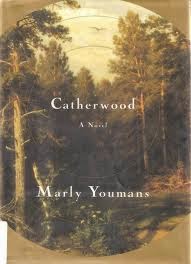
Farrar, Straus and Giroux edition
The publishing history of Catherwood (Farrar, Straus and Giroux, 1996) is that it arrived at FSG on a Monday and was bought for a first edition hardcover by editor Elizabeth Dyssegaard two mornings later. That's fast. I always felt that it was a great triumph to make a Danish executive editor stay up late and weep. It went into paperback with the newly-revived Bard imprint (but subsequently HarperCollins collapsed and restructured, so that was the end of Bard.) And the book was translated into Spanish, French, and German. One month my agent had a rush of seven queries about movie rights and then sold one-year rights to director Stacey Title and actor Jonathan Penner, but they didn't raise quite enough money for the project. Still, I was innocent enough to dream that everything would be easy from then on. The book was a Literary Guild alternate and had splendid reviews in splendid places, some of which you may see here.

Hat tips:
Bard edition

Thank you to publisher/editor Gordon Van Gelder of The Magazine of Fantasy and Science Fiction for telling writer Jeffrey Ford about this and asking him to send on the word, and then for sending me a xerox so I could see for myself. Either Cooperstown does not carry Entertainment Weekly, or else it sells out immediately!

Also, thank you to writer Melinda Jane Harrison for telling me what was in the text while I was still curious. Because a person--this person--is always curious. Thank you to Gary Dietz for the online link. And thanks to all you others who wrote to tell me!

Friday, December 06, 2013

Catherwood, again...

Photograph by Paul Digby: seedhead of a hearts a-bustin',
taken on my mother's mountaintop in Cullowhee, NC, August 2013.
So glad that Sienna Latham followed me on twitter today and left me a link to her lovely, long review of Catherwood.  One of the magic things about the internet is that a mid-list book once considered out of print and "done" keeps getting attention, almost twenty years after first publication (Farrar, Straus & Giroux, 1996.)

Another thing is that authors can put books back into circulation through ebooks. But what I'm most pleased about is that Catherwood is coming back as a paperback from Mercer University Press. When a book comes back out of print because a publisher wants the reprint, it's always a good sign.

Currently in print are A Death at the White Camellia Orphanage, Thaliad, The Foliate Head, and The Throne of Psyche (see tabs above.) Forthcoming are Glimmerglass and Maze of Blood. Perhaps I'll do an in-print post since it's that book-nabbing time of year . . .

Sunday, December 02, 2012

Small horn toot for Catherwood--

Trala, Catherwood is coming! (The novel was originally published by Farrar, Straus & Giroux in 1996, and afterward by the Bard imprint and in French, Spanish, and German translation. And Braille...) I was just writing some materials and packaging up review clips and so on for Mercer. I am so glad. It's always a good sign when publishers want to bring one's out-of-print books back into print. I've kept the ebook rights for myself, so it'll be a physical book. And the rebirth of a book seems like a good thing to announce on the first Sunday of Advent.

Monday, November 26, 2012

Book promises

Contracts on my mind...

I've just had two requests for story reprints, so that's pleasant.

And today I shall send back three book contracts with some amendments but signed. I've taken a long time to finalized these, and have dithered a good deal. That's what comes of not bothering to get another agent and yet hating to do business. I'm keeping ebook rights and a few others.

FSG, 1996
One of these contracts means that Catherwood will be back in print. Catherwood was doing quite nicely in the way of finding readers and had moved from the Farrar, Straus and Giroux hardcover to the newly revived Bard imprint when the HarperCollins implosion (that's what comes of eating too much, HarperCollins!) took down many imprints, including Bard. I felt it as a great disappointment, one that was followed by my next book being delayed to days after 9-11. I do have the luck, don't I?

Then there's Glimmerglass, a somewhat fantastical book with many threads--growing older, failure and renewal, chasing the Muse, love and marriage, siblings, murderous impulses, a flood, and more. Despite being somewhere on the continuum between what is called realism and what is called speculative fiction, the setting is nonetheless identifiable as a version of Cooperstown. Parts take place in and under the lake, in a wonderful little gate house that I've called the "Seven Dwarves House" because it has seven doors, and in an imaginary great house not so terribly different from others around the lake. And yet, in one key way, terribly different...

And last is Maze of Blooda book loosely based on the deep-South life and times of that unusual boy and man, pulp writer Robert Howard, with faux-Howard pieces interspersed, and to some degree channeling my hot summer weeks near Lexsy and in Collins, Georgia. I know that boy and his strangeness, and I know that hot Southern world, so I had great fun frolicking with him.

So I am sticking with Mercer for my 12th and 13th books, and by then I will have four first editions with them, a number that rivals my four with Farrar, Straus & Giroux, with lovely acquiring editors Elisabeth Dyssegaard and Robbie Mayes. And I suppose that will mean having the stellar team of Burt and Burt again as book designers. The pair designed A Death at the White Camellia Orphanage (Mercer, 2012) and The Throne of Psyche (Mercer, 2011.)

That reminds me, I haven't mailed my Thaliad contract, and the book's almost out. Coming!

Wednesday, February 22, 2012

Writing the past

WRITING THE TIME-PLACE

Writer Robert Freeman Wexler asked me for any tips on research, as he is planning a novel set in the past.  Though I imagine he has quite as much common sense as I do, nevertheless I sent him a few thoughts and now post them here for any other interested parties:

Research/writing tips for stories with historical settings:
 1. Think of time as a place you can enter. Don't notice any more of it that you would of: a. any new place your observer might see, if seeing for the first time; or, rather differently, b. any usual place your observer might see.
2. Keeping 1 in mind, don't overdo the research, or you may feel compelled to use it.
3. Use primary sources when possible.
4. Use secondary sources when you need to know a general tendency--as, what the typical house structure was for a particular time and place and class, naming ways through generations in a certain region, etc.
5. When moving from research to writing, resist like mad any "namedropping" tendency. That is, do not attempt to prove that you are in a particular place and time by stuffing in references to Mae West or how to make yak butter or the seeds commonly found in the belly of a bog body or any other fascinating tidbits unless they make sense to mention in the context.

Update:  I completely forgot this! Park any P. C. sensibility at the door. Don't pay any attention to -isms, or you will write a novel that has modern people running about in supposedly past times. Many a big literary seller has done just that, even books beloved of many critics. I once caught some flak from a sf/f reviewer about a children's novel, The Curse of the Raven Mocker, because the people of Adantis aren't so keen on girls wearing dresses. But the culture ways of the Adantans are specifically drawn from a mixture of nineteenth-century Scots-Irish settler and Cherokee culture ways. Time has not treated them quite the same way as the rest of us, and so many elements are unchanged or changed in a different way from the way ours have changed. So stick to your time and don't pay a whit of attention to fashionable contemporary sensibilities.

WRITING THE DEPRESSION

My steaming-into-the-station book, A Death at the White Camellia Orphanage, is set in a time not all that far away and so rather different from Catherwood and The Wolf Pit. It's about the same kind of distance that Thackeray had to stretch in writing Vanity Fair, I suppose. While I did not live in the Depression, my elder relatives certainly did, and I grew up hearing stories that often involved hardship. I spent part of my summers in a house that was etched with deprivation, and which I used in great detail in the book. But there were a lot of other details to look up--bits about trains and signals, hobo signs, eucalyptus trees, con men, and more.

JUST PLAIN WRITING

Of course, after twenty minutes staring at Pinterest, I have a cheap revelation that everyone does now have 15 minutes of fame, that reading is dead, that Melvillean "deep diving" is absurd, that time is frittered and wisdom extinct, etcetera! An hour afterward I recover and think that perhaps I had better put on my diving gear and go write a poem.

'Night.

Thursday, February 09, 2012

Forthcoming Books

One of the many foliate heads painted by Clive Hicks-Jenkins...
Choosing a cover will be hard!

For various reasons--the global economy and far-off pub dates that hampered me from arranging North American reprints--I have made a number of changes in my publishing schedule, both the when and the who.  

POETRY
The Foliate Head - Stanza Press (UK)
Thaliad - Phoenicia Publishing (Montreal, CA)

NOVELS
Glimmerglass - Mercer University Press
Maze of Blood - Mercer University Press

REPRINT
Catherwood - Mercer University Press

Tuesday, April 05, 2011

The House of Words (no. 11): One writer's lessons

"Buying a book," courtesy of photographer Herman Brinkman
of Amsterdam, the Netherlands, and sxc.hu.
Doing What You Want to Do, continued
Question for the day: Is there something to be learned from one writer's experience?

At this juncture, I am fairly confident that I will continue to be able to publish the books I want to write. I’m not promising where I will publish. I have three books of poetry and three novels forthcoming, and not one is at a major New York City house. I can’t say that I tried too hard to stay in New York, as I have shown exactly one manuscript to exactly two big houses in the past few years. One of the editors liked my books and asked to read a certain manuscript and then wanted to buy. In the end, she gave me the lowdown on the increasing commercialism in New York and her own lack of control over what she could buy. The other gave me a fairly usual rejection. I didn’t bother beyond those two.

Side note about publishing: I find that most book-manuscript rejections are flattering. Don’t let it influence your mind. Don’t get carried away. Nothing in publishing matters until it matters.*

Why have I gone elsewhere? Having parted with my agent, I somehow didn’t want to bother struggling in the city. None of my books to date had received a push. Catherwood was the only one selling wonderfully well at any time.  But that time happened to be just after it had just gone out of hardcover at Farrar, Straus & Giroux and into paperback at Bard, an old literary imprint that had been newly revived. Then HarperCollins imploded and took down many books and whole lines, including Bard. So I was in a situation where it seemed that the big boys had never done more for me than any hardworking smaller house. I was glad to have been on prestigious lists, sure, but my books had remained rather obscure. When I received a flurry of requests for manuscripts from outside of New York, I was ready to accept some of them. More metanoia.

A side note about publishing with a house: expect bumps. Expect disasters, small or large, because your book depends on a publishng and distribution machine and other people who have lives and goals of their own. Also, it is part of time and our human calendar—events that appear to have nothing to do with books affect the visibility and selling of books.

Should I be pleased about where I am? I have a book of poetry and a novel forthcoming at a rising university press that has decided to build a literary line. One of them was given a prize by an outside judge. The Throne of Psyche will appear shortly, and I was very taken with the design. Three books are forthcoming in the UK, where I hope to have more of a presence than I do now. I can reprint those later on in the U. S. And I have a book forthcoming in Canada. The only thing that I’ve ever published there prior to this is a translation of one of my books.

All of these books (and other requests, some that didn’t quite fit me) came out of editors and publishers liking my work and asking to see more or inviting me to submit. I love that. I just plain love it.

What are the worst things about where I am now?

A lot of the older books are out of print. Right now I'm working on obtaining a reprint of Catherwood. Because I haven't experienced that old-fashioned publisher's effort to build a readership for a writer and because I have worked in many different forms, I tend to feel a little uncertain about whether my readers will follow me into new or more unusual territory. (I tend to move about a lot in both subject matter and form, a thing publishers do not love, though it makes life more interesting. And alas, poetry seems to be unusual territory for many people these days!)

What’s the best thing about loving it and where I am now?

I wrote the stories and novels and poems that I wanted to write and gave me joy in the act of writing.

I wrote what I wanted to read.

As a result of a clear prior track in the world, I managed to be lazy about placing books and yet everything turned out fine.

All anybody can say about publishing comes from experience. My experience has been mixed. But most people’s experience is mixed. That's from the simple and inevitable fact that most writers don't have lead books, and therefore they are not at the forefront of the publisher's concern.

What can we take from one writer's experience, as readers or writers?

If you are a reader and you buy a book that is not a lead book and not perched anywhere near the bestseller list, you are making a statement and placing a vote that will affect both writer and publisher. Every book purchase counts. Every book purchase says you want to read a certain writer and that the publisher should have confidence in him or her. In the case of poetry, a modicum of readers voting this way may even mean that a house decides to retain its poetry line rather than jettisoning it. I was told that if each poetry book in a certain smallish house had managed to sell 300 copies, the house would not have gotten rid of the line. 300! Skip lunch out once, and you can vote for a book.

If you write and publish, be prepared for things to go otherwise than dreamed or planned.

If you are a writer passionate about words and storytelling rather that "product" and "market," hang onto your heart and soul. Don’t sell them down the river. Because if you do, a day may just come when you wish with all your being that you had written exactly what you wanted to write and wanted to read.


*The very same thing goes for movie rights. Does not matter until it matters. You sell rights? Still doesn’t matter, though the spare change is welcome. Set to film? I have a friend whose book was six weeks from shooting with a major star signed on for the lead. Six weeks out, the whole thing fell apart. Does not matter until it matters.