NOTE:
SAFARI seems to no longer work
for comments...use another browser?
Showing posts with label sculpture. Show all posts

Tuesday, February 11, 2014

The man in whitey-tighties--

Source: WHDH, New York Daily News

Looking

Let's talk some more about the man in whitey-tighties on the Wellesley campus. Because I somehow don't think that we've been talking about the right things when we talk about that man, created by Tony Matelli, maker of hyper-realistic sculptures.

You know, I'm glad when people are talking about art in any of its forms, but sometimes that conversation leads into the strangest places. I won't get into that--what's the use? I read the news this morning, all the time thinking about Orwell and Solzhenitsyn, and so I know quite well there is no use in arguing with some of the absurd things said about the sculpture.

Instead, I want to think about the sculpture and see what it is without being influenced by what has been said about the piece and without even having a notion that politically correct thought still rules our world and tells us what to say. I want to think my own thoughts and come to my own conclusions without one jot of influence from the outer world.

In fact, I will look at the sculpture from several different angles. In all of these, I'll try not to be reductive. The chiding comments I've seen about the piece tend toward a not-very-rigorous feminist, academic response and reduce the sculpture to something very narrow, and they certainly don't show art can be myriad in its implications. They attempt to deprive the sculpture of any mystery or strangeness.

What does it mean to show someone walking in sleep?

Here is a sleepwalker. In my head is a great deal on the subject from a man who insisted on living on his own terms, Henry  David Thoreau. I like him, prickly fellow though he is. He's one of my many soul mates in the arts, even though he wouldn't particularly want me to feel so. "Morning is when I am awake and there is a dawn in me," he says. We need "infinite expectation of the dawn," lest we be like most people, the "sleepers" of the rail bed that modernity and industrialization race over:
If we do not get out sleepers, and forge rails, and devote days and nights to the work, but go to tinkering upon our lives to improve them, who will build railroads? And if railroads are not built, how shall we get to heaven in season? But if we stay at home and mind our business, who will want railroads? We do not ride on the railroad; it rides upon us. Did you ever think what those sleepers are that underlie the railroad? Each one is a man, an Irishman, or a Yankee man. The rails are laid on them, and they are covered with sand, and the cars run smoothly over them. They are sound sleepers, I assure you. And every few years a new lot is laid down and run over; so that, if some have the pleasure of riding on a rail, others have the misfortune to be ridden upon. And when they run over a man that is walking in his sleep, a supernumerary sleeper in the wrong position, and wake him up, they suddenly stop the cars, and make a hue and cry about it, as if this were an exception. I am glad to know that it takes a gang of men for every five miles to keep the sleepers down and level in their beds as it is, for this is a sign that they may sometime get up again.
So we have a sculpture of a man, and he is asleep but helpless, hands out. Well, "sleepwalking through life" is a familiar idea. Sleepwalkers have long been an image of a kind of lost shamble through the days that is not uncommon but sad; sometimes sleepwalking can describe a passage in life in which one feels lost and uncertain. The sculpture portrays a man who is, indeed, sleepwalking through the busy--and, we hope, awake--life going on around him, as well as sleepwalking through his own life. Thinking of Thoreau, we can hope that he is struggling to walk, to get somewhere, to wake up!

If I consider the idea of sleepwalking, I tend to see that the figure is, in fact, a pitiable figure, one of those people Thoreau wished to wake. But that's not the only way of looking at the sculpture.

Side note on Thoreau and young women

Interestingly, Thoreau found that young women were among the very few who "improved their time" in the woods and found something worth the search. They were not biased; they were free and curious and could enjoy surprise, even if it was the small beauty of a colored leaf. Why do I mention it? Because there has been a radical gap between those on campus who react whimsically to the statue and those who are outraged, and that is . . . interesting.

Zombies side note

I notice that journalists can't help comparing the figure to a zombie. I suppose this is a natural enough result of the stance, but it's silly to let zombie fashion get in the way of your eyesight and your brain, which has not yet been eaten. I'm not a fan of the way journalists have shaped the story and don't think it has done much good for Wellesley women or for art.

What does his physical appearance say?

Details of the figure's appearance just might have something to say to us. The Matelli sculpture is a bit paunchy, isn't he? No washboard abs here. The man's not fashionably shaven-headed but a victim (everybody's a victim of something these days) of male pattern baldness. Despite what has been said by those who peer through the lens of political correctness, he is not a frightening shape but a more pathetic one, vulnerable and naked. He wears whitey-tighties and so is clearly out of fashion, even when he goes bed. It's hard to determine his exact age in many photographs because his face is slack with sleep, but he appears to be in the zone of middle-age. His hands look older than the rest of him and are a more accurate gauge.

More than simply a target as "white male," he's an Everyman groping his way, betrayed to our gaze in his semi-nakedness.

Unfashionable side note 

So why is the unfashionable so threatening to the young women of Wellesley--the fashionable, the trendy, the young and hip, the cutting edge, the future of our world? What any answer implies is that the unfashionable stands for things that are directly opposed to the fashionable. Different values. Different virtues. Differences. A gap.

How does the sculpture relate to its world?

Another way of seeing depends on context (although it relates to the idea of the unfashionable.) I'm thinking about where the artist chose to place him and what that choice might mean.

Set in the context of a women's college campus, who is he most like? Not the young women. Nor, I would hope, like their professors, though not every teacher is awake. No doubt one or two (I hope no more!) are sleepwalking.

But the Matelli man invokes one thing more than anything else. Parents. He is most like the average, unfashionable, mildly paunchy, balding everyman called Daddy, the man who climbs on the treadmill of labor every day and struggles along with his wife to pay a child's daunting bills for annual tuition and room and board at a private American college in A. D. 2014. (Sure, parents are varied in class and race, and some students are on scholarship. Yet he's still Everyman, exposed in all his and our mortal vulnerability.) For some daughter he may even be a nemesis like Plath's "marble-heavy" Daddy, "ghastly statue with one gray toe." But it's no surprise that he's a shock, an abomination, a trigger: he's our very own.

Myriad-minded art

A piece of art is, or should be, suggestible. In whatever form it appears (and whether you like it or not), art is not a thing to tame, to tie down, to reduce. Allow the work to have as much wildness and as much myriad-minded meaning as it can win for itself--the amount will vary, depending on the artist.

Matelli notes that students are "misconstruing" his work. Misunderstandings about art occur daily, hourly, constantly, though they don't usually make the national news. This curious instance reminds me that Yeats asked of university students protesting against literature in his own country, "Where, where but here have Pride and Truth, / That long to give themselves for wage, / To shake their wicked sides at youth / Restraining reckless middle-age?" Where? Here.

Thursday, December 23, 2010

12 Readings in Advent: Mountshang

Detail of a Moses by Phillippe de Champaigne (1602-1674)

"It's the high-level of orderliness that is so distinctive -- reaching down into the structures of appearance (light over skin over flesh over bone)and composing them into sweet, poignant chamber music --- that is so fine in the detail and so grand in overall effect. Can you really see this Moses leading an illiterate rabble of fleeing slaves accross the desert ? This is an intelligent, sensitive scholar of the 17th Century, pondering the great spiritual issues of his time."

MOUNTSHANG

Today I am going to recommend a blog that has been in existence for years but is, to my mind, under-visited: Mountshang, located at http://www.mountshang.blogspot.com/. Chris Miller has some fifteen blogs, covering various fascinations and passions, so it would not be surprising to find that some were visited more than others. I like Mountshang very much. Chris goes to see exhibitions in Chicago and reviews them, regularly going out and bringing back the goods in the form of many photographs and opinions about the work. He is funny. He is irreverent. He takes curators to task. He takes artists to task. He occasionally takes people to task in every aspect of life and makes sweeping judgments. He is a distinct figure, drawn sharply in his loves and peeves. In other words, he is wonderfully opinionated. I don’t always agree with his opinions, but that’s not the point. They are stimulating opinions that make me question what I think. When I climb the mount and visit with him, I encounter an astonishing number of visual artists whose work I would never know existed were it not for Chris and his great job of both hunting and gathering.

CHRIS MILLER’S SELF-DESCRIPTION

I live life dangerously by ignoring the advice of Chuang Tzu: "Your life has a limit but knowledge has none. If you use what is limited to pursue what has no limit, you will be in danger". Badly spoiled by my wife, I spend mornings in sculpture studio, afternoons in record shop, evenings on the internet, weekends at the Palette and Chisel Academy and Art Institute of Chicago, and, the time spent in between, reading ancient history."

FORM:

He gives us tons of pictures. His prose appears in a quirky mode that looks rather like free verse but is more interesting than a lot of free verse.

ENTERTAINING SAMPLE COMMENT FROM A POST:

Copeland Burg (1889-1961)

What a fun story!

Copeland Burg was a crime reporter
who started dabbling in art,
attacked Mrs. Logan's "Sanity in Art" screed,
and was told by his boss to
"Stick to rape and murder"

And his father
was a circuit judge
who was lynched by ranchers
in Montana?

No wonder his life was so confusing,
and eventually,
he quit his day job at the newspaper,
and just spent his life painting.

Not all of his pieces
are quite as minimalist
as the one shown above

ANOTHER SAMPLE, WITH UNEXPECTED OPINIONS:

Andre Masson (1896-1987)

Here's the kind of nightmarish stuff
I really can't stand.

Except that -- I couldn't stop
looking at it,
like this creepy statue [links elsewhere]
from the Aztec empire.

Jamie Adams

Here's a huge painting
that was hard to ignore,
perhaps because of those
"superficial skills that denote art"

As a viewer,
I feel like John Belushi in "Animal House,"
peering through the window
of a sorority house.

Oh no!

The ladder is starting to fall backward!

ANOTHER SAMPLE SHOWING HIS LOVE-HATE RELATIONSHIP
WITH THE ART INSTITUTE OF CHICAGO:

Perhaps I'll calm down
in a few months,
but the only word
I can find for the new
Roger L. Weston Wing
of Japanese art
at the Art Institute of Chicago
is
Disaster

And I could kick myself
for not photo-documenting
the display that it replaces.

Perhaps it's only sentimentality
that attaches me to the
quiet, meditative space that
the museum's collection of
Medieval Japanese sculpture
used to inhabit.

But I think that Cleo Nichols,
who designed the space in 1992,
successfully solved the problems
involved in displaying a diverse collection
of Buddhist sculpture
that originated in many different
centuries and temples,
and cramming it all into a small,
but aesthetically pleasing space.

The key, I think,
was letting one statue sit freely
on a platform in the center of the room
protected by a railing instead of a glass case,
allowing it to command the space of the room;
then setting the other sculptures into
glass protected niches set into the
surrounding walls;
and leaving the whole room dark,
with dramatic lighting on each statue.

Now,
as you can see at the top,
the pieces have been set into
glass display cases that protrude into the room,
making the entire display
feel like those cases
of ethnic paraphernalia
that used to be found
in the Field Museum of Natural History
(back before they updated their displays)

The sense of sacred space is gone.

And the room feels dry, dead, and clinical.

(though maybe that's O.K.
for displaying the pre-Buddhist
tomb effigies that are shown above.
After all, those pieces were made for a crypt,
not a shrine)

Thankfully,
they mostly left the Ando Gallery alone,
except that even there
they damaged it
by removing the heavy glass doors
that used to seal it off and make it feel
like such a quiet, secluded place,
that was part of Japan
instead part of an art museum.

What was the head designer,
Kulapat Yantrasast,
thinking about
as he made these woeful changes?

And as final slap
in the face
of anyone who enjoys
the rest of Asian art,
the Chinese painting and Korean ceramics
that used to be located in this area
have been removed,
while announcing that:

“The movement of several collections into the Modern
Wing last year has allowed us to better demonstrate our commitment to the arts of Asia by reworking existing galleries and creating new galleries for their display"

A statement which would only come true
if some of that new space
were ever used to display the Asian art
that was taken off view
to make room for the Japanese.

But I think that
no more new space is left.

It's all been taken
by the new galleries
of African and Pre-Columbian art.

But now that I've vented my disappointment,
here's some of the good stuff
that has been put on display here
for the very first time.

Much of it coming from the collection
of Roger L. Weston.

AND MORE ART INSTITUTE:

Here's one the signature pieces of contemporary art
that will be on display for a very long time
(it's too big to be moved,
and had to be installed before the building
was finished)

Do you notice what has drawn the attention of the crowd?

The label.

Because without that label's explanation,
who would give a second thought to this
meticulous reproduction of a rotting log?
(commissioned by Charles Ray)

And the light in the gallery is so dim and flat,
if the carving on that log were actually beautiful,
you would never know it.

(I've noted elsewhere that visitors are liable to trip over it --
and apparently this keeps the guards very busy)

More contemporary art
from the second floor (1950-present)

This pattern was repeated,
like wallpaper,
over an entire small room.

Got it?

Something about racism and national guilt.
If you can't figure it out,
read the label.

CHRIS AND FAMILY:

Chris appears to have grown up in a colorful family. His father was Midwest artist (sculptor, primarily, I believe, but also printmaker and painter) and important teacher-to-sculptors R. J. Miller, who appears to have a colorful, salty way of addressing the world that no doubt infected young Chris with the ability of making pithy and sometimes devastating remarks. Dick Miller was student of Milton Horn. He kept learning new technologies and modes and later designed sculptures via computer design. Chris is just as sharp on his father’s work as with anybody else’s, by the by. Evidently Chris has what his father called (with approbation) a “wild head.”

HOW ABOUT A LITTLE BITE MORE?

Rushing out of the modern wing in anger,
I come across one of its benefits:

a new (though small) area
devoted to Medieval Islamic ceramics
and painting.

Ahhhh -- the visual delights of work
that does not require
explanatory text!

Athough much of the space vacated by modern painting
has been filled with the new
"Eloise W. Martin Galleries of European Decorative Art"
... i.e. a lot of furniture, with some ceramics,
most of which fails to excite me.

Which reminds me
of one final question:

why is the museum director (James Cuno)
called
"The Eloise W. Martin Director" of the Art Institute?

Shouldn't he be called
"The People of Chicago Director" of the Art Institute?

I mean.....

how can the Eloise W. Martin Director
say "No"
to Eloise W. Martin ?

CHRIS, CHRIS, CHRIS—

How we relish you, you impetuous boy of . . . sixty or thereabouts! The Art Institute staff is probably fuming mad at him, but the truth is that he is its greatest lover in his own curious way.

I love people, I love energy of personality, I love character: Chris is character writ large.

Saturday, January 27, 2007

In the Realm of the Mouse Warrior: Jeff de Boer


Jeff de Boer is a one-man refutation to the sometimes-voiced idea that Canada is boring and staid (Not by me—Canada and I are pals. Vancouver! marvelous Montreal! Quebec City! I am a fan of even you, Ottawa, despite the fact that you infected me with a powerful alien snow virus during your winter festival.)

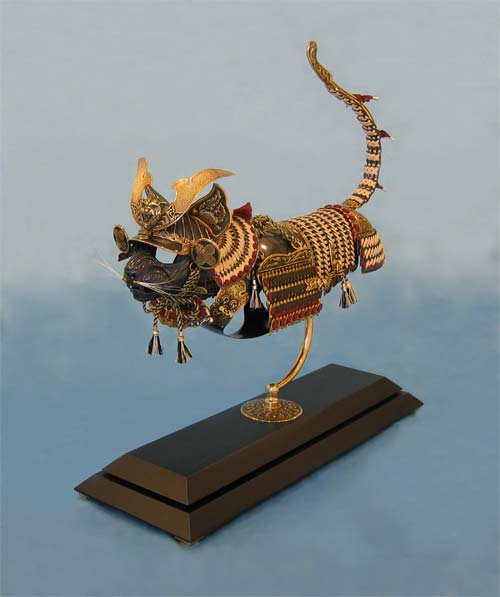
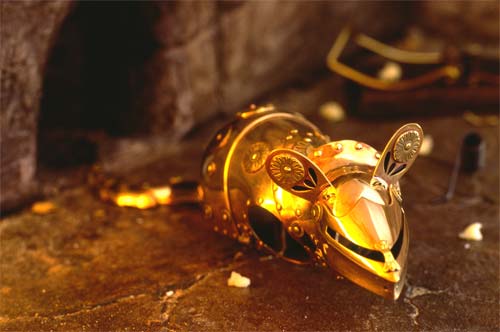
Jeff had a tinsmith father and made his first suit of metal armor in high school. In art school in Alberta he made his first suit of armor for a mouse. (Did I say that I love obsessed children? I do, having been one—and I am a mother. I have met obsession again in my own children.) Jeff has made many more mice-suits since then. These are not visual puns but elaborate “parade armor” that contains little crooks and corners and sweeps of beauty. No doubt those tiny internal gestures led to his later Exoforms, just as the playfulness led to his ray guns, rocket lamps, and large scale play and flourish.

In an alternate universe, these suits would be and perhaps are treasured by warrior mice—just as his samurai armor for cats would be and perhaps are coveted by those mighty mouse-hunters, the cats. One glance at these cunning, lovely little objects lets such a world spring into active life. Every year the maker is drawn to design a few more. In another realm, it is 2:00 a.m. and small wizardly mice are sending all their most wizardly thoughts to this one, shedding them onto Jeff de Boer. Surely he will make another under their spell, more surprising than any seen before!

His armor for executives transforms this world, reminds us of the small hammered links to the past. It reminds us that ordinary people, too, are engaged in battles and the over-toppling of kingdoms. The scabbard case, the catapult, the ringing metal of the tie stop the clock, break in and throw a bolt into the workings of the daily grind.

I like these things because they are surprising and finely crafted and show a sensibility at play and work. Further, I like them because they show how absolutely wondrous it can be to be a human being—deeply involved, in command of one’s tools, a bit quirky and frolicsome, springing forth with new ideas.

***

The mouse and cat armor pictures are from http://www.jeffdeboer.com/. As his email doesn’t seem to be working, I have basely pillaged the armor images, in the manner of a large feral cat from another universe. Also in the manner of a delicate, fierce, otherworldly mouse. Do not try to excuse them. They were barbarian warriors and had the need.

***


Sunday, November 12, 2006

Sticks

Sticks.
Favorite silly quote of the week
My children are 1/16th Akwesasne Mohawk, and so they have a special interest when Iroquois pop up in schoolwork.
The Daddy, asking study sheet questions: How did joining the Iroquois League help the Mohawks?
N, age 9: Better technology.
D: How’s that?
N: Sharper sticks.
***
The Akwesasne Mohawks did not join. They were fire-spirited Iroquois, once upon a time, and did not care for nation-building. But they liked sharp sticks.

More sticks.
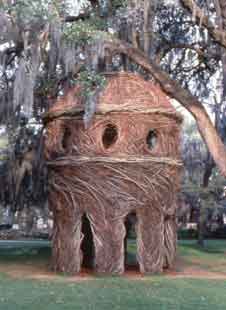
One of my favorite North Carolina artists is the withie-man, Patrick Dougherty. Evidently he was inspired by the forests around Southern Pines, where he grew up. They strike me as very "sticky" places. I've seen some of his creations in Raleigh and Carrboro. I just had a pleasant little fantasy that he came to visit and made us a little castle and village in the backyard. Then there would be four castles in Cooperstown. If you don’t know his magic cities and withie gyres and leaning towers, go indulge your wanderlust. The picture is borrowed from his sticky site, www.stickwork.net/.

***


Sticks to come.
Next week the gigantic ash tree comes down. Sad for the ash, sad for the dratted old pocketbook. I’ll have to write a poem for the extravagant creature. Three times it dropped an enormous branch on the lawn, one filling up the entire back yard. A fourth time it speared a large branch through the driver’s side of the windshield, about thirty seconds after I paused at the back door, thinking the day a bit windy. Life is so full of near misses: I'm very glad not to have been an ash-tree's shish kabob. I’d like to make a Dougherty house out of its no-doubt astonishing remains, but I’m only 5’3” and have nary a stick of scaffolding.

By stick, by stone, I am surprised!
I have been elevated! Poet and web-dreamer Michael Burch (another Southerner, by the by) wrote me that I am now not only a “Spotlight” poet for the month but also one of the permanently “featured” poets on The HyperTexts. Thanks, Mike!

Last stick
N’s silly 4th-grade joke, acquired at summer camp: What’s brown and sticky? A stick.

Wednesday, June 21, 2006

One Day Closer to Paradise

Exhibit 1201

Among the assorted notes and debris in my box this morning, I found an Opinion Journal (WSJ) article by Lionel Shriver, author of We Need to Talk About Kevin (HarperPerennial, 2004) and winner of The Orange Prize. It is an interesting little commentary on the state of art, rather like the tales of janitors sweeping up an exhibit or mistaking an artwork for trash left by a visitor at the Tate Modern.

It seems a hastily-prepared plinth was separated from the sculpture it was intended to support. The head, a work demanding two months of careful attention from sculptor David Hensel, was rejected by the Royal Academy. The plinth and the head's little boxwood prop were accepted as "Exhibit 1201."

Here's the good and the bad news, as Lionel Shriver sees it: "For those who despair that artists these days seem to have lost the skill of fashioning meticulously crafted objects, don't blame Mr. Hensel. While the slate base took only four hours to hack from a mortuary slab, and the little boxwood prop less than an hour, he had painstakingly carved and polished that laughing head for two months. But alas, the sculpture itself has--shudder--emotional content. It was originally christened 'One Day Closer to Paradise,' a far too expressive title; Mr. Hensel would have been better off with the portentously enigmatic 'Exhibit 1201.' His laughing head is not only fatally well rendered, but exudes a sense of joy and hilarity, and the overtly evocative is declassé."

We are not amused! We are not amused!

As has been pointed out before, all parody dies in this constricted, airless view of art. Shriver offers an example: "Me, I just put a brick on my desk. I gaze in wonderment at the contrast in textures--the smooth, unyielding sides of the brick, the rough, almost sexual crumble on its chipped corner, the humbler, more submissive sensuality of the scarred plywood desktop. I marvel at the fierce, affirmative perpendicular of the brick, in firm opposition to the languid, taciturn serenity of the lateral . . . But that's not even funny, is it? Joseph Beuys has piled bricks on a floor of the Guggenheim and called it art. How exasperating, a field so far out in la-la-land that it is impervious to parody. You see what I mean about being out of a job." She ends by pointing out that artists are out of a job as well, in this context--and likewise the R. A.

Who ain't?

As Twain said, "Who ain't an artist?" Well, almost. Those famous words were, "Who ain't a slave?" But I think either line will work in this setting.

Déjà Vu all over again

If only David Hensel had intended "Exhibit 1201," the "work" would be no different from one of Marcel Duchamps' "readymades" (they seem not to have been entirely "found" objects but often slightly-different duplications of found things, thus adding a slightly odd and interesting note to the whole enterprise.) And that would suggest that in 2006 some of us are stuck in 1913, the year of "Bicycle Wheel"--or perhaps 1913, the year of "Bottle Rack." Or perhaps some of us are abiding in 1917, when a urinal titled "Fountain" shocked its day, almost a century ago.

The Most Official Work of Art in the history of the Royal Academy,
and, perhaps, the world

The plinth-with-boxwood-support was seen by the Royal Academy as a work of art. Therefore it is a work of art. Therefore, it is titled by the Academy. Therefore, "Exhibit 1201" is actually a Duchampsian readymade created by the Royal Academy!

Sadly, "Exhibit 1201" offers neither humor or playfulness, shock or surprise. We feel only weariness that once again the art world of 2006 should befool itself with faded shadows of Modernism.

More on that little matter of surprise...

Indeed, we in 2006 cannot be shocked by anything much in the way of art--except, perhaps, by an unexpected and masterful incursion of the beautiful.

Daddy Duchamps at the chess board

What would Duchamps think? Duchamps turned his back on many modes (post-Impressionism, Cubism, Dada and Surrealism) and on groups of artists in the course of his progress. It certainly made him an interesting figure. Perhaps he would refuse to reply, turning his back on art--as he did in life--and sit down at the chess board. As he said, chess "has all the beauty of art - and much more. It cannot be commercialized."

Oops!
Or, words & the wrong worldview

While Shriver is dead right that the well-rendered and the emotional is still far out of fashion (in academic and intellectual circles and often elsewhere), another element surely came into play. Think of Duchamps and his titles--The Bride Stripped Bare by her Bachelors, Even (commonly called The Large Glass), Prelude to a Broken Arm (a "readymade" snow shovel), or Fountain. Many were whimsical or included rude puns intended to upset the bourgeousie. Now think about the title of Hensel's piece.

Words are things of power, and David Hensel used them in a way clearly forbidden by the art world--indeed, by a whole segment of the powerful and educated in Western society. Whether he 'meant' them, I don't know, but I do know where he made his fatal error. "One Day Closer to Paradise" emphasizes the joy of the sculpture, but the title also makes clear reference to a wholly unacceptable world view in the realm of the arts--a religious world view that affirms space for joy and that calls on the artist to fulfill his call not with detritus and evidence of the meaningless but with well-made things of truth and beauty.

What was the poor man about? In our era, this sort of thing is patently a thought crime!

This view reads the world as a place of trial, defeat, redemption, and victory--as a region bursting with complex and dramatic story, where joy is still alive. It is a view that proclaims that men and women--even artists--have souls, and that they can damage them by perverting their gifts. To borrow from Keats, it still affirms that a thing of a beauty is a joy forever.

And to point with a scattering of words at that out-of-fashion vision of the world and art and the role of the artist is, quite possibly, the source of David Hensel's downfall.

**********
There is a picture of the sculpture here. I'd borrow it, but Blogger is feeling whimsical and will not post images!

**********

Postscript: Laura's comment made me think that I should have pointed out that there is a great lively jumble of sites and organizations devoted to the return of beauty and the renewal of art--and just as surely, there are other sites accusing the "renewal" sites of squelching the "wildness" in art. Here are a few disparate examples: the Art Renewal Center is "committed to reviving standards of craftsmanship and excellence," and has sited itself firmly in the frying pan; Terry Teachout's article, "The Return of Beauty," deals with the subject--and even talks about the little Yankee snowdrift where I now reside (look for Glimmerglass Opera!) The sidebar of this blog contains links to Makoto Fujimura’s International Arts Movement, web site, and blog, with reflections on “a 500-year art,” suffering and beauty, the resurgence of beauty, and many other topics.