Despite rushing-about, despite progeny, despite getting ready for
The Book of the Red King, and despite celebrating the 4th of July over three days of barbecues and events and fireworks, I have been managing to do a little reading. And as it is feeling good, I thought to share the list. Please add your own midsummer list in the comments if you're reading something you like...
Irene McManus, Dreamscapes: The Art of Juan González (New York: Hudson Hills Press, 1994.) I picked this up at The Village of Cooperstown Library and was so fascinated by the artist's symbology and concerns (a father who came out as gay and became HIV+ in the 1980's, a man obsessed by Catholic imagery from his Cuban childhood, a painter who shows theatricality and love of tiny stage sets and shrines in his paintings and drawings versus a strong meditative tendency, a master of
trompe l'oeil, a reader with a love of poetry, particularly Garcia Lorca's poems, a myth-maker especially down to Narcissus--with mirrors and doublings--and Orpheus, a symbolist who is sometimes clear and sometimes hermetic, a visionary concerned with psychological and spiritual states) that I ordered my own copy. While it's clear that he was influenced by certain contemporaries and movements (his Minimalist-influenced pieces are surely my favorites from that particular corner of the art world), he is strongly drawn by European art made for cathedral and church settings and also by Vermeer and Rembrandt and other Dutch Golden Age painters.
And González has made me go back to
Federico García Lorca, Collected Poems (New York: Farrar, Straus and Giroux, 2002). And as I always say, rereading is the best reading.
David Lyle Jeffrey, In the Beauty of Holiness: Art and the Bible in Western Culture (Grand Rapids, Michigan: William B. Eerdmans, 2017.) I ordered this beautiful volume because of John Wilson's review, which is
here: "David Lyle Jeffrey's Unpopular Project." I'm on page 25 and liking the book very much. And one thing I just learned that I like a lot is that the Hebrew word for artistic creativity is
chokma-lev, or
wise-heartedness. I'll have to aspire to that! Here's some praise from John Wilson: "Jeffrey is a scholar who could easily intimidate readers with his erudition: master of many languages, ancient and modern; equally knowledgeable about literature and the visual arts; and intimately familiar, above all, with Scripture. Open his book at random and read a few pages: You’ll be stunned by the sheer range of his learning. And yet, unlike many of his academic peers, he doesn’t employ a style designed to exclude all but a handful of readers fluent in this or that jargon."
Wow. Crack-stroke of lightning, almost simultaneous with the thunder... Where was I? Hmm. I'm doing my third book event for my women's group (a group focused on creating and attending events related to arts and religion for going-on-two years now.) And the next discussion is of readings from
Kathleen Raine, Richard Wilbur, Charles Causley, and Elizabeth Jennings. So of course I am reading those four to get ready. (Past readings:
Frederick Buechner's little masterpiece, Godric; and
The Cloud of Unknowing in the new Carmen Acevedo Butcher translation from Shambhala.) Oh, and I've just reviewed
a book of poems and a novel by Valerie Nieman for North Carolina Literary Review. And that was an interesting assignment for me, as those of us who write poetry and fiction are the in the minority, and an even smaller minority of us write either a book-length poem (see Poochigian below) or a book-length series of poems (
Nieman's Leopard Lady, out from Press53 in Winston-Salem, 2018, and Jeffery Beam, below.) As I have done both (
Thaliad and
The Book of the Red King), I'm always glad to encounter new examples.
Thinking about an unusual book form in a current read...
Jeffery Beam has long been a devotee of beauty, and his
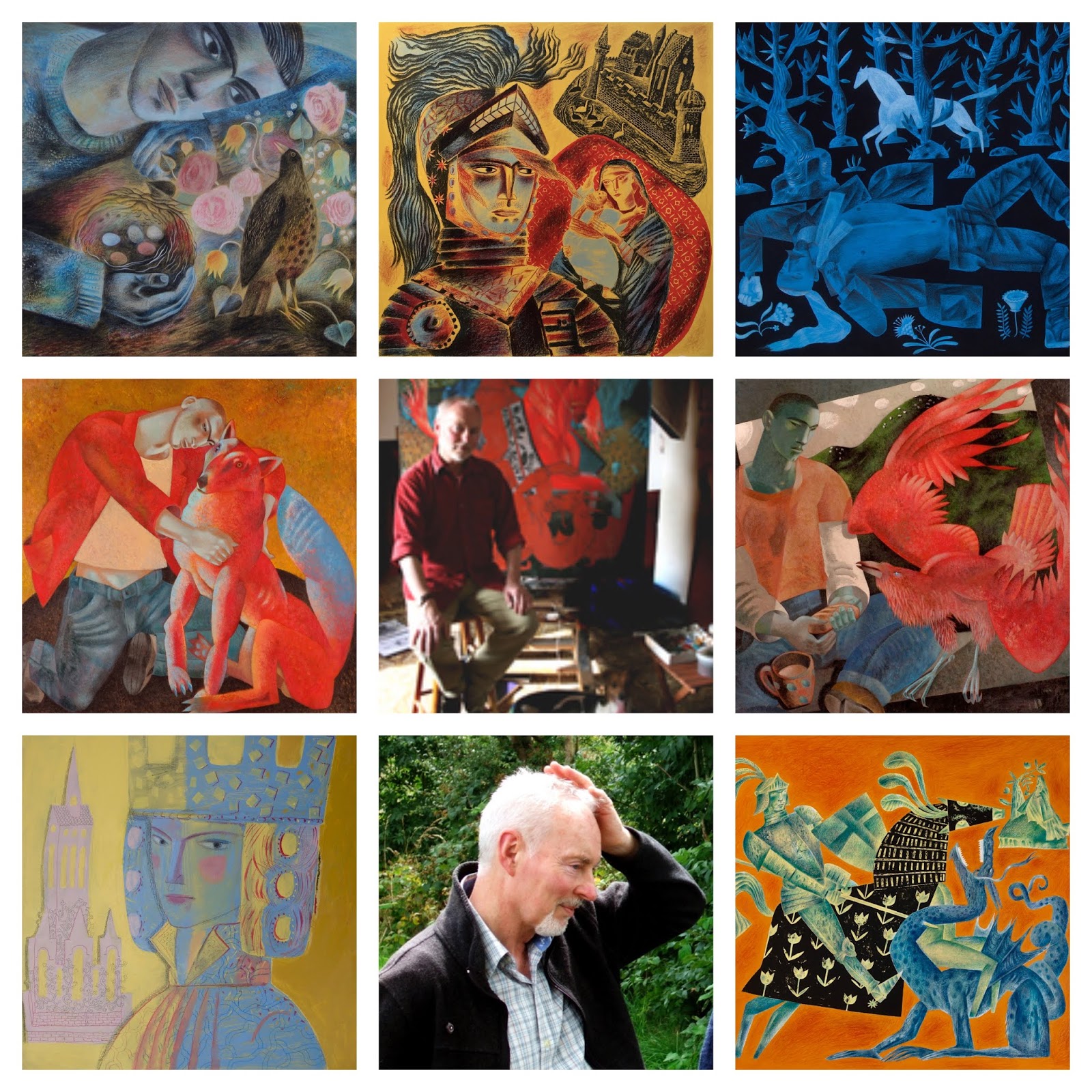
Spectral Pegasus / Dark Movements is one of the prettiest books to appear in recent years. This poetry collection is another in the realm of the book-length series of poems, and is also an addition to the world of ekphrastic poetry. It is a book of free verse responses to paintings--and since the art is intricately tied together in a series, naturally the poems are as well. And internally they are held together, elaborate parallelism often binding the lines, so there is a kind of macrocosmic and microcosmic structure in the form.
Spectral Pegasus / Dark Movements display a different way of thinking about what a book of poetry
is, and it strikes me that the book is determined to create its own audience--that is, to create the reader's understanding and sympathy for the project--through what is included. Short excerpts from Lindsay Clarke and Joseph Campbell serve as a kind of preface, nudging us in a desired direction. The poems and art form the core of the book, but they are followed by three essays about the poetry and the art. So the book itself teaches how to read it, and also how to look at the art by Clive Hicks-Jenkins... Then there's a whole other dimension to the book in which music and poems join in the CD. It's an interesting and rare way of looking at the making of a poetry collection, and one that must have taken a lot of love and care.
Here's a sample that goes with the weather outside...
THE GRIM REAPER APPEARS AS A NIGHT-FLOWER - Jeffery Beam (see below)
Delicate thief!
I thought your roar something
children imagined in a storm
Instead you light up the night meteoric
I hear you flash
Then all quiet
Done
Currently on the starlit nightstand of poetry:
Ned Balbo, 3 Nights of the Perseids 2018 Richard Wilbur Award
(Evansville, Indiana: University of Indiana Press, 2019)
Jeffery Beam, Spectral Pegasus / Dark Movements (thank you to Jeffery)
Higganum, CT: Kin Press, 2019
Includes reproductions of art by Clive Hicks-Jenkins. And a CD with poems and music!
Maryann Corbett, Mid Evil 2014 Richard Wilbur Award
(Evansville, Indiana: University of Indiana Press, 2014)
Jeanne Larsen, What Penelope Chooses (thank you to Jeanne) 2017 Cider Press Review Award
(San Diego, CA: Cider Press Review, 2019)
Amit Majmudar, Dothead
(New York: Borzoi Book, Knopf, 2016)
A. E. Stallings, Like (thank you to Ashley Cooper)
(New York: Farrar, Straus & Giroux, 2018)
Aaron Poochigian, Mr. Either/Or
(Wilkes-Barre, PA: Etruscan Press, 2017)
Unweavings
IN ROMARE BEARDEN'S COLLAGE, BODACIOUS - Jeanne Larsen
sirens croon among birds: a small crane, twin
gulls wheeling. Out there on the mast Odysseus
hangs hog-roped, neck a twist, his chin wrenched down.
What binds him is inescapable, & white.
Oh the blue blues, oh naked women's sweet
bone-black hips, oh shoreline's flame-green flames.
Look: in a mirror that is & is not beyond
this hanging
objet's frame, a mob. But with honey
-comb our great hearted man stopped up soft ears.
He'll make it to Ithaka, after all. A poem,
then, not about cosseting steep-walled shames. No threnody.
Poem of the trickster's survival. Poem of how
we do go forward. Of shuddering bodies, compassed.
It's always curious how certain threads coalesce in the world of letters. I'm still pondering the current combination on the loom of literary time, of which Jeanne Larsen's book is a part. Why re-think Homer
now? Along with Emily Wilson’s translation of the
Odyssey, Pat Barker’s
Silence of the Girls, and Madeline Miller’s
Circe, Jeanne Larsen's twisty, jazzy poems in
What Penelope Chooses question (
interrogate would be the hip critic's word) that composite, passed-down voice we call
Homer.
Even more than in Wilson's translation, which makes the Homeric line something different, more tense and compact by compression into iambic pentameter, Larsen's lines are tightened, broken, contemporary, full of frisky language play. Try these: nasty / sassy queasy peephole; beagle-brained square-jawed skull-thickener; poly-vocal fingers; sea dog, pollywog, old tarpaulin, / storm-scoured gob; blood-streaky, breached; nerve-zap yearning; clit / -whipped; PTSD blues; future snarled, blue-screened, timed-out. The poems question not just Homer but also form and what language is suited to a trickster--cheerfully tossing out not just the Homeric line but also pulling into new, wild shapes the sonnet form to which Larsen nods.
The freedom of time-leaping and the frolicsome language remind me a bit of Christopher Logue's unfinished versions--or "accounts," as he called them--of the
Illiad,
War Music. But as with Barker, Miller, and Wilson, a different sort of metamorphosis is underway. What was at the margins or not conceived to be worth sustained attention now gleams under a light: torn, ignored, or cast-off women; autistic (!) Polyphemus who loves his "nubbly" ram; a tapestry- and Homer-unweaving Penelope who may have had "a few brawly boys, a fickle maid" in her bed. What is at the margin takes stage, becomes center.