NOTE:
SAFARI seems to no longer work
for comments...use another browser?

Friday, December 15, 2006

Angels unawares


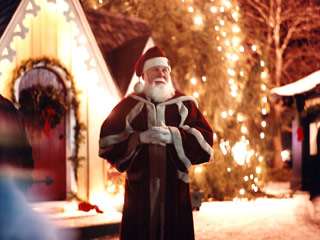
Last night my little N. had a mad helpless meltdown during math homework. We went for a walk in the lamplit night, both of us feeling a bit upset, and ahead saw Father Christmas--or St. Nicholas, or Santa, or Kris Kringle, or whoever-you-like--and his wife, dressed up in their red-and-ermine robes.

So N. skimmed down the block on his scooter and I flitted after him, and we caught up with them. And they proceeded to counsel N. on math, school, and life in general--and talked to me about my mother's visit and my father's death. The unexpected encounter felt very strange, a little hair-raising and astonishingly holy.

The pair had just come from a party for the handicapped children and adults from Springbrook, held at the mansion close to our house, where Mrs. Claus had danced with the boys and men in attendance. We have promised to pay them a visit in the little Gothic cottage on the square after my mother arrives.

***

I thought of this:

...Angels unawares. KJV Hebrews 13:2

***

And I thought of the last three lines of this, from the great William Butler Yeats, who always wrote very well about birds and women:

The Mother of God

The threefold terror of love, a fallen flare
Through the hollow of an ear;
Wings beating about the room;
The terror of all terrors that I bore
The Heavens in my womb.

Had I not found content among the shows
Every common woman knows,
Chimney corner, garden walk,
Or rocky cistern where we tread the clothes
And gather all the talk?

What is this flesh I purchased with my pains,
This fallen star my milk sustains,
This love that makes my heart's blood stop
Or strikes a sudden chill into my bones
And bids my hair stand up?

***
Deck the halls!

Pictures are from www.cooperstownchamber.org and www.cottageliving.com. The first shows Santa's cottage in Pioneer Park, next to the Tunnicliff Inn. The second is St. Nicholas (Paul Kuhn) outside the cottage. In the third, it is snowing on Pioneer Park. Oddly enough, all our snow has melted away, and it is in the 50's: very peculiar Cooperstown weather, but we are all glad.

***

Tuesday, December 12, 2006

Dog wags tail, tail wags dog

Overheard in my house:
Pythonesque

An upstairs-before-school exchange, audible from the kitchen downstairs:

B, singing lustily:
Always look on the bright side of--

R, with vigor and a soaring note of hysteria:
Shut up!

And now for something completely different...

Reckless, harebrained, madcap fool

Is there something forbidden about writing both poetry and stories? Does such a foolhardy impulse fall into the realm of impossible-to-compass?

Here is that interesting Canadian, Alex Good, on the practice: “In the entire history of literature in English, for example, I can think of fewer than five writers who have achieved a lasting reputation as both novelists and poets. Yet a quick look at the contemporary Canadian scene reveals a number of big names—Atwood, Ondaatje, Urquhart—who obviously feel they can play all positions on the literary diamond. At least some part of this has to be attributed to the cult of celebrity in today's publishing world, which sells us on the idea that anything produced by a literary genius is equally valuable. One has the sense that these authors don't even want you to read their books so much as they want shoppers to identify with a brand.”

When I think of writers who have pursued several major genres (excluding criticism) in English, I think of writers like Donne, Shakespeare, Hardy, Emily Bronte, Jim Harrison, Melville, Yeats, and Beckett. Borges talks about (somewhere--where?) not being able to tell whether the tail wags the dog or the dog wags the tail in his own writing of poetry and stories. Was the dog his stories? Or were the poems what were “important”? The dog likes his tail, but the tail must have the dog, after all.

Why might writing in multiple genres be good?

I am, you see, forced to consider this possibility first, because I like to work in a number of forms at once, and I prefer--like everyone else--to think that my choice might just be the right choice, at least for me. In the same week, I might be revising poems, starting a short story, and finishing a novel. I don't like to think that this might be somehow "against the rules" or a sure-fire road to a hell of low-burning mediocrity.

Coming to fiction changed my poetry. I threw masses of poems away after I began writing prose. Stories gave me a sudden and keen desire for my poems to be as different from prose as possible, and that drove me back to the resources of formal poetry. Form made me know freedom for the first time, for who can know freedom better than one who has tried singing in chains? Prose also made me want to write poems that were about more, and poems that were narratives, and poems that took their shape from strange and sometimes foreign rules. Poems made me want to write fiction that was entirely different from poetry, and sent me on a path from a sort of 'poet’s prose' to something more muscular. Poems made me think about what fiction has that poetry doesn’t—made me want to investigate causality and plot, for example.

Why should an insistence on writing in both areas be bad?

Perhaps it is because many people ramble from fiction to poetry or poetry to fiction without really making a difference between poetry and prose. Perhaps when poetry is only prose clipped into pieces—sometimes simply broken into lines on a page, sometimes wildly blended until the reader’s sense-making is denied—it is simply too small for many readers, too much like a dwindled version of prose.

Then it is the mere stick of a child that the fairies leave when they steal away the living girl or boy. Thought a mother may nurse and dandle such a changeling, she will never know what to make of that diminished thing.

* * * * *
Currently reading/rereading:

98 Reasons for Being
The Magic Pudding (aloud, to N)
Yeats
Map of Dreams
Kathleen Raine

* * * * * * *

A shooting chance

Can't write about poems without offering a bit of one's own for pot shots. Here's a poem from my 2001 book, Claire (LSU). It'll do for now--for a Christmas in Yankee ice and snow. I wrote it after my husband made some whimsical remark about Kateri being the only saint he could possibly claim as a relation. She is on the path to canonization in the Roman Catholic church. Not having grown up with saints, I have a certain fascination with them.

It's a narrow stream of a poem, short-lined, hemmed in by rhyme. I don't think I've written couplets in tetrameter again, as it crams the sounds very close together, though I've written lots of rhyming stanzas that alternate tetrameter/trimeter.

I somehow have the feeling that I've stuck this one up before, but I can't find it. Since I haven't posted many, the chance is not great. Yet I have three children, and so my mind is--presto!--shot.


KATERI TEKAKWITHA


A sister of the sun and trees,
She was so often on her knees

In snow that Jesuit brothers thought
Her surely mad. The God she sought

Would not ask for a lash of ice
And briars on naked skin, nor price

Her soul so high that she must plumb
The river till as blue and numb

As a March frog. She was a child
Of Akwesasne Mohawk—more wild

Than other tribes—the reason she
Was made of stuff so fearless-free.

No modesty! And weren’t her whips
Lashed on a naked spine and hips?

The linen froze upon her back
As she rose gasping from a crack

In ice—a wonder that the wave
Did not become her winter grave.

Today the cold still has its bite,
It’s just as hard to tell the right

From false. For some have seen a glow
From fires that burn in pits of snow,

And some have bent to catch the scent
Of something sweet, plucked roses, pent

In barrow earth. Such blooms are red
To look like blood when petals shed,

And there are thorns enough for all.
But records here are few and small.

A votive soul set down in ice?
A flensed and fevered bride of Christ?

Some say that she was simply plain
And odd, and liked the woods and rain

As others like a friend. Some say
Plainly simple. And some say nay,

Not dense. They say she had good sense
Who for her sins did rinse and mince.

They say, lovely as the river,
As arrows tensed, swept from quiver.

***
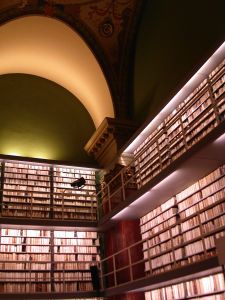
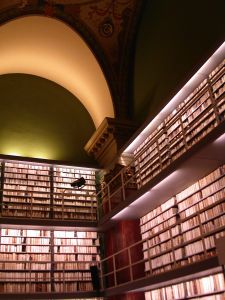
Photograph: Courtesy of www.sxc.hu and Philipp Kleinschmit of Barcelona: library in Wolfenbuettel, Germany.

Thursday, December 07, 2006

Weird Rollicksome Hornet Amplifications


REGARDING FORAYS TO THE HORNET'S NEST

Note to self, regarding prior post: never write about sex and books on blog.

My own final flourish (at least until some other hot-spirited soul shows up) in the comments:

Let all writers follow the thread of story until they reach the heart of the labyrinth, whatever it contains.

That's where I stand on writing.

Get rid of age divisions for books created by marketers. (My little fantasy!) If a child or a teen is ready for adult fare, fine. If he or she is not ready for adult fare, fine.

That's where I stand on children, teens, and reading.

"What I’m more interested in is the teacher who is not trying to convey a message about sex or anything else but who shines with passion for books, and who can help a teenager catch a little spark of that fire."

I stand by this.

MERVYN PEAKE, TRALA

The December 5th post from my beloved e-haunt, Giornale Nuovo, contains poems, quotes, and "details from a set of sketches and completed drawings done by Mervyn Peake for a projected illustrated edition of Dickens’s Bleak House, which, however, never came to fruition." Go see! And the transforming-to-sheep picture above is, of course, from his illustrations to the great Lewis Carroll.

OTHER PEOPLE SAVING US THE TROUBLE OF THINKING

At The Reading Experience, Dan Brown* has continued and amplified--I think this is one of his gifts, to latch on and develop--my post on rereading. I find in him much that is of interest, whether I agree or disagree, plus an appealing streak of the curmudgeon!

*Penitential update: Note what a rollicksome, careless mood can do. Poor Dan Green is now Dan Brown. From here on out, I shall either expect him to be an absurdly weathy fellow or else give him a different color name whenever I meet him--Dan Pale Ecru, Dan Lavender, Dan Puce, Dan Lemon Yellow, Dan Dandelion Silver, and so merrily on.

IRRATIONAL JOYFULNESS SPRINKLED ABOUT

Despite the fact of too many things on my list today and too many events this afternoon (five at last count), despite the snow (pleasantly covered with giant crows), despite the fact that I just remembered how the incredibly well-read editor John Wilson called me The Invisible Novelist (it is delightful to have titles, though!), and despite the fact that it was a mistake to pull the gutters off the house, I am feeling absurdly happy.

It must be the Bleak House illustrations.

Or maybe it is because Cooperstown is, as always, wonderfully dressed for Advent, and has an old-fashioned, Old World feel--rather like the corner of St. Michael's churchyard in Charleston, South Carolina that Henry James declared the most English bit of America.

Perhaps it is because I am reading and liking Clare's 98 Reasons for Being.

I feel quite, quite rollicksome (a portmanteau word in honor of Carroll.)

***

Tuesday, December 05, 2006

Reading children, children reading etc.


This post is growing and taking on legs...

METAMORPHOSIS

Despite Sven Birkerts on the coming loss of reflectiveness, I didn’t quite believe that the reading of what we call literature would be lost. But now I am beginning to wonder, although for an entirely different reason than those he offers. I knew so many passionate young readers—mostly girls—that I thought this fear just a tad silly. My feeling was that there were too many children who loved books, as I loved books when I was young. The result would be as many devoted, reflective readers as ever. The population willing to read literature has always been small. Perhaps the children I knew weren’t quite so rabid as I was, but they were addicted. (I didn’t bathe without a book, and I was one of those readers into the night that made flashlight-floggers happy.)

But I’m beginning to see a very different cause at work here. Today’s young readers have a plethora of “juvenile” and “young adult” books before them, and this leads to a curious problem. Here, I think that I must be talking about girls, for the most part. The boys I encounter tend to be readers of nonfiction, when they are readers at all.

When I was a child, I was stuck with the library and the books my parents owned. I did have a subscription to a book club—now and then I received a volume by Kipling, Swift, and so on. One of my happiest days was when I was at last allowed to have my own card to the adult library in sixth grade. I read many different authors, though Dickens was very big with me in sixth grade; Faulkner began to be big in the same way in ninth. By then, I had the freedom of the university library where my mother worked, and I spent afternoons poking around the literature section, sponging up novels and poetry.

I’ve begun to notice that many high school students fed on the nigh-infinite (often wonderful but not always terribly demanding) fare of children’s and young adult books have a tremendously difficult time confronting, say, a novel like Great Expectations. They are more at home with a children’s book (or the “cut scene” narratives of a video game, or a ‘graphic novel’). This goes for children who care about words and style, too.

Young men and women no longer need to “grow up” in their reading. There’s enough out there to hold them forever in the land of “young adult.” Perhaps that’s part of the reason why so many adults read children’s books now, and do not read adult ones. A student can, these days, be an English major without doing much "heavy lifting." One can avoid diving into any canonical deeps and stay on the surface, catching the waves near shore.

Perhaps I am wrong and simply “anecdotal” in my observations of one small village. Do you think so? I do hope you think that I am wrong, silly, benighted, even odd. Yes, I hope so.

*******
SALON FANTASTIQUE

Dave Roy has reviewed Ellen Datlow and Terri Windling's Salon Fantastique at www.curledup.com. He singles out three stories, one being mine. Somehow his comments harmonize with what I've written above. Here they are, minus the plot summary: "Finally, there is 'Concealment Shoes' by Marly Youmans. . . . Youmans writes with an easy flow to her words, making the children intelligent but not overly adult (a mistake too many authors make when they have kids as protagonists). They're inquisitive, like to play and run around a lot, but they're also well-read and they think things through. Youmans gives the idea of a haunted house a fantastic twist, and I really enjoyed reading every word of it."

********

JEROME MURAT, ALSO FANTASTIQUE
Update, 10:00 a.m. 5 December and I should be working!

Poet Jeffery Beam sent me several videos today, one the famous soccer match between Greek and German philosophers (with Karl Marx warming up on the sidelines), one a marvelous piece by mime Jerome Murat. He found it at the blog of poet Dan Vera, and now I am passing it on.

That makes a 3-poet recommendation.

If you love Cirque Ingenieux and Cirque du Soleil and wonderful "new circus" magic, this little performance is for you. If you are a dreamer, it is also yours. If you are prone to metaphysical flights of fancy and are lured by the idea of doubles and mystical resemblance, it is yours.

http://www.dailymotion.com/visited/search/jerome%20murat/video/xf9oo_jerome-murat#comment_input

*******
MORE ON CHILDREN & READING: TEENS, SEX, & BOOKS
After this, I really am going to stop procrastinating!

Matt Cheney of The Mumpsimus has written an article about "literature and high school and sex." "What is Appropriate" appears in The Quarterly Conversation. I didn't comment on it, because I could feel a long-winded thought approaching.

Here's that thought, with a few silly embellishments along the way:

Matt,

As a writer and a mother of three, I found your essay interesting—although I am of that weird ilk with no television reception. (We have a t.v. and watch movies, but we receive no channels.) I have never been afraid to talk about sex or violence or anything else with my children. I am not in the least afraid to let them read whatever they want to read.

But I would point out that communities are living organisms and vary wildly in how quickly their children grow up and in how quickly those children want to ask more "advanced" questions about sex—and that it’s doing no real favor to young people when you encourage them to exit the realm of childhood more quickly than they would without your help. Why are we in such a dratted hurry on this issue? (Of course, the community of an elite private school like yours is its own world, and tends to develop its own character. And yes, of course, there are teens going to it like rabbits in every corner of the world.)

Plenty of teens in the current generation simply aren’t interested in exerting their freedom to have sex—in this generation, there are many who have decided it’s not what they want now or even before marriage, and that there are other things that are important and even thrilling. This is rather a shock to some parents, particularly to those in the baby-boomer-and-after generations, who must deal with the fact that today's teens are--what a surprise!--not like yesterday's. (I also think that there are a good many young people who can see through consumer culture and political mumbo-jumbo, whether from the right or the left, so get some red chalk and color that herring!)

What I’m more interested in is the teacher who is not trying to convey a message about sex or anything else but who shines with passion for books, and who can help a teenager catch a little spark of that fire. The problem isn’t that our teens don’t get enough sex in their books and so aren’t ready to talk about it when they turn 20; it’s that too many of them don’t give a hoot about reading at all, or else can’t progress from book pablum and book candy to a more elegant and satisfying meal.

*******
Credit: "Bookends 2" is courtesy of www.sxc.hu and the travel-loving Benjamin Earwicker (great last name! I must remember that one.) "Carved wooden bookends from the Phillipines hold up a few old books."

***