NOTE:
SAFARI seems to no longer work
for comments...use another browser?
Showing posts with label multiple genres. Show all posts

Thursday, March 01, 2012

Hard to pin--

PIN-POST TABLE OF CONTENTS
Being rather fat, it needs one!
TO PIN
On the classification of this creature, Marly Youmans
A NEW 'PIN'
A fresh classification for the same
UPDATE ON THE ADDY FOR THE THRONE OF PSYCHE
More news about the Gold Award Addy

Golden butterfly--"gilded butterfly on a needle"
courtesy of sxc.hu and Karen Steiner of Austria.

TO PIN
In honor of Elsa Louise, let's change it to: IMPOSSIBLE TO PIN

For publishers and reviewers and booksellers, the writer needs to be pinned down.  It's helpful to sort and place him in a box with others of the same kind. It's helpful when placing the book on a shelf in a bookstore or on a search list in an online shop.

Some of us are hard to pin. Keep putting different pins in us, and we may turn out to be all holes: invisible to the naked eye. And that is true even though, from the inside of the writer, all the work seems to flow from the very same fount and to have a kind of seamlessness. Try and catch a butterfly? It can all go the beautiful, destructive way of Hawthorne's "The Artist of the Beautiful."

For a long time I was called a poet. Then I was titled "literary writer." When I set a  novel in the past, I was suddenly "historical novelist" to some--to more when I did it again. Then I further messed up the box of labels by writing a couple of books especially for my daughter and so publishing a Southern fantasy that was marketed to children, and then another marketed to young adults, although both were reviewed as crossover books that adults would enjoy. 

That's another mixed category. My adult novels tend to be mentioned as crossover books for bright teens. My children's books tend to be mentioned as crossover books for (also-bright, I am sure!) adults.

Meanwhile my poetry veers from lyric to monologue to narrative to epic. My 2011 collection, The Throne of Psyche, moves from a long blank verse narrative to a wealth of shorter forms. And what about the short stories, which might puzzle a labeler as well, being set in present or past and called realist or irrealist, depending on the story and the reader?

My upcoming books are equally mixed: a picaresque tale set during the Depression era (my ninth book and winner of The Ferrol Sams Award, A Death at the White Camellia Orphanage, now available as a pre-order); a novel that tells the awkward coming-of-age and destruction of a pulp writer, leaning on the facts of one such writer's life (Maze of Blood) and interspersing the story with fantastic faux-pulp passages; a story of a artist's rebirth in mid-life and pursuit of the muse, twisted together with a sort of dream journey/vision (Glimmerglass); an epic poem, post-apocalyptic (Thaliad); a collection of formal poems, many of them intensely "green" and mythic (The Foliate Head.) I'm working on revising a manuscript of poems called The Book of the Red King; oddly, the stories of the Fool and the King feel in some curious way like the most autobiographical thing I have ever done. (I am, of course, not the King--whose identity is various and unpinned--but the Fool.) I'm not much interested in autobiography unless it can be wholly transformed.

What kind of butterfly am I, flitting in the one bright meadow?  

Morpho peleides courtesy of Rudy Tiben of the Netherlands
and sxc.hu--I picked a morpho because one of the characters
in The Book of the Red King is linked to a blue morpho.

A NEW 'PIN'

Today I'm rather pleased to find myself in a whole new category. At this point, it seems that I am destined to be collected in many ways and so to be a collector of categories! When I have been pinned in a sufficient number of categories, perhaps I will have a kind of roundness in the world's eyes. It's hard to pin what is round.

If you hop over to Hellnotes, you can see that I have now been collected in a new box: "25 Women Horror Writers You Probably Haven't Heard of (But Should Know)." I am described like this:  "award-winning author Marly Youmans has a decidedly more darkly fantastical vibe to her than 'traditional' horror but has produced some of the most beautiful dark fiction." I like it; it sounds positively Hawthornean.

Certainly my two books marketed to children/young adults are rife with shadow, and a number of anthologized stories and others in magazines have a dark, fantastic tint as well. I'm quite pleased to be in some good company and also to venture nearer to a new set of readers. I even have meaningful linkages to several writers on the list, as I narrated Kathe Koja's essay on the maquettes of Clive Hicks-Jenkins for a film when I was in Wales last spring, and Catherynne Valente wrote an introduction for my forest tale, Val/Orson. So thanks to Hellnotes and to Darkeva, who snagged me as part of her collection.

UPDATE on AN ADDY FOR THE THRONE OF PSYCHE

Earlier I posted about the Addy Gold Award for The Throne of Psyche. If you would like to see the full list of Addy awards for Burt and Burt and Mercer, hop here.  The design team and Mercer now go onto regionals and, one hopes, nationals--they managed to beat out more than 50,000 other designs to place, so that's exciting!

If you would like to see how Clive Hicks-Jenkins, painter of "Touched," responded, jump here. You'll also see responses from some of Clive's real-life friends and e-friends, including the painting's owner.

Tuesday, December 12, 2006

Dog wags tail, tail wags dog

Overheard in my house:
Pythonesque

An upstairs-before-school exchange, audible from the kitchen downstairs:

B, singing lustily:
Always look on the bright side of--

R, with vigor and a soaring note of hysteria:
Shut up!

And now for something completely different...

Reckless, harebrained, madcap fool

Is there something forbidden about writing both poetry and stories? Does such a foolhardy impulse fall into the realm of impossible-to-compass?

Here is that interesting Canadian, Alex Good, on the practice: “In the entire history of literature in English, for example, I can think of fewer than five writers who have achieved a lasting reputation as both novelists and poets. Yet a quick look at the contemporary Canadian scene reveals a number of big names—Atwood, Ondaatje, Urquhart—who obviously feel they can play all positions on the literary diamond. At least some part of this has to be attributed to the cult of celebrity in today's publishing world, which sells us on the idea that anything produced by a literary genius is equally valuable. One has the sense that these authors don't even want you to read their books so much as they want shoppers to identify with a brand.”

When I think of writers who have pursued several major genres (excluding criticism) in English, I think of writers like Donne, Shakespeare, Hardy, Emily Bronte, Jim Harrison, Melville, Yeats, and Beckett. Borges talks about (somewhere--where?) not being able to tell whether the tail wags the dog or the dog wags the tail in his own writing of poetry and stories. Was the dog his stories? Or were the poems what were “important”? The dog likes his tail, but the tail must have the dog, after all.

Why might writing in multiple genres be good?

I am, you see, forced to consider this possibility first, because I like to work in a number of forms at once, and I prefer--like everyone else--to think that my choice might just be the right choice, at least for me. In the same week, I might be revising poems, starting a short story, and finishing a novel. I don't like to think that this might be somehow "against the rules" or a sure-fire road to a hell of low-burning mediocrity.

Coming to fiction changed my poetry. I threw masses of poems away after I began writing prose. Stories gave me a sudden and keen desire for my poems to be as different from prose as possible, and that drove me back to the resources of formal poetry. Form made me know freedom for the first time, for who can know freedom better than one who has tried singing in chains? Prose also made me want to write poems that were about more, and poems that were narratives, and poems that took their shape from strange and sometimes foreign rules. Poems made me want to write fiction that was entirely different from poetry, and sent me on a path from a sort of 'poet’s prose' to something more muscular. Poems made me think about what fiction has that poetry doesn’t—made me want to investigate causality and plot, for example.

Why should an insistence on writing in both areas be bad?

Perhaps it is because many people ramble from fiction to poetry or poetry to fiction without really making a difference between poetry and prose. Perhaps when poetry is only prose clipped into pieces—sometimes simply broken into lines on a page, sometimes wildly blended until the reader’s sense-making is denied—it is simply too small for many readers, too much like a dwindled version of prose.

Then it is the mere stick of a child that the fairies leave when they steal away the living girl or boy. Thought a mother may nurse and dandle such a changeling, she will never know what to make of that diminished thing.

* * * * *
Currently reading/rereading:

98 Reasons for Being
The Magic Pudding (aloud, to N)
Yeats
Map of Dreams
Kathleen Raine

* * * * * * *

A shooting chance

Can't write about poems without offering a bit of one's own for pot shots. Here's a poem from my 2001 book, Claire (LSU). It'll do for now--for a Christmas in Yankee ice and snow. I wrote it after my husband made some whimsical remark about Kateri being the only saint he could possibly claim as a relation. She is on the path to canonization in the Roman Catholic church. Not having grown up with saints, I have a certain fascination with them.

It's a narrow stream of a poem, short-lined, hemmed in by rhyme. I don't think I've written couplets in tetrameter again, as it crams the sounds very close together, though I've written lots of rhyming stanzas that alternate tetrameter/trimeter.

I somehow have the feeling that I've stuck this one up before, but I can't find it. Since I haven't posted many, the chance is not great. Yet I have three children, and so my mind is--presto!--shot.


KATERI TEKAKWITHA


A sister of the sun and trees,
She was so often on her knees

In snow that Jesuit brothers thought
Her surely mad. The God she sought

Would not ask for a lash of ice
And briars on naked skin, nor price

Her soul so high that she must plumb
The river till as blue and numb

As a March frog. She was a child
Of Akwesasne Mohawk—more wild

Than other tribes—the reason she
Was made of stuff so fearless-free.

No modesty! And weren’t her whips
Lashed on a naked spine and hips?

The linen froze upon her back
As she rose gasping from a crack

In ice—a wonder that the wave
Did not become her winter grave.

Today the cold still has its bite,
It’s just as hard to tell the right

From false. For some have seen a glow
From fires that burn in pits of snow,

And some have bent to catch the scent
Of something sweet, plucked roses, pent

In barrow earth. Such blooms are red
To look like blood when petals shed,

And there are thorns enough for all.
But records here are few and small.

A votive soul set down in ice?
A flensed and fevered bride of Christ?

Some say that she was simply plain
And odd, and liked the woods and rain

As others like a friend. Some say
Plainly simple. And some say nay,

Not dense. They say she had good sense
Who for her sins did rinse and mince.

They say, lovely as the river,
As arrows tensed, swept from quiver.

***
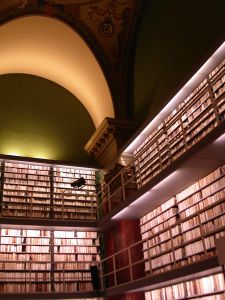
Photograph: Courtesy of www.sxc.hu and Philipp Kleinschmit of Barcelona: library in Wolfenbuettel, Germany.