NOTE:
SAFARI seems to no longer work
for comments...use another browser?
Showing posts with label blogging. Show all posts

Wednesday, May 18, 2016

Advice to the casual book reviewer--

Artist Clive Hicks-Jenkins.
Hand with heart from the interior
decorations for Thaliad.
If you google "how to write a book review," you'll find wheelbarrow loads of advice on writing a book review that looks just like almost everybody else's review. Since that's the case, I'm not going to repeat the usual advice. So here, my two cents worth of not-the-usual advice:
  • Go on trust. Always assume that the writer might actually know what he/she is doing. Try and figure out what he/she is doing if it doesn't fit your ideas of what a book should be. Maybe the book's not working, and that's why it doesn't fit. But maybe the book is good but differs from your expectations. 
  • Don't pay any attention to the label or genre that the publisher chooses. Remember that labels are for marketing. A label can be misleading, as it may well be incorrect or reductive. Many books are complex things, not happy with a label. Instead of relying on genre conventions for an idea of what a book should be, figure out what the book is on your own. Describe what it is--not the plot, but what it is, what it cares about, what terrain is important to the book and its characters, what purposes and vision drive its events and structure. 
  • Think about shape. All made things have a shape.
  • Each novel is its own world, with its own laws. It may resemble our world closely. Or not. You should be able to detect whether it fulfills its own promises, obeys its own laws.
  • Think about what propels the story forward. Is it causality, or something else?
  • Ignore the age label on the book, if there is one. It, too, may be incorrect, or the book may be what is often labeled as a crossover, and appeal to various ages.
  • Does the book have energy? Is it alive? Are the characters alive?
  • Does the book feel like a clone, or is it a unique individual? How so?
  • Does the writer appear to take pleasure in words and sound? 
  • Read some of the book aloud--mandatory! Get a feel for how the author writes; hear it in your own voice. You'll know more about sound and style and the writer's ear (tin or golden) by reading one page aloud than by reading a whole book to yourself. (This one is, of course, essential for collections of poetry.) 
  • Rereading is the most telling reading. Even a little rereading is helpful.

Wednesday, December 02, 2015

Signposts for the gadabout

62
With the incredible collapsing
hummingbird cake.
I've been playing on Facebook (so fun to get hundreds and hundreds of birthday wishes from all sorts of interesting people) and twitter (which, oddly, actually does good things for my books) and ignoring my blog for a good long while. Oh, I've been fairly dutiful and put up review clips for Maze of Blood, and left a books-in-print post when I ran off to Peru and Chile and Mexico. But I have left the blog in a condition of half-dressed neglect of late. Poor child, she needs her face scrubbed and a new gown and some kid slippers.

And so I'm wondering. I haven't asked what people would like to see or read about for a long time. So. Tell. Got a question, an idea, a wish, a direction, a signpost that fits?

Here are some of the things I've thought about doing lately. Tell me if you find any of them especially interesting, or even if you find them all dull and dowdy! Tell me your own ideas for what I should do, too--they may be better than mine.

Update (ideas from an editor): "I also wanted to suggest that you branch out and write more about non-literary, non-book topics. You are fun to talk to and have plenty of ideas and opinions, and it would be interesting to your readers as well as (I suspect) yourself to talk about some other things. What's it like living in Cooperstown (both as a small town, and as a wealthy tourist town in a mostly-depressed area of the country)? How about some interviews with other artists/musicians/writers who live in the area? What are the particular challenges and/or inspirations/advantages they deal with? Do you miss the South? Why or why not? Yankee attitudes vs Southern ones? You've been traveling - will you tell us about that?"

Update (from a painter friend): And would love to hear what you say about women authors not burning down the house with all of the men in it. Actually, we should do lunch to talk about that subject... 

And a brilliant US/NZ grad student: I would love to read more about how you and Clive work with a designer. (I would love to read more about whatever you feel like writing about, also.)

And an extremely capable writer, much published: Oh...as someone who has so woefully neglected her own blog, I am at a loss. Though, I do like it when you write about poetry, because as much as I love reading it, I am never very comfortable writing about it for fear of sounding like an idiot. So I enjoy reading authors who do (and you do) know how to write about it.

And thanks to the rest of you who have offered such interesting ideas here and via email and comments elsewhere. (Special thanks to Alexandria for her ideas, including a Marly-society with embossed i.d.! A writer needs people who have faith in her powers.)  

--I have a friend who won a major poetry prize and, a year out, nothing about the book has appeared. It seems the case that fewer and fewer books are able to succeed in our bestseller-winner-take-all culture, no matter how good they are. I am bothered that she has received no reviews, and I've thought about doing a little series of posts about some of the poems in the book. Alternately, I might just write a longer, meditative sort of article for some other site.

--I've also thought about an interview with the same writer.

art by Clive Hicks-Jenkins,
book design by Burt and Burt
--A lot of my friends and e-friends are in the visual arts. People tend to know about my friendship with Clive Hicks-Jenkins because of the jackets and covers, as well as the lavish interior art for Thaliad, The Foliate Head, Glimmerglass, and Maze of Blood. But I have thought about doing a little series in honor of some of my painter friends. Maybe it would focus on particular pieces. Maybe it would combine a little bit about the paintings or a painting with a question directed at the painter.

--A shopping list: off-the-beaten track books and art, focusing on people I know.

--Podcasts of poems and fiction excerpts? (Oh, I need to look for my good microphone that Paul Digby gave me!)

--I might consider writing something about how and why I've made such odd choices, often seemingly wrong-headed ones, having to do with marketing and publishers and agents and so on. But I always think it's too much to comprehend, even for me! So perhaps I don't want to do that one, though I've started it (and trashed it) before.

A head full of blooming thoughts...
Interior art by Clive Hicks-Jenkins for Maze of Blood
--And I was just reading a hip young thing's complaints about her new baby who prevents her from writing, and thought that I really ought to write something about how more life is always helpful to a writer, that we never make a mistake by embracing more life. (She also wrote about misogyny and male writers and so on, but much of that "heavy bores" me, as Henry would say. Just let me get on with my work without indignation burning in my head.)

--Here's more of a hot-button topic: what's wrong with our trendy ideas of the evils of cultural appropriation--why they are fundamentally a wrong way to think for writers.

--And here's another: why a woman writer should not "burn down the house" of literature, with all its white male dead locked inside.

--The idea of doing a piece about how Clive and I work with a designer is appealing. And I do have plans to do an interview elsewhere that puts the two of us together.

--And what about a piece about how Elizabeth Adams planned, did the art work for, and designed Annunciation (Phoenicia Publishing)?

--More on Karin Svahn's embroidery.

--Peru, Chile?

Probably some of those miss the mark. And maybe I'm not thinking of other ideas that might be splendid and suit me. Tell me what to think, and I might just follow your lead, or debate you. Ask me a question, and I just might answer.

Thursday, January 09, 2014

A proper thanks to Dale Favier, and an introduction to his writing-

Thank you to poet Dale Favier, way off on the other side of the continent, for this lovely facebook post... I'm a fan of his as well, so it's very sweet to have him comment on a book of mine this way. (And I should say that I'm grateful to the people on twitter and Facebook who have shared an enthusiasm for my books; I hope that I always remember to thank them, but if anyone has slipped by without my commenting back, I hereby thank them!)
  • It feels very, very strange to read novels again. I read Marly Youmans' marvelous A Death at the White Camellia Orphanage last year, and all the time there was a surreal throb at the back of my mind: it said, yes, people still write novels. People walking the earth today, they write novels, just like Charles Dickens and Leo Tolstoy did. Because to me, you see, present-day people -- by which I mean people I know online -- they write *poems*, not novels. Marly of course writes poems too, and she's eccentric, so that's all right. But now I'm reading Elizabeth Eslami's no less wonderful novel, Bone Worship, which makes me laugh and laugh. And now I'm thinking, maybe real present-day people write *novels*, too. And I read so slow now! But God, with my strangely slowed, poetry-trained senses, I read much better, and I taste before I swallow. I'm so grateful to the writers I know for hauling me into the 21st Century. It's really a beautiful, beautiful place. I used to think the beauty all died sometime at the beginning of the 20th Century. But it didn't really. Thank you, all of you. xoxoxo
What does he mean, eccentric? Dale, aka Mole, what do you mean, eccentric? I am going to assume he means for doing that odd thing, writing both poetry and fiction, and nothing else, unless he says otherwise.

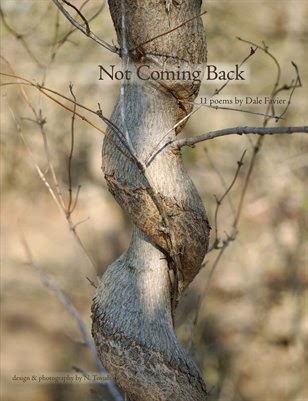
If you would like to read a poem by Dale Favier, you might go here, where you can also buy his Opening the World from Pindrop Press. I did, and I recommend it! He also has a collaborative book called Not Coming Back with photographer Nina Tovish, and you can read and see samples of poems and images here. I still need to get that one. You can also read poems and musing on his website. Here's a sample post; in this one he reminds me of Thoreau (one of his "like-minded people," surely), especially in the opening declaration:
I regret nothing except my occasional half-hearted gestures towards making myself acceptable. There was a time when I thought might find a home among like-minded people: I'm grateful to them for making clear that it will never happen, and so keeping me from wasting my time. There is so little time. My awareness of that deepens every day. No: you can take me as you find me, and that will usually be gazing at the sky, while points of rain or starlight patter on my threadbare scalp. The riddle is written up there, and I stop and puzzle out a few phrases, and wait for the lightning or the sunrise. And still the sphere turns, and turns, and turns in its faint wash of darkness. There is nothing else, not really. We are traveling at immense speed, even in simple terms of the earthbound physics Newton propounded: we are falling toward the sun at somewhat more than 67,000 miles per hour. Once you actually absorb that fact, the speeds at which we creep around our falling home take on a comic aspect. In the time it takes us to walk to the store we have also traveled ten thousand miles through space: yet the quarter mile's incidental movement on this blue-and-white marble's surface is the movement that impresses us. Well. Not so clever, for all our airs. No. Stars and rain are real, the silky hair threading between my fingers is real, the pulsing heart that lifts my fingertips is real. The rest? Toiling from speck to adjacent speck on a marble that's been thrown off a cliff? No: not so real. Not so real at all.
There you go. You may find him surprisingly like-minded at times--or you may find him fascinating because he is not. Meet the man, the Mole, the poet... And thank you, Dale! 

Wednesday, January 01, 2014

Thoughts worth expressing

Image courtesy of sxc.hu and Jenny Sliwinski of the UK
I like and recommend this brief Alan Jacobs essay that reveals (with the help of Murdoch, Orwell, and Lewis) many needful things to the reader (and that's me too): why we should read old books; why we should seek out opponents who differ from us in thinking from another age rather than the rabble-rousers from our own day; how to seek out thoughts worth expressing; and the value of coming to know "the full humanity of those who think very differently than you do."

And I wish that every person on social media who spends his or her short, golden time in bashing our obvious conservative or liberal blowhards would read and consider the essay... It might save the world a good bit of repetitive annoyance and even help keep those of us on social media (me too!) from being carried away by the stream of self-congratulatory assent one sees below our self-righteous posts attacking the much-puffed blather of celebrities, political and otherwise. Wouldn't it be interesting to focus on the ideas of better minds, perhaps not of our age or our country?

It's New Year's Day; a worthy list of resolutions could come out of the reading of this essay. And those of us who write books and keep a blog (yes, me too) might well meditate on the work of "thoughts worth expressing."

Wednesday, December 04, 2013

a commonplace from eastrod

I've already noted this on twitter and facebook, so I suppose it's already an old tale, given the scorching storytelling pace of the internet, but there's an interesting new books blog underway from one R. T., someone I encountered first on critic D. G. Myers's book blog, and later via novelist Scott G. F. Bailey and . . . here. He is especially keen on Flannery O'Connor, but seems to have a wide range of concerns. Why don't you pop by and help him launch? He's posting frequently and has lots of questions!

Saturday, June 08, 2013

Slog & sundry (+ requests)

Ruth Sanderson, from The Twelve Dancing Princesses
I'm afraid today is a Great Slog Day. Ruth Sanderson is coming soon, and I must quarry out the guest room, which is full of rummage sale items--too much stuff in this house!--and Scouts gear from the trip to the Grand Canyon. Do you know Ruth? Here she is at her Golden Studio, where you can learn about her painting and books. I met her when I was writer-in-residence at Hollins in 2010, and we had fine walks and talks (as I also did with then-MFA-student-and-now-teacher-and-writer-and-blogger Robin Rudd) and have a good deal in common. I am so glad that Amanda Cockrell (writer and director of the MFA in Children's Literature) and Hollins invited me to visit the MFA program; I enjoyed myself and made some grand new friends and acquaintances. (I'm not doing anything of the kind this summer, as I am going to tour a bit and focus on children and writing the rest of the time, but next year I will be doing a week-long poetry workshop at Antioch and maybe more....)

I've just done something that I never think to do, and have gone back and looked at the last six weeks to see what people are most interested in. And was pleased by the fact that lots of people keep reading even after the day is past. People appear to have been most drawn to the Tesla post from yesterday, one on Isaac Bashevis Singer, the Commonweal review of A Death at the White Camellia Orphanage, the "word-doodling" post, the seven deadlies, my mother (!) and her weaving, pictures of the house in Thaliad, "the value of art" post, the little post with links to Jeff Sypeck's review of Thaliad, a Lady Ise post, and one on Traherne.

I confess to being one of those bloggers (maybe it's all bloggers) who now and then think to jettison the whole enterprise. But I'm pleased that so many passers-by have paused to read. I wish that I had time to return the favor, as so many of you are bloggers, but in truth my life has become busy enough that I rarely do so.

Please leave a request or a question (questions are easier because more specific, usually) if you have something you'd like to see here. Or ask for someone--Susanna tends to ask for the Pot Boy--or some former guest. Requests and questions are always inspiring to the daily blogger.

I close with a list of links to my recent, in-print books. Careful. These paper children are looking for a home in your brain!

Marly, recent and elsewhere:
  • Thaliad's adventure in blank verse, with art by artist Clive Hicks-Jenkins of Wales (Montreal: Phoenicia, 2012) here and here 
  • The Foliate Head's collection of poems with art by Clive Hicks-Jenkins, Stanza Press (UK) here
  • A Death at the White Camellia Orphanage (novel) from Mercer University Press (currently ForeWord 2013 finalist in the general fiction category; The Ferrol Sams Award, 2012) here
  • The Throne of Psyche, collection of formal poetry from Mercer, 2011, here
  • Samples from my 2011-12 books at Scribd.
  • See tabs above for information on individual books, including review clips.

Friday, July 27, 2012

Blog End

To blog or not to blog? All we have to decide is what to do with the time that is given us.
--Faux-Shakespeare + Tolkien

Last week I was contemplating whether I ought to stop blogging--to shut the door on my little house at Blog End, and let the habit sleep... I tend to get a good number of visitors, and lots of comments on facebook links on posts, but I still felt a little unsure about whether it was worthwhile--and whatever do I mean by that? Perhaps that I'm busy; my time is limited. Perhaps that I have lots of books popping up and not much time to do that thing called "marketing." (I am only erratically good at marketing.) Perhaps that I'm reading 300+ books for an award. And that I have other books of mine in the pipeline that I need to work on.

Just when I was leaning toward closing up Blog End, the universe seemed to take an interest in my little habits. I had a spate of marvelous compliments about the blog, online and off, from writers and editors. I suppose that no matter one's age, a resounding response is always helpful--or that I am in some things a weathercock, easily blown from one direction to another.

So today I was looking at my top five most-read posts, and wondering whether high readership could tell me anything. I think it's interesting that the most-read one is about a lively young woman--a sort of character sketch via interview. Two of them have to do with the world of my friend Dave Bonta. One is about guest-editing qarrtsiluni, the magazine he edits with Beth Adams. The other is from a series I did called "The House of Words," and it features poet Luisa Igloria, who posts daily poems on Bonta's Via Negativa. One is about The Throne of Psyche winning an Addy. And the last is about Karin Svahn's ecclesiastical embroidery.

I'm not sure what I can conclude from those five. Perhaps that people and their passions are wonderfully interesting subjects. Perhaps that despite all my novels I lean toward poetry on the blog, though I'm not sure that's true. Perhaps that doing things for other people--featuring someone who has a little more life than most people or a relatively unknown person's passion or a poet's thoughts--is the most pleasing thing a blog can do. The most fun. The most enjoyable to write and to read.

Sunday, March 27, 2011

Lenten literary confession

Hello, friends and passers-by and Desirable Rabble from here and yon and kindly unknown people from around the world who come and go here peacefully without a whisper and also my mother--

Today is not a writing day. Today is a traveling day. This afternoon I am taking our three visitors from Bard College back to school while the rest of the family does quite nicely without me, or so I trust. It is also Sunday, and it is Lent, and so before departing I shall make another literary confession. (Feel free to make your own in the comments.)

You know those lists people are always making, the ones where poets write down their 10 Rules for Poetry to tell you what words are OFF LIMITS to poets, or should be? You know what I'm talking about--words like heart and soul and darkling and alabaster and whatever other words strike the list-maker as likely to end up in the sort of poem you will surely find on a blog page called Flowers of Inspiration Amid the Thorns of Motivation or some such.

Poets have a great fear of the smarmy. It's partly why many poets were so happy at the end of the last millenium to write drab, broken, etiolated poems and then read them in a low drone. Such practices seemed entirely to remove the dangerous possibility of smarminess and place that risk somewhere beyond the moon, which was, after all, another forbidden zone. Somehow nobody noticed that those poems were just a variant form of the smarmy. Partly it was the dearth of readers, a thing that came about because many of the poems were so very unappealing to the general populace, also known as people: those beings who used to read, love (note forbidden word love), and memorize poems.

So. You know the lists I mean. And now to confess: I find these lists both horrible and irresistible.

I feel a great desire to rush off and make my own (No use of the word NEWT! No uttering the word SPORK! Off with their pointy heads!) but usually I manage to control the Red Queen and the Dalek in me. But what I cannot, simply cannot rein in is a raging desire to use the forbidden word.

It is for this very reason that I have just written a poem featuring the word gossamer.

* * *
Please scroll up and down to see the new videos of "The Nesting Doll" and "A Fire in Ice."

***
"Billiard ball" photograph courtesy of sxc.hu and Gábor Suhajda of Budapest, Hungary.

Thursday, February 17, 2011

Blogs, Social Media, Hot Water, & Getting Fired, part 2

12 Suggestions for thought, continued

7. DISCUSSING PROBLEMS. Teachers and professors: when discussing the people in your life who give you trouble (particularly students and colleagues), be measured and thoughtful and always remember the principal or the dread Dean of Students, floating over your head in a little black dirigible. If you would like a skimpily-paid vacation from the U. S. government known as welfare, disregard this advice. Same goes for other workers. Yes, there is a little judgmental cloud floating over your noggin. Really. They haven’t found you yet? They will. Wasn’t “The Tard Blog” writer always doomed to firing? This morning teacher Natalie Munroe is in the news, suspended from work because of her blog. She seems to have leveled a lot of fair criticisms. But as she admits, some posts were written “out of frustration.” She was an English teacher; perhaps she could have used her writing skills to appear a little more judicious and less rash. Rash can be funny, and funny—if not well-considered—can get you fired. Every chortling thought does not deserve print.

8. COMMENTS AND TIME SPENT. This is about that little matter of time and not wasting it. If you want a lot of comments, you will have to work at it. My observation is that just as many or more people come to your blog when you cease working at it as before—they just don’t leave so many comments. I love getting comments and replying to them, but I no longer have the time to work at acquiring them. I hardly have any time to visit other blogs, for example. But it doesn’t make any difference to your stats.

9. LANGUAGE. A lot of profanity is used as humor, and I like humor. But there is a trade-off. I might’ve used profanity as a teen blogger, had there been such a thing, way back when. But it’s another element that alienates and strikes out at a portion of your readers, the ones who just don’t like it and think there’s too much trash-talk in the world. Some people speak one way on Facebook, another way while blogging: clearly, they’ve thought about the difference between social circle and public forum. Good idea. Do that too!

10. SOURCES OF HUMOR. Related issue: there’s a strand of thought that thinks toying with ideas of sexism and racism is funny or especially effective and barbed. Back to Rosen’s tweets again! (Lately I have been distressed to find that it appears that the more liberal a writer is, the more likely he is to attack a woman or a person of color who does not agree with his point of view: that is, the more likely he is to attack a conservative woman or a conservative black. This does nothing good for the liberal cause and is quite successful at alienating people. Rosen did not like Logan’s stance on the war in Iraq, so he felt free to mock a 20-30 minute assault on her. Or see, for example, the recent “black garbage pail kids” and “minstrelsy” and “monkey in the window” comments about Herman Cain.) Funny? It’s not.

11. LOVELESSNESS. My most general advice is always to write from a stance of love and to enjoy other people, no matter what their politics or religion or lack thereof. I see a lot of people writing from a stance of lovelessness, a point of view where they can only like people like themselves. Why bother to write and reach out, then?

12. WISDOM AND LOVE. In his famous Autobiography, Benjamin Franklin included among his goals, “Imitate Jesus and Socrates.” Many people have taken this straight; others have thought that little item tongue-in-cheek for its impossibility. Disregarding the fact that both Jesus and Socrates experienced a rather unpleasant death, we might say that it’s not a bad idea to exert wisdom. Nor is it a bad idea to consort with many, even "tax collectors and prostitutes," and yet hew close to your own beliefs and speak out of love for the world, bad as it may be. One by one, if we do so, we might just see the resurrection of civility on the web.


Photograph courtesy of Mustafa Kilic of Istanbul and sxc.hu.

Wednesday, February 16, 2011

Blogs, Social Media, Hot Water, & Getting Fired, part 1 of 2

This little post was inspired by several friends who have come to me in some degree of unrest caused by what they had posted on a blog. It covers a number of issues that have occurred to me over a few years of blogging. Part 2 will appear tomorrow.

12 Suggestions for thought

1. CHILDREN. Your blog is a sort of adjunct chamber to your house where people who do not know can visit. In the riot of your imagination, just ponder who might possibly stumble into your door: mad clowns, local predators, carnivorous aliens from another star system, and other potential undesirables. No matter how interesting they may be, they’re not people you want ogling your children. I never posted pictures of my three young children; when my first two children graduated from high school, I did post a picture of my son and of my daughter with friends on my blog. For me, when considering under-18 children, initials are good enough on a public blog.

2. FRANKNESS. In addition, don’t get too naked, metaphorically speaking, in that room. Reticence is a lost virtue, but you can bring it back and yet still reveal much that is interesting.

3. POLITICS. Unless your purpose is to write a political blog, what reason do I have to want to know your political stance? I tend to like people, and I’m interested in people—a writer ought to care about people—but I notice that many people blog as if wholly unaware that other people do not believe as they do. That mode leads people like Nir Rosen to think that they can make abusive, sexist, unclean tweets about an American woman’s rape and beating in a public square with complete impunity. Wrong. (In the interests of full disclosure, I confess that I am a registered Democrat who is not particularly happy with either party or with the way of the world as presently constituted. Hey, it’s a fallen world. But at the moment it strikes me as still falling.)

4. PURPOSE. And what is your purpose, anyway—do you have any coherent idea? Figure it out and stick to your goals.

5. INTEREST. We all have different interests. I’m going to talk about my upcoming books. But I probably have plenty of people who only choose to read the Midget Palace post or the I Interview my Visitors series. Don’t try to reach everybody in every post. A blog is a whole with many parts. That said, don’t examine navel lint than can only be of concern to you and your significant other—well, I think even navel-lint-level topics can be funny or curious, but one has to exert a little artifice. Do that. Don’t be lazy, don’t be boring.

6. MODESTY. You know, even Michelangelo and the Tang emperors and Shakespeare had to die. No matter what we believe, we can agree that our very birth is a miracle against long odds (so many sperm headed for our special egg, so many ancestors who might have died too soon); likewise, we all have a variety of gifts that we did absolutely nothing to earn, that were freely given to us at birth. The only thing we can take credit for is whether we use those gifts or not. And even then, we’re just lucky if we weren’t born to be featured on “The Tard Blog” or to be a slave in the cocoa fields or to find some other role that feels like doom. So how about a little humility?

To be continued...

Photograph courtesy of Michael Faes of Switzerland and sxc.hu.

Monday, February 26, 2007

The Rage for Order at the Palace

I have returned from a visit to my stomping grounds in Cullowhee, North Carolina, where I saw only a little snow; here, I find the same old, same old snow plus a little more. However, I managed to go to the theatre, visit with my mother and friends, see crocuses and daffodils and pansies, fool around in galleries, make a fairy house on top of a mountain with children, etc. All this despite R's History Day paper on Jehanne d'Arc!

Blogging thoughts: I will be slashing a path through a wildwood of posts in the next month. Much will be skewered and purged, ne'er (no, not e'er) to be seen again. I may resurrect a few things from the depths of the past--back when I was no doubt doing nothing but keeping a sort of aerial diary, read only by the accidental sort of tourist--but many others will quietly drift away into the ether or spring into their constituent particles.

"A transition from an author's book to his conversation is too often like an entrance into a large city, after a distant prospect. Remotely, we see nothing but spires of temples and turrets of palaces, and imagine it the residence of splendour, grandeur, and magnificence; but when we have passed the gates, we find it perplexed with narrow passages, disgraced with despicable cottages, embarrassed with obstructions, and clouded with smoke."

--Samuel Johnson, The Rambler no. 14 (5 May 1750)

The sword-wielding, order-setting woman is a bronze Jehanne d' Arc by Marie d'Orleans in a watercolor rendition by Laura Murphy Frankstone of Laurelines.

*******