NOTE:
SAFARI seems to no longer work
for comments...use another browser?
Showing posts with label Vampires. Show all posts

Thursday, February 07, 2013

The teeth of Richard III

The owl shriek'd at thy birth,—an evil sign;
The night-crow cried, aboding luckless time;
Dogs howl'd, and hideous tempest shook down trees;
The raven rook'd her on the chimney's top,
And chattering pies in dismal discords sung.
Thy mother felt more than a mother's pain,
And, yet brought forth less than a mother's hope,
To wit, an indigested and deformed lump,
Not like the fruit of such a goodly tree.
Teeth hadst thou in thy head when thou wast born,
To signify thou camest to bite the world...

and

The midwife wonder'd, and the women cried
"Oh! Jesus bless us! he is born with teeth!"
And so I was: which plainly signified
That I should snarl and bite, and play the dog.
        Shakespeare, History of Henry VI, Part III

and

Then forth the kennel of thy womb hath crept
A hellhound that doth hunt us all to death—
That dog, that had his teeth before his eyes,
To worry lambs and lap their gentle blood.
        Shakespeare, Richard III

The battle at the end of a long game of hide and seek has begun. Richard III has his adherents who claim that he was unjustly maligned--that he was a good and pious king distorted in the view of history by being the last of the House of Plantagenet. Thomas More and Shakespeare (in Richard III, particularly) and others suggested that a twisted body was an outward and visible sign of a twisted soul, though Francis Bacon praised him as a lawmaker.

I was interested to see that his supposed birth with teeth noted in comments on novelist Elizabeth Hand's facebook page this morning. Folklore extends its long hand...

Oddly, my husband had just been reading to me about that little matter of folk beliefs and birth teeth. Recently he has read me startling bits from a book by that extremely odd personage, Montague Summers. Our daughter brought home a copy of The Vampire, picked up at Willis Monie's, our used bookstore, and he dips into its curiosities now and then. Here is Summers on what it means to be born with teeth, and how that might "signify thou camest to bite the world":
Since the vampire bites his prey with sharp teeth and greedily sucks forth the blood it is not surprising to find that those who are born with teeth in their heads are considered to be already marked down as vampires. Even in countries where the vampire belief was lost this circumstance was considered of the unluckiest, and in Chapman and Shirley's Chabot, Admiral of France, V, 2, Master Advocate exposing the villainies of the Chancellor declares: "He was born with teeth in his head, by an affidavit of his midwife, to note his devouring, and hath one toe on his left foot crooked, and in the form of an eagle's talon, to foretel his rapacity. What shall I say? branded, marked, and designed in his birth for shame and obloquy, which appeareth further, by a mole under his right ear, with only three witch's hairs in it; strange and ominous predictions of nature!" [Summers quotes from George Chapman and James Shirley's The Tragedie of Chabot Admirall of France: As it was presented by her Majesties Servants, at the private House in Drury Lane. Licensed by the Master of the Revels on 29 April, 1635.]
Historian John Rous praised Richard III while living under his rule, but was quick to jump to Tudor propaganda under his successor. Suddenly Richard is described as ill-favored, the sinister shoulder rising higher than the right (due to his scoliosis) and marked by ominous birth signs--teeth and shoulder-length hair, said to be caused by having stayed in the womb for two years. The Montague Summers quote suggests how neatly teeth in the head and bodily distortion went together as signs of the demonic:  "It is evident that the old physical characteristics which mark a creature of demoniacal propensities had been remembered as of ill-omen and horror when exactly what they portended and betrayed had been lost in the mists of ancient lore."

Shakespeare comes very close to declaring the king a vampire: "thou camest to bite the world." However, looking at the various portrayals, it seems that the teeth are more those of the bad dog who hurts the lambs (the princes in the Tower and others.) It seems that "old physical characteristics" of the vampire are recalled as "ill-omen and horror."

Clearly the preferred Tudor vision of Richard III was that of a monster. We no longer believe that a child born with teeth or who grows into a "slantdicular" shape is demonic, but the war over whether Richard III came to "bite the world" or not is now renewed with the finding of his crooked bones.

Tuesday, February 15, 2011

Vampire-drudges & The Throne of Psyche, etc.

VAMPIRE DRUDGES & OTHER MATTERS

I shall have to start the I Interview My Visitors series and the one about publishing and luck and so on in a day or two. I still need to ferment and write some more, and I also need to format the I Interview piece, as it is long (poet and professor Robbi ought to be called Gabby!) and still higgledy-piggledy.

Unfortunately I also need to dive into the wreck and scour it because my daughter wants to bring friends home from college... And I want to work on The Book of the Red King! Sad, isn't it? Elsewhere in the family, the youngest son is reading a rather dreckish trilogy about vampires and drudges. By some miracle of maturing brain, he is clearly aware of the dreckishness, even though he likes the blood, gore, and excitement. Meanwhile, it occurs to me that if I were a vampire, I would have drudges who would be beavering away, quarrying out the midden that is a certain child's bedroom, hurling unwanted items and trash into the Dempsey dumpster that they so kindly had dragged to the front curb. And they would even be enjoying these Augean-Stables labors! Because they're drudges! It's their thing, their bag, their sweet meaning in life! I need a drudge!

OBEYING MY VISITORS: AMAZON AUTHOR PAGE

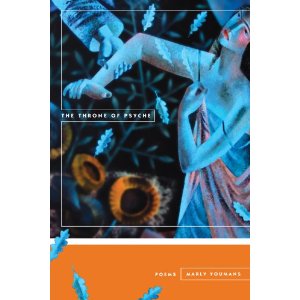
For The Throne of Psyche, it's pre-order and discount season at your local independent bookstore, your chain, your online flogger... And so I have obeyed a suggestion in the Comments and put up an Amazon author page, so if you want to take a look at the book, you may then click on my name and find me there.

MERCER CATALOG COPY

Here is my Mercer catalog copy for The Throne of Psyche. It looks quite attractive--that pale and peachy background color might have been picked just for my book... You'll have to imagine all the tasteful fonts and layout and so on. Also, the margins won't paste as they should, so you'll have to put up with a bit of waywardness on that front.

The blurby bit:

Marly Youmans is a native Carolinian
who currently lives in Cooperstown,
New York, with her husband and three
children. Her books include collections
of poetry, novels—her 2001 novel,
The Wolf Pit (Farrar, Straus & Giroux),
won The Michael Shaara Award—and
fantasies for young adults.

(That was before the Ferrol Sams Award, so it's not listed.)

The Throne of Psyche
Poems
Marly Youmans

Marly Youmans is “the best-kept secret among contemporary
writers.”
—John Wilson, Books & Culture

In The Throne of Psyche, Marly Youmans sweeps back and forth between
what is human and what is other, binding the two together or crossing the thresholds
between them. A prize-winning writer of stories and novels, she pursues tales both
otherworldly and earthy with passion and formal power in this eighth book, her
second collection of poetry.

The title poem’s narrative governs the entire collection in its yoking of Eros to
Psyche. Psyche is the young girl brought in fear to a marriage chamber that transformsinto forest as “The little stars” go “shrieking through the wood” and her childhood innocence is “struck asunder.” But she is more than mortal as she passes in and out of time: the child who hears a dryad prophesy, the goddess who sits on a throne or plays “in the arms of Love / As starlight steadies in his perfect flesh,” the figure of meditation and grief who walks along the broken palace walls of home, the bold adventurer who has been to hell and drunk the blood of memory in the place where all she once loved is now shadow.

Elsewhere in these poems are other potent narratives and revelations where mortal
flesh slams into death and transformation: a woman dances with God, the poet speaks
in the form of a dryad, a sister transforms into a fish and swims away, a doll is cast out from home and overtaken by a demon, the otherworldly infiltrates the leastmost dust,and a new mother walks with Death in his forest.

Such metamorphoses and broodings on the door ajar between human and
other remind us that Marly Youmans is “the best-kept secret among contemporary
American writers. She writes like an angel—an angel who has learned what it is to be
human” (John Wilson, Books & Culture).

April 2011 poetry
6 x 9 100 pp. Cloth, $30.00t 978-0-88146-246-3 H826
6 x 9 100 pp. Paper, $18.00t 978-0-88146-232-6 P422