NOTE:
SAFARI seems to no longer work
for comments...use another browser?
Showing posts with label fiction. Show all posts

Saturday, May 30, 2020

ZOOMFEST!


You are invited
to a
Pandemic Book Party

Jane Greer, Sally Thomas, Marly Youmans
reading from their new books:
two poetry collections and a novel.

Live
on
Friday, June 12
North America: 
3:00 Eastern, 
2:00 Central, 
1:00 Mountain, 
noon Pacific.
World time zone converter HERE.

Register in advance 


Jane Greer,
Love Like a Conflagration
Jane Greer founded Plains Poetry Journal, a literary magazine that was an advance guard of the New Formalism movement, in 1981, and edited it until 1993. Her poetry collections include Bathsheba on the Third Day (1986) and Love like a Conflagration (2020).
For  more about Jane, hop HERE
Buy her book via indies, Lambing Press, Amazon, Bookshop, and more...


Sally Thomas,
Motherland
Sally Thomas is the author of two poetry chapbooks, Fallen Water (2015) and Richeldis of Walsingham (2016), both from Finishing Line Press. Her full-length poetry book, Motherland, was a finalist for the Able Muse Book Award, and is available now from Able Muse Press.
For Motherland news at Sally's site, skip over to HERE
Buy her book via indies, Able Muse, Amazon, Bookshop, and more...


Marly Youmans,
Charis in the World of Wonders
Author of fifteen books of poetry and fiction, including The Book of the Red King (Phoenicia Publishing, 2019) and Charis in the World of Wonders (Ignatius Press, 2020.)
For reviews, purchase venues, blurbs, etc., jump HERE

Tuesday, May 26, 2020

Charis reviews, new poems, and more


Charis in the World of Wonders reviews

Greg Langley, The Baton Rouge Advocate: 
23 May 2020

Ben Steelman, The Wilmington StarNews:  
16 May 2020

Here's a blog review by Cat Hodge


Podcast review

Text clip:  What really makes this novel good is the interior life of the protagonist. She's an interesting character, and with a very rich, beautiful interior monologue... There is a sensitivity of  language; the language is beautiful without being overwrought... It's lovely,  it's captivating, it's beautiful. --Melanie Bettinelli, Raising the Betts podcast #051 (begins 38:25 mark), StarQuest Media Network / sqpn.com


New poems online

Three, including a commissioned pandemic poem... 
Thank you to The Living Church (Episcopal) for requests.

Smalls and Tinies

The next ten months will see ten miniature 
stories or story-like things
at North American Anglican. 
Here's the first: Iolanthe

Videos

Several at The Ballsians 
(youtube channel)

And more at my own site


Monday, May 04, 2020

LOL (lots of links)

A illustration by Galen Dara for one of my stories.
Because certain foreign readers (in countries with some difficulty in affordable book ordering) wanted to read more of my poems and stories, I have updated my record on my Short stories and poems page.

Though I tend to be a bit careless about record-keeping, I've added stories and poems, and I have added a lot of links. I hope that people enjoy some of these...

I've also added a section of what I call Tinies, and that section will have more links as some of these appear--ten will be coming out in the next ten months at North American Anglican.

Note for those who use Bookshop.org: I don't know what's going on with Bookshop, but my books have suddenly become hard to bring up by search there. I'll try and have them sort it out, but in the meantime, you can go directly to my own Bookshop page to search. They don't have all of my in-print books, but there are six: https://bookshop.org/shop/Marly_Youmans. 

Wednesday, March 25, 2020

Pete Candler's A New Decameron launches


Pete Candler's storytelling project--an edifice of words and images to be built during our time of pandemic, and glancing back to Boccaccio and the time of the Black Death--begins. Like Boccaccio's Decameron,  A New Decameron will rejoice in a multitude of narratives. Right now you'll find a trailer (including one of my poems as part of an introduction from Pete) and print versions (audio posted soon) of four poems of mine with art by Bruce Herman, who holds the ethereal, leafy Chair of Lothlórien at Gordon College.

Here's an excerpt from Pete's introduction, referencing the original Decameron:
I don’t know how many people are going to read Boccaccio these days, but I had a thought: why not recreate the Decameron for our time? I want to collect 100 stories to share online in written and audio form, to provide some of that common humanity Boccaccio’s characters found in their time. The only rule is that these stories should be as fully human as Boccaccio’s, and will be about anything except the coronavirus. The text versions will be posted here, accompanied by contributions from visual artists. The audio versions will be posted in podcast form and made available on Apple Podcasts, Spotify, and elsewhere.
Each day, for as long as our social isolation lasts (and possibly longer), we will post one new reading in the hopes of making something beautiful together out of our collective isolation, and, in the words of Boccaccio, “to offer some solace…to those who stand in need of it.” We may not have a lavish country estate to retire to wait out the contagion, as Boccaccio’s characters did, but we do have this, and that is not nothing. 
As Pete Candler is already the accomplished maker of the rich and challenging online project (films, still photographs, and stories) titled A Deeper South, I expect A New Decameron will be wondrous. If you haven't visited A Deeper South, go there too. "The vision of A Deeper South is rooted in the idea that the spiritual, political, and cultural health of a nation, region, city, town, or person depends upon an honest and unflinching memory; that the gravest danger to our cities and ourselves is a willful amnesia; that hope is to be found through the work of active remembrance, putting back together the fragments of personhood scattered by a culture of selective memory." Like A Deeper South, A New Decameron is ambitious and unifying in its goals.
To take pity on people in distress is a human quality which every man and woman should possess, but it is especially requisite in those who have once needed comfort, and found it in others. I number myself as one of these, because if ever anyone required or appreciated comfort, or indeed derived pleasure therefrom, I was that person. 
--Boccaccio, The Decameron


* * *
(Thanks to Artemis Journal and poetry editor Maurice Ferguson for permission to reprint two poems, and to Beth Adams for permission to reprint from her Annunciation anthology, which will be back in print from Phoenicia Publishing in July 2020.)

Saturday, December 15, 2018

Revelator, etc.


PICS
Have to admit that I was surprised by the huge numbers of people who wanted to weigh in on what my author picture should be... so many bossy, nosy, imaginative, funny people, particularly via facebook but also in other places. So here is another chance if you feel like being a smart-aleck or keen-eyed or wise judge: Marly at 65 board. I need one for a novel, one for a book of poems.

FICTION/ POETRY

News of the moment: you can read a piece of my fiction, "Prospero's Island," at the new Big Apple issue of Revelator Magazine, brainchild of Eric Schaller and Matt Cheney. And you can read one of my poems as well--"The White Orchard." So you could have Miranda and Caliban and Prospero and Isaac Newton on this lovely winter's day... Plus a lot of other interesting work by Richard Bowes, Craig Gidney, Chad Wood, and more. (Even Old Ezra!)


LAPTOP

Laptop still in agonies... Let's just hope the Time Machine releases all my files on a repaired or new laptop by the middle of next week... Otherwise I will spend the next few years typing manuscripts!


Tuesday, May 15, 2018

Morning thoughts on creation

A good image for a flourishing mind...
by Clive Hicks-Jenkins
for Maze of Blood

One of the stranger things about Genesis is that God is shown making the universe, and at its end the universe is good. In fact, very good. But it's not faultless. Genesis never claims such a thing. The universe is order drawn out of chaos. But it's not order drawn all the way out of chaos.

Without some chaos and change, new things would not rise up as time passes. Evolution would never happen. Some elements of perfection sound very attractive. Volcanoes would not erupt, tsunamis not spill over the earth. We wouldn't have to write books about why bad things happen to good people. Perhaps little would happen to anybody, but the world would be tidy and orderly and safe.

Or perhaps the world would be fully anti-narrative and nothing at all would ever occur. Perfection is static. The order of made things grows out of the soil and ferment of chaos.

A book or a poem (not Creation with a big C but a little-c sub-creation) aspires to perfection, aspires to bring order out of chaos. No one can create perfection, and I imagine a writer might just stop if he or she reached perfection in a work. A book or poem also aspires to do something new in the world, though most stories and poems do not.

And who are the best poems and books for? (Here I am skipping the au courant, the trendy, the passing fancies, the bestseller rages--they have their reward!) Are they written for readers? Not exactly, though words are a siren call sent out to readers who bob by in their little ships. At its best, a poem is made from a springing desire that is beyond words but becomes incarnate in words. A novel or other long work is a mixture of conscious decision and labor and that same springing desire which comes and goes like a will o' the wisp.

The new small-c creation may find readers if the work is good or very good but also if the work has luck and a push toward visibility. Then reader and the writer may at last unite, the reader creating in mind a singular, personal version of the work...

Saturday, May 20, 2017

Tabago!

Novelist and poet Seb Doubinsky (he writes in both French and English) has a new project he calls "The Tabago Page." Interviews with writers will not focus on marketing and promotion but try to dig a little deeper into the work and the novelist or poet (or the poet-novelist or novelist-poet. Not sure what I am!)

Here is my interview.

And thanks to those who have already shared on social media. 

Thursday, January 12, 2017

Reading Doña Quixote

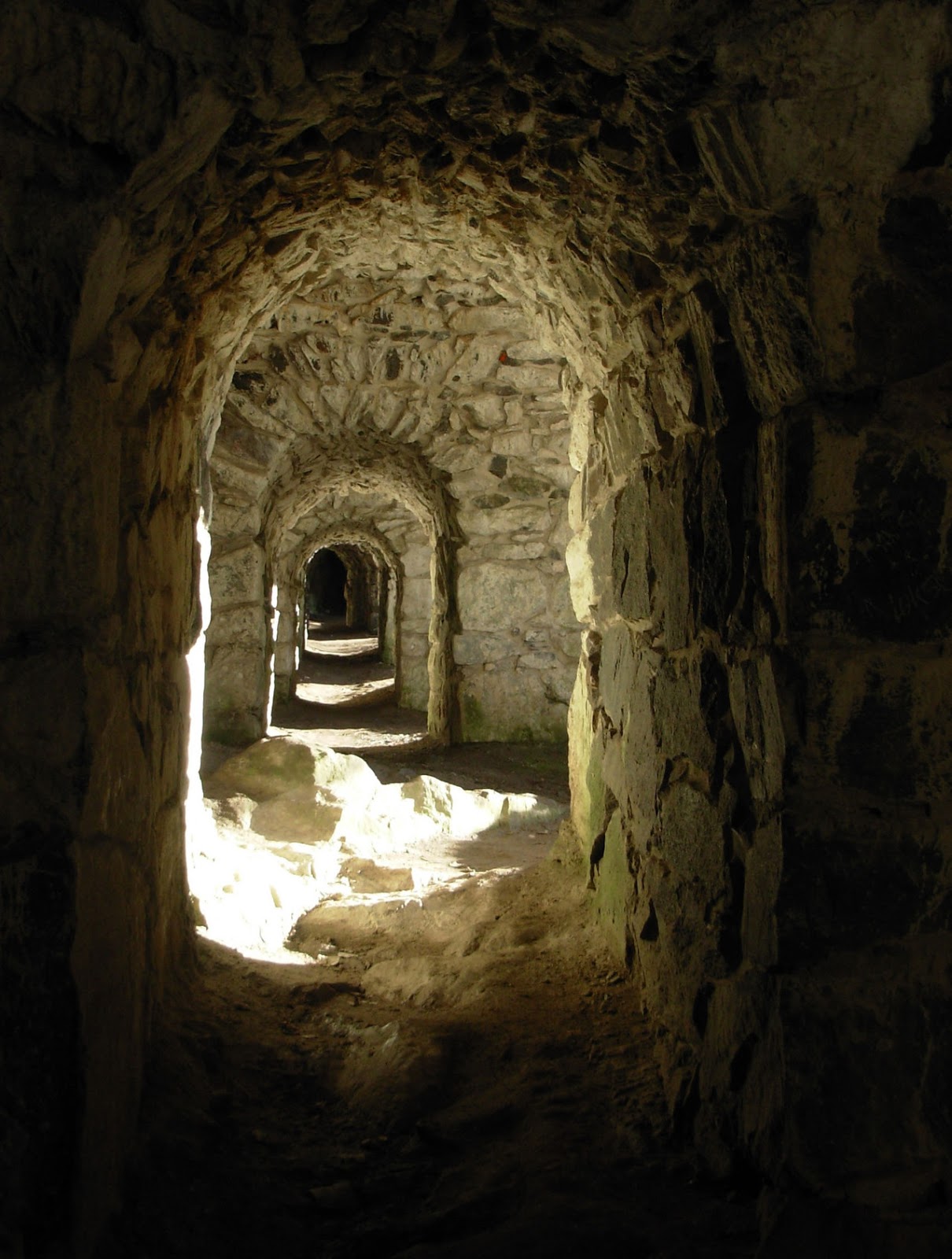
Courtesy of Päivi Tiittanen, sxc.hu
"Catacombs in Suomenlinna"
Yesterday and this morning I read Leena Krohn's Doña Quixote and Other Citizens. Portrait: Tales of the citizens of an usual city, and this is what I have been for some hours: a room through which the narrator and Doña Quixote (the woman who is like a tree that murmurs and sometimes drops shriveled leaves proclaiming death, the woman who is a poet) come and go, talking of many things, and sometimes of what the shriveled leaves proclaim. And in those hours, the city is mine and in me with its green-shining towers of telephone booths and its moving rooms, and I am also a room that holds many objects whose meaning sometimes is profound and secret and sometimes falls away and is lost. In and out of the room of me come figures who are rooms also and who connect with me and whose connection then falls away unaccountably, perhaps to recur, perhaps to drift through the gate built in water and be lost or bob away across the sea and perhaps return to me, for there are many deaths in a life, many passings-away and sometimes returns.

Into the room of me comes Doña Quixote with the poetry of herself and the strange wisdom that makes me know, and her melancholy that is also a fabric in the room of me, that matches something in me. Like a trick chalice, I fill up, and then at once everything I have drains away. All things go. All rooms are pendulums, moving toward a time when they will be no more. In all the city of interlocking and moving rooms (some a lit bus with the moving figures inside), I am found, I am lost, as Doña Quixote is found and lost also.

And now and then I am arrested by the knowing of this: the most important thing about a thing is that it is beautiful, whether it is a mysterious narrow gate in the sea, a gorgeous, filmy-tailed goldfish, a dancer like a flower's corolla, or a silken peacock that trembles, unfurling its mighty fan of eyes while the snowflakes sift down before and behind and onto its glistening green and blue.

But even that knowing cannot be grasped and held until it always lights the room of me or the room that is Doña Quixote but drains away. The loss and passing of that knowledge of beauty is like a death, like passing through a gate built in water. "One doesn't get used to living."

And now I have shut the book, though the sense of myself as a room--a room filled with strange objects that do not give up their secrets--remains. And the sense of beauty also, for the book is still open beside me. And that I have written (carelessly? wisely?) that the book is both shut and open seems entirely right.  10 January 2017


"Peacock feather"
Courtesy of Sean Okihiro, sxc.hu
You may read this short novel (or is it an interrelated collection?), Doña Quixote and Other Citizens. Portrait: Tales of the citizens of an usual city, in that gigantic volume, Leena Krohn's Collected Fictions: A Career-Spanning Selection from Finland's Most Iconic Writer. (What long titles! And I wonder what Leena Krohn thinks about being iconic. I'm not even sure what they mean with that choice. Revered? Painted on a wooden surface? Semiotic-iconic? Flowering from tradition? All of these?)  I do, however, feel quite sure it is a publication from Ann and Jeff VanderMeer's Cheeky Frawg Books (Tallahassee, FL, 2015.) Doña Quixote is translated by Hildi Hawkins.

Monday, January 02, 2017

Selected Reading, 2016 Happy New Year

Selected 2016 Reading List, in ABC order by author
Books by friends, books recommended by friends, 
new reads, lots of rereads, books read to review or blurb. 


Of course, I lost my list (so me!) partway through the year, 
so here's what I remember right now in the way of books read in full.

Aldhelm, Saint Aldhelm's Riddles, translated by A. M. Juster. Reviewed for First Things. (Yes, I liked it and gave it a great review.) My husband bought me a copy at the same time I bought myself one, so clearly it must be a "me" sort of book!

Jane Austen, Persuasion. Reread, again. It has climbed higher on the Austen list. Maybe I'm finally old enough to appreciate its virtues.

Jane Austen, Pride and Prejudice. Reread for the Nth time. In the kingdom of the novel-in-English, I can never be done with rereading Fielding, Austen, Dickens, Hawthorne, and Melville.

Jane Austen, The Watsons (fragmentary novel.) If you're a fan....

Willis Barnstone, translator of The New Covenant Volume I: The Four Gospels and Apocalypse. Translated from the Greek and informed by Semitic sources. Extensive introductory and appendix essays. I don't always agree with him but the essays and notes are interesting, and so is the translation, which uses Aramaic / Hebrew name ways and returns the text to poetry.

Michael Bishop, Joel-Brock the Brave and the Valorous Smalls  Read in manuscript to write a blurb for Kudzu Planet Productions. Illustrated with charm and abundance by Orion Zangara.  Full blurb: "Joel-Brock Lollis's family has vanished into the labyrinthine Sporangium below a curious Georgia emporium, Big Box Bonanzas. Glimpses of an older J-B Lollis of the Atlanta Braves on a BBB television suggest that Joel-Brock may never get back his parents and sister. The Valorous Smalls--almost-ten Joel-Brock, lively teen Addi, and tiny detective Valona--forge their way into the mushroom realm to change that possible future. Young readers who enjoy quests with marvels in the kingdom of the weird (mushroom warriors! mazes! time games! giant slugs!) will find much to interest, amuse, and surprise them in Michael Bishop's unusual fantasy, Joel-Brock the Brave and the Valorous Smalls, well and profusely illustrated in pen-and-ink by Orion Zangara."

Louise Bogan, The Blue Estuaries: Poems, 1923-1968. Fine poems, well worth reading. As with Muir, I like the mythic ones a lot. That may be because they were the first I knew, as both writers were in a mythic poetry anthology by John Alexander Allen bought when I was seventeen.

G. K. Chesterton, The Ballad of the White Horse. If you're a fan of LOTR, read this! Clearly a major source, far more suggestive of Tolkien than I expected.

Wilkie Collins, The Woman in White. Reread yet again. Such a marvelous "sensation" novel, such curious characters, such moody "set pieces," starting with the initial encounter with the Woman in White. While it was very clear on the unequal status of men and women (particularly as regards inheritance) at the time, I suppose that its marked fluidity of male and female roles within a Victorian world always conscious of what is proper must be of new interest to scholars in our era.

John Putnam Demos, Entertaining Satan: Witchcraft and the Culture of Early New England.

Annie Dillard, The Abundance. If you like Dillard, which I do, you might order this thinking (as I did) it would be chock full of essays. I was rather disappointed that this selection was not a little more abundant in its choice. Great starter book if you haven't met her before.

Seb Doubinsky, Predominance of the Great: non-haikus. Narcissitic comment: always so pleasant to have a poem dedicated to you--to find out what words the poet thought suited to "you."

Jeffrey Ford, The Shadow Year. Interesting to read another Ford novel. But if you have not but wish to read him, start with the short stories.

Richard Goldbeer, The Devil's Dominion: Magic and Religion in Early New England.

Georgette Heyer, The Marriage of Convenience. Read this one because Ellen Kushner kept talking about Heyer. It is frothy--rather as if Leon Garfield, Jane Austen, and P. G. Wodehouse had a word-frolic.

Clive James, Poetry Notebook. Wonderful essays, well worth reading. If you write or read formal poetry (you know, the stuff we used to just call poetry, back before Modernism), you will find him congenial, I expect.

Mary Kinzie, The Cure of Poetry in an Age of Prose: Moral Essays on the Poet's Calling. Learned about this one via a Michael Juster tweet. This book would be salutary for any young poet to read, no matter his or her bent, because he or she would be challenged by the description of the poetry of our day. Even if the poet radically disagreed (perhaps especially then?), such strongly formulated arguments would be helpful in coming to understand his or her own thoughts.

Ursula LeGuin, A Wizard of Earthsea.  Holds up from the first read, many years ago.

Ursula LeGuin, The Tombs of Atuan. Ditto.

George MacDonald, At the Back of the North Wind.
I loved this as a small child; it feels dated but still has the MacDonald sweetness.

George MacDonald, Phantastes. Foundational book for 20th-century fantasy.

Jo Mazelis, Ritual 1969. You can read my review of this collection (her third) for Planet: The Welsh Internationalist. "Jo Mazelis’s well-crafted stories in Ritual, 1969 (Seren, 2016) stand at a crossroads—liminal place between worlds where criminals and suicides were buried—of the fantastic and the homely real."

Alda Merini (Susan Stewart, translator), Love Lessons: Selected Poems of Alda Merini. I have read this book twice, trying to see why I should be a fan. Still not, alas. It seems more than a language problem, as I once again felt let down. Truly, I would like someone to explain to me why I should admire the poems. I would welcome a little enlightenment. Alessandra Bava tells me that Alda Merini is quite good, and I believe her but still can't see.

Edwin Muir, Collected Poems. I had not read him in a long time; I like his poems, especially the myth-tinged ones.

Garth Nix, Sabriel, Lirael, Abhorsen, Goldenhand and To Hold the Bridge. Y. A. fiction. The two last are new, a novel and a collection (the title novella is set in the Old Kingdom.) Thinking about going back to a novel for teens than I abandoned when almost finished, but I think this is about all the contemporary Y. A. I read last year.

Adam Roberts, The Thing Itself. I tweeted a lot of quotes from this book in the fall, and regret that it has not had a wider readership. If you love irrealism of any sort, try it. If you love Kant, try it. Oh, just go ahead and try it!

Robert Louis Stevenson, Kidnapped. Enjoyed as much as when I was a mere sprat. The "flight in the heather" (admired by Henry James) and the roundhouse battle are well-handled pieces that mix action with forcible inaction and watching. I also like the wild weirdness of the hideout for Cluny Macpherson, Jacobite rebel. The relationship between David Balfour and Alan Breck Stewart is effective in great part because Alas is so rash and bold and childish and proud, and David is tested in his loyalty to the man who has saved him. Set in the eighteenth century and making use of the murder of Colin Roy Campbell the Red Fox near Ballachulish (the Appin Murder), the story is well worth a read if you missed it, growing up.

Michel Tournier, Gilles and Jeanne (translated by Alan Sheridan.) Definitely should not be the first Tournier read. I think it must be called a failure, though failures are, of course, important to art and shed light on related work or can be transitional bridges to something more successful. Yet I dislike it. You know it's not kindred when the book is short and you start skimming anyway!

Robert Walser, Oppressive Light (selected poems, translated by Daniele Pantano.) Walser made me write a few poems in opposition to his, so I am grateful to him. I was a little disappointed--somehow expected more, when I should have been simply curious--but interested all the same.

Dallas Willard, The Divine Conspiracy: Rediscovering our Hidden Life in God. The self as kingdom flourishing within the divine kingdom.

W. B. Yeats, Crossways.
I always read Yeats, but this year I'm looking at his poems as separate collections instead of hopping about at whim (although I am doing some of that as well.) New poem "I Met My True Love Walking" has a sigodlin relationship to "Down By the Salley Gardens."

W. B. Yeats, The Rose.

Philip and Carol Zaleski, The Fellowship: The Literary Lives of the Inklings. How lovely to have such a wonderful setting, to be a writer in a setting where words mattered so very much. How sweet to grow and aspire in a small, encouraging country that cares about its literature.

Saturday, February 06, 2016

You asked, no. 9: resources

May your head be full of dreams!
Division page by Clive Hicks-Jenkins
for Maze of Blood.
Here's a reference list of critique and forum sites that I've made for the people on twitter and Facebook who ask me to read and critique their work. I'm afraid that I can't do such things for all who ask--I need to manage being a mother of three, hitting my deadlines, and accomplishing the writing and reading that I must do.

I think the best advice--advice I have often given--may be to get to know your regional poetry-and-fiction scene and area writers and poets. That way swapping work and critiquing can happen in a more natural way. I don't do that, but I imagine it's rather enjoyable if you don't--as I do--live in the middle of nowhere. But many people have little access to the kinds of events that occur in an urban area.

I'm not very good at telling people, NO. So here is a list of helpful places in lieu of a big fat NO. In other words, this is an attempt at a polite and helpful No, but thank you very much for thinking of me, and the very best of luck to you.

If you have a site, workshop, or person to recommend, please leave a comment.

ERATOSPHERE. FORMAL POETRY. I'm a member of the site, though I've never participated in the workshopping--just a tad too busy. But plenty of well-known writers of formal poetry have passed through its machinery, and people seem to love it. (I go by to see who has a new book, ask a question, see what the latest fracas is, etc.) www.eratosphere.ablemuse.com

ERATOSPHERE. FREE VERSE. Look for "Non-metrical Verse" in the forum topics. Workshopping of free verse. www.eratosphere.ablemuse.com

CRITTERS WORKSHOP. FICTION. SF/F/H. I know a bit about this one because someone in my family has used the site. He seemed to find it useful, although I remember him saying that one person who critiqued his work was stellar and the rest less or little help. You have to critique some work by others in order to become part of the system. www.critters.org

CRITIQUE.ORG WORKSHOPS. FICTION. MANY GENRES. NONFICTION. SCREENPLAYS. This one is a child of CRITTERS but is bigger than its parent--does all fiction genres, as well as nonfiction and screenplays.

LAURA ARGIRI. Reasonable fees for editing and revision work.  If you're interested, I can send you an email address.

CLAIRE YOUMANS. (No doubt she is a very distant relation!) Writer who edits nonfiction, fiction, and translations from Japanese and French. Ask me for contact information.

THE WRITE LIFE INDEX TO FINDING A CRITIQUE PARTNER Includes a lot of possible forums and workshops. http://thewritelife.com/find-a-critique-partner/  I don't know much or anything about most of these, but the site seems a good place to start.

***
POETRY COURSES And since someone also asked me about a poetry course this week, here's a site with links to free poetry courses. 

Monday, August 04, 2014

Metaphysical tea party with Edith Sitwell and Flannery O'Connor and peacocks

Clive Hicks-Jenkins, interior vignette
for Glimmerglass
SEEING

 Edith Sitwell: It is a part of the poet's work to show each man what he sees but does not know he sees.

 Flannery O' Connor: The writer should never be ashamed of staring. There is nothing that does not require his attention.

 ON “KEEPING RABBITS”

 E: A great many people now reading and writing would be better employed keeping rabbits.

 F: Everywhere I go, I'm asked if I think the universities stifle writers. My opinion is that they don't stifle enough of them. There's many a best seller that could have been prevented by a good teacher. 

HIDDEN LIFE

 E: The poet should speak to all men, for a moment, of that other life of theirs that they have smothered and forgotten.

 F: I use the grotesque the way I do because people are deaf and dumb and need help to see and hear.

HALF-ALIVE

 E: I am not eccentric. It's just that I am more alive than most people. I am an unpopular electric eel set in a pond of catfish.

 F: Whenever I'm asked why Southern writers particularly have a penchant for writing about freaks, I say it is because we are still able to recognize one. To be able to recognize a freak, you have to have some conception of the whole man, and in the South the general conception of man is still, in the main, theological.

 WOOD FOR THE FIRE

 E: I have taken this step because I want the discipline, the fire and the authority of the Church. I am hopelessly unworthy of it, but I hope to become worthy.

 F: Most of us come to the church by a means the church does not allow.

 F: All human nature vigorously resists grace because grace changes us and the change is painful.

 ART AND INCOMPLETENESS

 E: Poetry is the deification of reality.

 F: The writer operates at a peculiar crossroads where time and place and eternity somehow meet. His problem is to find that location.

 F: The novelist doesn't write about people in a vacuum; he writes about people in a world where something is obviously lacking, where there is the general mystery of incompleteness and the particular tragedy of our own times to be demonstrated, and the novelist tries to give you, within the form of the book, the total experience of human nature at any time. For this reason, the greatest dramas naturally involve the salvation or loss of the soul. Where there is no belief in the soul, there is very little drama.

Wednesday, January 30, 2013

Childe Phoenix

This month a story originally published in Lady Churchill's Rosebud Wristlet will be reprinted in Lightspeed. "Prolegomenon to the Adventures of Childe Phoenix" is one of my stranger stories, involving a death, chasmic separation, and a young boy's departure into the great outer world. In its surreal elements I see obsessions that I have also dealt with in poetry. In addition, there is an interview with me. The full issue is available February 1st as an ebook from Lightspeed Magazine: Science Fiction and Fantasy; otherwise, I'll be up some time in February. Here's the table of contents.

Friday, January 04, 2013

Most questions answered, no. 1

Paul Digby said... 
I'd like to see a post that discussed how your approach to writing might differ if there were no such things as publishing houses and ebooks and the like. How would you write for hand-bound limited edition stuff (as though 'literature' were no longer published or read). 

Would there be changes to your approach? Would there be differences in the way you completed work if there were never any deadlines. 

In other words - How would you write if your work were purely for your own joy, and that of those you know? The same?

And then I'd like to know what on earth David R is doing here and how did he slip through your very thorough screenings?

If no longer read at all, there would be no need for me, but since you ask about "hand-bound limited edition stuff," I suspect you mean exactly that. The answer is that I'm already pretty close. I broke up (sweetly, mind you) with my second agent and have depended entirely on requests for my work for publication ever since.

This method does not smack of "savvy" behavior, but it pleases me, in all but matters of distribution and wider sales--please go and buy some more copies of my books and give them out on the street corner! Better and easier, just assist Lady Word of Mouth in her much-needed work of sending out little messages when you like my books.

All this change means that I have been publishing with some of the houses who asked me to submit because they liked my writing. It has been a great relief to me to find that publishers and presses do ask for work, and that I don't have to go hunting for a publisher (though I may hunt for one for a children's book eventually.)

I have lately published with a range of these publishers: university press (as, my 2012 novel, A Death at the White Camellia Orphanage, and my 2011 collection of poetry, The Throne of Psyche); houses that knew me well through prior requests for my work for their anthologies (novel Val/Orson and collection The Foliate Head); and small press (Thaliad, where the publisher knew an excerpt before asking for the whole poem.) Several of those publications were labors of love by artist and designer and writer in a way that approaches the hand-bound aesthetic. Three of the books appeared as limited editions in hardcover. (See tabs above to read more about any of them.)

Deadlines aren't usually much of an issue because I appear to be what's considered fast in the world of writers, though I am slowed down by other commitments at times (my three children, the NBA judging stint, etc.) To me, the way I work does not seem fast and is often punctuated by times empty of writing . . . But I can say that if it took me 14 years to complete a book, I would not bother. It's really unfair, isn't it, how time spent and years of labor don't always help and do not mean some greater virtue in the work?

I do write for my own joy and can't say that there's another way for me with poetry and for many passages of fiction. Nonfiction and blogs are not that way but have an interest of their own. Fiction demands workmanlike bridges and ladders that are sometimes less than joyful, of course. Re-writing and tinkering are oddly satisfying. My joy comes from playing with language and also from the splendor of a flooding pleasure that comes with bringing something out of nothing--the influx of creative spirit, delicious and vital.

In the end, I look at all this in a simple manner. I have a gift that I did nothing to earn. What matters is what I do with the gift, and that I turn it into further gifts to go out into the world and live. For me, it feels magical and like a return gift that out there in the world, somebody is reading my words and so completing a story or poem.

P. S. I almost forgot that important matter of David R and the ongoing facebook tilts and tourneys and occasional friendly wars. The Balrogs have become very fat on spam and do not guard the gates any longer but lie around burping extravagantly (the borborygme!) and letting out tiny moans. Feel free to pop over and let out a lusty You shall not pass! when David R wanders by with his pack of cats and lemur.

Sunday, September 30, 2012

Janus-post: look both ways

Why do you feel that it is important that commercial fiction receive critical attention?
Jodi Picoult: Because historically the books that have persevered in our culture and in our memories and our hearts were not the literary fiction of the day, but the popular fiction of the day. Think about Jane Austen. Think about Charles Dickens. Think about Shakespeare. They were popular authors. They were writing for the masses.
vs.
Appreciation! Recognition! is Jove appreciated? Why, ever since Adam, who has got to the meaning of his great allegory--the world? Then we pigmies must be content to have our paper allegories but ill comprehended. 
--Melville to Hawthorne, in reply to a letter about Moby Dick, long considered a failure

"Thank goodness you're a failure--it's why I so distinguish you! Anything else to-day is too hideous. Look about you--look at the successes. Would you be one, on your honour?” 
--Henry James, The Ambassadors

Monday, September 10, 2012

Tolkien/Jacobson, genre/literary

Update: Book designer John Coulthart just sent me a link to this piece, in which he says Jacobson is more nuanced about genre. "The best fiction doesn't need a label." It looks interesting, and I'm going to read it now and then get back to work. Thank you, John!

High school started here on Thursday. The three children and I watched The Lord of the Rings trilogy in celebration of the start of the youngest's sophomore year in high school (the hallways of Orcs! the all-seeing principal Eye! the young women sharp as a blade!) and finished the last bit last night, finally obliterating the sign of sin and overreaching power in the volcanic flow of Mount Doom. Of course, the movies are nothing so complex as the book in three volumes that was praised by Auden and has been dearly loved and reread by many, but it got me considering that curious man, Tolkien, off and on all week. Last night I was thinking about how interesting it is that he disliked Macbeth and yet clearly does more than nod to it with his moving forest on Ent-march and his "no man" oracular prophecy and plot twist.

This morning I read Howard Jacobson's interview in the Guardian, where he says he is "contemptuous of genre things...." Not books but things. (I tend to be with Sendak in thinking that there are "good books" and then the others, but we live in a world where people like to categorize.) Jacobson goes on to reference without naming the Twilight series and then to cite 50 Shades. Ridiculously easy potshots! I'd like to see what he thought of Crowley's Little, Big, for example. He is also contemptuous of the term "literary fiction." He writes "fiction," he insists, while others write "crap." I know a lot of these attacks are a clever, Amis-like use of a media that desires column inches with sharp teeth and blood and hair. No doubt they are good publicity for the new book.

Those of us who write what is called "literary fiction" evidently want to be acknowledged as writing the only fiction that matters; that's why we desire that simple label, "fiction." What we do, we believe, matters more. But it ain't necessarily so. What I learned in writing two fantasies for young readers and a number of fantastic stories for anthologies is that our "literary fiction" worldview is provincial. Writers in other genres believe strongly that we write in simply another genre, one often less vital than their own. Sometimes they are right--depends on the book. It always depends on the book. Likewise, a book in another genre can clamber up to the heights. Entertainment may fly up into the realm of art. Why not? There are no rules, only the force and heart and skill of the mind behind the keyboard. What is The Tempest if not a romance of first love and a fantastic tale of a wand-wielding and -breaking wizard intended to please both the ruled rabble and the ruling classes?

Oh, I have sympathy for Jacobson's past situation, and am glad he has been lifted into light where he is visible. I know all about his "working away at the edges for years." No doubt the stacks of sold copies for A Death at the White Camellia Orphanage and Catherwood and all the rest are but very little hobbits compared to the giant cave trolls of a Booker winner or a NYT bestseller. But hobbits are sturdy, lovable storytellers and song-makers. And the hinterlands and the edges have their advantages. From the edge, you can reach out into space that has no chart, building a world outward as you will. From the edge, the trends and bubbles of the day are only white noise, lost in the distance, and what matters from the past stands like a great field of monuments where a writer can lose and find himself in wandering.

Any of us "at the edges" would trade something for visibility, for a greater number of readers. But it's an old story; I imagine that Melville, say, would have been willing to give up a limb and hobble like a peg-leg sailor to keep the readers he had with Typee and gain a few more. Poe certainly wrote wild attacks with teeth and hair and gave up everything in search of a wider audience. Dickinson ventured out and then back, sealing the door. Yet they and others like them--some remembered, some not--had their painful, joyful, austere reward, just as Stephanie Meyers and the writer of 50 Shades of Gray have a reward of another kind. Let's look to Jacobson's "genre things" for what we must do about the strange ways of the world. As Gandalf says, what comes to those in a time "is not for them to decide. All we have to decide is what to do with the time that is given us."

Thanks to Damien Walter, Guardian columnist, for the Jacobson interview link.

Friday, June 01, 2012

Imagination and feeling

We all suffer alone in the real world; true empathy's impossible. But if a piece of fiction can allow us imaginatively to identify with a character's pain, we might also more easily conceive of others identifying with our own. This is nourishing, redemptive; we become less alone inside.  --David Foster Wallace

I read these lines today and was struck by them because I disagree so simply and utterly. Yes, we suffer alone. But no, empathy is not impossible. Utter identification is impossible; we would have to become the Other in order to do so. But empathy is an act that used to be commonly taught in all classes of society; it began often in a young child's observation and instinctual feelings and proceeded to grow through the learning of manners and courtesy. It is still so in many places.

What startled me most in these lines was this: "we might also more easily conceive of others identifying with our own." That had never crossed my mind as a writer's motive for creating fiction until I read those words. In fact, a great deal of my life has been devoted to a role--mother--which one would be mad to undertake if hoping that "others" would "identify" with "our own" feelings. That's not why one becomes a parent. I don't believe that I've ever thought much about others identifying with my feelings; i never thought that there was some special need in me for them to do so, though I appreciate sympathetic feelings as much as anyone. And when I write fiction, I desire my readers to identify not with my feelings but with those of a created character, a being independent from me. My sensation as a writer is one of out-pouring; the sense of a single self or "me" is lost in the deluge.

I have spent many hours as a writer, a worker, a mother, a child, a relative, a friend, and as a simple passer-by on the world's road in identifying with the feelings of others. And I do indeed find the act to be "nourishing" and "redemptive."  Not only am I "less alone," but I am changed and charged with feeling by becoming, for a little while, linked to another person. The inside of me is a little bigger and a little more multitudinous than it was before.

So right now I am thinking hard about what it must have been to be David Foster Wallace, needing the knowledge that others could imagine feeling the way he felt in order for him to feel less alone. While I am most joyous when I turn outward in life or in creation, he needed the nourishment of others turning toward his inwardness and knowing his pain. And now it is empathy and imagination that will tell me what that means, and exactly how sorrowful it is...

Monday, September 05, 2011

Dear Professor Currie...


This morning I read “Literature and the psychology lab” by Gregory Currie, a professor of philosophy at the University of Nottingham. Among other things, he suggests that writers may be not more but less reliable than others at understanding the minds of others because they are so often a tad schizoid or bi-polar, an increasingly common way of investigating the artist these days. He believes that literature in general is not such a great measure of human understanding and that human imagination is not very accurate—even that creators don’t actually care much about other people, a thing I find manifestly wrong when looking in my own heart. (I note, as he does, that the research on writers and psychology he cites comes from male writers.)

Having come from neurologically strange stock myself, I find these sorts of arguments to be interesting but not very useful. Yes, someone with a dash of something or other may be looser on the mental leash that others are, may have access to rather different ways of thinking and, more importantly, to different ways of clicking words together. I may have had what is called a “splash” of something myself, having been notable as a child for a scissors phobia that eventually gave me hair that could tickle the backs of my knees when unbraided, an extreme aversion to tags and often seams, an ability to talk in paragraphs before the age of one but delayed walking (luckily I could tell people where I wanted to go), odd food proclivities (obsessed with raw veggies, I was an early raw foodist), etc. I certainly had a deep rage to read that caused me to read everywhere and at all times (a young mistress of how to read during class.)

We still live in an age when educators insist on justifying literature and finding a “reason” and purpose for art and when researchers are constantly whittling away at the artist’s “authority” as a voice for his or her fellows and times.  I am afraid that I don’t care a whit for these sorts of difficulties. They mean very little to me, even though I could make a perfectly fine argument for the tragedy of Oedipus as having great meaning and purpose, showing us the deep need for repentance and that even the most ignorant of evils must be accepted and borne and by the doer.  But all these avenues for discussion are lesser ways of talking about art, and they are insufficient for any artist. Writers do sometimes talk about literature this way, but writers often say silly things in audio interviews. If you want to ask a writer something, hand a question to him on a piece of paper or send it by email.

When I make something, it is because I am absolutely in love with the sensation of words rising from the fount and flooding through me, sluicing and driving, carrying me away, out of myself and into a larger and brighter realm.  The intense and piercing joy of making and word-twisting is what draws me on, what makes me sacrifice a good portion of my life to sitting in poky corners tapping at machines. And you know, I still hew close to the ancient idea that beauty, truth, and the often betrayed need for purity of soul (i.e. goodness) shine through the best works.

Perhaps I am a little bit mad, although I would be surprised to find it so: since about the age of thirty, I have lived a fairly quiet and perfectly ordinary life, the sort of life one needs to live in order to write. Like many people in the 21st century, I am often too busy. I have all the usual demands of a mother of three, and I meet them as they come, just like other women. I try to help my publishers by doing events and publicizing my books, and like most other writers, I wish that the books would just sell themselves so that I could have more time to write.

At the same time, I am doing something that pushes against the norm and is counter to the rather trivial, noisy, game-like culture of our day.  I am accreting the pearl of what I call my soul (you may call it whatever you like), in great part by making poems and novels, lapping nacre over the grit of my life. And in defiance of Professor Currie (forgive me, my book-loving professor!), I would say that far from not caring about other people, I consider everything I have made as a gift tossed into the sea of humankind. (Admittedly, they sometimes pay for that gift, and I am grateful to those those who by doing so vote for the continued publication of my work, supporting me and my publisher.) It makes me glad when people fish up one of my poems or stories or novels and like it and say so. I often have a strong feeling for people I have never met and may never meet because I know that they have walked with me through forests or city streets, just as surely as if we were the dearest of friends and had gone for a “real” walk, hand in hand.

Wednesday, November 03, 2010

Morning thoughts

Picture credit: One of two by Jamey Novick that I'll use for publicity purposes for The Throne of Psyche. This one's the more mischievous of the two.

Meter is so very fascinating and cool: yesterday’s poem has a line about metal flexing and returning to shape. The line has one trochaic foot, and it is at the point of flexing.

Lions move wonderfully. No wonder it was “hep cat” and not “hep gerbil” or “hep hedgehog.”

I have lived for twelve years in a cold Yankee place where one cannot buy so simple an item as a jockstrap for a little (not so little!) wrestling boy. Or a white Oxford shirt for his concert. So now I shall go waste hours zipping down to Oneonta and shopping. It’s a good thing this village is beautiful.

I am having a grand sluice. Twenty-one related poems since October 17, the last written in the last hour. I love it when madness bristles up and gives one a frisky shaking.

When will I ever have time to read again? A child in constant sports with 8th-grade homework (we must get them ready for high school, no matter if sleep and dream and play must be abolished!) is a time-devourer. I am so terribly behind on reading novels by friends and penpals as well as others. Nevertheless, I am reading The Cloud of Unknowing piecemeal, plus poems. Medieval minds fascinate.

I need a brownie, a house elf, a maid. Could use a good secretary. Alas, I have: me. No doubt I do not deserve more.

Feeling worried about future solvency of college-age progeny. One called yesterday to consult on a sonnet. The other is writing stories. (She also sent Stephen Fry on grammar naziis: http://www.geekosystem.com/stephen-fry-grammar/.) Must remember to introduce The Concept of Day Job.

Saturday, November 22, 2008

Books and Birthday

The Complete Birthday News

I have gone around the sun another time. My eldest is in North Carolina (where I ought to be, instead of being a frozen magnolia in the No’th), and my husband the mighty adventurer is stalking around after elk and mule deer in the wilds of Montana (his share of Akwesasne Mohawk blood must be acting up), so the day will be comparatively quiet around here with me, R, and N. Cake, presents, and modest frolics in the offing.

Book-length fiction: Val/Orson

Val/Orson (U.K.: P. S. Publishing) now has a pub date of March 2009. If anyone would like a pre-pub .pdf copy to review for print or web publications, including blogs, please leave me a note. And if anyone would like to pre-order, the book will be available in jacketed hardcover (limited edition of 200) and hardcover (limited edition of 500). (Does that seem confusing? What it means is that the hardcover without a jacket will have the jacket image on the body of the book.) Catherynne M. Valente will write the introduction.

Long narrative poems and lyrics

Currently I have poems forthcoming in Books & Culture and Mezzo Cammin. As I like Mezzo Cammin, I have sent the editor a number of poems and will have some in the December 2008 and June 2009 issues. I’ll put up a link when “The Throne of Psyche” goes up there, as I’d love to have any feedback on that one. It’s blank verse narrative in seven parts. In addition, chapter IV of my 24-part post-apocalyptic poem, Thaliad, will be up soon at qarrtsiluni. Any feedback on the long poems will be appreciated…

Stories


I also have several stories coming out in Postscripts, the hardcover/softcover magazine of P. S. Publishing—just signed limited edition sheets for the December issue. They will be shifting to anthology format soon. “Rain Flower Pebbles” is the one due out next month; it is another in a small series of stories that pilfer reality—my children, my federal house, the Fenimore-and-baseball-famous Village of Cooperstown—for purposes of strangeness.

Currently out is “Static” in Extraordinary Engines (a steampunk anthology from Solaris, edited by Nick Gevers), a rather Dickensian revel involving static, spontaneous combustion, and lightning. Next up (January 6, 2009) is “The Chinese Room” (DAW, ed. Pete Crowther) in We Think, Therefore We Are. This is a zany story based on an artifical intelligence “thought experiment” of John Searle. If that is not enough for you, there are midgets and former jockeys and love and sausages.

And there will be more anthology stories in 2009 as I whirl around the sun.

Photo credit: I have borrowed (as Huck Finn would say) this from Eric H., on www.visitingcooperstown.com/library.html, so be sure and visit his site--you can see what I see on a regular basis! I eyeball the interior of the library a lot more often than the precincts of The Baseball Hall of Fame, I promise.

Monday, June 04, 2007

Post-party cravings

Post-parties

After various bouts of company and three birthday celebrations for N, I am depleted and hollow, my ears ringing like a pair of abandoned shells. (Meanwhile, N is insatiable. Not satisfied with a picnic and vigorous games to polish off the weekend, he wondered if somebody couldn't come over to play late last night. Oh, to have the fount of energy that is 10!) Nothing but play and pre-play drudgery has been accomplished around here, and it's time to get back to some serious dreaming.

Caught in a downpour yesterday, I scurried home and then curled up in a blanket to read a manuscript and commit a blurb, something I haven't agreed to do in quite a while. More about that book, Auralia's Colors, anon.

Today I'll whisk my house in order and start reading the manuscript I wrote at Yaddo. Nothing like a little time to give some fresh seeing.

Cravings for a book

I'm having a great desire to read or reread something funny, a desire that comes to me now and then and must be satisfied. If you have a passion for a certain funny book, send it my way. Some of my favorite funnies and funny writers are: Henry Fielding, Tom Jones; Terry Pratchett (I really love his children's books, and I really should read Going Postal); Chaucer, of course; Robertson Davies; A Confederacy of Dunces (strike that--I don't know if it's a favorite because I haven't reread it: the great test); Kingsley Amis, Lucky Jim (so wonderfully, marvelously indebted to P. G. Wodehouse for the Drunk Lecture scene) ; most anything by the immortal Plum Wodehouse; heaps and heaps of Twain (and, as always, living in Cooperstown and having read a good bit of Cooper, "The Literary Offenses of Fenimore Cooper"); lots by Evelyn Waugh, Burgess, Dickens, etc. I've laughed over Daniel Pinkwater, reading him to children. Ditto Sachar and Holes.

What to read or reread? Maybe Amis junior. Maybe Amis senior. Maybe Vonnegut? I have a neighbor across the park who adores George MacDonald Fraser. I've read Steel Bonnets, his wonderful nonfiction account of the border reivers, but never anything else. Stephen Fry? I've never read him, though I like his turns on the Wodehouse stage. He must have soaked up a good deal of Wodehouse along the way.

Maybe Dodie Smith? I was thinking of getting I Capture the Castle for my daughter, but maybe I need to read it myself. What are the funny novels by women? Jane Austen is funny, in her two-inch-of-ivory manner. Who else? I haven't read Smiley's Moo... I've read the creepy Shirley Jackson but not the funny one. Interesting that she could be both, isn't it? I wonder what that says about humor, and how close it is to the awful. I definitely want to read Bad Manners by Maggie Paley, who was at Yaddo last month (seems moons ago!) That's a funny book...
*
Wild bittersweet
*
jarvenpa has been reprinting her poems at www.jarvenpa.blogspot.com/.
*
I have been thinking, brother, of the white peonies
that bloomed that spring our mother died
a ragged splendor along the boundary line
having survived so many hard winters

& being green fires, green bonfires at midsummer
despite the North Dakota storms, holding their own
electricity & stubbornness. Not, you understand
that they are symbolic, or anything more
*
And you get the rest of that poem, "Waiting for Spring in the Continued World," and more if you go see!
*
Print thresholds

This is just for people who like to keep up with my shenanigans. First, stories: “Power and Magic” forthcoming in the Firebird/Penguin anthology, Firebirds Soaring, 2008; “Prolegomenon to The Adventures of Childe Phoenix,” in the current issue of Lady Churchill’s Rosebud Wristlet; “Drunk Bay” is slated for issue 13 (Winter 2007) of Postscripts (U.K.); I’m unsure about a date for “Rain Flower Pebbles,” as I thought that was issue 11 of Postscripts but didn’t see it on the list; The Chinese Room,” We Think, Therefore We Are ed. Pete Crowther (DAW Books, forthcoming); “The Comb,” Fantasy Magazine; “The Seven Mirrors” forthcoming in anthology of novellas from Prime; “The Four Directions,” forthcoming in an anthology tba, “The Gate House,” forthcoming in Argosy; “The Salamander Bride,” forthcoming in “The Beastly Bride” (Viking, 2009). “The Smaragdine Knot” is out, timed to match up with the Scripps spelling bee. Logorrhea: Good Words Make Good Stories, ed. John Klima, (Bantam Books, 2007.) My novella, Val / Orson is slated for late 2008 at P. S. Publishing (U. K.)

I’m a little fuzzy on poetry publications, as my notebook has as many legs as a spirobolid millipede (homage to Dave Bonta) and is always wandering into crannies, but "Self-Portrait as Dryad, No. 4," "Here We Go Round," and "Self-Portrait as Dryad, No. 2" are to appear in the June issue at Mezzo Cammin—“an online journal of formalist poetry by women—and “The Sea of Traherne” appeared in the April issue of Books & Culture. Oh, and "Botticelli" at qarrtsiluni and "A Fire in Ice" (a riposte to the Billy Collins poem, "Taking off Emily Dickinson's Clothes") in an issue of The Raintown Review guest-edited by Joseph Salemi. Hmm. Can’t forget Klima’s Electric Velocipede, scheduled for fall: “When Demons Ruled,” and “Why the People Disliked Art, Circa 2005.” An old poem, “Children of Paradise,” is being reprinted in the 35th anniversary edition of Cold Mountain Review. There are a few more that I can’t remember… But then there's so much in life I can't remember!

Credit: The half-headed mannequin is courtesy of the photographer, Georgios M. W. of Denmark, and www.sxc.hu/.