NOTE:
SAFARI seems to no longer work
for comments...use another browser?
Showing posts with label fantasy. Show all posts

Friday, January 27, 2017

Help Jordan Murray pick a cover

Want to help Jordan Murray with her very first book cover decision? Jordan is the daughter of a friend of mine, and we recently met to talk over first novel (a fantasy) and her decision about whether to submit to publishers or to strike out into the exciting wilderness of self-publishing. Now she has decided to self-publish and just asked me what I thought of her choices of cover. So now you can throw in your own two cents as well. Keep in mind that it needs to appeal to readers of fantasy.

Step one. Go to 99 Designs and look at her four potential covers by four different artists and decide which you like (and why, if you know why!) You can leave a message there. (Or you can click on these images to enlarge. Also, click on the names to see more work by each cover artist.)

Step two. And, if you like, come back here and see what I thought about which cover would be more effective in drawing readers.

And then step three. Tell me why I'm wrong or right.

Please don't read my comments first, as they'll affect your own thinking. After all, I'm no expert, just a writer who has sometimes had a little say over the cover artist used--and sometimes not. I have sometimes gotten to pick a cover in just this way, and I've always enjoyed the process.

Update: Now I realize that changes are possible, I might just change my mind! I'd be inclined to tweak any one of these quite a bit.

And if you are a fantasy fan or know someone who is, share! Jordan is a bright, lively young woman, and I'm curious to see what tale she has told. The book will be out soon.


#76 by  Alfie™

1. I wish the figure was more detectable--it almost looks like tree roots in the smaller image, and even in the large one it takes seconds to read the image. That's not good, though I think this one has a certain charm (human beings always like a spiraling path, I find--the golden ratio at work?), and it looks pleasantly like pastels. It's absolutely clear what the genre is from the lettering and the image. Somehow the castle reminds me of a certain type of spider, so that's interesting but probably just me. I'm dimly wondering if some people will feel that the wagon looks too much like a Conestoga, so that you have two genre-thoughts clashing. Not sure. (p.s. Decimal in the wrong spot.)

#77 by  iMAGIngarCh+

2.  I fear this one is too all-around dark--the image is not easily readable, even when you blow it up to large size. For selling online, it seems hard to grasp. It's more elegant, but it's subdued, and I'm not sure that's what a writer wants for this genre. The image reminds me a bit of Arthur Rackham, a thing I like. On the cheesy-to-elegant fantasy scale, it's firmly not-cheesy, which I like, but it still strikes me as maybe not the best for hauling in reader-fish. Maybe not enough light-and-dark contrast between title and background? Maybe too busy and fussy? When cut down to small size online or in a catalogue, it might be too hard to discern its intent and elements.

#75 by B-Ro

3.  I like the way the "magic" element crosses. the spine. And the human figure is appealing to readers. (My agent criticized FSG's hardcover jacket for Catherwood as not having a human element at all--just forest, no figure in a story about a woman lost in forest. He liked some of the other versions better.) I think it may be a bit of a mistake to have a title with the word horn cover his crotch! On the other hand, given the nature of readers, maybe it's not! Never mind! Okay, I'd think about that issue, especially if you could get the cover artist to swap main title and your name. But now it's bothering me less. I would say that this one is much more modern-looking, and by that I mean the title font and color, the angled body and our angled viewpoint in looking down slantwise on the figure, and the abstracted (but magicky) background. Everything has good visibility, and the image and title would be readable in small size or in black and white. I tend to think this one fulfills what a jacket or cover is meant to do, but it may be too young. It probably would set up for future covers--she would be doing a main figure on the trilogy fronts, as in the Dillons' jackets and covers for the Garth Nix Abhorsen trilogy. But is it too y.a.?

#78 by  Sergey Gudz

4. This one has human beings in transformation (genre clarity there, and the lure of the human--and the faces are quite individualized) and also a lot of clarity on the nature of the book, and those things are valuable elements to consider. But the coloration strikes me as too muddy and murky for the author's purposes. The shadowy effect may or may not suit the story, but it surely makes reading the image a little more difficult for potential readers when seeing the cover at a smaller scale. But it is lighter behind the title.... If I were the author, I would shrink the image down to an inch or 3/4" and see what I saw--for that matter, I would try shrinking them all down and considering them in that way. Might be a help.

Upshot: I'd change the coloration of #4, make it less murky, go for more light and dark contrast and a different dominant color, make the copy more readable on the back. Right now it's not that readable. #3, I definitely would consider whether it is too young, though it does a lot of the things desired--clarity, balance of light and dark, etc. But if it's too young, yes, out. It does look y.a., the more I look at it. And #2 would have to be less dark and less detailed. And #1: I'm still thinking about the dratted wagon. And the guy who looks like tree roots at small scale. But it has some charm.

Painter Yolanda Sharpe votes for #4... And I'm more in favor of that one now that I know some changes can be made. I still don't think it's clear enough at the small scale we often meet online. And that remains important.

Just call me indecisive, I guess....

Postscript: A certain well known cover critic weighed in for #4, with a vote for a slightly modified #4, which he thought "dramatic and eye-catching at thumbnail size." That's the challenge now, I suppose, to have a cover that will stand up to being enlarged or shrunk down to postage-stamp size.

Monday, January 02, 2017

Selected Reading, 2016 Happy New Year

Selected 2016 Reading List, in ABC order by author
Books by friends, books recommended by friends, 
new reads, lots of rereads, books read to review or blurb. 


Of course, I lost my list (so me!) partway through the year, 
so here's what I remember right now in the way of books read in full.

Aldhelm, Saint Aldhelm's Riddles, translated by A. M. Juster. Reviewed for First Things. (Yes, I liked it and gave it a great review.) My husband bought me a copy at the same time I bought myself one, so clearly it must be a "me" sort of book!

Jane Austen, Persuasion. Reread, again. It has climbed higher on the Austen list. Maybe I'm finally old enough to appreciate its virtues.

Jane Austen, Pride and Prejudice. Reread for the Nth time. In the kingdom of the novel-in-English, I can never be done with rereading Fielding, Austen, Dickens, Hawthorne, and Melville.

Jane Austen, The Watsons (fragmentary novel.) If you're a fan....

Willis Barnstone, translator of The New Covenant Volume I: The Four Gospels and Apocalypse. Translated from the Greek and informed by Semitic sources. Extensive introductory and appendix essays. I don't always agree with him but the essays and notes are interesting, and so is the translation, which uses Aramaic / Hebrew name ways and returns the text to poetry.

Michael Bishop, Joel-Brock the Brave and the Valorous Smalls  Read in manuscript to write a blurb for Kudzu Planet Productions. Illustrated with charm and abundance by Orion Zangara.  Full blurb: "Joel-Brock Lollis's family has vanished into the labyrinthine Sporangium below a curious Georgia emporium, Big Box Bonanzas. Glimpses of an older J-B Lollis of the Atlanta Braves on a BBB television suggest that Joel-Brock may never get back his parents and sister. The Valorous Smalls--almost-ten Joel-Brock, lively teen Addi, and tiny detective Valona--forge their way into the mushroom realm to change that possible future. Young readers who enjoy quests with marvels in the kingdom of the weird (mushroom warriors! mazes! time games! giant slugs!) will find much to interest, amuse, and surprise them in Michael Bishop's unusual fantasy, Joel-Brock the Brave and the Valorous Smalls, well and profusely illustrated in pen-and-ink by Orion Zangara."

Louise Bogan, The Blue Estuaries: Poems, 1923-1968. Fine poems, well worth reading. As with Muir, I like the mythic ones a lot. That may be because they were the first I knew, as both writers were in a mythic poetry anthology by John Alexander Allen bought when I was seventeen.

G. K. Chesterton, The Ballad of the White Horse. If you're a fan of LOTR, read this! Clearly a major source, far more suggestive of Tolkien than I expected.

Wilkie Collins, The Woman in White. Reread yet again. Such a marvelous "sensation" novel, such curious characters, such moody "set pieces," starting with the initial encounter with the Woman in White. While it was very clear on the unequal status of men and women (particularly as regards inheritance) at the time, I suppose that its marked fluidity of male and female roles within a Victorian world always conscious of what is proper must be of new interest to scholars in our era.

John Putnam Demos, Entertaining Satan: Witchcraft and the Culture of Early New England.

Annie Dillard, The Abundance. If you like Dillard, which I do, you might order this thinking (as I did) it would be chock full of essays. I was rather disappointed that this selection was not a little more abundant in its choice. Great starter book if you haven't met her before.

Seb Doubinsky, Predominance of the Great: non-haikus. Narcissitic comment: always so pleasant to have a poem dedicated to you--to find out what words the poet thought suited to "you."

Jeffrey Ford, The Shadow Year. Interesting to read another Ford novel. But if you have not but wish to read him, start with the short stories.

Richard Goldbeer, The Devil's Dominion: Magic and Religion in Early New England.

Georgette Heyer, The Marriage of Convenience. Read this one because Ellen Kushner kept talking about Heyer. It is frothy--rather as if Leon Garfield, Jane Austen, and P. G. Wodehouse had a word-frolic.

Clive James, Poetry Notebook. Wonderful essays, well worth reading. If you write or read formal poetry (you know, the stuff we used to just call poetry, back before Modernism), you will find him congenial, I expect.

Mary Kinzie, The Cure of Poetry in an Age of Prose: Moral Essays on the Poet's Calling. Learned about this one via a Michael Juster tweet. This book would be salutary for any young poet to read, no matter his or her bent, because he or she would be challenged by the description of the poetry of our day. Even if the poet radically disagreed (perhaps especially then?), such strongly formulated arguments would be helpful in coming to understand his or her own thoughts.

Ursula LeGuin, A Wizard of Earthsea.  Holds up from the first read, many years ago.

Ursula LeGuin, The Tombs of Atuan. Ditto.

George MacDonald, At the Back of the North Wind.
I loved this as a small child; it feels dated but still has the MacDonald sweetness.

George MacDonald, Phantastes. Foundational book for 20th-century fantasy.

Jo Mazelis, Ritual 1969. You can read my review of this collection (her third) for Planet: The Welsh Internationalist. "Jo Mazelis’s well-crafted stories in Ritual, 1969 (Seren, 2016) stand at a crossroads—liminal place between worlds where criminals and suicides were buried—of the fantastic and the homely real."

Alda Merini (Susan Stewart, translator), Love Lessons: Selected Poems of Alda Merini. I have read this book twice, trying to see why I should be a fan. Still not, alas. It seems more than a language problem, as I once again felt let down. Truly, I would like someone to explain to me why I should admire the poems. I would welcome a little enlightenment. Alessandra Bava tells me that Alda Merini is quite good, and I believe her but still can't see.

Edwin Muir, Collected Poems. I had not read him in a long time; I like his poems, especially the myth-tinged ones.

Garth Nix, Sabriel, Lirael, Abhorsen, Goldenhand and To Hold the Bridge. Y. A. fiction. The two last are new, a novel and a collection (the title novella is set in the Old Kingdom.) Thinking about going back to a novel for teens than I abandoned when almost finished, but I think this is about all the contemporary Y. A. I read last year.

Adam Roberts, The Thing Itself. I tweeted a lot of quotes from this book in the fall, and regret that it has not had a wider readership. If you love irrealism of any sort, try it. If you love Kant, try it. Oh, just go ahead and try it!

Robert Louis Stevenson, Kidnapped. Enjoyed as much as when I was a mere sprat. The "flight in the heather" (admired by Henry James) and the roundhouse battle are well-handled pieces that mix action with forcible inaction and watching. I also like the wild weirdness of the hideout for Cluny Macpherson, Jacobite rebel. The relationship between David Balfour and Alan Breck Stewart is effective in great part because Alas is so rash and bold and childish and proud, and David is tested in his loyalty to the man who has saved him. Set in the eighteenth century and making use of the murder of Colin Roy Campbell the Red Fox near Ballachulish (the Appin Murder), the story is well worth a read if you missed it, growing up.

Michel Tournier, Gilles and Jeanne (translated by Alan Sheridan.) Definitely should not be the first Tournier read. I think it must be called a failure, though failures are, of course, important to art and shed light on related work or can be transitional bridges to something more successful. Yet I dislike it. You know it's not kindred when the book is short and you start skimming anyway!

Robert Walser, Oppressive Light (selected poems, translated by Daniele Pantano.) Walser made me write a few poems in opposition to his, so I am grateful to him. I was a little disappointed--somehow expected more, when I should have been simply curious--but interested all the same.

Dallas Willard, The Divine Conspiracy: Rediscovering our Hidden Life in God. The self as kingdom flourishing within the divine kingdom.

W. B. Yeats, Crossways.
I always read Yeats, but this year I'm looking at his poems as separate collections instead of hopping about at whim (although I am doing some of that as well.) New poem "I Met My True Love Walking" has a sigodlin relationship to "Down By the Salley Gardens."

W. B. Yeats, The Rose.

Philip and Carol Zaleski, The Fellowship: The Literary Lives of the Inklings. How lovely to have such a wonderful setting, to be a writer in a setting where words mattered so very much. How sweet to grow and aspire in a small, encouraging country that cares about its literature.

Friday, August 05, 2016

Congratulations

to writer and anthologist Lynne Jamneck, who says, "Eight stories from Dreams From the Witch House: Female Voices of Lovecraftian Horror received honorable mentions by Ellen Datlow for "The Best Horror of the Year 8." 
Sonya Taaffe - “All Our Salt-Bottled Hearts”
Molly Tanzer - “But Only Because I Love You”
Marly Youmans - “The Child and the Night Gaunts”
Karen Heuler - “All Gods Great and Small”
R.A. Kaelin - “Mnemeros”
Storm Constantine - “From the Cold Dark Sea”
Amanda Downum - “Spore”
Gemma Files - “Every Hole in the Earth We Will Claim as Our Own”
(And thanks to Lynne Jamneck for the request.)

Tuesday, September 02, 2014

"The Comb" at Far Fetched Fables


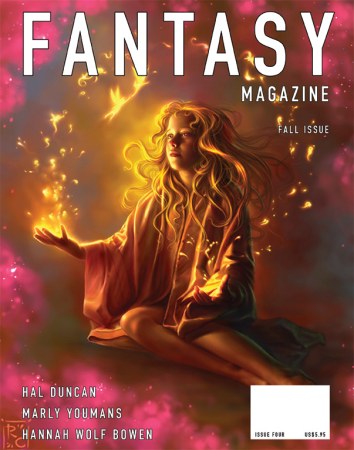
Fantasy Magazine, no. 7 (2007) Editor Sean Wallace.
Reprint in Fantasy: The Best of the Year, edited by Rich Horton (Prime Books, 2008)
Podcast at Far Fetched Fables No. 20 Bill Congreve and Marly Youmans

"The Comb" is the most drastically pruned of any short story that I have written--it is a third or perhaps a fourth of what was originally written. At the time when I was revising, I remember fearing to weaken the main character by not revealing the rest of her story. While I always feel that what is cut from a story remains as a kind of shadow to the work, extending outward by little, broken tendrils of shade, that was a lot to cut and so meant a very large shadow. I've been curious about whether any of that shadow is visible to readers, though it's hard thing to know.

Eventually stories and poems are finished with the writer and her worries. They wander away to find a place in the world or else to get lost and then go unread. "The Comb" has been published, anthologized, and now is read as a podcast by actress and writer Nicola Seaton-Clark. So the story keeps moving along in the wilderness of the world, finding a home.

Thank you to Nicola Seaton-Clark for reading and liking and now recording the tale! And thanks to Gary Dowell and the rest of the Far Fetched staff.

Nicola Seaton-Clark lives in the wilds of (almost) Eastern Europe with her long-suffering husband, phenomenal children and a grumpy cat. Trained as an actress and singer, she has worked in entertainment for over 20 years and currently splits her time between writing speculative fiction, helping her husband run their voice-over company, Offstimme, and voicing everything from commercials and documentaries to public transport announcements.  She also hosts this podcast…..

Monday, July 07, 2014

Glimmerglass at "Publishers Weekly"

Title page with decoration
(collage of painted and cut papers)
by Clive Hicks-Jenkins
Glimmerglass
Marly Youmans. Mercer Univ., $24 (224p) 
ISBN 978-0-88n146-491-7
     This stylish contemporary variation on the Bluebeard legend from Youmans (A Death at the White Camellia Orphanage) serves up an appealing blend of myth, mystery, and magic. [SOME SPOILERS AHEAD - SKIP TO END IF YOU DON'T LIKE SPOILERS.] Cynthia Sorrel, a painter in a creative rut, visits Cooper Patent, a hamlet located on New York's Glimmerglass Lake. she rents a rustic gatehouse cottage from half-brothers Theodore and Andrew Wild, who live together in their ancestral mansion, Sea House. Hired by the siblings to paint a portrait of them, Cynthia feels newly inspired as in artist after spotting a young boy running through the woods outside. The eccentric, "shifty" Theodore unnerves her, but she is charmed by Andrew, a widower and grandfather. The two eventually marry, and Cynthis grows attached to his three young grandchildren, Lizzie, Drew, and Ned. She continues to be wary of Theodore, however, particularly after he creepily relates a story to her of how, when he was young, his cousin Moss was lost in the caved-in tunnels beneath the house. Eventually, Cynthia decides to explore Sea House's subterranean labyrinth for herself in order to put the Wild family's dark secrets to rest. [END SPOILERS.] Even readers who don't go for more traditional fantasy fare should enjoy this vividly written yarn. (Sept.)

Two thoughts, with thanks to the PW reviewer... 

One, Bluebeard never popped into my mind while writing or revising this book! Perhaps I should have thought of him...

And two, I think there could be a serious and interesting argument between people who like to categorize fiction whether this book is literary fiction without a single fantastic thing in it (though much that is very strange), or whether it is, indeed, fantastic in nature. It does contain a figure that is or is not the Muse, and it does contain a strange passage derived from the classical world, the somnium. And it feels strange. But would or should a genre-loving person call it one or the other, literary fiction or fantasy? I don't know. Maybe they would call it interstitial. As I tend not to categorize except by good vs. bad, I don't worry about it. But as other people do, particularly reviewers, I think about categories from time to time.

Thursday, June 26, 2014

Morning thoughts: on making

Interior decoration by Clive Hicks-Jenkins
for Glimmerglass, out in September.
A lion, a leaf, and a crown--surely they are
nothing if not realistic. And yet, put them together...
AB OVO

Often I'm startled by my own absurd temerity in saying anything about books. What do I know? Why don't I stick to my own narrative and lyric frolics and words and keep my mouth fast shut otherwise? A writer is always making things up, beginning at the very beginning--knowing nothing about how to make what she must make next. It's yet another thing about being a writer that enforces (or should enforce) a kind of humility, whether a writer wants it or not. Having revised a poem or novel or story, I hold an amount of strange knowledge . . . and yet it all flies out the nearest window, never to return, when I sit down with the blank page, the not-yet-born next.

Yet I do persist in this mania of having and changing opinions, thinking that I know things about what I do. For example, I've long felt that the roots of our literature in English are quite other than what is often praised--this thing called realism that so dominates much of our thinking about books. And I've felt, in fact, that there is no such thing as realism, just as there is no such thing as the fantastical or irrealism. These words are but handles, convenient ways of describing points on a continuum. As I've said before, if a book could be perfectly and wholly "realistic," it would then replace reality in one Borgesian swoop. All works of literature are made from nothing, or from Yeats's "a mouthful of air." That is the nature of creation and the sub-creation that is literature.

From Beowulf to Gawain and the Green Knight to The Tempest to Tom Jones to Bleak House to the latest narrative in prose or verse, what matters in poetry and fiction is energy. Is the work alive? And the answer to that question has little to do with where a work falls on the continuum between realist and irrealist, and everything to do with whether it captures something of the energies of life.

* * *

ON RESOLVING TO SHUT UP (AGAIN)

It occurs to me (once again) that I have already said these things before, in some way or another. These morning thoughts, written before the dawn . . . Waking, making. Making is a kind of waking, isn't it? And a maker desires to be awake, to wake others.

* * *

OUR BORING, MODERN OBSESSION

Here's Jacob Bacharach, author of A Bend in the World, at Huffington Post:
Sometimes I think that all the really great works of surrealism predate our boring, modern obsession with dividing the real from the unreal, truth from fiction, the conscious mind from the dream. I'm using surrealism in its common and not specific sense; a lot of the works I'm going to mention are what you might call magical realist, or experimental, or postmodern, or just plain weird. I'm actually a fan of weird fiction myself. If my own writing ever spawns a genre, that's the name I'll lobby for. Anyway, in working on a current unfinished writing project, I've been rereading the Bible, and it's reminded me that of a friend of mine who once said that Revelation was his favorite science fiction novel. I'm a fan of Job, myself, which would give Burroughs a run for his mugwumps, although for true weirdness, you really ought to reread Genesis, in which the utterly ordinary and the utterly otherworldly coexist and commingle in a manner totally alien to the modern ear and imagination; the poetry of creation gives way to genealogy, and God flits between instantiating His word and dickering with little humans over the specific price and measure of disobedience...
I tend to think that all great literature has an element of the fantastical and the surreal: Bolaño, Melville, Djuna Barnes, Anne Carson, Laurence Sterne... Each era throws up writers who take their elbows to the way we're supposed to see things, and these are the ones I come back to when I am bored with being bored.
Via that interesting young seminary professor and writer, Wesley Hill

Saturday, May 03, 2014

Real and irreal

Detail from the cover of Thaliad. Art by Clive Hicks-Jenkins.
I picked this one for the post because it suggests a kind of leafing
and fruiting and singing that joins all good writers, maugre the mode!

This post is a wandering set of responses to another post, in which the ever-interesting Patrick Kurp talks about the literary loves and antipathies of H. L. Mencken. The portions about Mencken as a boy are full of charm, and the whole piece is of interest.

* * *

Having written two fantasy novels (grounded in the landscape and Scots-Irish/Cherokee lore of western North Carolina) and a number of short stories because one of my children was mad for fantasy, I find that am equally happy on either side of the "fanciful and unearthly" vs. "highly literal" divide. Oh, just remembered that I wrote a book-length post-apocalyptic poem, so that's tumbling into the fantastical, too, and I went back to the classical idea of the somnium for a chapter in a forthcoming book. Perhaps I am impossibly mixed--or mixed up--at this point. You see, somehow I fail to feel a keen, profound difference between what others view as various modes when I write. I like to frolic as and where I will, and as story leads.

I'm fond of mythic and fantastic classical works, and in English I like many of the fantastic-leaning poems of Old English and the medieval world. I find it curious that so many people have a pronounced love for or dislike of what we call irrealism. And yet how far it goes back in Western and world literature... So shall we toss Homer? Ovid? Portions of Shakespeare? What about Dante? Gilgamesh? The Mahābhārata? The Dream of the Rood? Or were those elements fine then but not fine now, or not fine for the novel?

In the end, I don't find the divisions of genre helpful for me--I mean, as a writer--and am quite willing to look for a good book under many sorts of labels. But I don't find it a fault that somebody else wouldn't feel the same way. Instead, I find the tendency to like or dislike in this way to be interesting and intriguing. (Of course, maybe that's because it says something about a person's makeup, so I'm off on a writer's nosey, personality-examining jag when I consider the subject.)

Such strong opinions are a challenge to my own stance, surely. And while I know my own mind, I'm not adverse to changing it.

I wonder what Mencken thought of the more fantastical creations of Twain. He may be labeled a realist for perfectly sensible reasons by literary historians, but Twain has some creations that fall strongly into another realm. Even Huckleberry Finn revels in the fact that people have very different angles of vision on the world and how to navigate it--a profusion of angles that just might suggest that we're already living in a kind of metaphorical multiverse, right here and now.

As to this matter of "realist" and "speculative" (choose whatever term you like for the latter--the sf/f/h world seems to expend a great deal of energy arguing that point) fiction, I believe it's all the same realm--a kind of continuum. A writer can move about on that continuum. A writer can stay put. Writers on many points of the continuum can strive to make a truthful and strong story. (Or they can strive for something lesser, but winning the world and losing your soul is a whole other dilemma and fish-kettle...)

Don't all narratives differ from reality and rejoice in making up a world? If a writer reached the point of absolute realism--impossible--we would have reality. And wouldn't that act of transforming words into complete realism be an irrealist tale?

Monday, June 03, 2013

Fireworks, and clarity--

The speculative writing world has gone off like fireworks again, this time over remarks about "lady writers" and "lady editors" and then later about woman's "quiet dignity" (referring to Barbie, of all things!) As someone who, thanks to two Southern fantasies written for my children and a post-apocalyptic blank verse poem, is occasionally invited to the speculative party and asked for anthology stories, I am near enough to that world to understand what is going on and to sympathize with writers and readers who feel a deep anger over the latest Resnick-Mahlberg debate in the SWFA Bulletin. (If you want to see some samples, google SWFA and E. Catherine Tobler, Foz Meadows, or Jim C. Hines for a start.)

But as somebody usually tossed in the "literary" camp, and who has written poetry and novels of many sorts and has never been to a con or read a Bulletin, I also have distance. What strikes me is that the unifying thread between the absurdities in the original article (the "ladyness" and focus on beauty in an editor, Old White Guys, Sean Hannity, etc.), subsequent woman-as-Barbie response, and the also-absurd "woman warrior" in armor-bikini on the Bulletin cover is one fatal to the writer: a refusal to see accurately all human beings as whole people and then portray them as such.

If you see clearly and in fullness, and depict believable people on the page, then characters have a chance to be so alive that time cannot easily devour their vigor and life. As Shakespeare wrote of Cleopatra, "Age cannot wither her, nor custom stale / Her infinite variety." This call for the writer to see and show with accuracy reaches past gender politics to the very heart of creation.

Likewise, if anyone sees other people clearly in ordinary life, he or she will tend to speak of them with the same clarity. To do so is to do them a kind of justice.

It is not because Resnick and Malzberg are Old White Guys, as they said of themselves, that their article so offended readers. Despite what some commenters have said, young people have no automatic claim on seeing more clearly and portraying more accurately than others. Nor do non-white people have such a claim. Nor do women. Nobody gets a pass on these things.

We all have blinders to remove. An Old White Guy has the same chance as any other to see clearly and in fullness--that fullness that leads to respect of one toward another and understanding--those who inhabit the changing world around him. An example? Melville was once an extremely Old White Guy, still striving for beauty and wholeness in words. So let's not let anybody off on an Old White Guy technicality. An OWGT is just not good enough. The goal for the Old White Guy in life or in written words should be the same goal as for the rest of us: to try harder to see, to know, and to catch the truth of human life in our daily words. And that includes the truth of women, who do not fight wars in brass bras, who do not care to be diminished and patted on the head, and who should be portrayed in their rich and "infinite variety." For a writer to fail to do so is to fail justice, and to fail creation's call.

Saturday, February 16, 2013

"Childe Phoenix" again--

Illustration by Galen Dara
SF Signal has reviewed Lightspeed 33. Here's a consideration of my story from that issue. You may read the entire review here.
“Prolegomenon to the Adventures of Chílde Phoenix”                            by Marly Youmans http://www.sfsignal.com/mt-static/images/stars4p5.gif
A coming of age story, a metamorphosis, the remembrances of a young boy now deemed a man wrapped in the imagery of familiar childhood folklore and fairy tales.  Youman’s language is often lyrical in its beauty, conjuring up fantastic images.   Blaise’s sister Vesta lays in a glass coffin inset into the floor. His loving mother is either very much present with him or absent and cannot be found. His father is an alchemist who will not allow his presence to be disturbed.  His grandmother tells dark, black tales from the Old World.  Without the presence of other children in his life Blaise feels very much alone, his only playmates the books in the house’s wondrous library.  Blaise’s recollections are underpinned with melancholy and a miasma that takes the form of an abyss that is slowly tearing his home apart.  This was my first experience with the work of Marly Youmans and I look forward to tracking down more of her work.
One thing I really like about playing in the sandbox with speculative fiction writers is that a story that does not quite "fit" in categories--like an odd, surreal piece--is welcomed and is reviewed more than once. There's a huge, enthusiastic support for the form of the short story that's lacking in the "literary" world.

Wednesday, January 30, 2013

Childe Phoenix

This month a story originally published in Lady Churchill's Rosebud Wristlet will be reprinted in Lightspeed. "Prolegomenon to the Adventures of Childe Phoenix" is one of my stranger stories, involving a death, chasmic separation, and a young boy's departure into the great outer world. In its surreal elements I see obsessions that I have also dealt with in poetry. In addition, there is an interview with me. The full issue is available February 1st as an ebook from Lightspeed Magazine: Science Fiction and Fantasy; otherwise, I'll be up some time in February. Here's the table of contents.

Tuesday, November 06, 2012

Genre and the (Parenthetical) Laundry-Woman

Hideous day of laundry and cleaning here: reminds me of several things having to do with genre fiction--science fiction and fantasy in particular. You may find them interesting. Or not. But here goes the laundrywoman, emptying out the contents of her head into the blog pail.

1.  I saw on facebook the picture of the World Fantasy winners, and they were men men men plus two couples (for editing and press work.) I don't object to men; I like men. I just wondered. It was just an awful lot of male faces. All the writing awards. And art. It's nothing to do with the particular men (in fact, I sometimes correspond with several of the winners), but I'm still wondering. Is that how it always works?

2. While I fold laundry, I often read. And I started thinking about a science fiction and fantasy trope. You know how Luke Skywalker (I have three children, so I know these things) loses his hand in great pain and gets a fancy new robotic one? And how Wormtail in Harry Potter (I have three children, so I have read the entire series aloud) loses his hand (also with great pain) and gets a fancy magic one in its place from Lord Voldemort? (Oh, and isn't he just like Tolkien's Wormtongue? And there's an important arm injury for Frodo, too.) And you know how in Garth Nix's Abhorsen trilogy (I have three children, did I say?) Lirael loses her hand--her best friend, the Dog (who talks and is much more than a dog) bites it off to save her--and the close tells us that she will gain a beautiful golden hand in its place, made by Sameth, the prince and Wallmaker? No doubt you may add some lost hands and metal replacements of your own if you reach science fiction or fantasy; there are more. Take Eugenides, who is deprived of his clever hand by The Queen of Attolia... Well, you add what you like. Gene Porter's Freckles had no hand. Read that one as a child. And there's a precedent of dogs biting off a hand with Fenris.

Point being, thanks to my laundry-reading, I am wondering if all this comes most clearly from the famous tale of Gotz von Berchlingen (1480-1562, a nice long life for the times), who was known as Gotz of the Iron Hand (as, say, Lirael became known as Lirael Goldenhand.) A Franconian knight, he lost his hand in 1504 in Silesia, when a cannon shot broke his sword hilt (hey, there's another trope--the sword that is broken) and drove half of it, along with arm-plates, into his right arm. His arm was crushed and the hand ripped away entirely. Being a gallant knight, he rode to camp and found a surgeon. He was later given an iron hand and continued as knight till his death, or so the book claimed. What a formidable fellow. Still competent with only one proper hand.

Maybe everybody already knows this... If not, now I do, and you do.

3. I have completely forgotten the third genre-thought I had while folding the endless laundry. Oh, lucky you! And now I need to eat and go vote. You too!

Monday, September 10, 2012

Tolkien/Jacobson, genre/literary

Update: Book designer John Coulthart just sent me a link to this piece, in which he says Jacobson is more nuanced about genre. "The best fiction doesn't need a label." It looks interesting, and I'm going to read it now and then get back to work. Thank you, John!

High school started here on Thursday. The three children and I watched The Lord of the Rings trilogy in celebration of the start of the youngest's sophomore year in high school (the hallways of Orcs! the all-seeing principal Eye! the young women sharp as a blade!) and finished the last bit last night, finally obliterating the sign of sin and overreaching power in the volcanic flow of Mount Doom. Of course, the movies are nothing so complex as the book in three volumes that was praised by Auden and has been dearly loved and reread by many, but it got me considering that curious man, Tolkien, off and on all week. Last night I was thinking about how interesting it is that he disliked Macbeth and yet clearly does more than nod to it with his moving forest on Ent-march and his "no man" oracular prophecy and plot twist.

This morning I read Howard Jacobson's interview in the Guardian, where he says he is "contemptuous of genre things...." Not books but things. (I tend to be with Sendak in thinking that there are "good books" and then the others, but we live in a world where people like to categorize.) Jacobson goes on to reference without naming the Twilight series and then to cite 50 Shades. Ridiculously easy potshots! I'd like to see what he thought of Crowley's Little, Big, for example. He is also contemptuous of the term "literary fiction." He writes "fiction," he insists, while others write "crap." I know a lot of these attacks are a clever, Amis-like use of a media that desires column inches with sharp teeth and blood and hair. No doubt they are good publicity for the new book.

Those of us who write what is called "literary fiction" evidently want to be acknowledged as writing the only fiction that matters; that's why we desire that simple label, "fiction." What we do, we believe, matters more. But it ain't necessarily so. What I learned in writing two fantasies for young readers and a number of fantastic stories for anthologies is that our "literary fiction" worldview is provincial. Writers in other genres believe strongly that we write in simply another genre, one often less vital than their own. Sometimes they are right--depends on the book. It always depends on the book. Likewise, a book in another genre can clamber up to the heights. Entertainment may fly up into the realm of art. Why not? There are no rules, only the force and heart and skill of the mind behind the keyboard. What is The Tempest if not a romance of first love and a fantastic tale of a wand-wielding and -breaking wizard intended to please both the ruled rabble and the ruling classes?

Oh, I have sympathy for Jacobson's past situation, and am glad he has been lifted into light where he is visible. I know all about his "working away at the edges for years." No doubt the stacks of sold copies for A Death at the White Camellia Orphanage and Catherwood and all the rest are but very little hobbits compared to the giant cave trolls of a Booker winner or a NYT bestseller. But hobbits are sturdy, lovable storytellers and song-makers. And the hinterlands and the edges have their advantages. From the edge, you can reach out into space that has no chart, building a world outward as you will. From the edge, the trends and bubbles of the day are only white noise, lost in the distance, and what matters from the past stands like a great field of monuments where a writer can lose and find himself in wandering.

Any of us "at the edges" would trade something for visibility, for a greater number of readers. But it's an old story; I imagine that Melville, say, would have been willing to give up a limb and hobble like a peg-leg sailor to keep the readers he had with Typee and gain a few more. Poe certainly wrote wild attacks with teeth and hair and gave up everything in search of a wider audience. Dickinson ventured out and then back, sealing the door. Yet they and others like them--some remembered, some not--had their painful, joyful, austere reward, just as Stephanie Meyers and the writer of 50 Shades of Gray have a reward of another kind. Let's look to Jacobson's "genre things" for what we must do about the strange ways of the world. As Gandalf says, what comes to those in a time "is not for them to decide. All we have to decide is what to do with the time that is given us."

Thanks to Damien Walter, Guardian columnist, for the Jacobson interview link.

Saturday, September 10, 2011

Oldish book, brand new review--


I love getting a review for a book that came out years before--it's encouraging to think that a book may be temporarily out of print yet still find its intended readers.  Here are a few clips from a new review.  Thank you, Black Cat Lit!
* * *
Set in the Blue Ridge Mountains of western North Carolina, The Curse of the Raven Mocker is a complex story inspired by the legends of the Cherokee and the culture of the region’s European settlers. Richly detailed and imagined, it’s a uniquely American fantasy...
I enjoyed this book because of its uniqueness in creating a fantasy world inspired by American myths. It was refreshing to read a fantasy that isn’t based on European myth... This may be the classic “child on a quest” storyline, but the beautiful descriptions of the landscape, imagery, and the language make this one different...
The Curse of the Raven Mocker is a must read due to its roots in Appalachian and Cherokee myth and the great characters Youmans has created. It’s clear that love went into the writing of this novel. It deserves to be a classic.

Monday, March 28, 2011

The House of Words (no. 5): Diana Wynne Jones

Death interrupts us in the midst of life, and just so it interrupts The House of Words. Here is Rebecca Beatrice Miller, my daughter, on the death of Diana Wynne Jones. I just imagine that this will remain for me the most beautiful and meanngful fan letter I know because it is a wonderful letter and because it is tied so tightly to the childhood of my middle child. Rebecca (along with her friends Jin and Lauren) was home on spring break when Diana Wynne Jones died. She wrote this letter shortly after returning to school.

* * *

Dear Diana,

This is the letter I’ve been meaning to write to you for--years now, I guess. But mostly since this August, when I heard that you were going off of chemo. I thought then that I’d write you a letter, and maybe, if it was you I was writing to, I’d finally be able to explain to someone just how important you’ve been to me. But I waited until it was too late. I know it’s a cliché, but I even remember saying to someone that I felt like by putting off that letter, I could stretch out your life, because you couldn’t die before I sent it to you. For the past eight months I kept thinking about how sad I’d be when it finally happened. But I think that I didn’t really believe that it would. I definitely didn’t realize how sad I’d really be.

When you’re a kid, it’s not like you don’t think about death. But you’re running on insufficient knowledge, and it’s puzzling and kids don’t tend to dwell on things that confuse them. Up until a certain age, I just kind of assumed all the writers I was reading were dead. Weird, since I live with an author--one who is perhaps more alive than most people. Like you were, Diana. That’s why when I read Howl’s Moving Castle for the first time, I wanted to remember your name. I guess that was the age when I started thinking about writers, their lives and writing processes. That’s when I started wanting to write seriously. I think I wrote my first real short story in third grade, the same year I read Howl’s Moving Castle. I remember something vague about a child in a big house, something about being caged. A cliff by the sea, and a boy who turns into a bird.

So I remembered your name, and I talked to my mom (who gave me the book) about you, and she brought me more books. Charmed Life and the rest of the Chrestomanci quartet (because it was just a quartet back then), the Dalemark sequence, Dogsbody, Eight Days of Luke. I still think that The Homeward Bounders is one of the most devastatingly sad books I’ve ever read, and the characters all seem so ancient and real. But there’s one book that I always go back to--of course, it’s Howl’s Moving Castle. I’ve read it so often. I don’t own a copy, I always check out the same old one from the library next to my house. The first time I read it, I was so tense and excited that my fingers tore little arch-shaped holes in the bottom edges of the pages. I like to read it again and look at the holes I made in the library copy so long ago--more than ten years ago--and wonder if anyone else read the book and touched the holes and wondered who made them.

From then on my childhood was a romance with the weird and wonderful, and I couldn’t get enough of your stories. Diana, you had this incredible way of saying so much with so little, so that as I read I had these little “oh” moments that were unlike anything I found anywhere else, and still are. You trust the reader in a way so few writers can: cleverly, yet modestly, with an unaffected enthusiasm that sweeps us away.

I don’t know if you’d remember this, but I sent you a letter once. More of a card, really--it was a piece of paper all folded up, with a picture of Tony from Magicians of Caprona dressed like Punch, with a big red nose. I’m not sure how old I was, but I’m thinking the drawing wasn’t too great. I don’t remember what was inside. I think I was too shy to write very much. It must have been when I was about eleven or twelve, a little before I first heard that Howl would be made into a film--a Miyazaki film, no less, of whom I was already a fan. (I was ecstatic, to say the least; at first I thought it couldn’t be real.) I think it was then because my mom was sending letters to you, and that’s when The Curse of the Raven Mocker was being written. I remember you read it, and you said you loved it, you loved how different it was next to the majority of the children’s fantasy genre. I remember that letter. I remember you saying that my picture was on your trophy shelf. I wonder how long it stayed there, and I wonder how crowded your shelf was then compared to later, when you must have gotten letters in floods. I was so happy though.

Diana, when people asked me who my favorite author was, I always hesitated, even though your name was the first one to come to mind. The truth is that you were more than a favorite author to me--you were not even in the same realm as other authors any more. You had a shrine in my heart where I placed the memory of the first moment that I opened one of your books, frozen, inviolate, forever. Your stories became a part of me in a way no other stories ever did. They spoke to me about loss and loneliness and helplessness and frustration, but they also made me laugh and sigh with happiness. You told me that childhood and life are hard, but things aren’t always what they seem and you find reasons to keep on going. Your books were a whisper of darkness and a dream of adventure. When I was happy or sad or sick of life I wanted to read Diana. Each time a new book came out, I had to have it. I brought five of your books to college with me, because I couldn’t stand not to have your words with me--a place without Diana doesn’t feel like home. You taught me a certain special kind of writing philosophy, the kind that said that children’s books don’t have to be dumbed down, that the best books are loved by adults and children alike, and by other authors. But most importantly, your books said loud and clear that you only ever wrote what you wanted to write. Remembering that freedom in thought that you had, the cheerful way you trampled expectations, makes me sadder than anything else. You weren’t merely a childhood favorite author; you were unique in all the world.

When I heard you had died, I didn’t just shed tears. I cried like a baby, helplessly and with abandon. I cried for about an hour, hiccuping until I couldn’t breathe. I was shocked at how I cried; I still can’t really fathom it, but in a DWJ sort of way I understand perfectly how I could have been touched and changed so much by a woman 57 years my senior, in a country I have never visited, who I never met.

Authors have a special kind of relationship with their readers. As creators, they have a tiny sort of godhood: a reader of stories usually never sees the writer’s face, or speaks with him or her, except maybe through letters. Likewise the author’s fate is led by a faceless mass of unknown number, sometimes buoying their spirits with letters and pictures. There is love between these two halves of the equation, a kind of devotion or loyalty that I feel doesn’t really exist anywhere else in the world. And I think it’s because of the nature of writing. When you read a book, you’ve got a direct line into someone else’s head; you’re literally reading their thoughts, even if they were refined and crystallized into this form.

Diana, thank you so much for giving me your thoughts, for teaching me so much, for helping me, for lending me your dreams and nurturing my hopes. Whenever I felt disgusted with the world, frustrated at life, or simply helpless, your words comforted me. This is the bitterest goodbye I’ve yet had to make, because at times I’ve thought that you were a sort of guardian angel to me.

I think you must view the afterlife in a funny way, so I won’t say too much--but hopefully, someone nice is paying attention and will make sure that you see this. If nothing else, Diana, just know that you made a little girl smile.

Love,
Rebecca

Diana Wynne Jones, 12 August 1934 - 26 March 2011

Nature's first green is gold
Her hardest hue to hold.
Her early leaf's a flower;
But only so an hour.
Then leaf subsides to leaf.
So Eden sank to grief,
So dawn goes down to day.
Nothing gold can stay.

Illustration: The cover to Howl's Moving Castle shown here is the same as the library copy Rebecca mentions.

Friday, November 03, 2006

Talk about forgetful! Light must be shed--

Paperback pub date:
November 2

The Curse of the Raven Mocker
(Firebird)
Ingledove
(Firebird)

This lamp is the baby of the fountain in the preceding picture and is also courtesy of Laura Murphy Frankstone. Last of the poetry aphorisms are below, happy in the fountain's company...