NOTE:
SAFARI seems to no longer work
for comments...use another browser?
Showing posts with label novel. Show all posts

Wednesday, March 31, 2021

Jackson Center interview

Though most people who keep up with me go to social media sites, I'm posting this for the wonderful dinosaurs who still follow blogs and don't follow facebook. It's a copy of the facebook interview from The Jackson Center for Creative Writing at Hollins. Conducted by MFA student Lena Fultz. Thanks to her and to the Jackson Center!


Hollins Creative Writing Alum Spotlight: Marly Youmans, M.A. ‘75 

Marly Youmans describes herself as a “Carolinian astray in snowy upstate New York.” After graduating from Hollins in 1975, she has written across genres—novels, short stories, and poetry. Youmans returned to Hollins in 2010 to serve as a Writer in Residence for the Children’s Literature summer program. 

Her work continues to win awards, with novels regularly appearing as finalists in ForeWord’s Book of the Year contest, among many others. John Wilson, editor at Books and Culture Magazine, describes Youmans as “the best-kept secret among contemporary American writers. She writes like an angel—an angel who has learned what it is to be human.”

Youmans spoke on her time at Hollins and her most recent (fifteenth!) novel, CHARIS IN THE WORLD OF WONDERS, with MFA student Lena Fultz.

LF:  What was your experience at Hollins like? What did you take away from your time here?

MY:  I wrote reams of poems at Hollins, and when I left at 20, I threw them all away—very much a young poet’s thing to do, though now I regret renouncing all those sparks of youth. Some years ago, Lee Smith told me that she found one of those old poems lying about the department and liked it: “The Magician’s Daughter.” 

Some of the women who were entranced with poetry (and the beloved Richard Dillard) are still friends of mine, especially Mary Bullington, Robbi (Kellman) Nester, and Susan Hankla. Susan was at Brown with me as well (riotous days!), and my fifteenth book, CHARIS IN THE WORLD OF WONDERS, is dedicated to Richard and Susan.

Amanda Cockrell invited me to be Writer in Residence at the summer Children’s Literature program some years back, and I enjoyed the return and still hear from some of the students. Just last fall, I had the decided pleasure of discussing Susan Hankla’s first full-length book, CLINCH RIVER, in THE HOLLINS CRITIC.  

I suppose that many a young writer discovers a need to rebel against what she has been taught in school, and against the times. And so I have ended up bounding away from the vers libre of Modernism and its after-shock movements, and have embraced meter and sometimes rhyme as liberating and strengthening forces. I’ve gone back to older and larger definitions of what poetry can be and can include: narrative and long poem, as in THE THRONE OF PSYCHE; long sequence with repeating characters, as in THE BOOK OF THE RED KING; epic adventure, as in THALIAD. Falling into the land of stories helped, for I soon wanted my poems and fiction to be entirely different creatures.

LF:  Your recent novel, CHARIS IN THE WORLD OF WONDERS, is set in Puritan New England. What does your research process look like for writing in a time before you were born? What is the biggest challenge?

MY:  In the books where I’ve delved into the past, I’ve moved through regions of time where I felt comfortable: CATHERWOOD and CHARIS in the seventeenth century, THE WOLF PIT in the nineteenth, and A DEATH AT THE WHITE CAMELLIA ORPHANGE in the Depression. 

I tend to consider fiction-time as a place rather than as an inaccessible era. Some of this is due to my extended family in Georgia. As a child, I spent some of my summer traveling-time at my maternal grandmother’s big Queen Anne house and property in Collins. My mother was the accidental ninth baby of a woman born in 1883; the home and our matriarch, Lila Eugenia Arnold Morris, felt Edwardian. And some of my vacation time was spent with my paternal grandparents; the sharecropper’s shack and farm are closely described in A DEATH AT THE WHITE CAMELLIA ORPHANAGE. Utilities were minimal, comforts sparse, mules stubborn, sun boiling. Tenant labors of ploughing in the fields, picking cotton and tobacco, preserving food, or making turpentine in the piney woods didn’t appear impossibly distant from the peasant’s vassal duties in a medieval and feudal world. My two Georgia family homes have been a blessing to me as settings for my imagination and as ways of understanding how to live and move in the past, as well as how to navigate a landscape of hardship, toil, and poverty. 

(Here I should pause and thank my late father for the burning motivation that made him a teenage tailgunner on a B-17 in World War II and afterward a professor of analytical chemistry—one who bought his elderly parents a house in town. And thank you, America, for the G. I. bill.)

For CHARIS IN THE WORLD OF WONDERS, I could skip over a lot of basic research because I had read so much colonial documentation and literature in earlier years. But I spent nine days at the American Antiquarian Society in Worcester, looking up specific things: occupations and titles in Massachusetts Bay Colony; accounts of Haverhill and Andover (now North Andover); letters; modes of address in England and the colonies; laws and punishment; differences between English and colonial goldsmiths; silver styles; contracts; marriage ways; recipes, etc.  

Mainly, I didn’t want to tumble into the silly ways in which “the godly,” as they called themselves, have been depicted with black clothes (out of reach for most), buckles on hats, constant dreariness, and so on. The keys to writing a novel set in the past are few but essential: never put contemporary beliefs and contemporary characters into the past (unless, of course, you are writing a time-travel book!); show the same amount of “stuff” and landscape as you would in writing of your own place and time; don’t feel that you must prove (by over-reference to songs, politicians, scandals, etc.) that a character really and truly is in past time; and wear any historical research lightly, avoiding the dread info-dump.

LF:  With the current state of the world right now, are you finding time and space to write? What does your writing routine (if you have one) look like?

MY: A great deal of my adult life has been spent as a mother of three (one is still at home), and children have no need for a writer. They need a writer about as much as an octopus needs a party dress, and this is a good thing; it has kept me from ever accumulating any big-headed thoughts and forced me to be ingenious about scraps of time. So no, I never developed a routine; I seem to be fatally allergic to anything that smacks of over-organization, outlines, or the old-fashioned writer with wife who protects writing time. I do, however, have a husband who cooks and bakes wonderfully well, and for that I am grateful.

Despite the pandemic, I am dividing my days between Cooperstown, New York, my home for the last 22 years, and Cullowhee, North Carolina, where I attended high school and where my mother lives. So, I’m sometimes shuttling back and forth along the Appalachian chain . . . Given my current situation, I’ve decided not to start a new novel until later, but I am writing poems.

LF:  Any future projects or upcoming events we can look forward to? 

MY:  I expect that the next book will be a poetry collection. Meanwhile, reviews and interviews and podcasts for CHARIS are still trickling out—it seems that I have an unfortunate tendency to have books launch during national disasters, but I’m hoping that readers will be kind enough to support pandemic books!


Wednesday, January 27, 2021

Bailey, Wetta, Charis...


Scott G. F. Bailey on Charis in the World of Wonders

Here's a clip from a new extended post about Charis in the World of Wonders from novelist Scott G. F. Bailley, author of The Astrologer. I picked this bit because he talks about language, but he has a lot more to say and is always interesting, so please take a look.

This is a beautiful book. Some readers, I have noticed, have difficulty with the poetic nature of Youmans' prose, and to them I say they should become better readers and lovers of language's music. "tilt and spill" "wondrous cascade" "ungrasped length" "bear and vessel what is unearthly and rained down" are wonderful constructions: just listen to the vowels and the rhythms, the moving accents from one sentence to the next. Youmans stretches prose, but never goes too far. Sound and sense, it's all there. I never do any book justice when I write about it, and I keep that tradition with this wee essay. Charis in the World of Wonders deserves lots of readers. Go be one of them, do. 

--novelist Scott G. F. Bailey, review post at Six Words for a Hat, 22 January 2021

And his earlier comment:

Marly Youmans' latest novel, Charis in the World of Wonders, is a great book...a rich tapestry of invention, a lovely long song of many overlapping themes. As with so much of Youmans' work, it is a myth writ on human scale, an instruction manual for discovering beauty and love in this fallen world. I do not exaggerate. 

C--novelist Scott G. F. Bailey, Six Words for a Hat31 December 2020

* * * * * * *


Fr. Augustine Wetta video on Charis

A Wetta-and-moi video was supposed to be up on youtube, but I can't seem to find it... so HERE is a link to the video on facebook.  If you click, you'll discover me in my dining room being interviewed by author and Benedictine monk Fr. Augustine Wetta (who was a private student of mine at the Antioch Workshops a few years ago. He has since published the novel we discussed (in part) at Antioch:  The Eighth Arrow: Odysseus in the Underworld.) I always cringe at seeing/hearing myself, so I have not watched it, but Fr. Dude (as he is known to his students at the St. Louis Priory school) asked some interesting questions...

Saturday, January 16, 2021

Charis at year's end, again...

Art by Clive Hicks-Jenkins

Thank you to Melanie Bettinelli and The Wine-Dark Sea for calling Charis in the World of Wonders "probably my favorite book of the year and the one I am most likely to recommend to anyone looking for a good book to read, and especially for a bookclub." She describes the book as "luminous" and says that she "cannot praise it highly enough." 

If you want to read why she thinks so, jump into The Wine-Dark Sea at this very spot.

I'm glad to see Charis walking onto her 6th year's end list. She's a intrepid traveler. And she's on the list with my friend Sally Thomas's Motherland (at Able Muse, Bookshop.orgAmazonbn.com, local indies etc.) So pleasant!

Thursday, December 24, 2020

Christmas, Charis, Willows


And it's Christmas Eve day! 
Here's stellar Fra Angelico, dreaming the Madonna and naked infant Christ 
with embodied angels, Peter of Verona, Thomas Aquinas, Barnabas, Dominic. 
Detail, Fiesole altarpiece, 1422, Convent of San Dominico. 
Public domain CC wikipedia.

Some bits of news:


Short version, Englewood Review of Books
"Twelve Important Fiction Books of 2020" https://www.goodreads.com/.../156371.ERB_Twelve_Important...
and
Longer version of the Charis in the World of Wonders page... 


"The Changes," "The Ruined Garden," and "Come to the Selvage of the Sea" kick off issue 19 Winter  2021 of Willows Wept: https://willowswept.com/ and https://www.magcloud.com/webviewer/1903662?__r=150177&s=w for the online version...  (And weirdly, the cover image by Troy Urquhart shows a Cherokee spot only a few miles from Cullowhee, NC, where I went to high school and still spend part of every year.)

Tuesday, June 16, 2020

Charis and Kristin at Wuthering Expectations

* * *
I am so pleased that two of my books have been discussed at the stellar Wuthering Expectations! Please take a look at the new post on Charis in the World of Wonders. See posts on both Charis and The Book of the Red King HERE.

Saturday, May 30, 2020

ZOOMFEST!


You are invited
to a
Pandemic Book Party

Jane Greer, Sally Thomas, Marly Youmans
reading from their new books:
two poetry collections and a novel.

Live
on
Friday, June 12
North America: 
3:00 Eastern, 
2:00 Central, 
1:00 Mountain, 
noon Pacific.
World time zone converter HERE.

Register in advance 


Jane Greer,
Love Like a Conflagration
Jane Greer founded Plains Poetry Journal, a literary magazine that was an advance guard of the New Formalism movement, in 1981, and edited it until 1993. Her poetry collections include Bathsheba on the Third Day (1986) and Love like a Conflagration (2020).
For  more about Jane, hop HERE
Buy her book via indies, Lambing Press, Amazon, Bookshop, and more...


Sally Thomas,
Motherland
Sally Thomas is the author of two poetry chapbooks, Fallen Water (2015) and Richeldis of Walsingham (2016), both from Finishing Line Press. Her full-length poetry book, Motherland, was a finalist for the Able Muse Book Award, and is available now from Able Muse Press.
For Motherland news at Sally's site, skip over to HERE
Buy her book via indies, Able Muse, Amazon, Bookshop, and more...


Marly Youmans,
Charis in the World of Wonders
Author of fifteen books of poetry and fiction, including The Book of the Red King (Phoenicia Publishing, 2019) and Charis in the World of Wonders (Ignatius Press, 2020.)
For reviews, purchase venues, blurbs, etc., jump HERE

Wednesday, January 01, 2020

Happy New Year's Day

A gaudy gif for you...


Have a wonderful next dance around the sun!

Just made a spanking new facebook page for Charis in the World of Wonders, fit for a New Year's Day. Please drop by, and check out the facebook page for the recent collection of poems, The Book of the Red King, while you're wandering my digital lands. Art on both pages by the marvelous Clive Hicks-Jenkins of Wales.


And hey, thanks to new subscribers
of my occasional newsletter, The Rollipoke...

Friday, October 26, 2018

The dead man in the huckleberries

Source: CNN, courtesy Scott Mitchell Leen, Chihuly Studio

Travel and illness are both estranging, and I've managed quite enough of both of late. Yesterday I felt like myself again and promptly wrote a poem about a visit to the Chihuly show at the Vanderbilt estate, Biltmore. I found this surprising because I no longer write many poems where the "I" is so clearly related to me. Lately I've written two long series of poems that ostensibly have nothing at all to do with my days, though of course that's a feint, a bull's red flag, a dropped handkerchief. Maybe the little poem was just grounding me--hey, I'm back in my life!

After that, I worked on a forthcoming novel. I had a dead man to tote to another part of the manuscript, and then I--poof!--turned a long passage of description into a scene starring the main character interacting with various things, including the hair of that aforesaid dead man.

The dead are heavy but portable. Sometimes they make more sense in one place than another. This is true in life also, but we don't get to choose. Although I do know a few people who carry around the dead in urns. On a mantlepiece, the dead are strangely magnetic. They provide a kind of focus to a room. Not the fashionable kind that house decorators desire... This seems wrong, of course. The dead are already magnetic without being physically present in a room. They follow us whether we will or no. They crowd around as we grow older. We ignore them most of the time, but now and then one becomes vivid.

Here they are, getting in the way of my blog post.

Possibly signaling for attention?

This morning I shall go take a look at my dead man, lying where I planted him in a patch of huckleberries, somewhere in the northern precincts of the Massachusetts Bay Colony. If he is not content to lie there, perhaps I shall move him again.

* * * * *

Despite getting so little work done (North Carolina, hurricane Florence, northern New York, a retreat at Mons Nubifer Sanctus, etcetera), I have a number of pieces of good book or book-related news but shall save them until some time after the next Rollipoke goes out, as Rollipokers get the news first--that's the deal. So if you're the sort of person who likes to be on tenterhooks, go right ahead.

Monday, January 15, 2018

Updatery

Brazilian photographer André Rainaud of Vitória, Espírito Santo
For the curious who must know and for the curious who are merely idle, well, I am barely back from a nine-day trip to North Carolina--all five of us shut up in a Tundra truck for 1800 miles round trip! And we survived and had no fights and no burst pipes at home, so that is lovely.

I have plunged back into frigid Cooperstown life and duties--and am also polishing on a novel manuscript set in the fascinating seventeenth-century world of those who called themselves "the godly," aka the Puritans. Perhaps I will now understand the Yankee mind better.

Now that long books are out of fashion, I have finally written a long book. How strange that is! And yet somehow typical. I did not intend to be against the grain but somehow once again I am. The book is a good bit more than 500 print pages long, as it is almost that long in typescript.

And so I shall be scurrying about fulfilling promises and then hurrying home to scour my manuscript and keep the house from tumbling down for the next several weeks. I have various bits of book-related news, some of which I have already discussed in the Rollipoke, that I will be announcing in a month or so. And with luck and labors, I shall be doing something or other with this large novel soon.

Send chocolate, be well, and stay cozy! 

Tuesday, November 07, 2017

Reads of the moment


Camille Paglia, Glittering Images: A Journey through Art from Egypt to Star Wars. (New York: Pantheon Books.) I read this aloud to my husband on our drive to my mother's house in western North Carolina in October and finished it up on the way back to our home in upstate New York. Some of her speculations are of the very sheerest, but it's a great read-aloud if you love art and don't care for the sterility and jargon of much arts criticism. Enthusiasm and respect for spiritual search inform the book. With the early works, the miracle of survival of ancient art and the admiration for the distinctive styles and crafts of shaping wielded by ancient, anonymous people are on Paglia's mind. And if you feel at all uncertain about the history of Modernism, she'll help you out in understanding how one sub-movement reacted to another. (And I must say that she managed to make me see Mondrian in an surprising new way--I had no real sense of what Mondrian thought that he was doing and found him surprisingly symbolic in his mode of conceiving and carrying out paintings.) I like and agree with her ideas of Warhol (or Mapplethorpe) as the dead-end of the avant garde, and I think those ideas translate well to what happened with poetry in the twentieth century, particularly when you look at how both painters pursuing realism and narrative and poets pursuing formal variety (including some ancient forms) and a widened subject matter are slowly gaining ground. Paglia insists (mightily!) on formulating her own thoughts without a whit of care for the winds and trends of culture in an era when academics tend to march together.

C. Day Lewis. The Poetic Image. 1946 Clark Lectures, Cambridge University. Still pertinent and well worth reading. Essays/lectures from someone who understands literary history and the Modernist place in it for good and for ill. "The Lyric Impulse" is a wonderful introductory piece. I thoroughly enjoyed the whole book, which is governed by the idea that human beings naturally seek to create and find harmony and orderliness in a world that is ever in flux, ever more various than we can compass. Highly recommended for those interested in song, ballad, and shapely poems.

Kingsley Amis, Lucky Jim. I read again after many decades and was surprised to find how well I remembered it, particularly the episode of the burned bedclothes and the "Merrie England" talk. The apex of the drunken address still reminded me of Fink-Nottle's, and antihero Jim Dixon of a sharper, much less hapless and sweet Bertie Wooster. After a stint in the British army, Kingsley Amis must have been out to break all the campus rules.... Is Dixon sometimes roiling with class rage, spite, boredom, maliciousness, immaturity, self-contempt, and an Amisian-Larkinesque view of women? Sure. He's an antihero all the way down. Here's Dixon in the morning: "Consciousness was upon him before he could get out of the way; not for him the slow, gracious wandering from the halls of sleep, but a summary, forcible ejection. He lay sprawled, too wicked to move, spewed up like a broken spider-crab on the tarry shingle of morning. The light did him harm, but not as much as looking at things did; he resolved, having done it once, never to move his eyeballs again. A dusty thudding in his head made the scene before him beat like a pulse. His mouth had been used as a latrine by some small creature of the night, and then as its mausoleum. During the night, too, he'd somehow been on a cross-country run and then been expertly beaten up by secret police. He felt bad.” Now I feel like rereading some Wodehouse and maybe The Loved One.

* * *

Here is the close of this post, written a day after Sayfullo Saipov, the man whose name means "Sword of Allah," mowed down bicyclists in Manhattan: "After hearing another New York round of generic responses and platitudes following the latest terrorist attack, I think we all need to send our politicians a well-written book or two. And maybe that should include a novel or two so they can begin to understand that not every human being thinks alike." But now that closing is already out of date, as we go on to the next massacre, alas.

* * *

I practice imaginative eliminativism about the category of entities known as "politicians." This is always a problem on election day.

* * *

Tonight I voted, and it was all so very Village of Cooperstown. First I walked with my husband to the Vets Club and had the traditional Rotary Club pancake dinner (with sausages from The Otesaga, mind you.) And I saw and chattered with all sorts of people I knew (including the former mayor, Carole) and was served by other people I knew (and the one I didn't know my husband knew and I promptly met.) Then we went a couple of blocks to the polling station, where I also saw lots of people I knew, voted for people I knew, hugged people I knew (especially Janet, whose birthday it was, and MaryAnne, who I hadn't seen in a long time), laughed with people I knew, received invitations from people I knew, and was asked if I was old enough to vote by somebody I knew (the sassy Rick, naturally.) So village-y. So lovely. So astonishingly NORMAN APPLE PIE AMERICA ROCKWELL! Okay, maybe not Norman Rockwell but pretty dear. Sometimes being a Southerner in Yankeedom is sweet. Yep.

And hey--it snowed. First flakes of the season. Pretty late, but I still resent it on principle. Southern principle.

Tuesday, February 28, 2017

Small hurrah on Shrove Tuesday

Yesterday I finished the draft of a novel. For me, it is quite long--358 pages of text, plus the usual front matter and divisions. And it has a glossary. I'm not sure whether I'll include the glossary. It glosses dialect words and clears up some common misconceptions. Maybe I'll just post it.... I'll take a break from the manuscript, and then start to revise it and also do some  persnickety research to make sure there are no stray historical errors.

Tuesday, January 17, 2017

Book notes, jig-by-jowl--

Alas for Aquila Rose

Well, I do like this new find! Printed by Benjamin Franklin when he was seventeen... The NYT claims for him "burning ambition and something of a punk-rock visual sensibility," a thought which might or might not have amused him--he was an amusing fellow--but is a silly one. The broadside looks like nothing so much as the slim, arch-topped, skull-and-often-hourglass-surmounted tombstones of early America. Benjamin Franklin doesn't need tarting up as a contemporary of ours, I say.

I love his Autobiography, its contradictions and buried humor. He can be quite grand and ambitious and make me laugh at the same time: "It was about this time I conceived the bold and arduous project of arriving at moral perfection." Of course, he soon finds out that he is incorrigible in a number of areas. Nevertheless, he has a tidy list of desired virtues, ending with "10. Humility. Imitate Jesus and Socrates." Now that's funny. More funny than punk-rock Ben!


Clive's Hansel and Gretel, a picture book

In other news, I have my Clive Hicks-Jenkins Hansel and Gretel, and you should too. The graphics are strong (for that matter, Gretel grows strong!) and wondrous, full of cunning details and bursting with bold images that--by some peculiar Clivean spell--manage to charm and delight while also grasping for what is cruel and grotesque in the Grimms' tale. The lively color-separation pictures, including four fold-outs, are propulsive and thrust the story forward. It's not a book for a little child, but it does pay lovely homage to the tradition of the European children's picture book.

Buy it here. It is worth every little coin you might spend, and would make a fine present for anyone who loves story and powerful and beautiful images. To see more images, scroll down through Clive's posts on the making of the book. They'll give you a dose of respect for the labor behind the making of the book, too.


And the secret novel

And now I am going back to the abandoned-for-a-time novel (sometimes too many other demands happen--that's our life, of course), which I am reading and remembering and starting to write again. A curious thing I have learned this week so far: It is now thought that the Wampanoag Nation was decimated (before the arrival of the Mayflower) by rat-borne leptospirosis complicated by Weil's Syndrome, rather than by smallpox, bubonic plague, etc. Squanto or Tisquantum appears to have been a later victim of the disease. I'm impressed by how much European activity there was along the coast in the sixteenth century--fishermen and whalers and fur traders. Leptospirosis still afflicts people in various parts of the world, and it doesn't take much in the way of rat urine to make a person ill.

And I've discovered the word nabbity, applied to a small but full-grown woman. I myself am rather nabbity, having lost more than an inch of late. I also like ruttling, to make a harsh or rough sound in breathing. I am reading Robert Forby's The Vocabulary of East Anglia. Unfortunately, I have only the second volume... That was not clear when I ordered it. So I shall have to find the first. Oh, and jig-by-jowl? Close together.

Thursday, January 12, 2017

Reading Doña Quixote

Courtesy of Päivi Tiittanen, sxc.hu
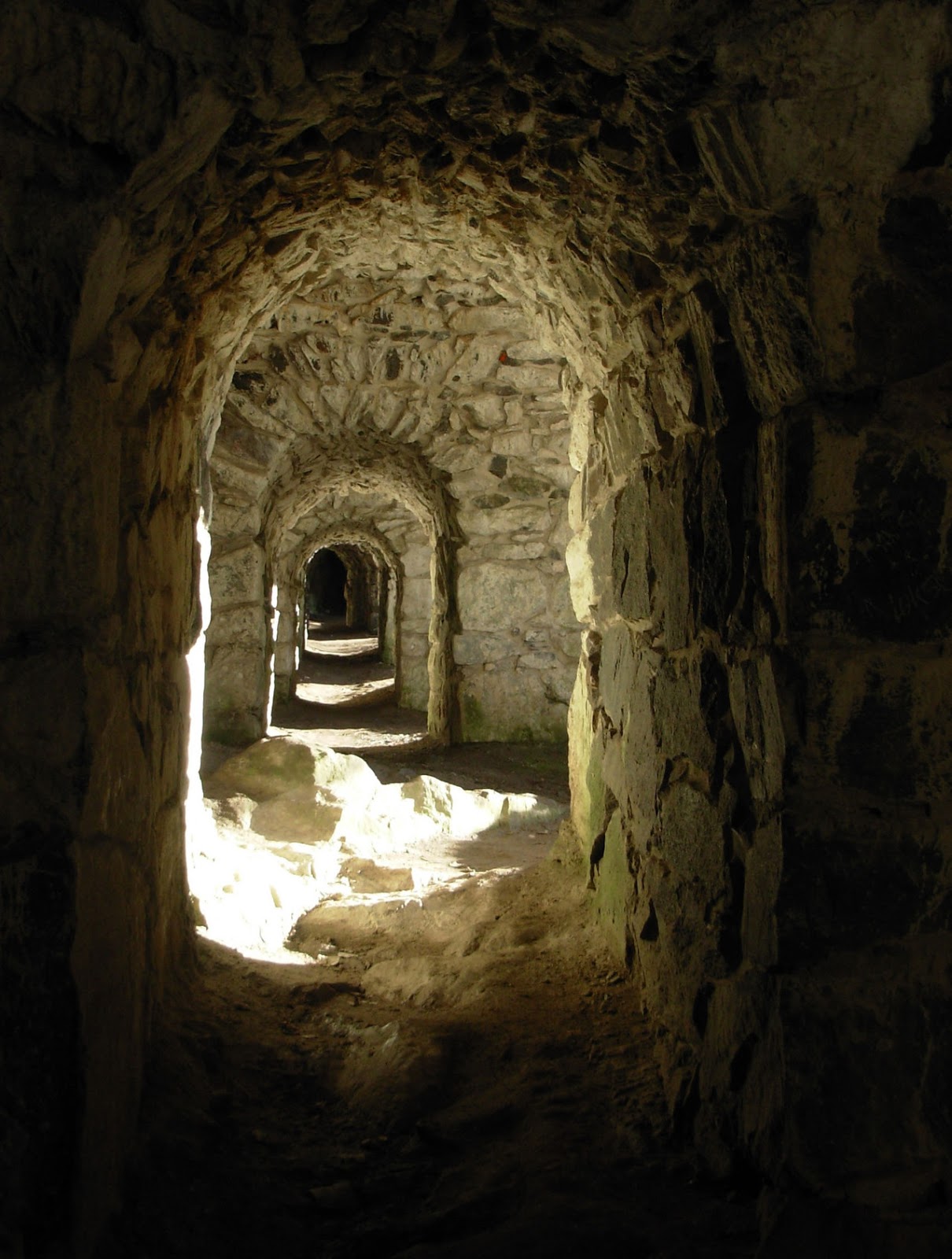
"Catacombs in Suomenlinna"
Yesterday and this morning I read Leena Krohn's Doña Quixote and Other Citizens. Portrait: Tales of the citizens of an usual city, and this is what I have been for some hours: a room through which the narrator and Doña Quixote (the woman who is like a tree that murmurs and sometimes drops shriveled leaves proclaiming death, the woman who is a poet) come and go, talking of many things, and sometimes of what the shriveled leaves proclaim. And in those hours, the city is mine and in me with its green-shining towers of telephone booths and its moving rooms, and I am also a room that holds many objects whose meaning sometimes is profound and secret and sometimes falls away and is lost. In and out of the room of me come figures who are rooms also and who connect with me and whose connection then falls away unaccountably, perhaps to recur, perhaps to drift through the gate built in water and be lost or bob away across the sea and perhaps return to me, for there are many deaths in a life, many passings-away and sometimes returns.

Into the room of me comes Doña Quixote with the poetry of herself and the strange wisdom that makes me know, and her melancholy that is also a fabric in the room of me, that matches something in me. Like a trick chalice, I fill up, and then at once everything I have drains away. All things go. All rooms are pendulums, moving toward a time when they will be no more. In all the city of interlocking and moving rooms (some a lit bus with the moving figures inside), I am found, I am lost, as Doña Quixote is found and lost also.

And now and then I am arrested by the knowing of this: the most important thing about a thing is that it is beautiful, whether it is a mysterious narrow gate in the sea, a gorgeous, filmy-tailed goldfish, a dancer like a flower's corolla, or a silken peacock that trembles, unfurling its mighty fan of eyes while the snowflakes sift down before and behind and onto its glistening green and blue.

But even that knowing cannot be grasped and held until it always lights the room of me or the room that is Doña Quixote but drains away. The loss and passing of that knowledge of beauty is like a death, like passing through a gate built in water. "One doesn't get used to living."

And now I have shut the book, though the sense of myself as a room--a room filled with strange objects that do not give up their secrets--remains. And the sense of beauty also, for the book is still open beside me. And that I have written (carelessly? wisely?) that the book is both shut and open seems entirely right.  10 January 2017


"Peacock feather"
Courtesy of Sean Okihiro, sxc.hu
You may read this short novel (or is it an interrelated collection?), Doña Quixote and Other Citizens. Portrait: Tales of the citizens of an usual city, in that gigantic volume, Leena Krohn's Collected Fictions: A Career-Spanning Selection from Finland's Most Iconic Writer. (What long titles! And I wonder what Leena Krohn thinks about being iconic. I'm not even sure what they mean with that choice. Revered? Painted on a wooden surface? Semiotic-iconic? Flowering from tradition? All of these?)  I do, however, feel quite sure it is a publication from Ann and Jeff VanderMeer's Cheeky Frawg Books (Tallahassee, FL, 2015.) Doña Quixote is translated by Hildi Hawkins.

Tuesday, October 04, 2016

A beginning, with green sheep...

*
The Ferrol Sams Award.
*
Silver Award, Foreword Book of the Year Awards.

*
"Its themes and the power of its language,
the forceful flow of its storyline
and its characters have earned the right
to a broad national audience."
--About.com review
I have been busy with children and deadlines and applying for a short fellowship, so here is a little snip from A Death at the White Camellia Orphanage in place of a post I've had no time to write. A snip, a clip from the beginning to a first chapter, instead...

1.
Death comes to White Camellia Orphanage;
A savage laugh, a riddle and reply.


The boy called Pip by his father—who had named him after a boy in a famous book, a child for whom everything had turned out well enough—woke in the dense warmth of an Emanuel County summer at 4:17 a.m., a fact that he learned years later when he became acquainted with clocks because for the rest of his life he would wake at the very same hour, the very same moment of the morning as if his body could never let go of the need to be awake for that minute of the day.  He did not open his eyes.  He did not need to open his eyes.  He knew where he was, the same place he had been for almost a year.  He was on the farm sharecropped by the Hooks family although the land was always called by another man’s name as if to remind the husband and wife that they owned not much more than debt and the clothes on their backs plus a spare change for Sunday and a clutter of ironware and dishes and a few clanking enamel chamber pots.  For the last several years it also had been known as The White Camellia Orphanage or The Cottage because of the doings of Mr. Sam Truetlen, owner of a nearby cotton gin and the far-off Gen’l Notions Store, who had traveled all the way to New Orleans and on to Dallas once upon a time, and there, on the outer edge of the known world, had toured a cottage-style orphanage intended for destitute white children and run by the Klan.  Some years later, Mr. Sam, being a man prone to fits of “projecting,” backed his own orphanage though most of its children still claimed at least one parent on some played-out, ramshackle farm.  Wherever his kind had sunk so desperate and low as to scoop up the red clay to eat, Mr. Sam would arrive on muleback and plod away with one or more children riding pillion, some to stay at The Cottage for a month, some longer. It got so that people for miles around could recognize Daisy Belle, the white mule, and Goshen, the soot-gray one.  As for the name of the orphanage, that was the influence of the Klan, with its Knights and Dragon, its Cyclops and Nighthawk and Kamellia—and Mr. Sam’s tip-of-the-hat to the city of Dallas.  So that was where Pip had been lodged for almost a year, in The White Camellia. 
It was high, hot summer in Emanuel County, Georgia, and not one soul was saved from the day’s blaze or from the night’s smother of warmth; up and down the county, the only sleep was a restless sleep, and near Lexsy, one or two old people woke in a fright because the air was just about too dense to breathe—their trembling hands reaching for funeral-parlor fans printed with a portrait of Christ and some luminous, faintly green sheep—and on some gully-shattered sharecropped place, an infant who had been fighting for air yielded up the ghost on his mother’s naked breast.  Mr. Sam, next door to the cotton gin, returned to bed and dreamed his nightly dream of being weighed in the scales and found wanting.  At The White Camellia Orphanage, the bone-tired children slept without dreaming, all but one, who dreamed about a lost penny.    
When he woke, Pip knew something was akilter.  He did not know more, neither whether the hour felt wrong or right.  There was a faint slippage of coolness on his back where his brother—his half-brother—Otto normally slept.  The kinship bond between them was tangible, such that the children seemed inseparable, a blood brotherhood of commingled beings.  Loss and grief had only made their physical need and ache for each other more clearly manifest.  The musky smell that belonged to the little boy was ebbing away, and Pip could detect only the presence of the two others in the bed and the four across the room.  The brothers always slept together, with a careful space between themselves and their bedmates, an act that demanded they cling to their perches even in sleep to avoid tumbling down into the deep valley of the bed.  Now Pip lay breathing in the scent of near-naked boys and the stink of the chamber pots. These were smells he did not find disagreeable, just as he did not dislike the fumes of kerosene from the lamp or the odor of Miss Versie, unwashed and marked with a faint whiff of blood.  

Where was Otto?  
Save

Tuesday, September 13, 2016

More snails

Snail Jar. So I call it!
Terracotta jar with three handles
Late Minoan ca. 1600–1500 B.C.
The Met. Schliemann collection.
Dear diary: What madness it is to start a novel in the midst of upheaval--weekly Wednesday and often Sunday theater performances by my husband and eldest all summer, planning to move a child living at home to Atlanta, need to visit my mother far away, general mayhem of life with three children in town, and so on and on--but I have done this mad thing. I've always been the sort of writer who writes poetry but occasionally trips and falls into a novel and then writes a ridiculous number of pages per day, but now my life is making me write this novel in a different mode, all little zigs and zags. I am distracted by many things. My time is broken into little pieces. I've always thought that the discipline of writing every day was more workable as a man's habit--or maybe that of some single woman with no children--but when I didn't have time to manage to write a novel but did so anyway, I would stay up very late during a draft. During The Wolf Pit, I had very little sleep, which was electrifying and not healthy. But this book is not being written in that way. Days go by with nothing new on the page. Soon I'll be traveling. I'm not sure whether this is the way I can write a novel, but it seems to be the way that this novel will be written, if it is written. I need to be Ariadne who offered the bright thread of the clew for the labyrinth and Theseus and maybe even the Minotaur, but in slow increments. Maybe I am more a snail, leaving a silvery track but making it very slowly and hoping not to end up as an ingredient in "The admirable and most famous Snail Water."

Right now I must go read and write some book reviews. But first I will write a little on my novel. I like this quote from Steinbeck's diary: "Problems pile up so that this book moves like a Tide Pool snail with a shell and barnacles on its back." And yet that book did move. Perhaps this one will also.

Thursday, July 21, 2016

Glimmerwords


I have found the lost microphone and fooled around with recording a snip from Glimmerglass. I may do more. Unless the general populace detests my audio self.

Like many people, I dislike recordings of my voice. My father once tried to record me reading Alice in Wonderland when we lived in Louisiana (Wonderland), and I was so self-conscious that I think I lost my mind in a sort of 5-year-old way.

Next time I am going to record in my closet, which is all buffery-buttery-soft and should make for better sound. And thank you to Paul for the gift of the microphone, which I will try not to misplace again. Both books and microphones wander, it seems.

Wednesday, May 18, 2016

Advice to the casual book reviewer--

Artist Clive Hicks-Jenkins.
Hand with heart from the interior
decorations for Thaliad.
If you google "how to write a book review," you'll find wheelbarrow loads of advice on writing a book review that looks just like almost everybody else's review. Since that's the case, I'm not going to repeat the usual advice. So here, my two cents worth of not-the-usual advice:
  • Go on trust. Always assume that the writer might actually know what he/she is doing. Try and figure out what he/she is doing if it doesn't fit your ideas of what a book should be. Maybe the book's not working, and that's why it doesn't fit. But maybe the book is good but differs from your expectations. 
  • Don't pay any attention to the label or genre that the publisher chooses. Remember that labels are for marketing. A label can be misleading, as it may well be incorrect or reductive. Many books are complex things, not happy with a label. Instead of relying on genre conventions for an idea of what a book should be, figure out what the book is on your own. Describe what it is--not the plot, but what it is, what it cares about, what terrain is important to the book and its characters, what purposes and vision drive its events and structure. 
  • Think about shape. All made things have a shape.
  • Each novel is its own world, with its own laws. It may resemble our world closely. Or not. You should be able to detect whether it fulfills its own promises, obeys its own laws.
  • Think about what propels the story forward. Is it causality, or something else?
  • Ignore the age label on the book, if there is one. It, too, may be incorrect, or the book may be what is often labeled as a crossover, and appeal to various ages.
  • Does the book have energy? Is it alive? Are the characters alive?
  • Does the book feel like a clone, or is it a unique individual? How so?
  • Does the writer appear to take pleasure in words and sound? 
  • Read some of the book aloud--mandatory! Get a feel for how the author writes; hear it in your own voice. You'll know more about sound and style and the writer's ear (tin or golden) by reading one page aloud than by reading a whole book to yourself. (This one is, of course, essential for collections of poetry.) 
  • Rereading is the most telling reading. Even a little rereading is helpful.

Thursday, April 21, 2016

Austen and transformation

Watercolor of Austen
Rohan Maitzen asks the question of whether Jane Austen is a romance novelist. I, not being in want of an opinion, answer....

Austen's landscape has always seemed to be far more treacherous and dangerous for a young woman than seems apt for a "romance novel" label. A young woman may fall very far, may plunge entirely out of her world. The stakes are far higher in Austen's books than any of our contemporary romances can attain, given the mainstream beliefs of our society.

Likewise, the meaning of the marriage plot in Austen is much grander than "romance novel" can convey. The pressing human question of how to live is, I find, often answered in Austen, and it is presented in the framework of the desire of men and women to become "one flesh." How strange that wish must often appear today, so unfashionable, so spiritual in nature! Yet clearly many, many people are still drawn by Austen.

With a sometimes-satiric pen, Austen offers a range of unions, from shattered or quietly failed to perfect, but a young woman (and her somewhat-less-young man) only makes it to perfect union by making mistakes and learning from them. On the way to her perfect marriage, Elizabeth Bennett turns down both an offer of pedantry and silliness and an offer of wealth and increased reputation; she learns about her own errors of discernment, and she changes, as does her future husband, Mr. Fitzwilliam Darcy, each one schooled by the other and by the painful results of mistaken ideas.

In the course of events, both Lizzie and Darcy are forced to contemplate what it means for a life to hold truth and virtue, and by the time they do marry, the reader is quite sure that both have increased in understanding. They have each become more generous and more clear-eyed about what is true beauty and goodness. They come together without anger, without scorn for the one of less wealth and standing or the one who is less socially adept, without conceit, without impediments of conventional thought. Each sees the other clearly. They are at last ready for a marriage.

Austen's books possess heroines who are coming to wholeness and seizing the great transcendentals of truth and goodness within a certain societal framework--one that is relentless in its demands and sometimes cruel--the need of genteel (though lively) Christian gentlewomen to marry and so find a safe place in the world. The novels are alchemical vessels of transformation and coming to knowledge. Their heroines are learning how to live and contemplating the promise of becoming one with another human being, their struggles set in a world where most unions don't work, and most people don't know how to live.

Tuesday, February 16, 2016

Maze of Blood at First Things

Having just fished a snow-laden contributor's copy of First Things out of the mailbox, I am pleased to find not only my review of A. M. Juster's St. Aldhelm's Riddles (thank you to Matthew Schmitz for asking), but also an appearance in the year's roundup of 2015. I'm very glad to be among the lucky few included in the essay.

Here's a look, for visitors who don't have a subscription. (The essay will probably up online later on, just as last year's was.) I should clarify that the reference to "who wasn't written for Marly or for me" is a glance back to prior paragraphs, where Claire Vaye Watkins is mentioned, along with her much-read (yes, I read it) essay in Tin House that stabs at a good many targets, especially "white male literati."

* * *

from John Wilson, "Books of 2015," First Things (March 2016)

Jacket art, Clive Hicks-Jenkins;
book design, Mary-Frances Glover Burt
      Marly Youmans's new novel, Maze of Blood, has an epigraph from Jorge Luis Borges (who wasn't writing for Marly or for me, but whose books I have read and reread over the years). It's taken from Borges's story "The Garden of the Forking Paths": I thought of a maze of mazes, of a sinuous, ever growing maze which would take in both past and future and would somehow involve the stars."
     I hate to give away too much and spoil someone's first reading, but here I will be violating that rule a bit. Maze of Blood is (among other things) a novel about the imagination--"about it" by enacting it. (Coleridge is a tutelary presence throughout.) The protagonist, Conall Weaver, is based on Robert E. Howard, the creator of Conan the Barbarian. Youmans tells us that before the book begins. But it is not a novel "about" Howard. Rather, it takes his experience as a kind of template.
     Howard committed suicide at the age of thirty--stunning, if you consider what he'd already achieved. (Lots of writers today have published very little by the time they are thirty!) Conall Weaver also kills himself--very early in the book. This is a novel told in reverse chronology: In the last section, Conall is a young boy.
     By now, you may be shaking your head--what sort of book is this? "Experimental fiction"? Ugh. Actually, no--though it may not be your cup of tea in any case. If you are willing to trust the writer, you'll soon get the hang of it. Conall Weaver, like Robert E. Howard, grows up in hardscrabble Texas, a setting in which his writing seems out of place. But he's not just alienated from his setting (which he also loves); he feels at odds with his "time." As does Marly Youmans in her "time," which is ours as well. His stories are an act of rebellion and an act of celebration.
     But this isn't simply a Portrait of the Artist--for Artists (or would-be Artists) only. We are all characters in search of an Author, so the Spirit of Story tells Conall:
     For everything inside a story--and know most of all, that the world is a story and began with a word--is made up. And so the tale of a Green Knight with his chopped-off head still holding a knight of the Round Table to promises made is no less true than the tale of a man crammed with secrets who spontaneously combusts and leaves behind only a black, tallowy mark on the floorboards, and his story in turn is no less true than the tale of a Texas sharecropper's wife who has had a miscarriage only ten days before but just this morning was walking behind the mule and guiding the jerking plow.

Saturday, February 13, 2016

Maze of Blood in Baton Rouge

Title: "Maze of Blood combines romance, adventure, mysticism."

Greg Langley, for many years the wise and wide-reading Books Editor at The Baton Rouge Advocate, has written a review of Maze of Blood. Find it HERE.

Clip: So “Maze of Blood” is a love story. It’s an adventure story. It’s mystic in places. It’s literary and poetic. It’s a Texas Gothic tale. All that is wonderful, but the book does have one hurdle for readers to overcome: The end is at the beginning. Caradog has died. Maybelline is no longer Conall’s best girl. And Conall, hero of the tale, has taken a fatal step almost before the plot finds its first complication. Then Youmans writes the story forward from a past point. It is told in first-person in the rich and sometimes fantastic voice of Conall. This may sound confusing, and in the hands of a lesser writer, it would be. But with Youmans, you can count on the entree being just as sweet as the dessert — no matter which one is served first.