NOTE:
SAFARI seems to no longer work
for comments...use another browser?
Showing posts with label Amazon. Show all posts

Wednesday, May 18, 2016

Advice to the casual book reviewer--

Artist Clive Hicks-Jenkins.
Hand with heart from the interior
decorations for Thaliad.
If you google "how to write a book review," you'll find wheelbarrow loads of advice on writing a book review that looks just like almost everybody else's review. Since that's the case, I'm not going to repeat the usual advice. So here, my two cents worth of not-the-usual advice:
  • Go on trust. Always assume that the writer might actually know what he/she is doing. Try and figure out what he/she is doing if it doesn't fit your ideas of what a book should be. Maybe the book's not working, and that's why it doesn't fit. But maybe the book is good but differs from your expectations. 
  • Don't pay any attention to the label or genre that the publisher chooses. Remember that labels are for marketing. A label can be misleading, as it may well be incorrect or reductive. Many books are complex things, not happy with a label. Instead of relying on genre conventions for an idea of what a book should be, figure out what the book is on your own. Describe what it is--not the plot, but what it is, what it cares about, what terrain is important to the book and its characters, what purposes and vision drive its events and structure. 
  • Think about shape. All made things have a shape.
  • Each novel is its own world, with its own laws. It may resemble our world closely. Or not. You should be able to detect whether it fulfills its own promises, obeys its own laws.
  • Think about what propels the story forward. Is it causality, or something else?
  • Ignore the age label on the book, if there is one. It, too, may be incorrect, or the book may be what is often labeled as a crossover, and appeal to various ages.
  • Does the book have energy? Is it alive? Are the characters alive?
  • Does the book feel like a clone, or is it a unique individual? How so?
  • Does the writer appear to take pleasure in words and sound? 
  • Read some of the book aloud--mandatory! Get a feel for how the author writes; hear it in your own voice. You'll know more about sound and style and the writer's ear (tin or golden) by reading one page aloud than by reading a whole book to yourself. (This one is, of course, essential for collections of poetry.) 
  • Rereading is the most telling reading. Even a little rereading is helpful.

Thursday, February 18, 2016

Running with the Amazons

That interesting formal poet, A. M. Juster, just tweeted a link to a writer talking about Amazon: "if you've left me a review on amazon.com or amazon.co.uk or any of the other amazons you can be sure that I've read the review and thought about it and that those reviews have a surprisingly important impact both to book buyers and to editors." Huh. "Surprisingly important impact both to book buyers and to editors." So go comment. I don't, usually. But maybe I should start.

Sunday, February 24, 2013

Trala / Unterecker / Wings

In which I am dutiful

At last, outfitted Thaliad pages for Amazon appear--at the link, and another here--at least for the paperback (hardcover, available through Phoenicia Publishing.) Anything to wish for, anything to dislike?

More Unterecker

"The achieved form, the symbol which the poem itself is, useful to the reader, but not useful as a motive for action, gives him a 'vision of reality which satisfies the whole being.'"

An otherworldly poem for the Sabbath

Here's a poem from the collection called The Foliate Head (UK: Stanza Press, 2012.) The "foliate" head is a leafy head, a green man head, and the book contains many leaves and many strangenesses. Here's one suitable for the thin part of the week, when our time impinges on sacred time. The poem was originally published in qarrtsiluni, and if you go there, you may listen to a podcast and read comments as well.

 “I HEARD THEIR WINGS LIKE THE SOUND OF MANY WATERS”

In the dark, in the deeps of the night that are
Crevasses of a sea, I heard their wings.
I heard the trickling of tiny feathers
With their hairs out like milkweed parachutes
Floating idly on the summer air,
I heard the curl and splash, the thunderbolts
Of pinions, the rapids and rattle of shafts —
Heard Niagara sweep the barreled woman
And shove her under water for three days,
I heard a jar of fragrance spill its waves
As a lone figure poured out all she could,
Heard the sky’s bronze -colored raindrops scatter
On corrugated roofs and tops of wells,
I heard the water-devil whirligigs,
I heard an awesome silence when the wings
Held still, upright as flowers in a vase,
And when I turned to see why they had stilled,
Then what I saw was likenesses to star
Imprisoned in a form of marble flesh,
With a face like lightning-fires and aura
Trembling like a rainbow on the shoulders,
But all the else I saw was unlikeness
That bent me like a bow until my brow
Was pressed against the minerals of earth,
And when I gasped at air, I tasted gold.

Saturday, February 23, 2013

Thaliad / surprise / artist and reader

The week past

was a pleasant one for Thaliad, with wonderful things said privately and on the net. As a number of people have asked me if there is anything they can do for Thaliad or another of my 2012 books (A Death at the White Camellia Orphanage, The Foliate Head, and Thaliad), and as I seem to be irredeemably shy about asking people to do anything at all, I am linking to a pretty good list (from somebody who is not a bit shy about telling us!) of what anyone can do for any newish book they want to help. It's accurate enough, though I think that the importance of "likes" and reviews for Amazon's secret algorithm is underestimated. Those things change how (in)visible a book is, and determine whether it comes up as an alternative in searches and "you might like" lists, as well as in such things as Amazon newsletters.

A surprise 

that I hope people will find pleasant is on the way! If you want a hint, go here, although it won't be quite like what has gone before. I'm feeling pleased and glad that other people like Thaliad and want to celebrate it. I'll be recording a portion of the poem this week in advance of this interesting surprise...

Addendum: I wasn't so sure that people would be lured by surprise, but now that I have seen some immediate remarks by people at twitter and facebook, I feel pressed to add here that the work at the link was done by the marvelous Paul Digby, who is a fascinating man--UK-born composer, videographer, photographer, painter, bespoke framemaker, carpenter, etc. He has an artistic sensibility that affects everything he touches. Thank you, Paul!

I left a quote

on poet Dale Favier's blog yesterday, in response to some comments on his second post on Thaliad. I remembered the quote this morning and add it in here, as I think it sums up something I believe and also pays tribute to readers as co-artists:
If an author interprets a poem of his own he limits its suggestibility... Ultimately meaning in art--both meaning of literary symbol and of that greater symbol the work of art itself--is a joint achievement of artist and audience. As the artist pounds into his symbol all the richness he can summon, as he 'takes a word and derives the world from it,' so to the symbol the intelligent reader brings all of the past he has been able to gather into himself. --John Unterecker, from his guide to Yeats

Tuesday, February 12, 2013

Reading and dreaming by Glimmerglass

The Feckless Marketer
I become one of Mary
Boxley Bullington's

exuberant people... 
Shakespeare and Sendak

Here's a clip from Stephen Greenblatt's lovely New York Times article on Shakespeare and Sendak:

But it is not in the early comedies nor in the great middle tragedies that I feel the most intimate connection between Shakespeare’s work and Sendak’s sensibility: it is in those strange late plays known as the romances. Here Shakespeare turned to stories of children stolen from their parents and then miraculously found again; stories of wicked stepmothers who take advantage of fathers in the grip of sloth or depression; stories of sudden, violent outbursts of mad jealousy; stories of terrifying loss and the sweet, autumnal experience of reunion.

During his lifetime, Shakespeare was ridiculed for this unexpected turn in his work. “If there be never a servant-monster in the fair,” Shakespeare’s rival Ben Jonson snorted contemptuously in the preface to a new play he was mounting, “who can help it?” Jonson was loath, he declared, “to make Nature afraid in his plays, like those that beget Tales, Tempests, and such like drolleries.” Drolleries: it was for Jonson as if Shakespeare, near the end of his career, had started to write children’s books. But the author of “The Winter’s Tale” and “The Tempest” did not care. He understood that to reach down to the deepest wellspring of creative power, he needed to explore the child that was still miraculously alive and intact within him. The courageous ability to plunge into that strange innermost being, as into a dark, fathomless pool, was Maurice Sendak’s special gift, and it is the indelible sign — like a birthmark — of his Shakespearean inheritance. That inheritance, so rare and so precious, commands our gratitude and our wonder, for we know that it means that Sendak’s work, like Shakespeare’s, will continue to give intense delight, long after we have all vanished, like breath in the wind.

Marly in the tower

Am I the sort of poet and novelist one pictures hunkered by the fireplace in a little tower? I'd like to live in our Kingfisher Tower, which I can see standing in the edge of frozen Otsego Lake (a.k.a. Cooper's Glimmerglass) from my writing window. At least I'd like to live there if it could be made warm and snug. I could live in Kingfisher and dream my dreams and occasionally emerge blinking in the sunlight, only to be bewildered by the mad, busy ways of the marketplace.

Why might I be that sort? Fecklessness, it seems--

I declared myself a marketing maroon yesterday. After 11 books, I finally grasp that the Amazon algorithm for sharing and promoting work depends on Amazon reviews! And that's despite having had several agents and lots of book friends and so on. That's what comes of dreaming up stories and poems in an ice hut, a snow hill, a positive igloo in Utter Boondocks. So this is a thank you to those who have posted reviews on Amazon--I was pleased, but all this time did not realize how much they mattered. I hope some of you who wrote me lovely letters or notes on facebook and twitter about my three 2012 books may wander over as well.

Capote

Did you see Kevin Helliker's Wall Street Journal article about Truman Capote's evasions and fabulations on the little matter of facts and In Cold Blood? While I find things to admire about Capote, In Cold Blood has never been one of them. For me, it is one of those books that feels like cold iron burning the soul. I read the book long ago, and would never reread.

Paula Byrne on NPR: Jane Austen

I expect Janeites will be interested in Paula Byrne's entertaining interview about her biography of Austen, traced through emblematic possessions. The biographer says that she was inspired by character Fanny Price looking over the objects--her small, special treasures--in her modest room.

Interview clip:

The topaz cross was a real-life present, it's her own cross I used, that Charles Austen, who was in the Navy, gave to [his sister] Jane Austen. ... And she repays the compliment in Mansfield Park when Fanny Price is also given a topaz cross as a present from her brother. And there's this amazing moment in Mansfield Park, when she wants to wear it to go to the ball, but she doesn't have a chain for it. And she's given a chain by Henry Crawford, and the chain won't go through. And she's secretly delighted because she doesn't like Henry Crawford and she doesn't want to marry him. And then Edward gives her a chain, and the chain goes through the cross. It's a wonderful symbolic moment. But you know, it's also a reflection of the fact she was a Christian. He didn't buy her a locket, he bought her a cross. So these objects lead us into all sorts of different alleyways...

Thursday, December 21, 2006

Amazon, Invisible Writers, & a Christmas Resolution

WRITERS & AMAZON MANIA

Everybody knows that a lot of writers read their reviews at Amazon. In the past, I’ve admitted to reading enough of mine to be amused that Francis McInerney, the “commercial-real-estate-development executive (currently between jobs)” made famous for his fifteen minutes via The New Yorker’s Talk of the Town, thought that the style of The Wolf Pit was a bit rich for his taste.

Sorry, Francis, not all books are for all people! This is, in fact, a blessing.

The New Yorker noted that “McInerney’s first Amazon review, in 1997, was of Robert Ludlum’s The Matarese Countdown (‘Wonderful book, may you write dozens more!’), and his most recent was of The Da Vinci Code (‘A riddle wrapped in a mystery inside an enigma, as Sir Winston Spencer Churchill once wrote. . . . A fantastic ride’). He said that he reads about a hundred and fifty books a year, and his body of work suggests an omnivorous appetite: biographies, thrillers, histories of science and art, mountain-climbing yarns, and anything relating to Star Trek or Star Wars.”

AMAZON & MID-LIST

Mid-list book is defined in many ways. I define it as a book by a writer that the publisher knows and values as a good writer—perhaps values as a writer of excellence—and desires for the purpose of adding brightness to the house list; nevertheless, the publisher does not plan to provide the marketing and promotion needed for the book to attain a measure of visibility. The mid-list writer is the ultimate cheap date, who will make some money for the publisher and not be much of a bother otherwise. Most of what such a writer gets will be the sending out of review copies, with a few flourishes on the side.

If I look at Amazon (a place that does not particularly support or sell mid-list writers but does keep their in- and out-of-print books available), I see the results of such a status. I can find my name and my books mentioned in books by other writers: there are books about good books, like American Historical Fiction: An Annotated Guide to Novels for Adults and Young Adults or Best Books for Young Teen Readers: Grades 7-10 (Best Books for Young Teen Readers); there are books that dedicate to me (Where the Southern Cross the Yellow Dog: On Writers And Writing) or acknowledge me (Ursula, Under); there are books that use my books to talk about great fiction (Ron Rozelle’s Write Great Fiction: Description & Setting (Write Great Fiction Series) or to talk about something else entirely (Girls Speak Out: Finding Your True Self by Andrea Johnston and Gloria Steinem); there are numerous anthologies with my stories.

Curiously, a book about writing, like Rozelle’s Write Great Fiction, will do better than the book of mine that it uses as an example—and it will also do better than Rozelle’s own fiction! Are more people trying to write than are actually reading books? In general, books about novels do better than the novels themselves.

RUNNING WITH AMAZONS,
& LAST YEAR’S RESOLUTION


Numbers do have an impact on writers, even if those writers are determined on paths less taken. Last year I made a resolution last year to publish more stories in visible, less “literary” places. By the end of December, I will have closed on sales of at least 15 stories that are out or forthcoming in many anthologies and magazines. That’s in addition to the other work I did this year: revising a long novella; working on a novel; and writing poetry.

And I can see that one little resolution is making a difference, as I have received lots of requests for stories, novels, and poetry this year. How much difference? Time tells, as ever.

A CHRISTMAS CHALLENGE,
A NEW NEW YEAR’S RESOLUTION


Among other things, I’ve been reading Clare Dudman’s 98 Reasons for Being. This morning the new paperback of her lovely 98 Reasons stands at 890,817 on Amazon.com. It’s no surprise that more people want to read Nora Roberts or Danielle Steele than Clare Dudman, but the familiar news has inspired me to make a Christmas resolution, or perhaps my first New Year’s resolution: next month I will write something about Clare’s book, and I will try to do more all year long to help shine a little light on interesting mid-list writers who remain invisible. That is, not the writers who receive a first print run of 20,000 or more and a decent promotional budget, but the true invisibles who are known only to a coterie of followers. Many of these writers are, no doubt, utterly invisible to me now. (Feel free to offer a favorite.)

I will also pledge to write something about some of the unpublished writers who contacted me last year. Perhaps I will interview a few of them . . .

And I’d like to challenge other bloggers to make spreading the word about invisible writers one of their own resolutions for 2007. A peeper is a tiny creature, but set a chorus of them going and they can shake the spring nights.

WHERE CREDIT IS (OFTEN) DUE

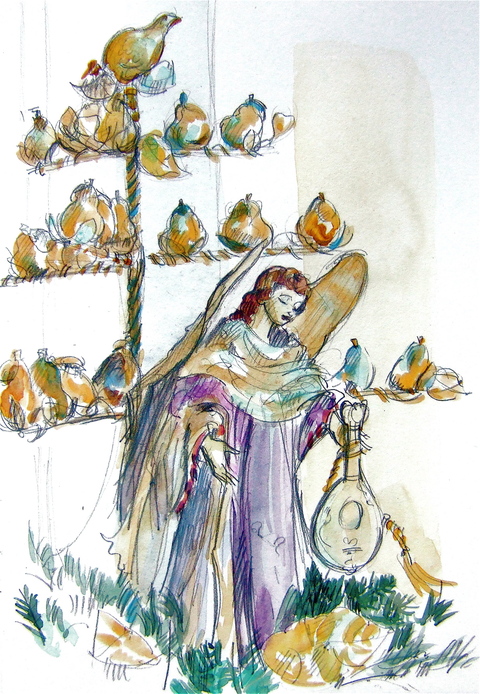
The angel and the partridge-on-tree with pears that are trying to metamorphose stems into beaks and fat pear bodies into fat partridge bodies is by Laura Murphy Frankstone of Laurelines. I suspect that this display is at Fearrington Inn, but that's a mere guess. She may have a book of her Paris sketches soon, and she's thinking about further books, hurrah!

& LAST OF ALL: MERRY CHRISTMAS-TO-COME

And that’s Merry Christmas to you, whoever and whatever you are. Wish me whatever you like in return . . .

Mary stood in the kitchen
Baking a loaf of bread.
An angel flew in the window
‘We’ve a job for you,’ he said.

‘God in his big gold heaven
Sitting in his big blue chair,
Wanted a mother for his little son.
Suddenly saw you there.’

--from the late, the marvelous Charles Causley,
with his poem, Ballad of the Breadman

Christmas was close at hand, in all his bluff and hearty honesty; it was the season of hospitality, merriment, and open-heartedness; the old year was preparing, like an ancient philosopher, to call his friends around him, and amidst the sound of feasting and revelry to pass gently and calmly away. --Dickens, The Pickwick Papers

***