NOTE:
SAFARI seems to no longer work
for comments...use another browser?
Showing posts with label The Foliate Head. Show all posts

Wednesday, August 02, 2017

Linkfest: some poems online

Images from three in-print poetry books--
The Throne of Psyche,
Thaliad
,
and The Foliate Head.
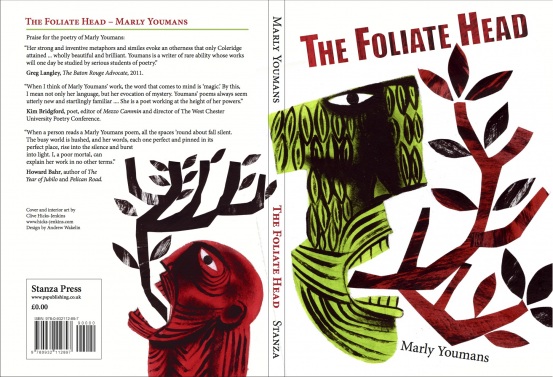
All art by Clive Hicks-Jenkins.

I have added about 150 links to poems online on the stories-and-poems page. Some are poems or excerpts from published books--Claire (LSU), The Throne of Psyche (Mercer), The Foliate Head (UK: Stanza), and Thaliad (Montreal: Phoenicia)--and others are from future books, including a good many poems from The Book of the Red King. Some of them are not final versions, having been tweaked before they found a home in a book.

Thanks to Clive Hicks-Jenkins and three wonderful designers--Andrew Wakelin of Wales for The Foliate Head, Mary-Frances Glover Burt of Atlanta for The Throne of Psyche, and Elizabeth Adams for Thaliad--the books are beautiful. Good to have and to hold and to read.

Wednesday, January 18, 2017

Precipitous slippage

Once upon a time I was a new-made Associate Professor with tenure; my answer to that lovely promotion was to quit academia entirely because I wanted to be a poet and novelist, not an academic poet and novelist. I felt that I would be a stronger, better writer outside the land of ivory towers. What I did not grasp at the time was how completely the academy would take over the world of writing, particularly the realm of poetry, and make it into a near-monolithic enterprise. (Simultaneously, both poetry and literary fiction began to move toward being minor arts--well, poetry was already on the way.) This change has meant that academic writers support one another and give one another various helpful privileges.

Those of us outside the academy are somewhat in the cold, particularly if--as I do--the writer believes that the diminishing returns of Modernism are upon us, and that the way forward is back through tradition and form. Free verse and an obsession with originality (I don't see how that works, given that we're more than a century past modernism's birth--Modernism hasn't been modern for a long time) have become a kind of ideology in our university system. A large number of journals are associated with colleges or are founded by MFA graduates. Most of these are primarily interested in free verse. Meanwhile, I am not primarily interested in free verse, although I do have a recently-finished collection containing poems that derive from a foreign chant tradition that looks free but contains many rhetorical flourishes allied to that tradition.

Do I regret my decision about leaving the academy? No, I don't. I am a better writer because of that choice, and I also had the luxury of having three children, which I probably could not have managed if I had stayed in college settings as a writer and teacher. I find that it is hard to do three major things well, but two--well, you can give up a lot of things that are enjoyable but not essential and so make two big callings work.

I still have a few writer friends who are in the academy and make their living there; I think it's fine that they made the choice to stay in. Most people who gain a perch there do, after all. I just think that I made the right choice for me. What else can we do but try to make right choices? I admire people like poet-professor-mother Luisa Igloria who grasp after mastery in three realms. The late Doris Betts (professor, dean, writer, mother) comes to mind among novelists.

We live in a time when very few poetry books sell in reasonable numbers. I've talked to various editors about sales and found that some poetry books don't break the 50-mark. That's pretty sad, isn't it? I hear that Copper Canyon books sometimes make it to 600; those are the sorts of little numbers a poetry press depends on. (The funny thing about a poetry book is that it can become the sort of book that you return to again and again. So in that way it's a better bargain than most books.)

My picture of how my own poetry books are doing is a bit fuzzy. I know that Thaliad continues to trickle (or seep, maybe!) along in sales for Beth Adams's Phoenicia Publishing and is heading toward the 400-mark in combined paperback/hardcover. [Update: I was pleasantly wrong! 425 copies so far, as of January 19th.] The Foliate Head has sold out its first and second hardcover printings at UK's Stanza Press, though there are still a few copies available on line. I'm don't know the paperback or hardcover numbers at Mercer for The Throne of Psyche. Those are my three books that can be called "in print," though The Foliate Head is technically out of print.

Interior illustration by Clive Hicks-Jenkins
for The Foliate Head
If you care about poetry, please consider buying books. While I would like you to support mine, I tend to be pleased when I see anybody buy a good poetry book. And I always remember the quote taped up on the poetry shelves at the Bull's Head Bookshop (UNC-Chapel Hill shop, now defunct) run by novelist Erica Eisdorfer: People who say they love poetry and never buy any are cheap sons of bitches. --Kenneth Rexroth. It's not polite, but it gets at something. I just looked it up online and found a different version that says, I’ve had it with these cheap sons of bitches who claim they love poetry but never buy a book. Maybe both are right, as Rexroth didn't hold back and may have been muttering variations on the theme for years!

Yes, poetry is rapidly losing its status. Yes, what was once an important art is now a minor one and in danger of going the way of lacemaking. Times change. Television and internet make inroads; well, that's just how it is, we say. What we add to culture changes culture.

But if you care about poetry, do more. In fact, all of us need to support what we love in a time when what is seen and praised and supported is heavily-marketed, commercially-validated books, film, visual arts, etc. And we need to remind ourselves over and over again that we can choose. We can choose roads less taken. It will make all the difference.

Friday, July 15, 2016

The Foliate Head sends out a leaf--


Thanks to Roderick Robinson for writing about The Foliate Head (UK: Stanza Press, 2012) on his blog, Tone Deaf. The post begins, "I bought Marly Youmans’ The Foliate Head because I’ve liked other poems she’s written. She wears her wide experience of literature lightly and I know from her blog, The Palace at 2 am, she has things to say which interest me." Read the rest here.

Side note: Copies are still available in various places, but the second print run will soon be sold out completely. (Thank you, readers, that you made it possible for a second print run to exist.)

It's one of the wonderful things about the internet that books no longer vanish completely when the traditional three-month window for reviews is done, and bookstores ship back their unsold copies. Large, deep-pocket publishers still control what sells best through the marketing of "lead books," for the most part, but the internet means that other books--books that are not "lead books" at one of our largest publishers--have a chance to be known later on. And that's a good thing, as what sells best is always the best.

Tuesday, June 28, 2016

The Foliate Head, on sale--


Just back from the coast and noticed that The Foliate Head (second printing, hardcover) is now listed as not out of print and is on a very good sale. In fact, it is no longer 15 pounds but a mere 4 pounds. So, get it while you can--P. S. Publishing end of print run and clearance sale! Scrumptious wodwos art by Clive Hicks-Jenkins, wonderful design by Andrew Wakelin. Poems by me--for more samples, go here.


THE FOLIATE HEAD


Peering from medieval churches,
Dressed in leaves of ash and birches,

Camperdown elm and English oak,
Doghobble, sassafras, and poke,

Here winks the sprite who can transcend
His yearly death, for whom no end

Can be unless by our misdeed.
His verdant woman bleeds to breed

A world of leaves, his phoenix-pet
Cries cockerel against regret,

Remorse, and all that’s passed away
While crowing-in triumphant day.

The green man’s lodge is budding wood,
His roofbeam’s resurrection rood,

The axis mundi staking cloud
To earth and realms below the shroud.

The roulette balls fly round the sun,
The spiral years are never done . . .

Within my dreams, he’s young and lithe,
Unheeding of the reaper’s scythe,

But when I meet him in the park,
He’s changed his guise from light to dark;

I go to grasp his creaking hands
And find him dressed in swaddling bands.    


    Monday, April 04, 2016

    April! A very big poetry-month sale at Stanza Press

    UPDATE 4/5: So sorry, I think we may already be sold out of the second printing! There are a few copies left at online sellers but not at sale price.  UPDATE 4/20: I understand that the above may be wrong, and that there are 60 copies remaining, but the site still says out of print. They've promised to look into the situation... More when I know! The Foliate Head, a hardcover poetry collection normally selling for £15.00, is on sale for a paltry £4.00; some of the other books are on sale at Stanza for a mere £2.00, including Matt Bialer's Tell Them What I Saw and Jo Fletcher's anthology, Off the Coastal Path. See the whole sale list here.

    The Foliate Head is a gorgeous-looking little book with profuse green man art by Clive Hicks-Jenkins and design by Andrew Wakelin. I'll add some poems below so you may judge whether it is also good in other ways; there are a few on the page for the book as well. 

    Thank you to publisher Pete Crowther for asking for a book, and for allowing the threesome of me and Clive and Andrew to have our way with it! I'm very glad that it went into a second printing.


    "Whan that Aprille with his shoures soote / The droghte of Marche hath perced to the roote, / And bathed every veyne in swich licour, / Of which vertu engendred is the flour," then we simply must have a poetry-month sale. (Thank you, Geoffrey Chaucer and Pete, again.)


    PUCK IN SPRING

    Now the catamount will scream,
    Now the bears awake from dream
    That the winter’s night prolongs
    Till the ice dissolves in songs.
    Now the daybreak fires the mist
    By the mountain ridges kissed.
    While the crocus blossoms yield,
    Opening along the field.
    Now it is the hour in spring
    When the jetting sap will bring
    Fresh desire to boy and girl
    Waking to a brighter world.
    And the fairies hunting shade,
    Finding meadow grass arrayed
    With the bloom of early bells,
    Creep inside the fragrant cells.
    Now in clearing, vale, and slope,
    All the land is drunk with hope—
    In the ancient greening weald,
    Now is loosed what once was sealed.
    Why, the very mountains reel
    At the turning of the wheel.

    “I Heard Their Wings Like the Sound of Many Waters” 
    In the dark, in the deeps of the night that are
    Crevasses of a sea, I heard their wings.
    I heard the trickling of tiny feathers
    With their hairs out like milkweed parachutes
    Floating idly on the summer air,
    I heard the curl and splash, the thunderbolts
    Of pinions, the rapids and rattle of shafts—
    Heard Niagara sweep the barreled woman
    And shove her under water for three days,
    I heard a jar of fragrance spill its waves
    As a lone figure poured out all she could,
    Heard the sky’s bronze-colored raindrops scatter
    On corrugated roofs and tops of wells,
    I heard the water-devil whirligigs,
    I heard an awesome silence when the wings
    Held still, upright as flowers in a vase,
    And when I turned to see why they had stilled,
    Then what I saw was likenesses to star
    Imprisoned in a form of marble flesh,
    With a face like lightning-fires and aura
    Trembling like a rainbow on the shoulders,
    But all the else I saw was unlikeness
    That bent me like a bow until my brow
    Was pressed against the minerals of earth,
    And when I gasped at air, I tasted gold.

    THE MAGNOLIA GIRL


    She climbed the great magnolia tree
    To learn the ways of bird and bee,

    And there the Prince of Darkness came
    To tempt her with delicious shame.

    He bore her up and bore her down,
    He let her try his royal crown

    While leaves went clattering-a-clack
    Like gossips warning at her back.

    A burst of starlight from his face,
    His every move a sigh of grace—

    Could you resist his lightsome wiles,
    Or stop the arrows of his smiles?

    What was a tendency to hiss
    When set beside a glowing kiss?

    In long-ago and far-away,
    She danced her dance the livelong day—

    She showed him all her naked skin,
    And what they did was mortal sin.

    When boredom dulled his passion’s rage,
    The Serpent Prince desired a cage;

    He jailed her in the blooming tree
    And spread a lie that she was free.

    Addicted to the streaming light
    From which her lover once took flight,

    She now repents those leisure hours
    Misspent among magnolia flowers. 


    Thursday, December 17, 2015

    You asked, no. 2: writer, artist, designer

    Clive Hicks-Jenkins: When time allowed and opportunities came my way, I began to make book cover images for some of my friends, the chief among them being Marly Youmans, who because of her reputation as a writer was able to persuade one of her publishers to employ me. For The Foliate Head she even persuaded the publisher to take on my brother-in-law, Andrew Wakelin, as the designer, and he produced a splendid book-cover and ensured the layout inside was handsome. It was The Foliate Head that also established my regular practice of making page-division images and vignettes for Marly’s books.
    Sienna Latham asked how Clive and I work with a designer. Perhaps there's no one answer to that, as to so many things! But now I'll try to think my way through and find out, right now.

    What is always the same is our relationship. The two of us trust each other to do good work, and we don't interfere--I don't try and make the artist draw a certain element or in a particular mode, that is, and he doesn't try to encourage me to write other than I do. We never try to hurry each other in any way. We are curious about what the other is doing. Although we are very different, we have common loves, a kinship in sensibility, and are drawn to some of the same material, something we discovered early in writing letters back and forth.

    As there are some books that have only a jacket (and cover) from Clive, I'll speak to those that are also decorated by him on the interior. We have worked with three designers on interior / exterior art, and I would say that it's a great help to have a designer care about the material. Our three designers are Andrew Wakelin (The Foliate Head), Elizabeth Adams (Thaliad), and Mary-Frances Glover Burt (Glimmerglass and Maze of Blood.) Perhaps it is surprising that each of the three people involved with making the book--writing, art, and design--is so free to do what he or she likes. Certainly I've been in situations where I've had little knowledge of what was happening with a jacket/cover. I've also been privy to the sight of publishers (not mine) and writers (not me) attempting to budge Clive, though why one would do so, I cannot imagine. Gratefulness that he wants to do a piece of work for a book of mine is always my slant on things.

    The main hurdle with books with a good deal of art is getting publishers to agree with what we will do. The great advantage with heading toward small and university presses is that people can be willing to agree or compromise. (The down side tends to be less visibility, less "push" for books, of course, as there is less muscle behind a launch.)

    Andrew Wakelin, the brother of Clive's partner, was an interesting choice as a designer, in that it was possible for Clive and Andrew to meet in person to discuss layout, and for Peter Wakelin to render opinions as well. Clive and I have a love for foliate heads, and the images arrived with that sense of ease that comes from love and long practice. I had little to do but admire, although we certainly discussed choice and placement. As I had met Andrew while in Wales, I found it easy to imagine their meetings at Ty Isaf when reported by email. The primary challenge with having Andrew serve as designer is that he is not an employee of Stanza Press (a division of P. S. Publishing in the U.K.), and so we had to get permission to use a different designer and also to tinker with the Stanza Press template for poetry books. (Val/Orson, which has jacket art from Clive, was outsourced by P. S. to writer / designer Robert Wexler, so we knew it was possible. Interestingly, I got to stay with Robert and his wife, Rebecca Kuder, when I taught in the Antioch summer workshops.) It helped that Pete Crowther asked for a poetry book, since when people ask, they're more likely to accept some variation (though Pete is a wonderfully nice and agreeable man.) It also helped that Andrew is a grand designer. We had an unexpected bit of difficulty with pagination and length because of the template, and at the last moment added a few poems that were congenial with the manuscript.

    Designer-and-more Beth Adams is someone I met long before she asked for Thaliad (Ivy Alvarez and I had edited an issue of quarrtisiluni, the magazine she founded with Dave Bonta, and I live not far from Beth's childhood home.) She is a visual artist, writer, editor / designer, and publisher. Her Phoenicia Publishing (Montreal) is a micro-press in staff and a macro-press in ambition. As a team, we had many common interests and were united in the desire to make the most beautiful book possible, given the constraints of small press. (Constraints are often good challenges that lead to ingenuity.) The three of us kept in close touch. Our emails were full of forwarded quotes from one another and the many images Clive made, all influenced by American folk art.

    One marvelous aspect to Phoenicia Publishing is that Beth's hand is in everything. Because she writes and makes art and designs, there's a seamlessness and feeling of a central editorial taste about all Phoenicia's books.

    Mary-Frances Glover Burt, who designs for Mercer University Press (her company is Burt and Burt), had a great many images to work with for Glimmerglass, as Beth Adams did for Thaliad and Andrew Wakelin for The Foliate Head. Because the press stands as an intermediary between artist and its chosen designer, one would think that we might feel a little more detached from Mary-Frances. But it's a new world now, and we're all hooked together by social media. We're big fans of Mary-Frances. Here's Clive on her imaginative jacket design:
    Clive: By contrast [with The Throne of Psyche, which used existing art] I made the artwork for Glimmerglass specifically for the project, and I’ve greatly enjoyed working with Mary-Frances Glover Burt as she’s sensitively transferred my drawing to the cover and made clever adjustments to finesse it into what you see at the top of this page. (I shall not spoil the illusion by indicating where adjustments have taken place, but suffice to say that she’s been quite the magician!) Moreover she’s made the wrap-around truly beautiful, with the lettering for the cover cleverly reconfigured for the spine, and the foliate elements unspooling onto the flaps. I particularly like the detailing of where she’s inserted a white rectangle for the necessary barcode on the back cover, but sweetened it by having a foliate element passing in front of a corner of it. Gorgeous work, Mary-Frances.
    We felt confident about each person's part in the process--Clive and I had already seen what an elegant job Mary-Frances did with The Throne of Psyche, which won an Abby design award for Burt and Burt and Mercer--and we looked forward to seeing what she would do. (Clive's description of what she has accomplished is so appealing, and I also liked the tiny minotaur on the spine, hooked onto the lettering Clive mentions.)

    Perhaps it's in Maze of Blood where one sees most vividly how very imaginative a designer can be. In some ways, Mary-Frances appeared to have less to work with and more of a challenge when Clive's many small decorations for the interior of Glimmerglass gave way to something larger. with Maze of Blood. Despite being busy with other projects, Clive made six portraits for division pages, plus the head on the jacket.
    Clive: The drawings, which are variously embellished versions of a man’s head, are intended as poetic expressions of the text rather than as representing specific episodes. Because I had only six images to play with, I tried to densely layer my ideas, so any one drawing might be seen to be referencing multiple aspects of the narrative. Vegetation and flowers figure strongly in Marly’s text, as do the imaginative universes the protagonist conjures in his novels and short stories. I wanted to combine both in this image, and so while the ‘flowering’ has been informed by aspects of American folk-art… particularly appliqué-quilts… by setting it like the crest of a headdress, it can simultaneously echo of some of the writer’s elaborate inventions of ancient and mythic cultures. In each image the man’s eye has been replaced by a substitute. There’s been a beetle, a flower, the sighting of a revolver and a coiled ribbon of paper. Here a ‘folk-art’ bird is the stand-in, and I like that the plumes of its tail might be seen as ‘tears of blood’.
    At one point, Mary-Frances requested a sketch of folded paper like the maze in one of the heads, and she used it on the title page. Other elements were plucked from the six portraits--a bird, a gun, insects, flower--and woven into the text pages, as well as appearing like a passage into the prefatory and out the concluding pages. The jacket flaps and rear of the jacket also show how she has re-used signal elements like the passion flowers and moth and gun, all dark and shadowy in the rich blue of the background. The foliate bar code detail that Clive liked on Glimmerglass? There's a moth that has settled onto, slightly into, the bar code of Maze of Blood.

    What strikes me about all these triangular relationships is that they are founded on a trust in the abilities and creativity of other artists. In all cases, the people involved respected the abilities of the others and left them in freedom. While it always seemed that a good deal of collaboration was happening because I was constantly seeing fresh images, in truth we were simply immersed in one another's work and having the great and happy pleasure of watching how one art generates another. Seeing the energies of the initial work flow elsewhere and generate new work is marvelous. When this sort of collaboration goes well, each person is a part of a dynamic, moving whole--as, say, one spiral branch of a triskelion.

    p. s. In answer to another question, the hardcover of Thaliad is only available via the Phoenicia site. The paperback can be ordered via the usual places.

    p. p. s. If you want to see Clive's lovely response and some also-lovely comments, go here. And Alan Lee has ordered three of our books! My fantasy-loving, writing-and-cartooning child was as excited as when a Diana Wynne Jones blurb arrived for Ingledove.

    p. p. p. s. All the above is an attempt to describe something that is simple, full of love and joy and magic.

    Friday, April 24, 2015

    NPM4: I give you water-devil whirligigs--

    April, national poetry month, no. 4

    Image by Clive Hicks-Jenkins
     from the back of The Foliate Head
    "I Heard Their Wings Like the Sound of Many Waters,"
    The Foliate Head (hardcover from Stanza Press, 2012)

    *
    I like bigness in a poem, and this one started with a phrase that has a cosmic largeness to it. I also like mystery in a poem, and don't think all that much of a poem that exhausts all its mystery in short order, so I hope this one retains both largeness and mystery. It first appeared in the qarrtsiluni here.


    *

    "I Heard Their Wings Like the Sound of Many Waters"

    In the dark, in the deeps of the night that are
    Crevasses of a sea, I heard their wings.
    I heard the trickling of tiny feathers
    With their hairs out like milkweed parachutes
    Floating idly on the summer air,
    I heard the curl and splash, the thunderbolts
    Of pinions, the rapids and rattle of shafts—
    Heard Niagara sweep the barreled woman
    And shove her under water for three days,
    I heard a jar of fragrance spill its waves
    As a lone figure poured out all she could,
    Heard the sky’s bronze-colored raindrops scatter
    On corrugated roofs and tops of wells,
    I heard the water-devil whirligigs,
    I heard an awesome silence when the wings
    Held still, upright as flowers in a vase,
    And when I turned to see why they had stilled,
    Then what I saw was likenesses to star
    Imprisoned in a form of marble flesh,
    With a face like lightning-fires and aura
    Trembling like a rainbow on the shoulders,
    But all the else I saw was unlikeness
    That bent me like a bow until my brow
    Was pressed against the minerals of earth,
    And when I gasped at air, I tasted gold.

    Interior division page with art by Clive Hicks-Jenkins
    The Foliate Head book design by Andrew Wakelin


    Tuesday, April 21, 2015

    NPM: I give you harpies

    April, national poetry month, no. 1 

    I am finally getting around to celebrating national poetry month. Last year I did a giveaway; this year I'm just going to give everybody a few poems. Here's one about harpies because everyone loves to spot some harpies except the people who are persecuted by them. Those unfortunate people would be men, mostly. Sometimes it is way beyond first-rate to be a woman.

    "That Which Snatches" (blank verse) is the fourth poem in the opening Powers section of The Foliate Head, a hardcover book now in second printing from Stanza Press in the UK. The poem originally appeared in that wonderful online magazine, Mezzo Cammin, edited by poet Kim Bridgford. (It can be ordered from Amazon, or by special order through indies and other bookstores.) You can read more poems from the book here. 

    The gorgeous art in The Foliate Head
    is by Clive Hicks-Jenkins.
    Book design by Andrew Wakelin.

    THAT WHICH SNATCHES

    Vulture-like, the harpies wheel on updrafts
    Or settle in the grove of wind-whipped trees,
    Their small, secretive faces looking out
    Without sign of interest or passion,
    As pinched and harsh as soul heads on a stone
    Propped up by mourning Puritans on land
    Unused to buried bone: winged skulls that glare.
    One is singing, Turn away, my bonnie,
    Turn away home, and yet there is nowhere
    To turn, no home when such weird sisters sing.
    In Cretan caves they hang like ungroomed bats,
    Letting locks hang, letting the lice parade,
    Their molting feathers like some nightmare bed
    Where no man fancies lying—that’s a truth
    That galls, for only breeze that glances here
    And there and then is gone could bear to kiss
    Their shriveled, wicked purse of privacies.

    Bedraggled, murderous, entirely foul . . .
    If they had hands, the fingers would be small,
    As leathery as paws for throwing scat
    At queens or prophets. No respect, no cheer,
    No proper sentiment for the flawless
    Horses of Achilles, their own offspring,
    That wept to smell the battle-scent of death.
    No sisterly devotion to Iris
    Tricked out in sunstruck iridescent drops.

    They’ll shriek the dawn awake and howl for flesh,
    Heraldic frights so ignorant of evil
    They could be us—so self-absorbed, so free.
    On branches in the bleeding wood of souls,
    They shift their talons, sigh in sleep like doves,
    Dreaming of men like birds of paradise,
    Of leaf-winged forests tumbling in a storm,
    The phoenix burning on her nest of myrrh
    Who found this harpied world worth dying for.

    More from Clive...

    Sunday, November 09, 2014

    Review plus post, the Star (NC)

    Art by Clive Hicks-Jenkins for Glimmerglass.
    A novel turn, rich and strange 


    Review, Ben Steelman, StarNews 
    (Wilmington, North Carolina) 
    9 November 2014
       
    3-page review begins here

    Clip: "Fantasy and myth mix with classic whodunit in “Glimmerglass,” the latest novel from poet and South Carolina native Marly Youmans. This is only detective fiction, though, in the sense that “Hamlet” is a play about a kid who can't get along with his stepfather. Youmans takes a couple of overworked genres and makes them undergo a sea change into something rich and strange."

    Photo by Paul Digby, July 2014
    This one was taken in Ohio right after I taught
    at the Antioch Writing Workshops.
    The lady behind "Glimmerglass" 


    Background post
    by Ben Steelman, 
    Bookmarks blog
    at StarNews Online 
    9 November 2014.
    Read it here.

    Favorite clips:

    ...Youmans writes one of the best writers's blogs in the ether...

    Youmans’ poetry collections include “Thaliad,” “The Throne of Psyche” and “Claire.” I have been meaning to write for years about “The Foliate Head,” her 2012 poem cycle about the Green Man, published in Britain by Stanza Press, which must rank as one of the most beautiful books of the 21st century. Notable are the illustrations and illuminations by the Welsh artist Clive Hicks Jenkins. Jenkins also did the artwork for “Glimmerglass.” *

    *Glimmerglass, Thaliad, and The Foliate Head all contain exterior and extensive interior artwork by Clive, and his art is also on the cover of The Throne of Psyche and Val/Orson. The design work on The Foliate Head is by Andrew Wakelin, wonderful UK designer.

    Thank you, Mr. Steelman!

    * * *

    crew list here
    There's a typo in the blog post that I find amusing. My father was a sharecropper's kid and teenage tail gunner on the WWII Incendiary Blonde who, thanks to the G. I. bill, later became a professor of analytical chemistry. (His teen train escapades, his farm home, and his father's love for one of his mixed race brothers influenced the creation of Pip in A Death at the White Camellia Orphanage.) As a professor, he couldn't help butting heads with administrators and often said, "The lightweights float right to the top." And so I found it comical that he appears as a college president rather than professor... He also liked to quote Lewis Carroll's "I'm mad. You're mad. We're all mad." That one is a little more generous, as it puts us all in the same zany boat!

    If you click on the picture, you'll see my handsome young father standing at far right. Hubert Lafay Youmans of Lexsy, Georgia... Hu. His hand looks a little odd--swollen from a fistfight in town the night before.

    Saturday, August 09, 2014

    The Tree Finder


    Here's a poem from The Foliate Head for tree-and-word lovers. It originally appeared at the Dave Bonta and Beth Adams e-zine, qarrtsilunias part of "Two Poems from the Plant Kingdom." A recording and lots of interesting comments on the poems are here. (As it's not as freely available in the states as a US-published collection, I'll just add that the book is available by ordering directly from Stanza Press (UK) and the usual online sites, as well as by special order via indies.)

    WIELDING THE TREE FINDER

    Do you ramble the ground—are you a tree and yet a forest,
         does your great bulk blossom in one night
         like an elephant singing a love-song to the moon,
         do you transform to a reservoir for water and stars,
         do you grow hollow for whistling,
         do you become an ossuary,
         do you hold African mummies in your heart,
         are you baobab?
    Were you sacred to healers and priests who haunted oak groves,
         golden shoulder pins on their woven garments,
         your parasite branches in their hands
         —the raspberry girl slaughtered, seeds between her teeth—
         were you sharpened to a Norseman’s spearpoint,
         did your mischief kill a god, fairest of the Aesir,
         do you draw warmth of kisses to an orb of leaves,
         are you mistletoe?
    Are the rosy pastors and the bulbuls feasting on your seeds,
         are you red and hairy like Esau,
         are your flowers good in bowls of curried pottage,
         are you a tree of red silk cotton,
         bombax malabarica?
    Were you a thousand scented pillars
         around the forecourt of an emperor,
         are you malleable in the whittler’s palm,
         are you swooning-pale and infant-smooth,
         are you a parasite tethered to roots of others,
         are you sandalwood?
    Are you loose-tethered, a yielder of leaves to wind,
         are you a sender-out of roots, are you clone,
         is a forest of your kind a single sentience,
         and in fall are you quivering yellow,
         boreal, afflicted with melancholy,
         a breather of mists and cold,
         are you quaking aspen?
    Do your flowers steam with fragrance as the heat increases,
         do the chrysomelids rut within your clutch of petals,
         do your blossoms shatter as the beetles copulate,
         are you Amazonian—are you annona sericea?
    Are you a kingdom, are you castles in the air,
         are you a garden of Babylon in mist,
         are your branches colonies of dreaming epiphytes,
         are the flicking tails of lizards lost inside your cities,
         are you flying above the prayers of the Maori,
         are you kauri, the tree that must forgive?
    Were you as dense and black as mythic thrones of Hades,
         were you strong, were you midnight ripped in lengths,
         were you foretelling gleams—Victoria’s jet beads—
         were you heavier than the fat man’s coffin,
         were you Pharoah’s favorite chair,
         are you ebony?
    Are you dawn redwood or frangipani,
         are you whistle thorn or cannonball,
         are you linden, myrtle, jacaranda,
         are you sourwood or silverbell,
         are you a branch of good and evil,
         are you the lemurs’ Ravenala,
         are you Yggdrasil, axis of nine worlds,
         are you a cross whose branches reach forever,
         are you water-tapping, cloud-catching, sun-devouring,
         are you leaf, are you branch, are you root, are you tree?

    Wednesday, July 23, 2014

    Blog hop, bog hlop for Richelle Hawkes

    Now in pre-order
    Available via Mercer, online shops,
    and your favorite indie bookstore
    Richelle Hawks of Shipwreck Dandy asked me to participate in her blog hop, and so here goes--

    What am I working on?

    Right now I have finished up a week at the Antioch Writing Workshops in Yellow Springs, Ohio, where I ran a poetry workshop and also met one-on-one with various people to discuss both poetry and fiction manuscripts. It was great fun, and I met lots of wonderful people, and stayed with writers Robert Wexler and Rebecca Kuder. Now I’m staying with friends-in-the-arts Lynn and Paul Digby, and Paul is taping and filming me reading poems and some fiction. Later on he’ll make some videos (and there will be podcasts) with his own music.

    When I go home, I need to finish up some manuscripts that have been lying around, waiting for attention.  I have a poetry manuscript and a novel for children that are in need of some final polish or tweaks here and there. I have a novel forthcoming next year that I mean to revise one more time—occurred to me that I really ought to change the order of a few things, long after it arrived at the publisher's office.

    More here
    I won’t start a large, new project until those things are done, though I’ll be writing poems and small stories. I’ll be doing some traveling on behalf of my  novel, Glimmerglass, beginning with SIBA in Norfolk in September. I really need to arrange more events at the moment. And I’m still doing some work to help out recent poetry and fiction books—The Throne of Psyche, A Death at the White Camellia Orphanage, Thaliad, and The Foliate Head. (See tabs above for information.)

    How does my work differ from others in its genre?

    I write lyric poetry, long narrative poetry, short stories, novels of various sorts, and even a few Southern fantasies for young adults, so I find that one a daunting question. Think I’ll leave it for readers to answer!

    Ferrol Sams Award,
    Silver Award, ForeWord BOTYA
    More here
    Why do I create what I do?

    One of the most beautiful, good, and true acts human beings can perform on planet Earth is to rejoice in the greater Creation by making things. To create art is to live a larger life, one with greater energy and joy and scope.  

    I make things in order to speak to and give back to the created world—to make shapeliness and to seek power and truth in words that, once pushed into the right order, may become an experience for another human being. I love the thought that somewhere, someone may be reading one of my books and feel something of what I felt when I was making it.

    How does my creative process work?


    More here
    I might as well say that it falls as a golden waterfall from a distant star. The more I go on, the less I know and the more I feel about the mystery of art. If my writing is moving in its most natural and most potent way (as opposed to my simply doodling with words because, say, I haven't written a poem in a while and want to do so), it simply pours through me like a wave of energy that becomes embodied in words. Words and stories and poems swoop in, and later on I polish them and play with them until they are right. 

    All work falls short of the fire that burns in the mind, but approaching that original fever is a constant lure. I love that fay call from within (or perhaps from without?) and the attempt to answer back.

    More here.
    And who to tag for the Gob Holp, Ogh Bolp, Blog Hop?


    Scott G. F. Bailey
    Scott's blog hop response here

    More to come...