NOTE:
SAFARI seems to no longer work
for comments...use another browser?
Showing posts with label green man. Show all posts

Friday, July 30, 2021

Rabbits, Tavener, Poems

TINNERS' RABBITS

Thanks to Conor Sweetman and the staff of Ekstasis, who recently accepted a couple of poems of mine; the first can be found HERE. If you want to know more about the rabbits--hares, really-- you can see a Cornish tin miner's  badge here, an Alsace puzzle plate here, a Mogao Caves temple decoration here, a Jewish tombstone here... And there are many more examples, in many cultures.

In England and Europe, the three hares appear to have been adopted as a symbol of the Trinity, and certainly they are three-in-one in an Escheresque manner! Syncretic symbol? In part because rabbits are linked to fertility, I think of the also-fertile green man motif. I've never understood the reason academics don't see why Medieval churches adopted the image of the green man, often shown as vomiting leaves. Surely he is an emblem of new life and creation. Moreover, he speaks creation like the God of Genesis, who says, "Let there be light: and there was light." The green man is a rude thing, sure, but clearly bursting with life and its enchantment. I expect the Gawain poet with his Green Knight would've understood. The three hares seem a similar borrowing, an understanding that patterns underlie the nature of the world and are meaningful, even when they seem a bit homely and countrified. The three hares remind me of what composer John Taverner called images or verse of "primordial innocence," work that is simple and beautiful and childlike. For him, that's always connected with being open to revelation, ready to receive something from beyond.


TAVENER, YOUTH, POEMS

Thinking of Taverner and beauty... 

His Three Holy Sonnets (inspired by Donne's "Spit in My Face," "Death Be Not Proud," and "I am a little world") were written when he was fifteen. And I'm still thinking about how Stravinsky looked at the score and wrote "I know" on it. So many possible reasons to write such a thing!

Interesting to have good work remaining from the teen years. I regret throwing away all my poems when I was twenty and graduated from college. They were fantastical and full of youth, whatever else they were. In love with sound and enchantment. And I should never have gone on to graduate school. It was not good for my poems. Unlearning took me a long time.

STILL IN A MAYBE-ISH MOOD

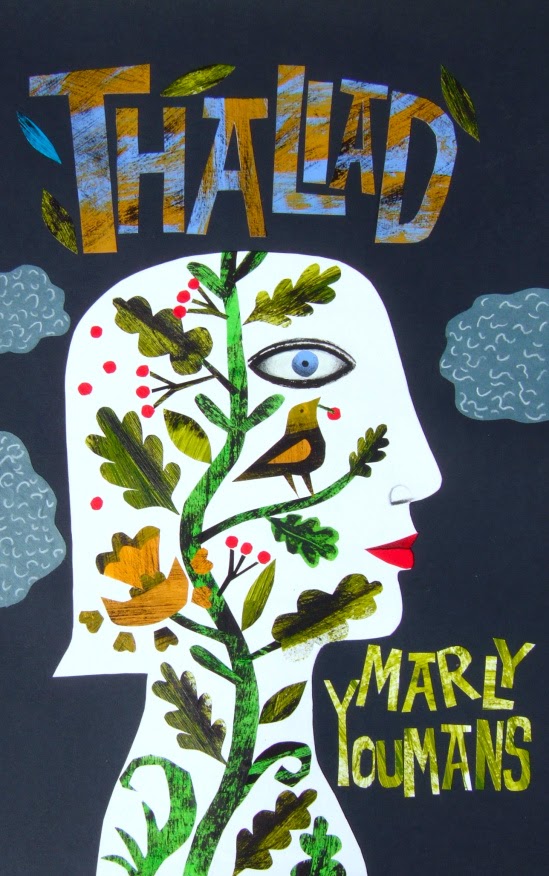
Though I've been doing too much travel and have too many strenuous things to accomplish this year (not bookish things!), I'm again thinking about writing another long poem, as I mentioned before. I've been surprised by how many people have read and liked Thaliad (that is, in the smaller scale numbers of poetry), but even more years of Western cultural decay have passed by since that poem was published, so that I find that I now have some doubt of readers picking up a long formal poem.

But I still might do it, at least for myself. I have a good deal of work I've never tried to publish, and not everything has to be sent out in the world. Still pondering.

Tuesday, June 28, 2016

The Foliate Head, on sale--


Just back from the coast and noticed that The Foliate Head (second printing, hardcover) is now listed as not out of print and is on a very good sale. In fact, it is no longer 15 pounds but a mere 4 pounds. So, get it while you can--P. S. Publishing end of print run and clearance sale! Scrumptious wodwos art by Clive Hicks-Jenkins, wonderful design by Andrew Wakelin. Poems by me--for more samples, go here.


THE FOLIATE HEAD


Peering from medieval churches,
Dressed in leaves of ash and birches,

Camperdown elm and English oak,
Doghobble, sassafras, and poke,

Here winks the sprite who can transcend
His yearly death, for whom no end

Can be unless by our misdeed.
His verdant woman bleeds to breed

A world of leaves, his phoenix-pet
Cries cockerel against regret,

Remorse, and all that’s passed away
While crowing-in triumphant day.

The green man’s lodge is budding wood,
His roofbeam’s resurrection rood,

The axis mundi staking cloud
To earth and realms below the shroud.

The roulette balls fly round the sun,
The spiral years are never done . . .

Within my dreams, he’s young and lithe,
Unheeding of the reaper’s scythe,

But when I meet him in the park,
He’s changed his guise from light to dark;

I go to grasp his creaking hands
And find him dressed in swaddling bands.    


    Tuesday, April 26, 2016

    Dreaming back


    Making Manuscripts from the Getty Museum.
    Well worth watching...

    I'm surprised by how many times the medieval world has crept into my books (perhaps most obviously in The Foliate Head, Val / Orson, and The Book of the Red King, but elsewhere as well) and into many of my blog posts. Perhaps I really am living in the wrong century, though I would not have lived long in the medieval world and am grateful to modern medicine's influence in matters of bad bacteria and childbirth.

    My own possibly-quirky explanation of why green men invaded European churches here.

    Druidic verse from Amargin, and a link to Yeats here.

    "The Annunciation Carved in a Medieval Prayer-nut" here (and in the print edition.) And no, you're not missing anything; it ends with "stumbles--"

    And here's one where þa middangeard crept in. "Vermont Kingdom."

    And a bit of The Book of the Red King here or here. Some of these will be a little altered when the book appears.

    A favorite medieval-mad website: Jeff Sypeck, Quid plura? Here are his medieval-inflected posts.

    And here is Jeff's Beallsville Calendar, now in progress, inspired by medieval calendar poems.

    Christmas at Camelot from Clive Hicks-Jenkins
    Clive's posts on Gawain and the Green Knight are here
    Information on ordering the Gawain prints (more to come) at The Penfold Press

    The medieval world is still with us. I just went to the door for mail and found a box of wine and New Selected Poems by Les Murray. Looking up an interview, I see him talking about influences: "Various Scottish and Irish medieval poets too, Dunbar and the poet of that mighty anonymous hymn from Ireland, "Be thou my vision, O Lord of my heart," hymn 31 in John de Luca's Australian Parish Hymn Book" (Image Journal.) And here's this, a comment I might have made, from another interview: "the deadliest inertia is to conform to your times" (The Paris Review.)

    Wednesday, March 19, 2014

    Green men go to church--

    Maddy Aldis-Evans photograph,
    Exeter Cathedral, Somerset
    The placement of leafy heads of green men (and the rare green woman) on cathedrals and parish churches has become what is called a "vexed subject." No document tells us precisely why a medieval sculptor would do such a thing, and writers on the subject tend to think it a wonder and mystery, though they often point to ideas of rebirth and regeneration (think of Bertilak in Sir Gawain and the Green Knight, who is a figure of renewal met by Gawain at two Christmastides.) A common question asks why medieval Christians should bring such pagan-looking faces into a church structure?

    For me, a better way to question foliate heads is to begin by assuming that they belong where they are. Then the question becomes why they belong in a church setting, and how that reason could make sense to a medieval Christian.

    I've always felt that these odd heads were not surprising, and I thought about it again last Saturday when hearing my friend James Krueger (Mons Nubifer Sanctus) say that God creates freely and so can make a free creation that is itself free to create and be fruitful--as it says in Genesis, "let the earth put forth" and "let the waters bring forth."

    The Foliate Head
    UK: Stanza Press, 2012
    Green man by Clive Hicks-Jenkins
    Maddy Aldis-Evans photograph,
    water spout, Kelmarsh St. Denys, Northamptonshire

    If the foliate head precedes Christianity in Europe (a thing we do not know one way or another), there's certainly a reason why it followed men and women into churches and cathedrals; the generative, bringing-forth head must have fit the transformed world. And if it did not precede Christianity, the head must have seemed a good thing to bring into a changed world for the first time. Either way, it appeared somehow right to a medieval Christian to sculpt a greening face. Likewise, the image must have met the approval of priests and architects.

    A green head is at one with the purposes of the God as revealed in Genesis, fulfilling the injunction of fruitfulness. Mouth (or sometimes nose) breathes out leaves, breathes out the spirit of creation. The head that puts forth leafy breath is usually male, sometimes a woman, sometimes a creature, sometimes a crowned king. Thanks again to James for the reminder that "spirit" and "breath" are the same word in Hebrew and Greek, and for the thought that the late-created human being in Genesis is a microcosm of creation, combining and holding earth ("dust") and intellect and spirit as one.

    This idea of a person as microcosm is a lens through which we can approach the foliate head even more clearly. "I am a little world made cunningly," says Donne, years later but in harmony with his medieval forebears and the Genesis story. How does the idea of microcosm as lens work, and why might a medieval Christian find a foliate head perfectly congenial with the words heard on the Sabbath? First, in a green man or woman we find the image of God, for Genesis tells us that each human being is made in God's image. Each person (green or not) is also, then, a kind of microcosm of God. Second, God in turn is known through the Creation. Each human being is also a microcosm of Creation, created from dust, mind, and breath of life. As a result, each person has the potential of reflecting back God's nature and Creation. In that way, a man or woman may become creative and fruitful (like the foliate head), living in harmony with the purposes of God.

    But these are very strange portrayals of human beings. What might a head sprouting leaves have said to a medieval Christian about life lived as a reflection of God and Creation? I suggest that it might have told the observer to live a larger life that was more expansive, more creative, and more like God. That's a lot to ask of anybody, much less a medieval peasant. Yet such an urging is a natural outgrowth from the power displayed by foliate heads. These green images from churches and cathedrals are full of energy, sometimes almost lost in a thicket-sphere of leaves. They are wildly alive, vital and strong. Nothing is stinted. Everything flourishes. All these statements would have worked for a medieval Christian as ways of describing the powers of God and Creation. From an alien yet human head--the microcosmic image of world and God--a torrent of free creation bursts forth, spilling with leafy, lavish Niagaras of new life. The foliate head says in its green speech, then and now, go and be like me. 

    * * *
    Green man collaborations: Clive Hicks-Jenkins

    Marly and I are friends that have long shared an interest in this subject, and so it was only ever going to be a matter of time before we collaborated on a 'foliate' project. In fact come to think of it, the first book we did together, her novel of twindom and life in a forest, Val/Orson, also had an underlying 'foliate' theme, and so did our last, her epic narrative poem Thaliad. You'll find that in time that no matter how deeply you mine them, the best subjects return over and over again to inspire.  --Clive Hicks-Jenkins to Timothy Hoover, who is exploring the ways of the green man in mask-like constructions made form natural materials

    A foliate Thalia
    (art by Clive Hicks-Jenkins)
    Clive Hicks-Jenkins,
    green man from The Foliate Head.