NOTE:
SAFARI seems to no longer work
for comments...use another browser?
Showing posts with label interviews. Show all posts

Wednesday, March 31, 2021

Jackson Center interview

Though most people who keep up with me go to social media sites, I'm posting this for the wonderful dinosaurs who still follow blogs and don't follow facebook. It's a copy of the facebook interview from The Jackson Center for Creative Writing at Hollins. Conducted by MFA student Lena Fultz. Thanks to her and to the Jackson Center!


Hollins Creative Writing Alum Spotlight: Marly Youmans, M.A. ‘75 

Marly Youmans describes herself as a “Carolinian astray in snowy upstate New York.” After graduating from Hollins in 1975, she has written across genres—novels, short stories, and poetry. Youmans returned to Hollins in 2010 to serve as a Writer in Residence for the Children’s Literature summer program. 

Her work continues to win awards, with novels regularly appearing as finalists in ForeWord’s Book of the Year contest, among many others. John Wilson, editor at Books and Culture Magazine, describes Youmans as “the best-kept secret among contemporary American writers. She writes like an angel—an angel who has learned what it is to be human.”

Youmans spoke on her time at Hollins and her most recent (fifteenth!) novel, CHARIS IN THE WORLD OF WONDERS, with MFA student Lena Fultz.

LF:  What was your experience at Hollins like? What did you take away from your time here?

MY:  I wrote reams of poems at Hollins, and when I left at 20, I threw them all away—very much a young poet’s thing to do, though now I regret renouncing all those sparks of youth. Some years ago, Lee Smith told me that she found one of those old poems lying about the department and liked it: “The Magician’s Daughter.” 

Some of the women who were entranced with poetry (and the beloved Richard Dillard) are still friends of mine, especially Mary Bullington, Robbi (Kellman) Nester, and Susan Hankla. Susan was at Brown with me as well (riotous days!), and my fifteenth book, CHARIS IN THE WORLD OF WONDERS, is dedicated to Richard and Susan.

Amanda Cockrell invited me to be Writer in Residence at the summer Children’s Literature program some years back, and I enjoyed the return and still hear from some of the students. Just last fall, I had the decided pleasure of discussing Susan Hankla’s first full-length book, CLINCH RIVER, in THE HOLLINS CRITIC.  

I suppose that many a young writer discovers a need to rebel against what she has been taught in school, and against the times. And so I have ended up bounding away from the vers libre of Modernism and its after-shock movements, and have embraced meter and sometimes rhyme as liberating and strengthening forces. I’ve gone back to older and larger definitions of what poetry can be and can include: narrative and long poem, as in THE THRONE OF PSYCHE; long sequence with repeating characters, as in THE BOOK OF THE RED KING; epic adventure, as in THALIAD. Falling into the land of stories helped, for I soon wanted my poems and fiction to be entirely different creatures.

LF:  Your recent novel, CHARIS IN THE WORLD OF WONDERS, is set in Puritan New England. What does your research process look like for writing in a time before you were born? What is the biggest challenge?

MY:  In the books where I’ve delved into the past, I’ve moved through regions of time where I felt comfortable: CATHERWOOD and CHARIS in the seventeenth century, THE WOLF PIT in the nineteenth, and A DEATH AT THE WHITE CAMELLIA ORPHANGE in the Depression. 

I tend to consider fiction-time as a place rather than as an inaccessible era. Some of this is due to my extended family in Georgia. As a child, I spent some of my summer traveling-time at my maternal grandmother’s big Queen Anne house and property in Collins. My mother was the accidental ninth baby of a woman born in 1883; the home and our matriarch, Lila Eugenia Arnold Morris, felt Edwardian. And some of my vacation time was spent with my paternal grandparents; the sharecropper’s shack and farm are closely described in A DEATH AT THE WHITE CAMELLIA ORPHANAGE. Utilities were minimal, comforts sparse, mules stubborn, sun boiling. Tenant labors of ploughing in the fields, picking cotton and tobacco, preserving food, or making turpentine in the piney woods didn’t appear impossibly distant from the peasant’s vassal duties in a medieval and feudal world. My two Georgia family homes have been a blessing to me as settings for my imagination and as ways of understanding how to live and move in the past, as well as how to navigate a landscape of hardship, toil, and poverty. 

(Here I should pause and thank my late father for the burning motivation that made him a teenage tailgunner on a B-17 in World War II and afterward a professor of analytical chemistry—one who bought his elderly parents a house in town. And thank you, America, for the G. I. bill.)

For CHARIS IN THE WORLD OF WONDERS, I could skip over a lot of basic research because I had read so much colonial documentation and literature in earlier years. But I spent nine days at the American Antiquarian Society in Worcester, looking up specific things: occupations and titles in Massachusetts Bay Colony; accounts of Haverhill and Andover (now North Andover); letters; modes of address in England and the colonies; laws and punishment; differences between English and colonial goldsmiths; silver styles; contracts; marriage ways; recipes, etc.  

Mainly, I didn’t want to tumble into the silly ways in which “the godly,” as they called themselves, have been depicted with black clothes (out of reach for most), buckles on hats, constant dreariness, and so on. The keys to writing a novel set in the past are few but essential: never put contemporary beliefs and contemporary characters into the past (unless, of course, you are writing a time-travel book!); show the same amount of “stuff” and landscape as you would in writing of your own place and time; don’t feel that you must prove (by over-reference to songs, politicians, scandals, etc.) that a character really and truly is in past time; and wear any historical research lightly, avoiding the dread info-dump.

LF:  With the current state of the world right now, are you finding time and space to write? What does your writing routine (if you have one) look like?

MY: A great deal of my adult life has been spent as a mother of three (one is still at home), and children have no need for a writer. They need a writer about as much as an octopus needs a party dress, and this is a good thing; it has kept me from ever accumulating any big-headed thoughts and forced me to be ingenious about scraps of time. So no, I never developed a routine; I seem to be fatally allergic to anything that smacks of over-organization, outlines, or the old-fashioned writer with wife who protects writing time. I do, however, have a husband who cooks and bakes wonderfully well, and for that I am grateful.

Despite the pandemic, I am dividing my days between Cooperstown, New York, my home for the last 22 years, and Cullowhee, North Carolina, where I attended high school and where my mother lives. So, I’m sometimes shuttling back and forth along the Appalachian chain . . . Given my current situation, I’ve decided not to start a new novel until later, but I am writing poems.

LF:  Any future projects or upcoming events we can look forward to? 

MY:  I expect that the next book will be a poetry collection. Meanwhile, reviews and interviews and podcasts for CHARIS are still trickling out—it seems that I have an unfortunate tendency to have books launch during national disasters, but I’m hoping that readers will be kind enough to support pandemic books!


Monday, June 11, 2018

Clinched: A Talk with Poet Susan Hankla

Pictures show Susan Hankla, Clinch River, the logo for Groundhog Poetry Press,
and R. H. W. Dillard--poet, writer, stellar teacher, leader of the whistle pigs,
and founder of Groundhog Poetry Press.

I am feeling downright happy about the interview with poet Susan Hankla that went up online this week. Susan and I worked hard on it, and we have received a generous response from social media to the interview, including 40+ shares or re-links of my facebook post, along with promises to buy the book and even a promise from a well-known writer to review!

If you haven't heard my bell-ringing and clamoring on this so far, please hear it now and take a look at our discussion. At the bottom of what I think of as an unusually interesting and revelatory interview, you will find some poems from the book.

Thanks to those of you who take a peek. I've wished for Susan to have a full-length book for a very long time and am pleased to support and recommend her poetry collection, Clinch River, available from Groundhog Poetry Press via SPD, or Small Press Distribution.

* * *

Introduction to the interview with some facts about Susan Hankla:

My review of Susan Hankla’s Clinch River in the October 2017 issue of The Hollins Critic begins like this: “I doubt that any other reviewer of Susan Hankla’s first full-length book, Clinch River, has had the great good luck of seeing her, a young woman, dance playfully with an enormous rattlesnake skin. Such is my sparkling luck.” I have known Susan Hankla for decades; she is one of those attractive, special people who spill over with an abundance of life, and it is a great pleasure to question her about her first full-length poetry collection, its poems bound tightly to her growing-up years and to a coal-mining region in the Appalachian South. As I wrote in the close of my review, the poems “tangle coming-of-age stories with hard times in coal country. They juxtapose the girl who cannot leave, clinched by poverty’s snares, with the girl who goes away and can return for the treasure, the gold that lies buried in her childhood: these poems, these golden apples. Take them!”

Clinch River comes to the world from poet R. H. W. Dillard’s Groundhog Poetry Press, a new small press in Roanoke, Virginia. Richard Dillard serves as publisher, editor, designer, compositor warehouse manager, and shipping director for the new poetry press, which is already shipping out its second “suite” of handsomely-designed paperback books. Distribution is through SPD, which already lists Hankla’s book as “recommended” and a poetry bestseller. Having made “not a snobbish decision but a purely practical one,” Richard Dillard is accepting Groundhog poets by invitation only. A well-known and much-admired writer and professor in the undergraduate and M.F.A.program at Hollins, he has no trouble filling his roster of poets.

A Hollins graduate with an M.F.A. from Brown, Susan Hankla previously published a chapbook with Burning Deck Press of Providence. She has appeared in Gargoyle, Beloit Fiction Journal, Michigan Quarterly Review, Blue Mesa, Artemis, Hollins Critic, Open Places, Southern Poetry Review, Poetry Northwest and New Virginia Review. A resident of Richmond, Virginia, she has received a Virginia Commission grant in fiction and fellowships to the Virginia Center for Creative Arts and the Frost Place.

Now read the interview and poems!
Thank you to editor Jean Holzinger....

Saturday, May 20, 2017

Tabago!

Novelist and poet Seb Doubinsky (he writes in both French and English) has a new project he calls "The Tabago Page." Interviews with writers will not focus on marketing and promotion but try to dig a little deeper into the work and the novelist or poet (or the poet-novelist or novelist-poet. Not sure what I am!)

Here is my interview.

And thanks to those who have already shared on social media. 

Tuesday, May 10, 2016

Brazil interview for Maze of Blood

Art by Clive Hicks-Jenkins.
Design by Mary-Frances Glover Burt.
Mercer, fall 2015

Suzanne Brazil interviewed me about Maze of Blood for Women Writers, Women's Books. And as she did when interviewing me when Glimmerglass appeared, she asked interesting questions. You can find the brand new interview here. (See the note about Suzanne at the foot of the interview--she's a busy lady.) Thank you to Suzanne!

Interview for Maze of Blood at Women Writers, Women's Books


Interview for Glimmerglass at Blogcritics part one and part two 
or The Seattle Post-Intelligencer part one and part two


Art, Clive Hicks-Jenkins
Design, Mary-Frances Glover Burt

Sunday, April 17, 2016

Elizabeth Adams on printmaking and more

Pulling a print for the Annunciation anthology

Elizabeth Adams, artist, writer, designer, singer, publisher at Phoenicia Publishing in Montreal: what an interesting woman she is! Here's an interesting, down-to-earth interview with her on the subject of printmaking and making art over time:
  Part 1 
and

She is not yet old enough to include in the posts on "elder artists," but here's a great quote from her that applies to the topic of making art and growing older:
Printmaking always carries technical challenges, and I continue to improve my skills and experiment with new materials and techniques. There's no substitute for experience. In all of the arts, we face the challenge of not becoming discouraged, and the risk of "failure," whatever that means to each of us. We need to continually push ourselves in new directions, and not get stuck in repetition. I'm happiest when I am learning new things and pushing myself, so I try to remember that. I'm over 60 now so I've been at this a pretty long time, and hope to be a creative person until my last breath!
Beth is a great publisher / designer (my book with her press is the gorgeously-produced Thaliad with art by Clive Hicks-Jenkins) who is very particular about projects she takes on--that they "fit" her sensibility and vision for Phoenicia. She is also just a wonderful person to know.

Another one from Annunciation

Tuesday, March 17, 2015

Brazil and fire--

Suzanne makes posters (of me)

Today I'm finishing up (hope!) galleys for Maze of Blood (now with an updated page.) Meanwhile, here's a fun thing from Suzanne Brazil, who interviewed me recently (a 2-part interview that ran at Blogcritics and Seattle Post-Intelligencer). She is making e-posters with quotes drawn from the interview, and so far I've spotted and collected five on a Pinterest board. Huge thanks to Suzanne for spending so much time and thought on the interview and posters. Evidently there will be more:


Fire

And thanks to Endicott Studio for mentioning "The Salamander Bride" as a fire read in a bibliography accompanying that interesting article, "Fire and the Fire Bringer" by Heinz Insu Fenkl. I loved the old Endicott Studio and am glad it is back, all new and shiny.

Thursday, October 23, 2014

Two new interviews...

marlyparkinglot
21 October 2014. Cullowhee, North Carolina.

Josie's Kaleidoscope

Here's a long interview conducted by writer Josie Cook... She bumped into me in Ohio when I was teaching at the Antioch Workshops last summer. Thank you, Josie!  

Note: If you click on the link a .pdf file with pictures will be downloaded.

And here's another at Tor.com:

The Pop Quiz at the End of the Universe... with me! Take a rocket ship to my planet, right here. And thank you to Katharine Duckett of Tor.

Photo credits: Top picture was taken a couple of days ago in Cullowhee, North Carolina by my mother. The second picture is by Rebecca Beatrice Miller, August 2013.

Marly Youmans pop quiz interview
Photo by Rebecca Beatrice Miller.

Wednesday, August 27, 2014

Jot of glory + dewy-new interview--

from "Letter from the Editor," Books and Culture Magazine

Speaking of superb novels, let me recommend two others that will be appearing not too long after you receive this issue. In September, Knopf will publish Station Eleven by Emily St. John Mandel, which imagines the aftermath of a global pandemic of unprecedented ferocity. We follow a wandering troupe as they make their circuit in the upper Midwest, stopping at tiny settlements to perform Shakespeare and play music. In the same month, Mercer University Press will publish Marly Youmans' Glimmerglass, set in Cooper country in New York State, a book in which the fantastic and the quotidian are cunningly interlaced. These two novels have very little in common except for the quality of their imagination—but that is more than enough to make them kin.

Online interview

The industrious G. G. has an interview series called Writers Who Read, and she does indeed seem to be curious about everything in book land and describes herself as "writer of romance, reader of everything." Thank you to her for a new interview. When I reread the responses this morning, I was surprised by a few things, and that's probably to the good. Jump here.

How it starts: Who are you? 

Marly Youmans. Some people know me as the author of 13 books, counting this year’s Glimmerglass and next year’s Maze of Blood. I write poetry (mostly formal, including long narratives), short stories, novels, and the occasional essay. Other people know me by my married name, and as the mother of three children. A few village spies have figured out that I am both of those people.

And from there it rambles on to beloved books, (dis)organization, modes of reading, and more. Take a peek and know me better...

Monday, May 05, 2014

CC: Robbi Nester asks--

Lummox Press, 2014
What follows is a copy of an interview conducted by Robbi Nester, posted last Saturday on a facebook page for The Liberal Media Made me Do It, a brand new anthology from Lummox Press, edited by Robbi. Although the interview has been re-posted here and there on facebook, I'm adding a copy for people who don't venture that way online.

* * *

For our second interview with a contributor from the book, I've chosen Marly Youmans, a poet, novelist, and commentator on the arts (and other things as well).

Robbi: Do you often listen to/write about public media?

Marly: I often listen to NPR, but television is not part of my day--I don't really have time for it, though I did watch PBS when I was much younger. I once had an idea for a novel while listening to a folk music show on WAMC (Albany.) A folk singer on Wanda Fish's The Hudson River Sampler told an anecdote about her grandmother wandering off the edge of her farm in Vermont and becoming lost, traveling on foot in Canada for months without meeting a soul. That little seed of an idea eventually became Catherwood (Farrar, Straus and Giroux, 1996. It's out of print now but will be back in print within a year.)

UK: Stanza Press, 2012
Now in second printing!
RN: What else are you doing in your work right now?

MY: I'm writing poems and tiny stories because I have little time at the moment. I have several poetry and fiction manuscripts to polish, and I have an idea for a novel that I want to work on when time appears! I'm not in a hurry to bring out another poetry book because the last three came in such close succession (The Throne of Psyche, The Foliate Head and Thaliad.) I'll be on tour again later in the year, and I'll be teaching at Antioch in the summer.

RN: National Poetry Month just ended; what poetry-related activities do you recommend to our readers or potential readers?

MY: Oh, I don't know--these days, when poetry has such a dwindled audience, recommendations seem almost out of place. Go to a good university library and enjoy the lost art of browsing? Read a Shakespeare play aloud with friends? (Pick one with some marvelous blank verse, couplets, or songs.) Or study a pronunciation guide and then read some Chaucer with friends, taking turns? (Enjoy it--laugh a lot!) Memorize a poem? Go to a well-stocked bookstore and buy a new poetry book by a living writer? Pick out a press to support and follow--buy books directly from their site? Choose a writer to support, so you see how his or her work changes over time? Try translating or writing a particular form in order to understand it better? Read translated poetry?

Montreal: Phoenicia Publishing, 2012
This is a beautiful and powerful book--
worth owning, worth reading and
rereading. --Rachel Barenblat
RN: Though I see your reason for saying poetry's audience has dwindled, all the same, the number of MFA programs (online particularly), spoken word events, self-publishing outlets, and such has grown exponentially. What do you think this disparity means? Does it herald big changes in the art, or only the effort to turn the impulse of poetry, which will always be with us, into a commodity?

MY: My opinion on these subjects is a tangle of contradictions. For example, I don't think an over-the-top proliferation of MFA programs (it is, yes, a commodity and cash cow for universities) is a good tendency, given the state of the economy and the level of student debt incurred by many. On the other hand, a free ride with years to write must be very sweet! And I know people who have gone for the MFA because they need more credentialing for teaching, even though they've published quite a few books. That's useful, though here I point out that we've gone credentialing-mad in the last fifty years. If an English department wants a writer, they should go for a writer of good books and have no concern for the diploma. But the university administration has a concern with ticking off boxes and improving its rankings. But what's the use of a credential to poems and stories? None. It's like giving a tiara and matching earrings to a terrier. But we are a nation obsessed with credentials from the ivory tower. Signs of change are appearing on that front, though, and perhaps we will become more sensible.

Mercer University Press, 2012
The Ferrol Sams Award
Silver Award, ForeWord BOTYA
I expect that creative writing (like a lot of people, I'm not fond of that label) was more vibrant when it meant bold first ventures at places like The University of Iowa and UNC-Greensboro and Hollins--when it had the life and energy of something new and daring. Lately the programs have been attacked as places where writers teach, anoint, and credential other writers who will go on to teach, anoint, credential--an art for the free market economy. A program today is going to have to struggle against that image. So far, though, they seem to be surviving and multiplying.

You ask about self-publishing. Self-publishing is one of those curious things that is just exactly as good as the work of the person making use of it. Self-publishing has an old, venerable past. It also has an old, cheesy past. The dilemma is once again the excessive nature of current usage, this time with the added difficulty for the reader of finding needles in a gargantuan haystack.

I'm not in the least opposed to self-publishing, particularly for mid-list writers. The major New York publishers put enormous amounts of money and time behind the lead books they decide to sell, but the rest of the list must share small money and small marketing time. (It's hard. The gobbling-up of large New York houses has meant pressure from conglomerates to fatten profits in a traditionally low-but-steady-profit industry.) A first-rate writer without lead book status becomes a design in the classy wallpaper on which the lead books are hung.

Mercer University Press, 2011
"a writer of rare ability whose works
will one day be studied by serious
students of poetry."Baton Rouge Advocate
But here's an issue for poets: poetry is never lead book material. Oh, you may find some push for a Billy Collins or a Mary Oliver or a Sharon Olds. You may find a push behind a celebrity who decides to publish a book of poems. Is it a problem? Not really. A poet needs to see the situation and get on with navigating rocks and shoals; if that means self-publishing allures, fine.

Currently I'm thinking about self-publishing the reprint of a novel, even though I have offers from a number of publishers. I'd like to give it a try once, if only out of curiosity. Whitman, Woolf, and plenty of other writers have relied on self-publishing.

Since I've been living in a rural village for the past 15 years, I don't have a sense of the range of poetry events available in a city. My experience with tour readings at bookstores and other venues is that they are still attended by many different sorts of people, not just writers, and that's good. I'd be curious to know how many people attend, say, "spoken word events," and how often they draw a crowd including more than the organizers and the poets who appear regularly. Perhaps that's irrelevant and wrong-headed--perhaps the fundamental purpose of such events is to create a sort of sub-world where poetry retains meaning and purpose for every inhabitant. Sometimes I have the feeling that poets are a sort of lacemakers' guild, quietly going on with the work in stray corners. If that's so, fine. I'll make lace.

Monday, March 26, 2012

Pip Tattnall on the rails again--

Note the train, with the monkey to celebrate!
Here's another piece of the launch interview, this time by friend and artist Clive Hicks-Jenkins, hosted at his Artlog. He asks two questions; one comes from his years as a painter, the other from his earlier time playing many roles in the world of the stage--dancer, actor, choreographer, set designer, director, etc.

Comments off--please comment at Clive's Artlog.

So far: interviews

Though official pub date is Friday, books have arrived
and both hardcover and ebook are available
at the usual online outlets and bookstores.


Interviews to date
The most recent one is Susanna Leberman's post from yesterday.

Part one at Beth Adams (Phoenicia Publishing), The Cassandra Pages (setting and research); part two at Beth Adams (Phoenicia Publishing), The Cassandra Pages (uniqueness, advance, challenge)

At Dale Favier's Mole (origin stories and the Depression)

At Vicki Johnson's The Garden (time and modes of working)

At Rebecca Kuder (orphans and a link to "The Horse Angel")

At Susanna Leberman's Shedding the Inner Dialogue (on history and research)

At Marja-Leena Rathje, on printworks and other passions (the name of the orphanage)

At Hannah Stephenson's The Storialist (the feel of writing in different modes)

Sunday, March 25, 2012

More on Pip Tattnall, riding the rails--

A Death at the White Camellia Orphanage
Mercer University Press, March 30th, 2012
hardcover or ebook
If you look at the list of top ten blog posts in the left-hand column, you will find that my number-one all-time blog post (standing now at 1,390 visitors, though "16 things I learned from editing qarrtsiluni" is close behind) was the first of the "I Interview My Visitors"series. The subject was Susanna Leberman of Lacey's Spring, Alabama--a wonderfully impetuous, lovely, passionate, careless-in-spelling-and-apostrophes, hat-wearing diarist on livejournal. She breaks my heart with her annual passage of grief for her much-beloved father; she fascinates me with her Eastern Star and her bonfires and her love for history and people of all ages and all sorts. She has a strain of goodness-without-goodiness that is rare, and she spills over with a little more life than most people can muster.

Now Susanna has asked me a question as part of the book-launch interviews for A Death at the White Camellia Orphanage. You may find her right here.

Comments are off; please leave any comments on Susanna's livejournal site!

Friday, March 23, 2012

More of the interview by Beth Adams--


La dame aux camélias: talking to Marly, part 2

Part two of an interview between Beth Adams of Phoenicia Publishing and me is now up--hope you will take a look and enjoy it! Publication day for A Death at the White Camellia Orphanage is in one week.

Comments are off here, as I would rather Beth get any comments you might like to make. Many thanks to her.

Thursday, March 22, 2012

La dame aux camélias, no. 1

Beth Adams--publisher-editor of Phoenica Publishing, qarrtsiluni managing co-editor with Dave Bonta, writer, artist, singer, and much more--has posted the first part of an interview with me.

Please take a look! You'll not that there's evidently a poet's rule that Beth and I must wear a black shirt, similar glasses, have hair of a certain length, and no makeup--bit comic. Unfortunately we couldn't both manage tall. The picture was taken across the street from my house by Beth's husband, Jonathan Sa'adah.

Comments are off here, as I'd much rather she have them.

* * *

Cooperstown-Oneonta area readers, the reading at The Green Toad Bookstore has been changed to April 12th at 7 p.m.

Wednesday, March 21, 2012

Sundry, again--

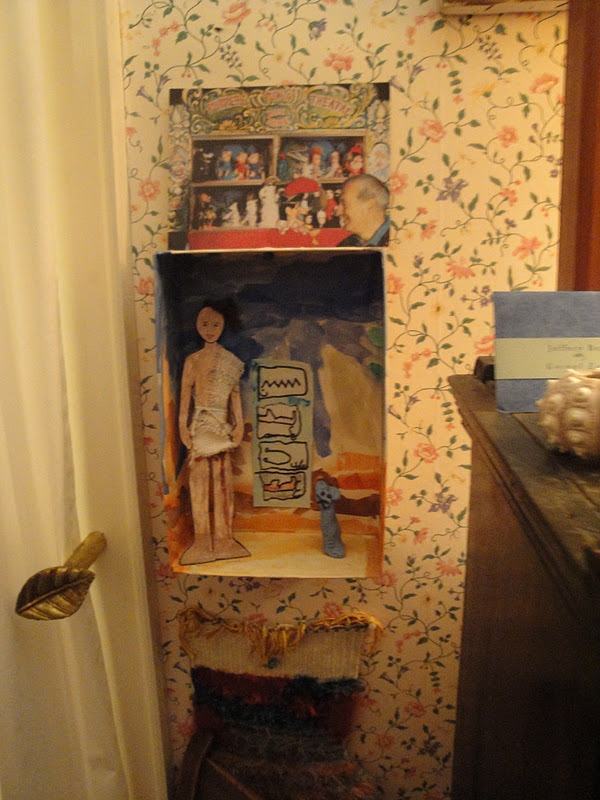
My writing room.
Weaving by my daughter when small;
Egyptian diorama by child no. 3;
Welsh postcard;
tiny poetry book by Jeffery Beam.
INFANT STEPS

IAM-Otsego takes another little step: my new group blog. (I'm neglecting The Lydian Stones at the moment because: a. I am busy; b. nobody has sent anything new, and I haven't bugged any of the people in queue. And people need to be bugged for such things!)

BOOKS IN TRANSIT

Reminder: books shipped three or four days ago from the Georgia warehouse to indies and online stores. If you are an Amazon or bn.com buyer and want a copy of A Death at the White Camellia Orphanage, know that the pre-order deep-discount will go POOF! very soon.

APORIA, HIATUS, ETC.

I'm very sorry, but I am now too swamped to read manuscripts, read ARCs and do blurbs, etc. Temporarily saying a big fat "NO!" to all such things. I have now finished all but one of those sorts of obligations and shall not take on any more for some time. Update: As soon as one posts something like this, a request immediately arrives! Apologies to T. Aaron Payton, and good luck to him on his first book, The Constantine Affliction, a steampunk adventure forthcoming from Night Shade Books.

READING

Finished Mundome while folding a mountain range of laundry. The book strikes me as having been an excellent start for A. G. Mojtabai. Clever handling of point of view. I'm going to have to read some more by her and see how she progressed.

INTERVIEWS

A full-length interview for A Death at the White Camellia Orphanage will be up Thursday-Friday, so please come back tomorrow.