Jeffery Beam, reading and singing--listen up, world! In our culture, poets tend to be invisible, but here's a good look at Jeffery. Links below.
"This [3-part] reading offers a range of poetry, songs, and reflections from Jeffery Beam’s career – from the age of 17 to the present – as well as poems and songs from others, to illuminate his life-long conversation with the Divine in Nature. A troubadour poet, he is the author of over 20 works of poetry and sung poems in books and CDs, and is a photographer, editor, and critic. The reading was part of the Faith and the Arts series at St Matthews Episcopal Church, Hillsborough, North Carolina. Recorded October 18, 2015."
Four recent books by Beam at Lady Word of Mouth: http://ladywordofmouth.blogspot.com/…/four-recent-books-by- Jeffery's website at UNC: http://www.unc.edu/~jeffbeam/ More poems by Jeffery, picked by former NC poet laureate, Kathryn Stripling Byer of Cullowhee, here: http://ncpoetlaureate.blogspot.com/…/poet-of-week-jeffery-b
Showing posts with label poet. Show all posts
Showing posts with label poet. Show all posts
Friday, April 15, 2016
Thursday, April 14, 2016
Elder artists, 3: Yeats
 |
| Poetry Ireland |
Maurice Harmon, "Old Age and Creativity"
Poetry Ireland May/June 2012
The question is what happens when the poet reaches old age. Does he discover new subject matter and different techniques? There are no simple answers. Very often the subjects that preoccupied him in the past still interest him although he may approach them from a different angle and in a different tone. W B Yeats made growing old itself an issue. He did not like it, hated the loss of physical strength and the waning of sexual energy. In ‘Sailing to Byzantium’ he declared, ‘An aged man is but a paltry thing’ unless ‘Soul clap its hands and sing’, unless he can counter physical decline with imaginative intensity. He proceeds to make conflict central to his later work, dramatising and imagining the contrast between youth and age, past and present, stability and change. In the process his style changed from the ringing declarations of ‘Sailing to Byzantium’ to the compressed power of ‘Leda and the Swan’ to ballad forms in Last Poems. He was that kind of poet, constantly remaking himself and becoming remarkably vigorous in old age. In these years he also extended his intellectual range, placing his sense of personal loss within the contexts of civilisations rising and falling.
***
The wonderful Louise Bogan on Yeats,
The Atlantic 1938
 |
| Muse and poet |
...
Yeats's faith in the development of his own powers has never failed. He wrote, in 1923, after receiving from the King of Sweden the medal symbolizing the Nobel Prize:—
It shows a young man listening to a Muse, who stands young and beautiful with a great lyre in her hand, and I think as I examine it, "I was good-looking once like that young man, but my unpractised verse was full of infirmity, my Muse old as it were, and now I am old and rheumatic and nothing to look at, but my Muse is young." I am even persuaded that she is like those Angels in Swedenborg's vision, and moves perpetually "towards the dayspring of her youth."
***
Monkey postscript
Despite the proliferation of testicular tales, no "monkey glands" were involved in Yeats's self-renewal. He did have a vasectomy, an enactment of what Susan Johnston Graf called "sexual magic," evidently a belief that the "vital energy of procreation would be channeled into imaginary, literary, and visionary work" (W. B. Yeats: Twentieth-Century Magus, p. 203)
Graf suggests that, as Kathleen Raine--a follower of Yeats and Blake, and a poet worth reading--pointed out, the operation (and other sometimes-embarrassing-to-scholars facts like an interest in the occult) may have been one element that allowed a new flowering. His belief in its efficacy, that is, may have contributed to his powers in his late writing. If you really (really, now!) want to know more, you can google "Yeats" and "Steinach operation" to find out heaps more. Richard Ellmann and others have attempted to put the wilder stories to bed, so to speak, but it seems the rumors are a bit too lively to suppress.
Friday, April 08, 2016
A Throne in April

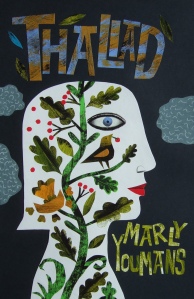
April is poetry month: I've already posted about special April sales for The Foliate Head (Stanza Press, and now the second printing is out of print) and Thaliad (Phoenicia Publishing), and thought that I should add a post for The Throne of Psyche, still in print in both hardcover and paperback from Mercer University Press. Both versions are handsome books; the hardcover won an Abby design award for Mary-Frances Glover Burt and the company of Burt and Burt. The cover image on both hardcover and paperback is by Clive Hicks-Jenkins.
At various times I've posted copies of poems, and so here's a little batch of samples from the book. The collection runs to more than a hundred pages, so this is just a snip:
originally published in Mezzo Cammin,
from the title poem
*
A Fire in Ice (riposte to Billy Collins)
originally published in The Raintown Review
*
originally published in storySouth
*
originally in Mezzo Cammin
originally in The HyperTexts
*
originally in Mezzo Cammin
*
Tears of a Boy, Age Six
originally in Books and Culture
A Child at the Tropic Pavilions
originally in Mythic Passages
In Extremis
originally in storySouth
Tuesday, April 05, 2016
Phoenicia, April sale, and Elizabeth Adams
 |
| Bookplates by Elizabeth Adams |
All the full-length books are on sale, including Annunciation and How Many Roads?Beth Adams is a stellar publisher with many talents, including wonderful design work, a thing often missing in new books. She works hard, and I'm hoping that word of mouth is kind to her press--if you're an admirer of Phoenicia, why not write some Amazon reviews, post about the press (feel free to copy anything in this post) and its books, or simply tell people you know? And of course, the purchase of a book sends a message to the publisher that says you support the kind of work she is doing and hope she will keep adding to the sum of what's worth cherishing in the world. Being a small-scale publisher is not easy, and I am glad that Beth continues to make beautiful books.
Bookplates and prints are also for sale in the new Store on the website. Hope you'll take a look.
You know, I feel so fortunate to be able to work with the authors and artists whose work we have published. I wish I could bring out more books each year but it's just too difficult - this is basically a one person operation, with some generous help in certain areas from my partner, and it's time-consuming and costly, while being extremely rewarding from all other points of view. I know a lot of you have supported this endeavor over the years and this is a chance to say, again, thank you - both from me and from the authors themselves.
I love what Dave Bonta wrote on Facebook when he shared the announcement: "These are all good. Some are down-right great. (I know because I have read all of them.)" That's about the most straight-forward recommendation I can imagine!
The new Phoenicia store has the book plates above, as well as some lovely prints from the Annunciation anthology. Take a look!

Why not sign up for the newsletter?
*
And see the complete catalogue of books and music here.
 |
| April sale. Books shown are the Annunciation anthology, poetry by Rachel Barenblat, Claudia Serea, Luisa Igloria, Magda Kapa, and me, and Jonathan Sa'adah's photographs from the 60's and early 70's. |

 |
| You may also visit Studio Cassandra at Etsy to find Beth's watercolors, prints, pastels, and more. |
Saturday, April 02, 2016
Wishing for Randall Jarrell

Here's a comment from Suzanne Ferguson that shows how critical Jarrell was about the trajectory of cultural change. (Elsewhere, he lamented, "The climate of our culture is changing. Under these new rains, new suns, small things grow great, and what was great grows small; whole species disappear and are replaced."*)
The magnitude of what had been lost in American culture reaffirmed for Jarrell "the final, important, intense value" of art, of poetry for making sense of that loss. Paradoxically, his depression about the political climate, the devaluation of art in a consumer culture, and the plight of undereducated, oversocialized*** children created a need for him to write the tales, the now-classic children's books, and the late poetry in which he gives voice to the extraordinary feelings of ordinary people trying to transform their lives that are "commonplace and solitary." More and more it is the strength of this last creative work, after a struggle with what he saw as "ominous" changes in "the climate of our culture" (Sad Heart 86)*, that makes Jarrell a central figure in mid-century letters, one who cannot be relegated to the margins, where off "in a bright spot somewhere in the corner / Is the small radioactive planet men called Earth" (CP 333).* --from Jarrell, Bishop, Lowell, and Co: Middle-generation Poets in Context*A Sad Heart at the Supermarket.
**The Complete Poems
***Somewhere he complains about American children being raised on applause, rather like current complains of an "everybody gets a prize" sort of schooling.
There's a grand bouquet of flowers to chose from when we think about American poets. But who is the most important critic in the states? It might be Eliot, though he left us. Or Auden, who is ours and not ours. But it just might be Randall Jarrell. I hope we grow some more poet-writer-critics of his kind.
The soul has no assignments, neither cooks
Nor referees: it wastes its time. It wastes its time.
Here in this enclave there are centuries
For you to waste: the short and narrow stream
Of life meanders into a thousand valleys
Of all that was, or might have been, or is to be.
The books, just leafed through, whisper endlessly.
--from "A Girl in a Library"
Friday, February 26, 2016
Dear Wikipedia,
 I notice that you have decided that I am a New Formalist. You may like to know that, in fact, I did not know the term until a few years ago, about the time Kim Bridgford invited me to be on a panel and later to run a panel at the West Chester Poetry Conference. Even now, I am not entirely sure what New Formalism is, other that a list of those poets who are willing to write in meter and sometimes rhyme. I occasionally go by Eratosphere to see what some of those people are doing and who has a new book. Somehow I don't think that's enough to make me a member of a literary movement.
 And I would not dare to claim a part in any movement, as I completely failed in my duty to live in large cities and know poets. In fact, I lived for a very long time without knowing many poets--I seemed to know mostly fiction writers and painters. Now I know more, thanks to twitter and Facebook and such places, but I can't say that I have restricted my knowledge to writers who like meter and rhyme.
But how can I be part of a thing I can't even define? Perhaps I should go read a definition. Perhaps I should worry about how I've never been to a New Formalist salon. Have I missed a great many good parties? Perhaps I should go read a manifesto. Is there, in fact, a manifesto? Or perhaps a badge? A pin? Send word!
Good cheer,
Marly
* * *
My favorite-via-email response from a poet and writer: "My sense is that Dana Gioia and the others in the late ‘80s and early ‘90s who deliberately pushed to repopularize form are the real “New Formalists.” (Wasn’t there a journal by that name? They even had a nice anthology called, I believe, Rebel Angels.) Now that they’ve all done their thing and taken the heat for it, for which I am very grateful, we should all just be “poets” and leave it at that, methinks. Besides, I reserve the right to go bonkers in free verse whenever I please." -J.
Wednesday, January 20, 2016
You Asked, no. 4. With bells on.
 |
| A flowering head--what every writer desires. Art by Clive Hicks-Jenkins, division page for Maze of Blood. |
And what did you do?
Yesterday I was reading the late (the newly late) Michel Tournier (for a commissioned article), interspersed with poems by Robert Walser and Rubén Darío. I ended up writing a poem about Walser and another about a fountain in Chile dedicated to Rubén Darío. The rest of the day I spent trying not to scratch my eyelids and seeing that child no. 3 was packed for college.
So skip it, it's just marketing--
really good marketing--
Marly Youmans continues to put out superb novels. Early in 2015 I read her excellent Glimmerglass, a book about life and inspiration. Very late in 2015 I read her latest, Maze of Blood, which is naturally getting good reviews and you should buy two copies, give away one and read the other. -novelist Scott G. F. Bailey at the wonderful Six Words for a Hat
You asked series.
I'll continue the topic requests later, I expect. Right now I am feeling rebellious and itchy. Also sad about the arts death-sluice that is this January. Another unexpected loss today. April is no longer the cruelest month. In the meantime, here's a little poem by Luisa--oh, never mind. As usual I have put a book down somewhere and can't find it! How about a little Robert Walser instead?
Never mind about continuing later.
Because I feel a You Asked coming on. Midori Snyder asked for writing about poetry, and here is some. I feel pretty sure it's going to be highly wayward, though.
TADA! You asked, no. 4.
 |
| They should have used Malevich's White on White. |
Well, maybe we're not quite here yet. We'll get to the poem eventually. It's our goal. We're going on a walk. With goal.
Walser in a white field. There's Modernism for you, Robert Walser having terrible or mildly terrible (we can't sustain the terrible forever, and really he prefers the mildly terrible) thoughts and denying himself, being a detached flâneur and going on white sanatorium walks (less a walk than a stroll, without the incidental pleasures of a stroll) into snow and then dying with his eyes wide in a white field.
He might as well be a barely visible white on white (or white on what, as auto-correct would have it) square in a Malevich painting! All hail the Suprematist Manifesto and Suprematist Malevichian Utterings: "Art no longer cares to serve the state and religion, it no longer wishes to illustrate the history of manners, it wants to have nothing further to do with the object, as such, and believes that it can exist, in and for itself, without 'things' (that is, the 'time-tested well-spring of life')" It's all mal, and life's a bitch, Malevich!
Hey. Give me the well-springs of life! All of them. Give me marvelous things.
It's all so very meta, the self-abolishing, self-obliterating artist Robert Walser with the incredibly tiny, almost-disappearing handwriting vanishing into a white field like a sheet of blank paper. (Himself a slight mark on that paper, to be carried away, erased.) And that's an image from his first book! (And also rather like, kindred to this poem, our goal.)
I must be terribly obstinate because twice in the past three days I've written poems in response to Walser's poems, and in both cases I am busy refusing, refusing, refusing him and being of pretty good cheer. Of course, I like him. I do tend to like people. And so I was quite nice to him in both poems... even tried to get him to come inside out of the cold, into the warm, buttery light.
Perhaps it's because I tromped along in my own self-obliterating field of youth, long ago, but I always have the impulse to tickle Robert Walser unmercifully, to insist on going along on his random walks, to force him into peculiar or lovely destinations. I would have annoyed him by bundling up (deliberately picking out bright colors) and chasing after him, snowball in hand. Whump! I would have brought children along, and they would have pelted him with more snow and insisted that he make snow mermaids and castles and forts for battles. We would have dragged him outoutout of his white square backdrop. We would have made him scribble letters in the snow, ten feet high. We would have dressed him in a thousand zany scarves, knit by long-haired women and containing strands of their hair.
Do You See?Yes, I see. "Stiff and dead." It snowed, and Robert Walser lay flopped in the field with his eyes flung open, staring at a white, socked-in sky. Something should have saved him from his bleak, threatening age, and from the final sanatorium where he went to be mad but didn't seem it. But nothing did save him.
You do see me crossing the meadow
stiff and dead from the mist?
I long for that home,
that home I've never had,
and without any hope
that I'll ever be able to reach it.
For such a home, never touched,
I carry that longing that will
never die, like that meadow dies
stiff and dead from the mist.
You do see me crossing it, full of dread?
I like you, Robert Walser, but I am very glad that I crept out from under the giant monochrome monoliths of Modernism and Post-modernism and Post-post and infinitely on through refracting fun-house mirrors. It's pleasant out here in all this freedom, and there are shouts and outrageous, manic rhymes and walks with funny and gorgeous and moving goals! All the same, I'm going to read your The Walk very soon.
I don't know German, so I should ask Scott Bailey if the translations by Daniele Pantano are much like the original. They look, soundwise, somewhat simplified. But perhaps that's in part an illusion, made out of my ignorance. Certainly he's not interested in duplicating his rhyme schemes, when Walser works in rhyme.
And that's the end of You Asked, no 4. More anon, no doubt.
Epilogue
Today I shall notnotnot scratch my eyelids, and I shall clean a bit of house, walk on the treadmill in avoidance of hideous weather, and work on The Book of the Red King. I'm getting there. It's just so huge! Five years since I wrote most of the poems in a great rush, and I'm still not done tinkering and arranging and downright fussing.

Saturday, May 31, 2014
Poems at Mezzo Cammin

Take a look at the new issue--lots of familiar and not-so-familiar names in the realm of women-who-write-formal-poems. Also, please look at the just-prior and brand new post about "The Magician's Card," an essay written for Fujimura Institute.

Thursday, April 10, 2014
Phillips at Lady Word of Mouth

And the great poetry giveaway is here.


Sunday, July 14, 2013
A gift outright--
I hope to never again write a post like this one. But every time a friend of mine has quit writing in drought and despair, I have written one.
Too long a sacrifice
Makes a stone of the heart.
-Yeats
A light rain is blowing past the window, and I can hear the Grateful Dead, playing in Doubleday Field. I'm thinking about a friend of mine, far away, who is a poet. He has had a long journey, holding fast to the arranging of words, but now he has changed.
He has fallen into silence.
Why? He feels the lack of the strong support that readers give to the poet, the sense that there is someone out there and that the poem is not a tree falling in a dead forest. He feels an ebbing of the support that bookstores give--the knowledge that the poet is welcome to read in his home region. Even with all the wonders of the internet, he feels too solitary. (I should add that poets can use another kind of support; that is, their publishers need the encouragement of book purchases saying that others find the poet worthwhile. Without that encouragement, a poet may soon go unpublished no matter how much the publisher loves the work.)
Here's a piece of a letter from my friend. He has published many, many books and chapbooks of poems, but here is what he says:
Surely there is still a place for face-to-face encounters with a mature poet who has achieved and published widely, particularly in his home region. Surely there is still a place on our shelves for the book. Part of making the world we want to see and cherishing the best of what already exists is supporting the work.
I'm going to order some books of poems. In the words of another poet, "I shan't be gone long.--You come too."
Too long a sacrifice
Makes a stone of the heart.
-Yeats
A light rain is blowing past the window, and I can hear the Grateful Dead, playing in Doubleday Field. I'm thinking about a friend of mine, far away, who is a poet. He has had a long journey, holding fast to the arranging of words, but now he has changed.
He has fallen into silence.
Why? He feels the lack of the strong support that readers give to the poet, the sense that there is someone out there and that the poem is not a tree falling in a dead forest. He feels an ebbing of the support that bookstores give--the knowledge that the poet is welcome to read in his home region. Even with all the wonders of the internet, he feels too solitary. (I should add that poets can use another kind of support; that is, their publishers need the encouragement of book purchases saying that others find the poet worthwhile. Without that encouragement, a poet may soon go unpublished no matter how much the publisher loves the work.)
Here's a piece of a letter from my friend. He has published many, many books and chapbooks of poems, but here is what he says:
If I were really rich I’d just buy thousands and give’m away [. . . .] I know it’s a rough business now, but I remember those glory early days of the independent bookstore and their championing of local authors, poetry, and the small press. Not any more.
It really is one reason I haven’t been able to write since retirement. It seems so fruitless. Hardly any way to reach an audience – and though one would like to think the glory is in the doing (I can remember my youth when I wrote endlessly and didn’t care) but you do want to feel like someone is listening, can listen, has access to listen and ultimately after 50 years it has deadened me.This poet has been published in book and CD and on the internet, and his words have been lauded and set to music; he has had the affection of many publishers. He is at an age when he ought to be honored and welcome in his home region, often invited to read. Yet he is discouraged, "deadened."
Surely there is still a place for face-to-face encounters with a mature poet who has achieved and published widely, particularly in his home region. Surely there is still a place on our shelves for the book. Part of making the world we want to see and cherishing the best of what already exists is supporting the work.
I'm going to order some books of poems. In the words of another poet, "I shan't be gone long.--You come too."
Thursday, May 30, 2013
Morning after storm--
 |
| Wendy Chidester is one of the artists discussed in the Spring 2013 issue of American Arts Quarterly. Her paintings of out- of-date machinery are like "relics ... the wonder-working bones of saints" (p. 42.) Liquid Fuel Iron, oil on canvas, 24 x 26. I like this labor-saving relic of the past, and can't help personifying the lady iron and her little caboose- and-papoose child. Looks a bit dangerous to use, doesn't it? |
The mail arrived, and I have a poem (along with Amit Majmudar, Kevin Durkin, and Robert Levy) from The Book of the Red King manuscript in American Arts Quarterly (Spring 2013.) It's a poem about the Fool, and about creation, called "Wild to Make." What a handsome little magazine... The poem will eventually appear on the accompanying website.
Saturday, March 23, 2013
Lux aeterna: Paul Stevens
 Alas, there is need for a second post today--alas, for it too is about a death. Poet and culture-maker and lovely man Paul Stevens died this morning in Australia, with all his family about him. Thanks to poet Janet Alexa Kenny for letting his many fans and friends know. I'm thinking of the close of his poem about Tasmania: "At last to sail free / Between southern capes / Thick with kelp and wild foam, / With wave awash, surging, / Late sun on the headland, / And shadow down valley / Past all memory."
 |
| The Flea. Cover image by Mark Bulwinkle. |
Many of us are grateful to his work in founding magazines of formal poetry. The Shit Creek Review. Chimaera. The Flea. I tend to think the marvelous Flea his crowning glory as a magazine founder, as it is so very different from all other poetry magazines and so interesting in its relation to literary history--binding his love of Renaissance and metaphysical poetry to his love for his contemporaries. Artist Makoto Fujimura has talked about "caring for our culture." Paul Stevens was an example, a caretaker of culture.
Pax tecum, Paul Stevens, father and teacher, maker of poems and marvelous 'zines. I wish that I had known you sooner; I am glad that I knew you in the marvelous aether of the internet, where minds brush against one another despite all distance in space. Even now your words and your poetry 'zines touch us, although we are severed from you in time.
The Relics
Archaeologists in Italy have unearthed two skeletons
thought to be 5,000 to 6,000 years old, locked in an embrace.
Their sex has not yet been determined. (BBC)
Mother to daughter, softly touching, is it?
Sister to sister's delicate embrace?
Friend to friend, companions past corruption?
Brother to brother, face to well-loved face?
The wheat crop rippled in the heat, the cattle
Grazed sweet grass, milk splashed in bowls of clay;
All fell to dust; from dust these rise, recovered
As brush and trowel lift slow time away.
Lover to lover, holding all that's dear,
They gaze into each other's eyes, long blind,
Stripped back to bony gesture: stubborn relics,
So much of earth, so much of human kind.
Originally published in Poemeleon, reprinted in The Hypertexts
Friday, January 25, 2013
There is no other village
 |
| One of the vignettes from Thaliad, by Welsh artist Clive Hicks-Jenkins. My Thaliad page. Phoenicia Publishing Thaliad page. |
This excerpt from Thaliad has already been shared in several places, so if you're a regular visitor to my little cluster of huts by the internet stream, you may have seen it. What's the news of Thaliad? Lady Word of Mouth appears to be working slowly and yet steadily on such an unusual item as a 21st-century adventure in verse . . .
Now and then in writing, I was aware of drawing on some prior work. There's one long passage where I felt Anglo-Saxon rhythms and ways of describing, for example. But in this one I felt the presence of Cavafy, and the close of this chapter is indebted to him. Writers are always indebted to those the masters they love who did the work, and occasionally that indebtedness is strong enough to notice and acknowledge.
from XXI, (Samuel and Thalia, after tragic events):
Then Samuel in sorrow vowed to her
Now I will leave and find another place,
A village where my heart is not in earth,
And Thalia replied to him with truth:
There is no other village, is no place
To find where your dead heart is not in earth.
And still he moaned his lot, exclaimed with tears,
I want to go where ground is not a waste,
And where my life is not a ruined town.
And Thalia with mercy answered him:
In time you will begin to heal your heart
And all that seems a waste will bloom once more.
But he went on in anger, blaming God,
The strangers who had maundered into town,
The grave that meant a stone around his neck,
Until she spoke in haste against his words:
For you there is only this blood-drenched ground,
The murdered life that is your freight of guilt,
Also the murdered life that is your own,
The world that you create by how you act
Or see or how you dream the world to be,
Your world that’s ruined everywhere like this,
Which you yourself have caused to be a waste,
Which you yourself have scorched with inner fire.
Saturday, October 13, 2012
Ashley Norwood Cooper & Alicia Stallings
In the middle of an unusually busy Saturday, I took a break to see poet and recent MacArthur Award winner Alicia Stallings, who stopped to see Ashley Norwood Cooper on her way to Ithaca College. Alicia is a fine poet, and Ashley is a fine painter. It was a lovely visit, which I memorialize here:
You can learn more about Ashley and her paintings here, and you may learn more about Alicia and her poems here.
 |
| Ashley Norwood Cooper (L) and Alicia Stallings |
Friday, March 02, 2012
The Open Secret Society of the Poets
As James Thomson is best known as the author of the poem, "The City of Dreadful Night," he surprises me with his essay, "Open Secret Societies," with its praise for heroes, poets, and saints. The last quarter of his life must have been terribly depressive, as he was insomniac and increasingly isolated by alcoholism and melancholy. But he was youthful when the essay was written, and evidently he and life together had yet to make him the most despairing of the Victorians.
 |
| The Floating Press, Ltd. ebook edition |
There is the Open Secret Society of the Poets. These are they who feel that the universe is one mighty harmony of beauty and joy; and who are continually listening to the rhythms and cadences of the eternal music whose orchestra comprises all things from the shells to the stars; all beings from the worm to man, all sounds from the voice of the little bird to the voice of the great ocean; and who are able partially to reproduce these rhythms and cadences in the language of men. In all these imitative songs of theirs is a latent undertone, in which the whole infinite harmony of the whole lies furled; and the fine ears catch this undertone, and convey it to the soul, wherein the furled music unfurls to its primordial infinity, expanding with rapturous pulses and agitating with awful thunders this soul which has been skull-bound, so that it is dissolved and borne away beyond consciousness, and becomes as a living wave in a shoreless ocean. If, however these their poems be read silently in books, instead of being heard chanted by the human voice, then for the eye which has vision an underlight stirs, and quickens among the letters which grow translucent and throb with light; and this mysterious splendour entering by the eyes into the soul fills it with spheric illumination, and like the mysterious music swells to infinity, consuming with quick fire all the bonds and dungeon-walls of the soul, dazing it out of consciousness and dissolving it in a shoreless ocean of light.
--James Thomson (1834-82), aka Bysshe Vanolis, aka James Thomson (B. V.)
Wednesday, February 29, 2012
A Gold Addy for The Throne of Psyche
 |
| A Gold Addy for The Throne of Psyche |
Update from the Mercer website: The Throne of Psyche: Poems by Marly Youmans was awarded a GOLD ADDY® for Book Cover Design in recognition of the highest level of creative excellence and was judged to be superior to all other entries in the competition. Mary–Frances Burt commented that “it is an honor to work for Mercer University Press and author Marly Youmans!”
Monday, February 27, 2012
Throne Sampler
Here are links to some of the poems from The Throne of Psyche that are on this site--probably I have posted some others, but these popped up easily. So here they are in one place, so you wander through them and have a sense of the book. At 109 pages, the book is rather long for a volume of poetry, so there's plenty left to discover.
As for ordering a book that has now been out some months, you probably will have to order it through your favorite indie or else order from an online site. Books don't stay in stock at brick-and-mortar stores for very long these days, especially poetry books. For comments, reviews, an interview, and more, go here.
About the Digby videos, with links
The Marriage Bed, from the title poem
and how to find more of the title poem
A Fire in Ice (riposte to Billy Collins)
Southern to the Bone
Here We Go Round
At Cullowhee
When Demons Ruled
Snow White in Wildwood
Three little poems for my three children:
Tears of a Boy, Age Six
A Child at the Tropic Pavilions
In Extremis
* * *
 Next book: A Death at the White Camellia Orphanage
(Mercer University Press, 2012)
Inaugural winner
of The Ferrol Sams Award for Fiction
 |
| Cover image: Clive Hicks-Jenkins Designed by Burt and Burt |
As for ordering a book that has now been out some months, you probably will have to order it through your favorite indie or else order from an online site. Books don't stay in stock at brick-and-mortar stores for very long these days, especially poetry books. For comments, reviews, an interview, and more, go here.
About the Digby videos, with links
The Marriage Bed, from the title poem
and how to find more of the title poem
A Fire in Ice (riposte to Billy Collins)
Southern to the Bone
Here We Go Round
At Cullowhee
When Demons Ruled
Snow White in Wildwood
Three little poems for my three children:
Tears of a Boy, Age Six
A Child at the Tropic Pavilions
In Extremis
* * *
 Next book: A Death at the White Camellia Orphanage
(Mercer University Press, 2012)
Inaugural winner
of The Ferrol Sams Award for Fiction
Sunday, February 26, 2012
Sampling Dale Favier's "Opening the World"
 |
| The cover features an oil-on-panel by Robin Weiss. |
Unlike many people he looks at the world from a particular angle; he has a stance and point of view. It's not mine, so I enjoy peering through his eyes--as, here:
DISTANCE
Full moon tonight,
pouring through seaglass.
Distance, some say,
is the garden of illusion;
but philosophers of sight
used to fret about why, if you press
an object to your eye,
you cannot see it. Some distance,
they concluded, is required.
Oh, don't cry, don't cry, dear.
The blundering stops
and so do we.
When the rattle of the world
fades away, and the stars
vanish into light, we will be
droplets on a high webstrand
spun between two branches.
And here I especially like the dream muddle of rain with snow, snow and blossom, rain and tears, sky and eyes--and the music of the thing:
THE RAIN YOU SENT
Darling,
the rain you sent was mixed with snow.
I could not tell which between
the snowflakes and the apple blossom
on the black sidewalk; I woke and you were
weeping on my chest. Your hair
and the snow and the apple blossom,
I could not tell which between
the sky and your eyes;
I dreamed that you were here.
I could not tell which between
the dream and the sky, the tears and your hair,
the sidewalk and the waking.
Darling,
the rain you sent was mixed with snow.
Now I think we need a poem to go with that snazzy-looking cover with birds. Here's Dale grabbing Crow as a subject. Watch out, Ted Hughes! I especially like the demented pigeon, the crow-motion, Crow's philosophy, and the cowlick feathers. As in children's books about talking animals, we feel quite sure that we know these creatures as people, too.
CROW
Crow cocks his head for a swift, assessing look.
A quick grab and a prancing gallop
(skip to my Lou, skip to my Lou)
out of the traffic:
safe enough. He holds the captive burger bag
down with one foot and tears
with a strong black beak. Nothing.
Tears again, and again, till the bag is in tatters.
Nothing inside.
He's philosophical about it.
Some bags have stuff and some don't;
there's no way to know without ripping them up.
It's all in a crow's day's work. With a toss of his head
and a flirt of wings, he throws it aside, and the wind
takes it into the street again.
He takes time out to jeer at a pigeon
on general principles. His chest
swells up; he squints and bobs and he rasps
out the insults; it hurts your throat
just to look at it. Whatever you may think
of crows, they're willing to work. Anything
worth doing, says crows, is worth doing
forcibly.
Pigeon blinks and totters and starts and endless mutter
of excuses and extenuations. Crow's having none of it.
He takes to the air and pulls, wing-grip by wing-grip,
up to the telephone wires. Takes two deep breaths
and calls the pigeon some more choice names,
and then ignores it, majestically, while the pigeon
is still explaining that the thing is, it's not so,
I didn't mean, you can't just say, it's only, you know?
--whatever pigeon's say. Crow's on the lines,
swaying in the wind, above it all; the strong free air
ruffling his cowlicked feathers. It's good
to be alive.
Like these poems and want to help get the word out to readers? What can one do to help?
1. Tweet this post.
2. Do a tweet about the book.
3. Share via facebook--this post or your own--Google+, and such places.
4. Do a blog post. Or you may steal this post and re-post: be my guest.
5. Collar your friends and practice word of mouth.
6. Does your local library have a suggestion box? Drop one in!
7. Share the book on goodreads or similar sites.
And now I need to go read another of Dale's poems... You may find more of them at his blog, mole.
And now I need to go read another of Dale's poems... You may find more of them at his blog, mole.
Marly Youmans's novel now in pre-order is A Death at the White Camellia Orphanage. Her 2011 book of poems is The Throne of Psyche.
Saturday, February 25, 2012
"Beauty, Outlaw of the Arts"
 I, Ferrywoman, battled snow devils and bursts of snow to rescue child no. 3 from camp near Greenwich; when I arrived, my incredibly skinny boy of 14 was perched on the very heights of the ridiculous, sporting a plush bathrobe over his jeans and large pink and white rabbit ears worn over an orange Cooperstown High School knit cap. Evidently there had been an Easter egg hunt in the snow, and he had worn the ears ever since.
 On the way, I whipped into Old Saratoga Books in Schuylerville and grabbed a few--one for the boy, and three for me--Reynolds Price's The Collected Poems (you know you're gone when they collect you), a marvelous-looking book called Leaves in Myth, Magic, and Medicine (the first book by Beaufort's Alice Thoms Vitale, then 86), and a quirky choice of something called The Poetry Circus, a 1967 attack on modernist poetry that aroused my curiosity. How could I resist chapters called "The Plodding Muse," "Beauty, Outlaw of the Arts," "The Music of the Buzz Saw," "How to Write a Modernist Poem," "Strutters, Swaggerers, and Gesticulators," etc.? As he was born in 1896 but was opposed to almost everything Modernism stood for, I am intrigued to see what such a man had to say--while I've read plenty of Modernist work of all sorts, I don't think I've ever read anything substantial from an opponent.
And here I had never heard of him, a pretty big fish in the great sea of words: a man clearly active in the culture wars and productive in three genres. It gives one pause.
* * *
Stanton Coblentz, from the introduction to The Poetry Circus:
 All through my life, poetry has been for me a joy and a wonder, a pilot and an inspiration. Ever since the days of lonely adolescence, when it provided consolations and companionship, it has enriched my world with treasures beyond reckoning. But the poetry that has called to me has been a poetry of singing and ringing lines, of skylarks and a wild west wind, of lovers and midnight trysts, of mountains and stars and the towers of Camelot. It has been a poetry of all the dreams, the hopes and aspirations that make up life, all life's delights and sorrows, its searches and achievements and despairs, and its passionate reaching toward other worlds. Most of all, it has been a poetry of nobility and music, which has made life seem more meaningful and has given glimpses of universes beyond the senses and of truths beyond logic.
* * *
It would be very interesting to compare the Coblentz book of 1967 with Tom Disch's The Castle of Indolence of 1994. They have a related stance, and each writer can be quite amusing--then, too, they have so much in common, each writing poetry and science fiction and nonfiction. I notice that they use some of the same tactics--for example, turning poems into blocks of texts and examining them for any qualities in the prose that might differentiate it from prose. However, the examples Coblentz uses are drawn from the major Modernists, so that Pound, Moore, Cummings, Eliot, etc. are examined.
* * *
Marly Youmans's novel now in pre-order is A Death at the White Camellia Orphanage. Her 2011 book of poems is The Throne of Psyche.
Wednesday, February 15, 2012
Folded poems
 |
| A cheerful display of the books from www.origamipoems.com |
One likeable thing about the web is the way it gives rise to new forms--my pen-friend Corey Mesler has just been published in an origami book, and you may have a copy at the price of a sheet of paper and a little ink. Here is the book, with a cover by Corey's teenage daughter Chloe. And here you may follow visual and verbal instructions on how to fold your sheet of paper, making a single cut and ending up with a small workable book. Afterward, you may read about the industrious and much-published author and bookstore owner here. A complete index of poets and places where the origami books are displayed is also available.
Subscribe to:
Posts (Atom)