 |
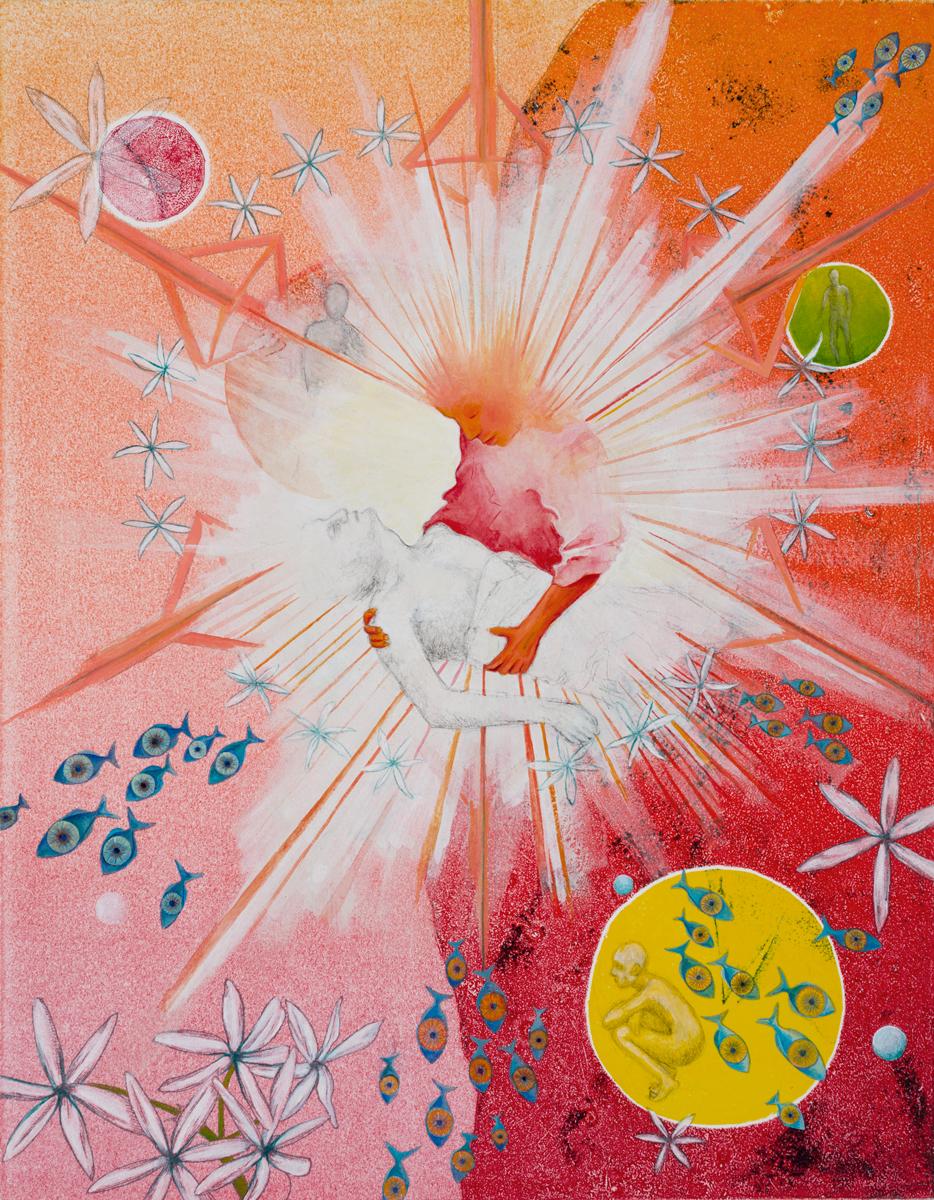
| Art by Kim Vanderheiden. Here is just one of twelve works made by artist Kim Vanderheiden in response to a single poem from The Book of the Red King. Am I astonished? Yes, I am astonished. Where possible, readings will be accompanied by images of art-in-response by Kim, Clive Hicks-Jenkins (my longtime book-illuminator), and Mary Boxley Bullington. What a deeply touching thing to have serious artists surprise me with wonderful pictures before the book even appears from Phoenicia Publishing of Montreal, under the guidance of Elizabeth Adams, publisher of beautiful books. What a marvelous and joyful and entirely unexpected gift. The Red King approaches. The Fool is singing on his journey. And Precious Wentletrap is wandering the moon path. Pub date comes near! TBA |
Showing posts with label Mary Boxley Bullington. Show all posts
Showing posts with label Mary Boxley Bullington. Show all posts
Wednesday, May 22, 2019
The lure of the Red King


Monday, July 04, 2016
The Fourth of July
 |
| Mary Boxley Bullington, "Independence Day," Ink, acrylic, gouache, gesso on museum rag board. |
If we falter and lose our freedoms, it will be because we destroyed ourselves.
--Abraham Lincoln
Neither James Madison...nor any of the other Framers of the Constitution,
were oblivious, careless, or otherwise unaware of the words
they chose for the document and its Bill of Rights.
were oblivious, careless, or otherwise unaware of the words
they chose for the document and its Bill of Rights.
--Hon. Diane Wood
A wise and glad and free 4th of July to us all.
What happened to the signers of The Declaration of Independence?
What happened to the signers of The Declaration of Independence?
Thursday, March 10, 2016
Traveling the Red King's lands
 |
| Graham Ward, "Child in Tarifa" This "starved-brush" painting is one that inspired one of my poems in the Red King manuscript, "The Stellar Child." Generation works both ways! I've also written some poems for Graham to use in a future gallery show. |
One of the curious things about this manuscript is that thirteen prints and paintings have been made in response to its poems, even though it is not yet out as a book--not even submitted. One of them is by Mary Bullington, and I've posted it several times before. Some came from a poem that has never ben submitted anywhere, written for a friend, who sent it into the aether. Eventually it landed in an artist's inbox and became a seed. What a surprise! I've always thought that a work should, in the ideal, be generative. So this makes me feel pleased.
Quite a number of poems about the Red King and the Fool (and Amara the alchemist and many others) are online, but if you would like to see a group of them at once, you may find some at Mezzo Cammin and at At Length. Of course, I have fiddled with them since....
Monday, March 07, 2016
You Asked, no. 15: collage strategies of Mary Bullington
 |
| Flaunting my petticoats: The Red Tyger glued on a monoprint of the same collage (2012). |
Please click to see larger images. Note that some pictures are not embedded but at the foot of the post--all pictures mentioned are in the post. To see more of the Bullington-Youmans interview party, click on the appropriate tag at post's foot. To see more of You Asked, do likewise.
Youmans: As a collagist, you're a follower of a wandering muse, and you often completely revise a collage multiple times before you are satisfied. A visit to your two studio rooms shows that you have a bewildering variety of painted scraps and pieces in baskets and even littering the floor--small catalysts for the imagination. Clearly you often cut up and paint many times before you are finished with a piece. Ignoring for a time the realm of instinct and muse-ravishment, can you describe your methods in a systematic way?
 |
| Collage-plate (with drawing atop) from which collographs of Red Tyger were printed. |
For me, collage is a very versatile means of invention and of expression. Below are just some of the many approaches to the technique I've used—with images to go with them.
1. Overlap and Layering: Layers add dimension and texture to a 2-dimensional piece. In layering my collages, I consider what needs to be covered from the bottom layer, and what should still be visible. I like to let my petticoats show a bit.
The Red Tyger (2012) is a collage of figures cut from a drawing in India ink, acrylic and black gesso monoprint using an earlier version of this collage as a plate (technically, this is called a collograph). The blue-gray background of the collage is another collograph taken from the same plate. Thus the blue-grey shapes behind the collaged figures act as shadows. A new intensity and vibrancy in my layering of collages emerged in 2015: In my own Voice (Listen) adds one layer of collage over another, with layers of freshly painted pattern in between.
 |
| In My Own Voice (Listen) |
3. Sharp Contrasts in shape, color, value, texture, and pattern generate energy. Lady with Two Cats plays red against green, polka dots against batik-like patterns and near solids, and not least, the human creature against the cat. [See 8th picture at foot of post.]
 |
| detail, In My Own Voice (Listen) |
 |
| early draft, Antiquity |
 |
| Antiquity, 2014 |
7. Vision and Revision: Finally, collage is a very forgiving technique. It allows me to rethink and revise paintings and even collages that don't quite succeed. Though the number of choices it gives me can be confusing, collaging allows me to save the good, remove the bad, and rearrange the whole. Collage often reinspires a piece that is going nowhere. [See image 6 at foot.] In Tijuana 1953 (2011), I cut up and rearranged an abstract painting I'd spoiled, overlapping and reinventing the elements until they danced.
 |
| Flower Filigree as a painting on paper, uncut as yet, January 2015 |
 |
| Background for Flower Filigree, March 2015 |
 |
| Flower Filigree with background 1 "Background 1 had a palette too similar to the pierced painting Flower Filigree." |
 |
| Background 2 for Flower Filigree, March 21, 2015 |
 |
| "Pairing Flower Filigree with the 2nd background created visual excitement." |
 |
| Tijuana 1953, 24" x 24" "Overlapping the elements until they danced for me." |
 |
| Medallions "repeats yet varies circle & star at least 15 times each." |
 |
| Lady with Two Cats plays red against green and polka dots against patterns and solids. |
 |
| Leaves of Grass before cropping, with a couple of scraps of collage. |
 |
| Leaves of Grass, 2014 |
 |
| The Little Engine That Could, 2015 "In The Little Engine that Could, the last surprise, perhaps, was the big red bird shape." |

Wednesday, February 24, 2016
You Asked, no. 14: Spiring up from leaf litter: Mary Bullington and collage
 |
| Amid the rubble. All images via Mary Boxley Bullington. |
Youmans: I think of the floor of your collage studio as leaf litter--a compost composed of dropped fragments that is continually being stirred up and giving birth to something new. Can you talk about your materials and method, as well as your sense of having a call to be an artist?
Bullington: Years ago, my brother Andy, coming into a studio paved with my collage scraps, said, "You could make a whole series just using this stuff, and call it Floor Art." And I do! Here we go back into the idea of the materiality of my work, and how this affects the process of making it. But first, a definition: Collage = any work of art made primarily by cutting or tearing and adhering papers and/or textiles to a support, using the basic principles of design to create unity and surprise. (The word collage derives from the French word coller, to paste.) Collage is made out of 2-D material cut or torn, arranged, and pasted into place. It's a very forgiving technique in that you can cut out the bad and save the good, and also, a highly morphic way to work, because you're constantly moving bits and pieces around, sometimes completely changing appearances and structures as you do.
 |
| Lion collograph to make collage pieces. |
 |
| Lion early on, with human mask. |
 |
| Lion, approximately stage three, on olive ground. |
 |
| Lion's head |
 |
| Standing His Ground. 2011-2015 |
 |
| "Who Peynted the Lion?" |
And then, on top of all this, there's always the possibility—the probability, really—that the work will fail. An artist has to be willing to make some stuff that's seriously BAD—I mean, god-awful. Not on purpose, mind you. Again, my brother Andy, a full-time musician, says it as well as anyone: "You're never going to do anything really good unless you are willing to stink up the room--completely stink it up!" So sometimes you work up a rage, and then you work in a rage. Very few artists talk about this, but it's true. Other times you work in terror. When I find myself going out on a limb and getting scared, I will start talking to myself: "Do I have any idea what I'm doing? NO!!!" "Okay, then, let’s do it some more!" Sometimes things go bust—you ruin something good, and it's really not retrievable. The best you can do for now is shove it into a drawer for a month—or for a year or two or three. Or you have to cut out the part or parts that might be usable and pitch the rest. And off and on, if you are growing as an artist, your eye will change—your taste will change. I have several photo files labeled "Work Destroyed for No Good Reason." Almost every time I troll through my photo folders, I find new images to put in the "Destroyed" albums. Very discouraging. But you can't let it defeat you. After all, you chose this life, didn't you? You knew you were crazy, didn't you? But the truth is, Marly, on some level, we didn't choose this life—it chose us. But we did choose against common sense to listen to the inner call—and to obey it.
That obedience—and the discipline to work in its traces—is part of the ethic of art-making. When I look back on the last 20 years or so, I realize I became a visual artist basically on a hunch—a pretty good hunch, maybe, and obviously a better hunch than becoming a medievalist turned out to be. Or being a poet, for that matter. Because, as you said, Marly, in your answer to my question about the Artist-as-Fool in The Book of the Red King, the Fool—that is, the Artist--knows he's found his true home when "he becomes fruitful." For that, I found myself willing to step heedlessly off the cliff into thin air.
 |
| The mess on Mary's studio floor. |
Saturday, February 20, 2016
You Asked no. 13: Reading, affinities and animadversions
 |
| Berlin, 1932 Collage in progress Mary Boxley Bullington |
Bullington: Who are two or three of your favorite poets—the ones you return to over and over--and why? What do you look for in reading other poets? What gives you the most pleasure when you read or write poetry and what most annoys you? Why?
Youmans: Yeats. I have a love for Yeats that just won’t quit. This year I’m not dipping into him but reading him book by book, trying to get a better sense of the stages of his life in poetry. I admire the way he kept burgeoning and leafing out, and that he continued writing into age without becoming stale. He didn’t stay one thing; the young lyric poet of the Celtic Twilight is very different from late Yeats, though they have elements in common. And all this is true even though I don’t particularly care for some of his ideas, and even though I don’t always sympathize with his created mythology. Nevertheless, I like it that he has a mythology and framework and edifice of poetry, and that he mythologizes his own life and loves and concerns, placing it and them on a higher plane. I’m fond of his sense that what we see is not all that there is, and of his attempts to pierce various veils. Most of
 all, I like it that his poetry always wishes to approach song.
Shakespeare. How can I not pick him? He is so myriad in voice, so infinitely varied in what he undertakes. I don’t expect any more explanation is needed, even if he is a dead white male, jettisoned by hip English departments.
Lots of other poets have left work that I return to: the Beowulf poet, the Gawain poet, Wyatt, Herbert, Vaughan, Donne, Marvel, Blake, Keats, Coleridge, Dickinson, Hopkins, Bishop, etc. And that’s just poetry in English (or Anglo-Saxon.) Whim will take me back to Li Po or Borges or Cavafy or Homer (or Lodge’s versions!) or Sappho or Virgil or Tranströmer or Rilke or Darío or Akhmatova—it’s hard to say where I might whirl off to next, though I have some contemporary poets I want to read or reread, and I’ve been wanting to take a look at more work from the classical world. I started the morning with a poem by Gabriela Mistral, but this month I’ve been reading Robert Walser and Yeats and Chesterton’s The Ballad of the White Horse (clearly a strong source for Tolkien), and also Mary Kinzie’s The Cure of Poetry in an Age of Prose.

What do I look for? Both a sense of kinship and utter difference please me. I am lured by sound, truth, muscular strength, metaphysical boldness, beauty, fearlessness, range of subject, wideness and depth—by many things. I suppose what pulls me most surely is the sense of captured energy and life.
You ask what most annoys me. I don’t think annoyance ever comes into my writing or reading. I’m simply going to stop reading if a work seems lifeless and without energy. I’ll also stop when a poetry book seems too prosaic, as if a bit of prose had been chopped into lines, helter-skelter. I’m especially likely to put a book down when that very prosiness does not work in terms of prose syntax. I tend to get tired of poems with a narrow scope of subject and lack of depth. Poetry is a great sea, with room for little jellyfish and sharks and right whales. Just as the sea needs every sort, poetry may need every sort of poet. Even the sorts of poets whose work a writer dislikes may be important to him or her—important in strengthening and establishing what it is the writer does like and desire to see in poems. And even a smaller talent brings joy and growth to its owner, and surely that’s good.
 Some other general tendencies and popular academic trends bother me. I don’t like to see poets who are scornful of the past lives devoted to poetry. The proper stance for any poet in relation to the past ought to be one of humility in the presence of mastery. The dead should not be dead to us if their work is alive. The academy-based desire to wage war on what is called cultural appropriation can be destructive to an art that has long been a kind of Silk Road of cultural exchange. Who could possibly untangle those world-spanning threads? Likewise, the idea of rejecting all dead white male writers is destructive to young poets, particularly women. Don’t read Shakespeare, Milton, or Chaucer? Cut them from the English major? Just slash yourself off at the knees and be done with it! The trajectory of many ideas now trendy in the academic world is destructive to poets. The misapprehension that we still have a living avant garde in poetry and so haven’t exhausted the concepts born of Modernism is, to me, simply wrong. The academy should be a fruitful place. Too often of late, it has crafted strictures that hobble the mind.
And what do I find bothersome in my own work? I’m not exactly sorry when time shows me that a poem of my own isn’t as good as I thought it was—how terrible if I could never tell! I simply go on my path, pursuing the muse. But every poet knows that the fire in the head will never be fully matched by a poem. That’s why Yeats’s wandering Aengus spends his whole life chasing after a glimmering girl. The dream poem will always be better than the poem on the page, since no poem can quite catch the entirety of the flood that sweeps through when a poem arrives. And that’s fine. Perhaps an onslaught of perfection would put an end to future poems.
Youmans: Yeats. I have a love for Yeats that just won’t quit. This year I’m not dipping into him but reading him book by book, trying to get a better sense of the stages of his life in poetry. I admire the way he kept burgeoning and leafing out, and that he continued writing into age without becoming stale. He didn’t stay one thing; the young lyric poet of the Celtic Twilight is very different from late Yeats, though they have elements in common. And all this is true even though I don’t particularly care for some of his ideas, and even though I don’t always sympathize with his created mythology. Nevertheless, I like it that he has a mythology and framework and edifice of poetry, and that he mythologizes his own life and loves and concerns, placing it and them on a higher plane. I’m fond of his sense that what we see is not all that there is, and of his attempts to pierce various veils. Most of

Shakespeare. How can I not pick him? He is so myriad in voice, so infinitely varied in what he undertakes. I don’t expect any more explanation is needed, even if he is a dead white male, jettisoned by hip English departments.
Lots of other poets have left work that I return to: the Beowulf poet, the Gawain poet, Wyatt, Herbert, Vaughan, Donne, Marvel, Blake, Keats, Coleridge, Dickinson, Hopkins, Bishop, etc. And that’s just poetry in English (or Anglo-Saxon.) Whim will take me back to Li Po or Borges or Cavafy or Homer (or Lodge’s versions!) or Sappho or Virgil or Tranströmer or Rilke or Darío or Akhmatova—it’s hard to say where I might whirl off to next, though I have some contemporary poets I want to read or reread, and I’ve been wanting to take a look at more work from the classical world. I started the morning with a poem by Gabriela Mistral, but this month I’ve been reading Robert Walser and Yeats and Chesterton’s The Ballad of the White Horse (clearly a strong source for Tolkien), and also Mary Kinzie’s The Cure of Poetry in an Age of Prose.

What do I look for? Both a sense of kinship and utter difference please me. I am lured by sound, truth, muscular strength, metaphysical boldness, beauty, fearlessness, range of subject, wideness and depth—by many things. I suppose what pulls me most surely is the sense of captured energy and life.
You ask what most annoys me. I don’t think annoyance ever comes into my writing or reading. I’m simply going to stop reading if a work seems lifeless and without energy. I’ll also stop when a poetry book seems too prosaic, as if a bit of prose had been chopped into lines, helter-skelter. I’m especially likely to put a book down when that very prosiness does not work in terms of prose syntax. I tend to get tired of poems with a narrow scope of subject and lack of depth. Poetry is a great sea, with room for little jellyfish and sharks and right whales. Just as the sea needs every sort, poetry may need every sort of poet. Even the sorts of poets whose work a writer dislikes may be important to him or her—important in strengthening and establishing what it is the writer does like and desire to see in poems. And even a smaller talent brings joy and growth to its owner, and surely that’s good.

And what do I find bothersome in my own work? I’m not exactly sorry when time shows me that a poem of my own isn’t as good as I thought it was—how terrible if I could never tell! I simply go on my path, pursuing the muse. But every poet knows that the fire in the head will never be fully matched by a poem. That’s why Yeats’s wandering Aengus spends his whole life chasing after a glimmering girl. The dream poem will always be better than the poem on the page, since no poem can quite catch the entirety of the flood that sweeps through when a poem arrives. And that’s fine. Perhaps an onslaught of perfection would put an end to future poems.

Thursday, February 11, 2016
You Asked, no. 11: a painter's words
 |
| Mary's studio windows and chest of drawers. Click to enlarge the images. |
Youmans: We met in college, in a writing class taught by R. H. W. Dillard. You still write poetry (and I still think you should put a book together.) Talk about the ebb and flow of your own writing, and how its course (a tidal stream, maybe?) moves through the lands of your painted work.
 |
| A motto for Mary's studio |
My first impulse was to say that I find writing poems and painting really don't mix. In fact, I wrote out a rather petulant first draft of an answer saying how antithetical the process of working on each of these art forms is for me. True! I find that writing of any kind—and the analytical thinking that goes with it--gets in the way of making visual art, and therefore I try NOT to mix the two. On the whole, I find that the act of writing activates very different parts of my brain from the act of making visual art, so I consciously try not to get too verbal or analytical when I'm in my studio, especially when beginning a new work or radically revising an old one.
 |
| Mary in the studio, c. 2010 |
on paper or canvas or wood is, at the most literal level, to draw! And our handwriting is so ingrained in us by the time we're grown that writing with a pencil, crayon or other graphic tool is a kind of drawing that we do without thinking—or at least, without thinking of it as drawing per se. So I begin by making marks or writing phrases or screwing around in some way that makes the paper less clean. In short, I begin by doodling.
 |
| The rainbowed shelves of acrylic paints. |
 |
| "The Studio, Early September" 2011 |
Ah! But here I DO see a marked similarity between my process in writing poems and my process in making visual art. The years of creative experience I had of writing poems was of sitting down in front of a typewriter or a blank screen and doing a kind of mental doodling. This was not drawing, but simply letting words come, and come totally at random. When I start writing a poem, any word will do. My first job is—and always has been--to pay attention, and to type the words, phrases, and sentences almost as rapidly as they come into my brain. And the kind of attention I pay—rapt attention—is key to this process. I can change the words later, but at the start, I dare not break the chain that brings them, one after another, sometimes filled with surprises. I'm not making a poem at this point, not at all. I am simply recording a rhythmic, hypnotizing thought, a thought I didn't necessarily know I could have, and to have it I have let it come, word by word, phrase by phrase, sentence by sentence.
 |
| Mary's poetry table, downstairs. |
***
Click on You Asked in the labels below for the whole series thus far. Click on Bullington-Youmans interview party for just the Mary-Marly yack so far.

Monday, February 08, 2016
You asked, no. 10: children and books
 |
| Mary Bullington, "Creation," 2013 Mixed media collage of painted papers on monotypes and painted paper (acrylic, gesso, oil pastel, india ink) 25" x 22" |
***
Bullington:
How on earth did you find time to write all those books while having and raising 3 children?
Youmans:
I wrote a book with my first baby on my lap. Once I had two children, that idea didn't work so well. At times I have dispensed with sleep, though I don't recommend this as a way of proceeding. It probably impairs baseline health and will make the books more wild. I drafted The Wolf Pit on very little sleep because for several years prior, any spare time had been taken up by general over-busyness, two long-distance moves, and a problem pregnancy. My lively youngest child wasn't yet in school. Nor was he particularly sleepy. A little more sleepiness would have been helpful and obliging of him, but it wasn't in his nature, and so that was fine.
The questions of finding time and whether to have children are important to any artist who is a woman. It is essential to remember that children have no need for a writer (or other sort of artist) in their lives. It is essential to recall that they have a deep need for a mother. Not infrequently, children present syndromes or issues that turn out to be quite time-consuming. Of course, many of our great, now-historic women writers were childless--Woolf, Austen, Dickinson, Wharton, Emily and Anne Brontë, George Eliot, etc. On the internet, one can still learn that young women sometimes mourn that their children stop their writing, or diminish their ability to write. We live in an era of falling birthrates in the West, particularly in Europe, where many people are choosing to have no children and to enjoy the subsequent leisure time and increased wealth that comes with living without them. Having children is a decision, one with a cost.
For me, having children meant having a bigger life, a more challenging and profound and beautiful and even more painful life. After all, without life, there is no art. The question was whether I was willing to patch together scraps of time and quilt together books in them, whether I had the mental concentration to write books in that scattered way, and the discipline to write late at night. And yes, it turned out that I did. I should add that three of my books were impelled by the obsessions of my children. Also, fragments here and there ought to have footnotes to their credit. But even if those things were not true, the simple yielding to a larger life was transformative to me.
A final tribute: I would not have thirteen books and a batch of nigh-finished manuscripts if my husband did not cook dinner most of the time. He took over much of the cooking when my middle child was two, and life became busier than before, and he never quit. He's a stellar cook and baker. Am I properly grateful? Yes, I am.
Monday, February 01, 2016
You Asked, no. 8: Kin to the Fool
 |
| Watch out, Fool! |
DEFINITION OF FOOL
--from At Length
(more Red King poems there)
What does it mean to be a fool?
Is it to reel about the world
Like stars made out of icicles,
Dangerous and breakable?
What does it mean to be a fool?
Is it to make the things no one
Can recognize or put to use?
For the beautiful, for hurt joy?
He spins around, wanting to learn.
The Fool is dreaming that he lies
With truth—across a grave like glass
He lies, the shaft shoaling with leaves.
What can he do with schooling dark?
Each minnowed leaf says leave-taking.
He shakes his rattle at the dark
And fills his antic hat with leaves.
Bullington:
In response to my question about the place of myth in your work, you wrote of the book of poems you first sent me in 2010 and that you're finishing now, The Book of the Red King: "Why do I feel so kindred to the Fool?" This struck me like a hammer. A fellow artist once brought me an astrology chart image of myself, based on the time, year, and date of my birth. It was the tarot image of the Fool looking back at the little dog playing at his heels as he steps off a cliff into thin air. I thought this was hilarious—and very true of me! But I didn't see the Fool as an image of the creative until I read your Red King poems. So, tell me, why do you "feel so kindred to the Fool"?
Youmans:
First, I will not lie, exactly, in answering this question, but I will not answer it as fully as I could do, if I wanted to do so. But I don't. Fair warning!
Second, all Fools are tricksters, wielders of stories and parables. I may have lied already, while wearing the mask of the Fool.
Third, I feel that the poems themselves say all I could possibly say about why the Fool and the writer (or any artist who has a calling) are the same. The reading of the book-to-be will be the experience of why the two things are the same--and it will be more, a good deal more, I hope.
The Fool in The Book of the Red King manuscript has a great struggle growing up. There's early death in the family, there's difficulty. He runs to the forest and becomes a sort of young woodwose: "When I ran off to the forest, I was / Looking for a favorable message, / I was looking for a sign or omen, / I was searching for some news of dreamtime." Eventually he lies down in darkness and has a kind of death himself. Even his bones are scattered, until "The little animals and the big came / Trotting with my teeth-grooved bones in their mouths." A "Lazarus breath" enters his mouth and he awakens, "braced to live before I died again."
The story's all about metamorphosis, transformation, reaching for a union of opposites, and climbing the alchemical ladder toward a kind of burning gold. It's about finding more and larger life, reaching for wholeness, mixing the profane and the sacred--"A wordless word, a sluice of fiery rain, / A sweetness that is hurt, made flowering"--into one great unity. The holy Fool is an ancient figure, and this Fool is a torrent of opposites, seeking more life and love of all sorts (including the love of his pearly girlfriend, the lovely Precious Wentletrap), often finding confusion, desiring to make, to be bigger than he can possibly be. It's a question early on, whether he will be destroyed by his own impulses and situation or instead will answer the call to aspiration and journey. Even when he finds a stopping place, darkness and memory still visit him--it's still a challenge to not tumble back into that former world. After all, he appears doomed from birth: "The Fool crashed out, howling into the world-- / A bruiser, slimed and slick and shock-haired, plopped / On his fontanelle, his catch less body / Like something tumbled from a guillotine."
 |
| from the Major Arcana |
But when he reaches the city of the Red King, it's clear that he has found his real home, in part because he becomes immediately fruitful. All the anguish and hardship of his long journey flowers into something else: "He stood as pivot of the wheeling square, / And language was a gold chrysanthemum / That burst with fountain-like abandonings / Of stories, fragments, anecdotes, and jokes--." His excessive flood of words calls out to the world, and one person answers: "At dusk when the Fool shone, his petals fire / Against the cobalt air, the city lay / Hip-deep in golden words and visible / To naked eyes as far as the new moon, / The Red King left his tower under stars / And followed gold to make the Fool his Fool."
All this business about metamorphosis is, of course, tied in with the Tarot you mention. In esoteric meanings, the Fool is a story's protagonist. The Tarot Fool goes on, passing through the various mysteries of life and meeting archetypal figures along the way--that is, he goes on a fool's journey through the emblematic places and archetypal figures of the Major Arcana. While the Rosy Cross and such esoteric brotherhoods made use of the Tarot as an initiatory pattern, I didn't study or make a lot of use of that material, though the Fool does meet "the Tarot witch"and her daughter, and there's a poem that is based closely on the Fool card: "...The fortunetellers sketched / This card, the Fool with feathers in his hair, / As if those ancients knew that he would come to pass / And stand between all things, the ground and air, / Wildwood and the castle, Red King and Corvid King." The Tarot connection does, however, reinforce the idea of transformation and archetypes that come from alchemy.
In some ways, we are all the Fool because we go on a wandering path through the life and are changed by it--we begin as children (i.e. innocents or fools), going on insufficient knowledge, and learning as we are knocked about by events. An odd thing about the Tarot and this book-to-be is that it seems quite possible to talk about the sequence in detail based on the Major Arcana and the Fool's Journey, even though I didn't have that in mind. Jung would have something to say about that mix of Tarot and archetypes. Don't we set off heedlessly into the big world with its Magician and Hierophant and Lovers, little realizing that we are about to step over precipice after precipice?
Wednesday, January 27, 2016
You Asked, no. 7: Inviting the soul
Bullington-Youmans interview party, continued. In response to a request to interview some of my painter friends, I have been interviewing Mary Boxley Bullington. As she, in turn, insisted on interviewing me, a part of the You Asked series will be composed of our questions to each other.
Youmans:
In the comments, you said to Paul Digby, "I was bemoaning the slack time in my process to an older artist friend, who said, simply, 'You are not a robot.' This helped. But in the midst of summer or winter doldrums, I sometime wish I had a bot I could send into the studio--to clean it up, if nothing else!" Don't you think that time that often appears wasteful to others is essential to the making of art? If you agree, can you say why?
Bullington:
I absolutely agree. Walt Whitman says, "I loaf and invite my soul, / I lean and loaf at my ease observing a spear of summer grass" (Song of Myself). Creating anything good requires down time as well as studio time or time at the typewriter. Down time is not, for me anyway, time in the grocery store or sorting and washing clothes; it is not lunching with friends. I also need real segments of time when I'm not creating and not doing anything that looks constructive. Not because I'm thinking up great ideas. I'm not. I'm just letting the well refill.
How? For me, that's mostly time I'm going to spend reading, or looking at pictures in books, and napping. I know I ought to walk more, especially in the woods around here, but I've gotten out of the habit, and in cold or hot weather, I just don't want to. It's important to spend some time every day or almost every day, even if it's only an hour, in the studio shuffling collage pieces around or using a paint brush at random. This is free play, and it's the only way I know to discover something new.
I also need, especially before I buckle down to work after a hiatus, to just plain loaf. I like to go to what Mama used to call "early attic" antique malls and browse. Don't have to buy anything, don't even have to be looking for anything. But the proximity to old things—china, furniture, dolls, tools, even bric-a-brac—inevitably brings memories of my family and my grandmother's house—her "cool room" where she kept pickles and jams--and her kitchen, but also her formal rooms, her elegant wall paper and curtains, the straw carpets she put down in summer, the waxing of the floors in the fall before putting the wool rugs back down. This doesn't trigger ideas for art per se. It just lets me remember things and times that went into making—ME. Sometimes these excursions make me sad, and I'll have to leave. But mostly these reveries fill me with gratitude for the people I've known so well and lost, and for the rich textures of my early life.
Art books also get their due. Over the years I've built up a decent art library—and I'm still always on the looking-out for more books. I can spend an hour just looking at pictures, sometimes analytically, often not so much. Photographs also help—or anything that I find I'm interested in. Last year, it was archaeology and the early history of man. More recently I've begun an immersion study of Hitler's rise. I'm reading William Shirer again. I went into an "antiquey" place thinking to find a new art book—and I found Rembrandt, and some other good stuff, but what do I buy? Seig Heil! An Illustrated History of Germany From Bismark to Hitler (1974) by Stefan Lorant, the man who basically invented photojournalism. I read a little Shirer, then I pore over the black and white photos, mostly unremarkable in quality, in Lorant's great big book.
Am I wasting time? Yep! But I think the key to the constructive wasting of time is to let myself "loaf at my ease," inviting my soul to wander and contemplate whatever the hell it wants. My favorite Dr. Seuss when I was a child was McElligot's Pool: "'Young Man,' laughed the farmer, 'You're sort of a Fool./ You'll never catch a fish/ In McElligot's Pool.'" And the boy who is fishing goes off on a riff that includes journeys down subterranean rivers from the Bahamas to the North Pole. I may or may not get a single picture out of the grim reading reading I'm doing right now, nor out of studying Lorant's Seig Heil, but I also know I ignore my natural inclinations and interests, however arbitrary, at my own artistic peril.
 |
| Mary Boxley Bullington, "Kells." (a.k.a., "Carpet Page.") Acrylic and gesso on paper with collage, 31" x 22." 2015. Available at The Art Store, a gallery in Charleston, West Virginia |
Youmans:
In the comments, you said to Paul Digby, "I was bemoaning the slack time in my process to an older artist friend, who said, simply, 'You are not a robot.' This helped. But in the midst of summer or winter doldrums, I sometime wish I had a bot I could send into the studio--to clean it up, if nothing else!" Don't you think that time that often appears wasteful to others is essential to the making of art? If you agree, can you say why?
Bullington:
I absolutely agree. Walt Whitman says, "I loaf and invite my soul, / I lean and loaf at my ease observing a spear of summer grass" (Song of Myself). Creating anything good requires down time as well as studio time or time at the typewriter. Down time is not, for me anyway, time in the grocery store or sorting and washing clothes; it is not lunching with friends. I also need real segments of time when I'm not creating and not doing anything that looks constructive. Not because I'm thinking up great ideas. I'm not. I'm just letting the well refill.
How? For me, that's mostly time I'm going to spend reading, or looking at pictures in books, and napping. I know I ought to walk more, especially in the woods around here, but I've gotten out of the habit, and in cold or hot weather, I just don't want to. It's important to spend some time every day or almost every day, even if it's only an hour, in the studio shuffling collage pieces around or using a paint brush at random. This is free play, and it's the only way I know to discover something new.
 |
| "Where is My Big Toe?" Ink on card stock, 5" x 7" "Doodling has its pleasures, and so does looking at doodling!" -MBB, from private messaging Click to look closer. |
 |
| "Human Kind Among Others" Ink on card stock, 5" x 7" |
 |
| "Birds of a Feather" Ink on card stock, 5" x 7" Click to catch the smallest birds.... |
Subscribe to:
Posts (Atom)