Surely it is a mark of sheer eggheadedness to post an entry on Wikipedia. However, I have done so and now added Templeton to Wikipedia's list of Invisible Cities. Fictional cities, I think Professor Wiki calls that entry. And I must say that the local Rabid Cohort of Fenimore Cooperites (the RC/FC) has proved rather slow off the mark not to beat me to it. (Halloo, Hugh--why's the RC/FC lagging in Wiki-land?) I'm used to our local historians and critics leaving the rest of us--Southerners-in-exile like me, the yearning social climbers on the rungs below Clark-Busch-Hager Land (makes one feel Jane Austenish--those great-grandfathers made their fortune in beer! in sewing machines! in trade!), the Bassett workers, the baseball shop owners, etc.--in a fog of dust.
By the by, if you have an interest in Cooper's dreams about the wilderness, the best place to start is Mr. MacDougall's The James Fenimore Cooper Society. It also has a section in praise of Fenimore Cooper's daughter, Susan Fenimore Cooper, author of the marvelous Rural Hours.
And here is the Wiki post:
Templeton - A little Yankee village on the shore of the imaginary Glimmerglass, both invented by James Fenimore Cooper in The Leatherstocking Tales; the name of the lake having infiltrated the so-called non-fictional realm with great success, the name of the village appearing there infrequently.
I did not, however, mention that I have pilfered the imaginary town for my own twisted purposes in many short stories . . . Some things need to remain secret. Now you know.
* * * * *
P. S. to the RC/FC: Note that the link to the Tales is Not Found. How can that be? Shall it stand?
Wednesday, December 28, 2005


Saturday, December 24, 2005
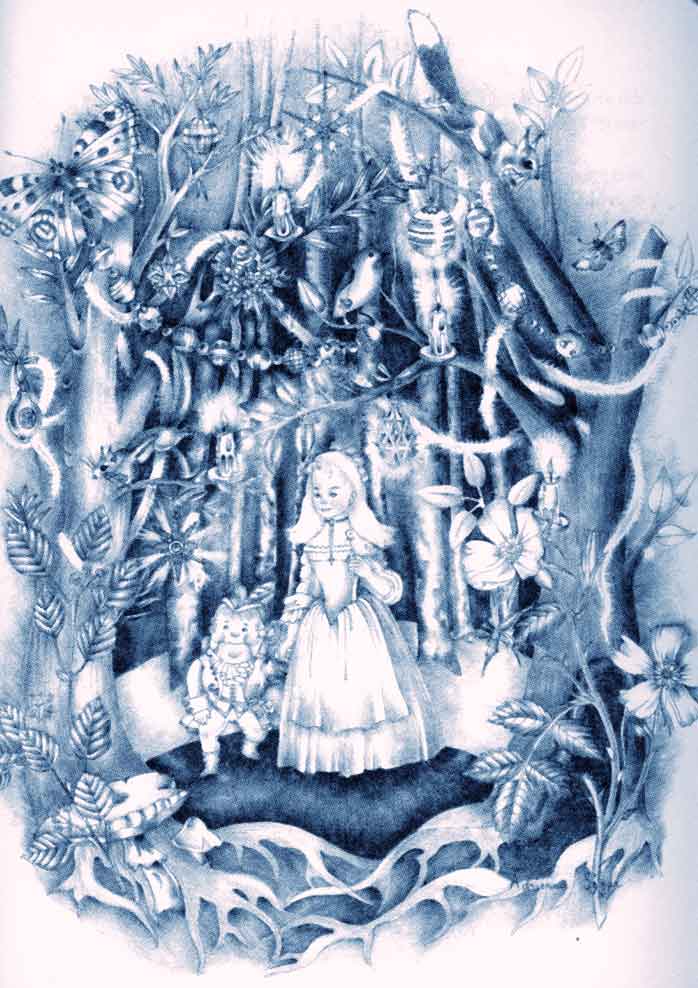
In the magical Christmas-tree forest. Rose's cookies. Light. Pax tecum.
 As a small child, I did not own many books, but several of the ones that I possessed have continued to possess me. About the time I moved from Gramercy to Baton Rouge, before first grade, I was given the Alice books. They were hardcovers in a slipcase with the Tenniel illustrations, and I still have a strong love for Carroll. I don't know what happened to the books; perhaps they are still around, tucked in a box. Other Alices are on my shelf, but not those.
But I still have my childhood copy of another book I loved, The Snow Queen and Other Stories, an oversize Golden Book illustrated by Adrienne Segur, with an image from "The Nutcracker" on the cover. I believe that this was given to me at Christmas when I was in third grade. We had moved from gorgeous, rich, marvelous Louisiana to an alien place of flat, severe beauty, and all that I had lost seemed to find some kind of echo in these tales and pictures. Glimmers of them--particularly "Winter's Promised Bride," "The Nutcracker," and "The Snow Queen"--have lit odd corners of my stories and poems. And I'm sure that "Tall Jorinda" borrowed her name from "Jorinda and Joringel." The book is in my writing room, propped on top of a bookcase...
I'm not alone in having fantastical memories of a book that Segur illustrated--Terri Windling talks about writers and artists with a childhood passion for Adrienne Segur's pictures (http://www.greenmanreview.com/windling.html), and there are many mentions of Segur at Endicott Studio. I spent hours with The Snow Queen, reading the stories and poring over the illustrations, wandering through the cruel snows and the magical Christmas-tree forest.
* * *
Friends and strangers who have written me a note or left a comment or simply come by and passed on to other pages--a joyful Christmas to you. As there is not one Day but Twelve, I'll be back during Christmas, but now I have many things to do. The castle of home has that lovely smell of warm spices, and the best cookie cookbook in the world, Rose Levy Beranbaum's Christmas Cookies, is seeing hard use. (These days you can write Rose at her web site, Real Baking with Rose.) This year My Man Who Bakes (and Cooks) is working his way through chocolate-pistachio marzipan spirals, coconut kisses, Rose's crescents, cashew chewy puffs, chocolate madeleines, mahogany toffee crunch, and buchettes de Noel. (Later will come gingerbread people and terriers and other animals, elaborately painted with royal icing by the whole crew.) Most of the cookies fly out the door on Christmas Eve, landing on our neighbor's tables in the heart of the village--in the oldest residence in Templeton, in the house that's hard by the hanging ground and made of bricks from Fenimore Cooper's Otsego hall, in the two townhouses (we have just two), in the stone house with the herringbone pattern, and in other colorful and sometimes ghost-ridden houses. I always like to peep in the haunted mirror across the street to try and catch a glimpse of the ghost.
The snow is crisp and hard over the graves of Fenimore Cooper and Susan Cooper, and in the dark afternoon we will be out in the cold, lighting luminaires on the walkway that swoops past their names. And that's just the start.
Christmas approaches, glimmering...
* * *
I have always thought of Christmas time, when it has come round, as a good time; a kind, forgiving, charitable time; the only time I know of, in the long calendar of the year, when men and women seem by one consent to open their shut-up hearts freely, and to think of people below them as if they really were fellow passengers to the grave, and not another race of creatures bound on other journeys.
~Charles Dickens, A Christmas Carol
Tuesday, December 20, 2005
Starfire Crown: Merry Christmas
 I'm on the Poem for Monday mailing list at Burke's Book Store in Memphis. This week novelist, poet, and bookseller Corey Mesler sent out a real, sure-nuff Christmas poem. These days that seems a rather bold act, even in Tennessee, and I'm passing on this bit of loveliness.
* * *
Woodcut courtesy of www.godecookery.com, the site for Medieval and Renaissance recipes.
* * *
A Christmas Carol Poem
by G. K. Chesterton
The Christ-child lay on Mary's lap,
His hair was like a light.
(O weary, weary were the world,
But here is all aright.)
The Christ-child lay on Mary's breast
His hair was like a star.
(O stern and cunning are the kings,
But here the true hearts are.)
The Christ-child lay on Mary's heart,
His hair was like a fire.
(O weary, weary is the world,
But here the world's desire.)
The Christ-child stood on Mary's knee,
His hair was like a crown,
And all the flowers looked up at Him,
And all the stars looked down.
***
Now isn't that simple and lovely and magical? It has a radiance and a sweetness that many a contemporary poet, immured in the School of the Politically Correct & the Lyceum of Snipped-up Prose, has never found. Innocence and world-weariness go arm in arm until the end, when what Elizabeth Bishop called "infant sight" conquers all in the final verse, when the flowers of light and the flowers of earth are drawn to turn their faces to the child.
And you can even sing the lines to your favorite carol or ballad tune. That old alternation of tetrameter and trimeter iambics is shapely still. The ballad stanza is easy on the ear, even when it doesn't use all its resources and sticks to one rhyme per quatrain, abcb.
If you'd like to be on Burke's list for a weekly poem, write Mr. C. Mesler via burkes [at] netten.net. Corey's "mind-blowing hippie novel," We Are Billion-Year-Old Carbon, is now available ($14.95 paperback, $25 hardback). Want a signed or inscribed copy? Go to www.burkesbooks.com.
A resounding Merry Christmas to you, with peace and joy and no materialist Happy Inoffensive Money-grubbing Holiday wishes at all.
Friday, December 16, 2005
The year of the blue tree, part 5
In which the blue forest invades a cottage in the Village of Templeton...
6:58 p.m. N is asleep, and R falls asleep immediately upon arrival. At home, we discover that the tree is about sixteen inches too tall for the 9' 6"ceiling. Mike measures the ceiling with a 9' 6" fishing pole. We knew the tree was too tall, but we didn't know how high the ceiling was. There! that's settled. We can't cut off the bottom, because it now appears that the spruce is actually three fused trees, and the base is meant to be hold them together. Briefly I remember the perfect ten-dollar tree of last year, a lovely thing that was immaculate in form and just tickled the ceiling. We heave and wrestle and turn this multiplying tree in our enormous cast-iron Victorian bucket stand. We chop the top--the many tops--and I stuff the leftovers into a big galvanized bucket. There, they look like a small tree, a civilized and easy tree. Our spruce looks utterly wild, untamed, a whole forest of trees crammed into an 1808 parlor. We discover three of last summer's nests. They belong neither to hummingbirds nor wrens but are generous habitations, streaming with the raveled grass from the hummocks. Tips of a possibly infinite number of trees swim on the ceiling, bent slightly.
It will look astonishing, I say.
Mike wants to cut more at the top so that we can use our Polish glass finial. It will be all stubs, if we start trimming, I point out. Maybe we should just hide the finial somewhere in the tree, somewhere surprising. It may be that everything about this tree is supposed to be surprising, beginning with the fact that it made it over hill, dale, hummock, etc.
Well! That is enough for one day.
I'm awfully glad that I have a no-never-work rule for Sunday, or I might have mistaken the day for hard labor instead of a mere dawdling afternoon of Christmas tree cutting. Everyone who is awake is ravenous, and the others will be likewise, when we wake them. After dinner, we can light candles in the living room and admire our personal forest. Who knows what might happen next, with this huge wild green place asserting itself in the room? Funny, now that it's in the lamplight the tree doesn't even look blue.
Finis
That was a day in Advent 2001: the fifteenth of December. Life has gone flooding on, over the dam of sticks and through the magical woods. N is no longer toddling about in a tall cap, and B and R are now teenagers, shedding strands of the cocoon of childhood, holding a dying man close, encountering their first major death--looking forward and looking back. Life and death skip hand and hand through the blue forest. I go on being a writer and a mother, living two lives, watching out for wolves in the undergrowth and falling stars above the canopy. Other nigh-perfect trees have come and gone, but a blue branch still stirs the imagination.
Today is a Snow Day, no school, no karate, no cars passing in the street. It's windless, so the flakes are falling straight down and the firs are keeping their snow. The sketchy plum trees and the gazebo with its ravel of Dutchman's pipe vines go foreign and lovely.
6:58 p.m. N is asleep, and R falls asleep immediately upon arrival. At home, we discover that the tree is about sixteen inches too tall for the 9' 6"ceiling. Mike measures the ceiling with a 9' 6" fishing pole. We knew the tree was too tall, but we didn't know how high the ceiling was. There! that's settled. We can't cut off the bottom, because it now appears that the spruce is actually three fused trees, and the base is meant to be hold them together. Briefly I remember the perfect ten-dollar tree of last year, a lovely thing that was immaculate in form and just tickled the ceiling. We heave and wrestle and turn this multiplying tree in our enormous cast-iron Victorian bucket stand. We chop the top--the many tops--and I stuff the leftovers into a big galvanized bucket. There, they look like a small tree, a civilized and easy tree. Our spruce looks utterly wild, untamed, a whole forest of trees crammed into an 1808 parlor. We discover three of last summer's nests. They belong neither to hummingbirds nor wrens but are generous habitations, streaming with the raveled grass from the hummocks. Tips of a possibly infinite number of trees swim on the ceiling, bent slightly.
It will look astonishing, I say.
Mike wants to cut more at the top so that we can use our Polish glass finial. It will be all stubs, if we start trimming, I point out. Maybe we should just hide the finial somewhere in the tree, somewhere surprising. It may be that everything about this tree is supposed to be surprising, beginning with the fact that it made it over hill, dale, hummock, etc.
Well! That is enough for one day.
I'm awfully glad that I have a no-never-work rule for Sunday, or I might have mistaken the day for hard labor instead of a mere dawdling afternoon of Christmas tree cutting. Everyone who is awake is ravenous, and the others will be likewise, when we wake them. After dinner, we can light candles in the living room and admire our personal forest. Who knows what might happen next, with this huge wild green place asserting itself in the room? Funny, now that it's in the lamplight the tree doesn't even look blue.
Finis
That was a day in Advent 2001: the fifteenth of December. Life has gone flooding on, over the dam of sticks and through the magical woods. N is no longer toddling about in a tall cap, and B and R are now teenagers, shedding strands of the cocoon of childhood, holding a dying man close, encountering their first major death--looking forward and looking back. Life and death skip hand and hand through the blue forest. I go on being a writer and a mother, living two lives, watching out for wolves in the undergrowth and falling stars above the canopy. Other nigh-perfect trees have come and gone, but a blue branch still stirs the imagination.
Today is a Snow Day, no school, no karate, no cars passing in the street. It's windless, so the flakes are falling straight down and the firs are keeping their snow. The sketchy plum trees and the gazebo with its ravel of Dutchman's pipe vines go foreign and lovely.
Subscribe to:
Posts (Atom)